Share

Eastern Box Turtle
🔤 Taxonomy
Terrapene carolina is the accepted scientific name for this species.
Common names used in the hobby:
- Eastern box turtle
- Common box turtle
📌 Description
A terrestrial North American box turtle needing humid leaf litter, spacious land housing, UVB, soaking access, and legal-origin proof.
Adults are usually about 10-20 cm, but their care needs are not small. The species is long-lived, sensitive to drying, and unsuitable for a decorative dry display. With stable care it may live 30-60 years.
🌍 Distribution
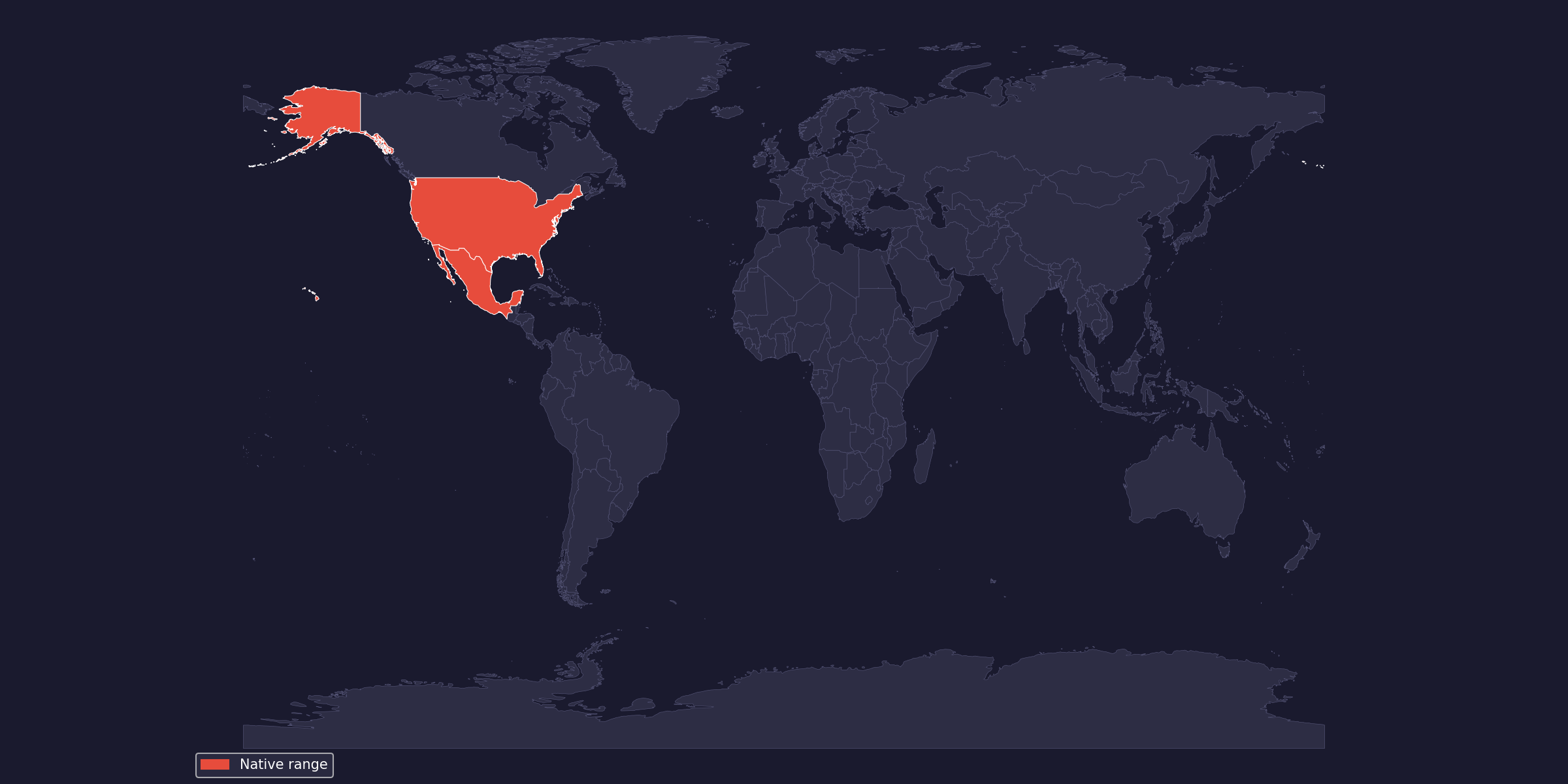
Eastern North America, including woodland edges, humid deciduous forests, meadows, thickets, and seasonal wet areas.
Captive care should not be a dry desert-style terrarium. The essentials are humid leaf litter, deep substrate, retreats, shallow water, thermal choice, and the ability to burrow or withdraw to a cooler area.
🌡 Climate across the native range
Monthly climate normals from reviewed GBIF occurrence locations:
Maryland — United States of America
| Month | Min °C | Mean °C | Max °C | RH % |
|---|---|---|---|---|
| January | -5.6 | -0.8 | 4.1 | 66 |
| February | -4.8 | 0.6 | 6.1 | 63 |
| March | -0.5 | 5.6 | 11.6 | 59 |
| April | 4.4 | 11.2 | 17.9 | 58 |
| May | 9.7 | 16.6 | 23.4 | 65 |
| June | 14.8 | 21.3 | 27.8 | 69 |
| July | 17.6 | 23.9 | 30.2 | 69 |
| August | 16.9 | 23 | 29.2 | 71 |
| September | 13 | 19.3 | 25.5 | 71 |
| October | 6.3 | 12.8 | 19.2 | 67 |
| November | 1.6 | 7.3 | 13 | 65 |
| December | -2.9 | 2.1 | 7.1 | 64 |
Georgia — United States of America
| Month | Min °C | Mean °C | Max °C | RH % |
|---|---|---|---|---|
| January | 0.5 | 6.6 | 12.6 | 67 |
| February | 1.4 | 8.4 | 15.4 | 64 |
| March | 5.3 | 12.6 | 20 | 64 |
| April | 8.7 | 16.3 | 23.9 | 63 |
| May | 13.4 | 20.5 | 27.7 | 70 |
| June | 17.8 | 24.5 | 31.1 | 71 |
| July | 20.1 | 26.3 | 32.5 | 73 |
| August | 19.9 | 25.8 | 31.7 | 74 |
| September | 16.8 | 23 | 29.2 | 73 |
| October | 10.2 | 17.2 | 24.2 | 69 |
| November | 5.2 | 12.3 | 19.3 | 68 |
| December | 1.7 | 8.3 | 14.8 | 66 |
Alabama — United States of America
| Month | Min °C | Mean °C | Max °C | RH % |
|---|---|---|---|---|
| January | 2.2 | 8 | 13.8 | 69 |
| February | 3.5 | 9.9 | 16.3 | 65 |
| March | 7.3 | 14 | 20.8 | 64 |
| April | 10.5 | 17.6 | 24.6 | 64 |
| May | 15.1 | 21.7 | 28.3 | 69 |
| June | 19.1 | 25.3 | 31.5 | 70 |
| July | 20.9 | 26.8 | 32.6 | 73 |
| August | 20.6 | 26.4 | 32.2 | 74 |
| September | 18 | 24.1 | 30.1 | 71 |
| October | 11.6 | 18.4 | 25.1 | 68 |
| November | 6.7 | 13.4 | 20 | 69 |
| December | 3.4 | 9.5 | 15.6 | 69 |
Weather data by WorldClim v2.1 · Monthly normals queried by Herpeton Academy from raster values; relative humidity is derived from vapor pressure and mean temperature.
Location references use GBIF.org occurrence data where available; original occurrence records retain their source dataset licenses.
⚖️ Legal status
As of 2026-06-05, this article records Terrapene carolina as CITES Appendix II, EU Annex B, and Bern Convention: not relevant. State, provincial, national, and municipal rules may still restrict collection, possession, transfer, breeding, import, or transport. Keep invoices, breeder or origin details, transfer/import papers, and identification photos that match the scientific name and individual animal.
Wild collection is a major conservation concern for box turtles. A responsible keeper should start only with a legal, documented animal and should never treat outdoor release as a solution for rehoming.
🤌 Husbandry
Terrapene carolina is a terrestrial turtle that needs a humid, structured land enclosure. Do not keep it in an aquatic tank and do not leave it on a smooth bare floor. A good setup is closer to a protected forest floor than a display case.
Plan at least 180 x 90 x 45 cm for one animal, about 1.62 m². More room is strongly preferred, especially for active adults and females. Outdoor pens are excellent only when protected from escape, predators, overheating, flooding, and pesticides.
🧪 Water, substrate, and hygiene
Always provide shallow water for drinking and soaking. The dish should be low enough for easy entry and exit but safe if the turtle turns around. Change it often because box turtles frequently defecate in water.
Moisture is useful; stagnant wet substrate is not. Remove feces, uneaten food, and moldy leaves. If the enclosure smells sour or rotten, hygiene or ventilation is not adequate.
💡 Lighting
Provide a clear day-night cycle of about 10-12 hours. UVB should be planned around Ferguson Zone 2, with a measured basking or exposure zone and shaded retreats rather than flooding the whole enclosure with UV.
Indoor animals need bright visible light and a reliable UVB source unless they receive regular safe outdoor sunlight. Glass does not provide useful UVB, and old lamps can still shine visibly while producing weak biological output.
🌡 Heating and temperature
Typical structured targets are:
- ambient or air: 22-28°C
- basking surface: 30-32°C
- cool retreat: 18-22°C
- night: 16-22°C
Use thermostats and separate thermometers. Heat should create a usable gradient, not one uniform hot box. Check surface temperatures, water temperature, and the animal’s actual choices before changing feeding or seasonal routines.
💧 Humidity and water
Humidity target is about 60-80%, with humid retreats around 75-90% when needed. Use deep substrate and leaf litter rather than a constantly wet surface. Balance humid hides, drier patches, clean water, and airflow.
Water dishes, pools, platforms, and ramps should be easy to clean and should not abrade skin, toes, or shell. For aquatic species, water depth must allow normal movement while still giving safe resting and exit options.
🌿 Enclosure and layout
The enclosure should offer hidden routes rather than only open floor. Leaf litter, low plants, cork bark, and slightly uneven substrate reduce stress. Solitary housing is the most predictable option.
Secure boundaries matter. Aquatic turtles climb ramps, hoses, and filter parts; box turtles push weak edges and dig under loose barriers. Outdoor pens need predator protection and escape prevention from the start.
🥗 Feeding
This species is omnivorous. Offer earthworms, insects, safe-source snails, quality pellets as part of the diet, leafy greens, seasonal vegetables, and limited fruit. The recorded interval is every 1-2 days, but adults often need stricter portion control.
Feed for stable body condition rather than maximum appetite. Remove leftovers, record weight, and adjust frequency for age, season, temperature, reproductive state, and activity. Use calcium and supplements according to diet quality and UVB access.
🥚 Breeding notes
This is an oviparous species. Typical clutch size is about 3-8 eggs, with incubation around 26-29°C for about 60-90 days. Females need access to a suitable nesting area. Even without planned breeding, an adult female may need substrate with enough depth and correct moisture.
🩺 Common problems
Watch for swollen or closed eyes, wheezing, nasal discharge, shell softening, foot wounds, diarrhea, parasites, prolonged refusal to eat, and unusual hiding. Dry housing makes eye and kidney problems especially important.
Quarantine new animals, record weights, monitor shell and skin condition, and use an experienced reptile veterinarian for injuries, swelling, persistent refusal to eat, respiratory signs, or abnormal buoyancy.
📌 Conclusion
Eastern Box Turtle care suits keepers who can maintain a large, humid, secure land enclosure for decades and keep legal-origin records intact. The common failure is dry, cramped housing treated as a simple display.
📚 Sources and further reading
Key sources checked for this revision:
- CITES Appendices, checked 2026-06-05
- U.S. Fish & Wildlife Service turtle CITES appendices chart
- European Commission wildlife trade overview
- TFTSG account: Terrapene carolina
- USGS Eastern Box Turtle range map
- GBIF Backbone Taxonomy
- WorldClim v2.1