Share

Eastern Mud Turtle
🔤 Taxonomy
Kinosternon subrubrum is the accepted scientific name for the eastern or common mud turtle. Current turtle checklists retain K. s. subrubrum and K. s. hippocrepis; the Florida form formerly treated as K. s. steindachneri is now usually recognized as the separate species K. steindachneri. Older books may use Kinosternon pensylvanicum.
📌 Description
The eastern mud turtle is a small, smooth-shelled, bottom-walking turtle. Adults usually measure 7.5-12.5 cm and weigh under 300 g, but they can live for more than 30 years. The double-hinged plastron may close much of the shell, and a restrained animal can reach surprisingly far with a strong beak.
Its size makes the enclosure manageable, not simple. This species uses shallow water, soft-bottomed wetlands, vegetation, and terrestrial retreats. A tall empty fish tank does not provide those choices. Clean water, safe routes to the surface, a genuine land area, and minimal handling are the core requirements.
| Adult size | 7.5-12.5 cm |
| Expected lifespan | 30-40 years |
| Minimum adult enclosure | 90 x 45 cm footprint, larger preferred |
| Water / basking | 23-26°C / 30-32°C |
| UVB | Ferguson Zone 2; about UVI 1-2 at basking height |
| Diet | Mainly aquatic invertebrates, mollusks, whole prey, and complete turtle pellets |
🌍 Distribution
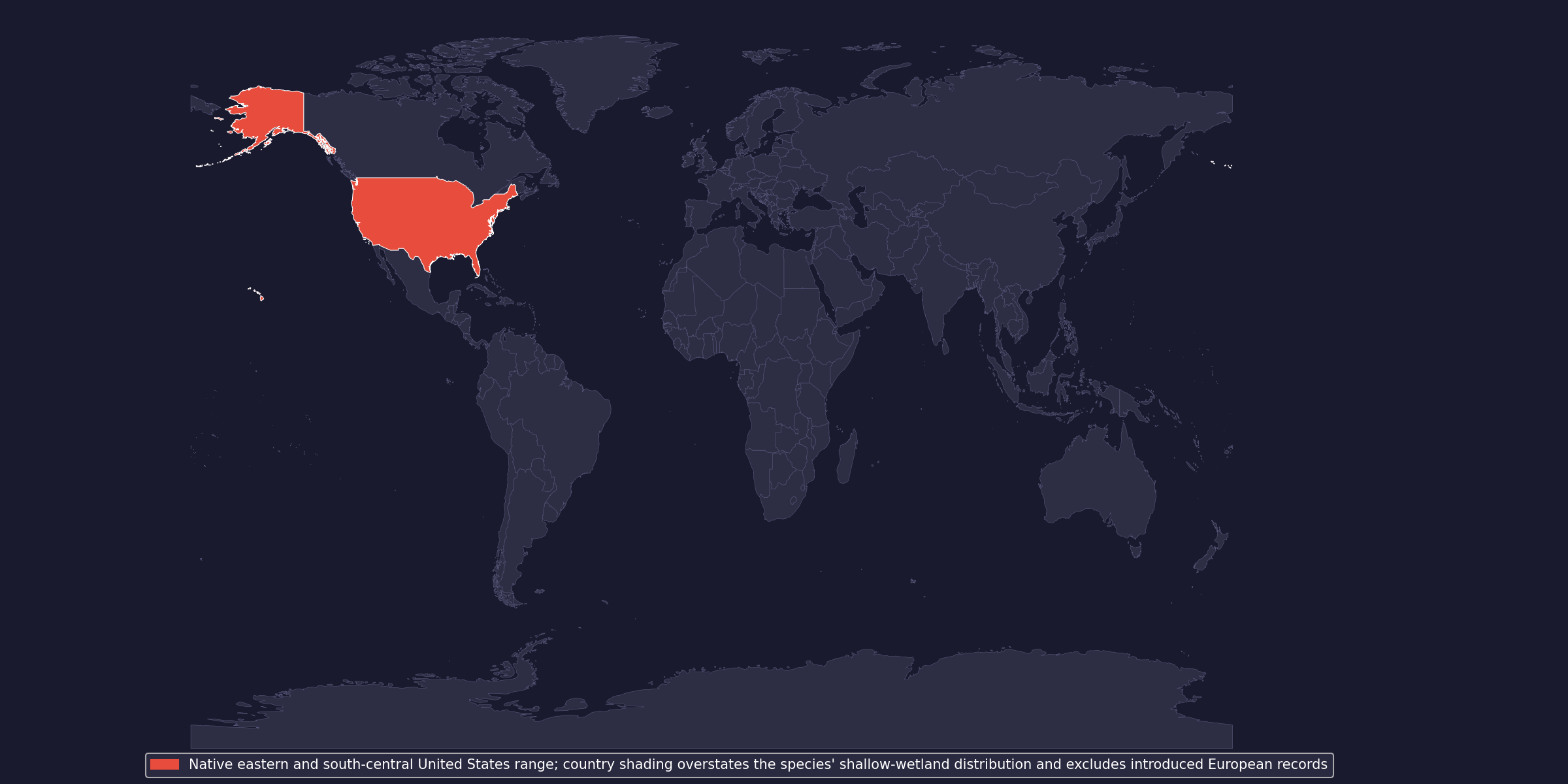
The species is native to the eastern and south-central United States, from the Atlantic coastal plain through the Southeast and west along the Gulf and Mississippi drainage. It occupies shallow ponds, marshes, swamps, vegetated ditches, quiet creeks, and other slow or still waters with soft substrate. It also travels on land after rain, during drought, for nesting, and to reach seasonal refuges.
The broad outdoor climate does not translate into one aquarium temperature: turtles select shaded shallows, submerged cover, mud, and terrestrial burrows. The seasonal tables below explain the native cycle but are not instructions to cool an unprepared captive turtle.
🌡 Climate across the native range
Monthly climate normals from reviewed GBIF occurrence locations spanning the species’ Atlantic and Gulf ranges:
Maryland — United States (northern Atlantic coastal plain)
| Month | Min °C | Mean °C | Max °C | RH % |
|---|---|---|---|---|
| January | 0.9 | 3.3 | 6.4 | 70 |
| February | 1.4 | 4 | 7.5 | 70 |
| March | 4.6 | 7.5 | 11.2 | 69 |
| April | 10.2 | 13.1 | 17 | 70 |
| May | 15.6 | 18.2 | 21.6 | 73 |
| June | 20.8 | 23.2 | 26.2 | 74 |
| July | 23.6 | 26 | 28.8 | 74 |
| August | 23.1 | 25.3 | 27.9 | 74 |
| September | 20.1 | 22.1 | 24.7 | 74 |
| October | 14.2 | 16.4 | 19.2 | 72 |
| November | 8.2 | 10.5 | 13.4 | 70 |
| December | 3.6 | 5.8 | 8.7 | 72 |
South Carolina — United States (southeastern coastal plain)
| Month | Min °C | Mean °C | Max °C | RH % |
|---|---|---|---|---|
| January | 7.8 | 10.8 | 14.7 | 75 |
| February | 9 | 12.1 | 16 | 75 |
| March | 11.6 | 14.7 | 18.5 | 74 |
| April | 15.4 | 18.5 | 22.1 | 73 |
| May | 19.9 | 22.7 | 25.9 | 75 |
| June | 23.5 | 25.8 | 28.6 | 79 |
| July | 25.2 | 27.4 | 30 | 80 |
| August | 24.8 | 26.8 | 29.3 | 82 |
| September | 22.6 | 24.9 | 27.6 | 79 |
| October | 17.9 | 20.6 | 23.9 | 76 |
| November | 12.7 | 15.6 | 19.3 | 75 |
| December | 9.5 | 12.4 | 16 | 77 |
East Texas — United States (western Gulf range, K. s. hippocrepis)
| Month | Min °C | Mean °C | Max °C | RH % |
|---|---|---|---|---|
| January | 4.9 | 8.4 | 13.6 | 73 |
| February | 6.6 | 10.5 | 15.9 | 73 |
| March | 10.2 | 14.4 | 20.1 | 72 |
| April | 14.2 | 18.7 | 24.4 | 70 |
| May | 18.8 | 23.1 | 28.5 | 72 |
| June | 22.7 | 27 | 32.1 | 72 |
| July | 24.6 | 28.9 | 34.1 | 68 |
| August | 24.5 | 28.9 | 34.2 | 66 |
| September | 21.2 | 25.5 | 30.8 | 67 |
| October | 15.6 | 19.8 | 25.2 | 69 |
| November | 10.1 | 13.8 | 18.8 | 73 |
| December | 6.1 | 9.6 | 14.4 | 75 |
Weather data by Open-Meteo.com · CC BY 4.0 · Monthly normals calculated by Herpeton Academy from daily archive values.
Location references use GBIF.org occurrence data where available; original occurrence records retain their source dataset licenses.
⚖️ Legal status
Kinosternon spp., including K. subrubrum, are listed in CITES Appendix II and EU Annex B. International trade therefore needs the appropriate CITES documentation, and keepers should retain the invoice, breeder details, import or transfer papers, and photographs linking the animal to those records.
The species is native wildlife in the United States. Collection, possession, breeding, and sale rules vary by state, and the US Lacey Act can apply when wildlife was taken or traded contrary to state, tribal, federal, or foreign law. Never collect a wild turtle or buy one without checking the rules at the place of origin and destination. The Bern Convention is not relevant because this is not a European native species.
🤌 Husbandry
House one turtle per enclosure. Mud turtles do not need companionship, while feeding competition, biting, and persistent courtship can occur before the keeper notices stress. For one adult, a 90 x 45 cm footprint is a defensible minimum; 100-120 cm of length allows a better water-land transition and more cover.
Use shallow-to-moderate water with multiple resting routes. About 20-30 cm suits many healthy adults when wood, cork, plants, and ledges let the turtle reach air without sustained open-water swimming. Hatchlings, weak animals, and new arrivals need shallower water that allows them to breathe while standing. Increase depth only after observing controlled swimming and climbing.
Provide a substantial accessible land area, not only a floating dock. Females require diggable nesting substrate even when never paired. Quarantine new animals alone with separate nets and siphons; record weight, appetite, feces, buoyancy, skin, and shell, and arrange fecal testing for wild-caught or uncertain-origin animals.
🧪 Filtration and water
Use an oversized external or sump filter with strong mechanical and biological capacity, ideally rated for two to three times the actual water volume. Diffuse the return so that the entire bottom is not swept by strong current. Screen intakes and guard heaters.
In a cycled system, ammonia and nitrite should remain at zero. Test after startup, major cleaning, unexplained odor, or illness. Siphon food fragments and feces, rinse mechanical media before flow falls, and replace part of the water regularly. Do not replace all biological media at once. Condition tap water where necessary and match replacement-water temperature closely enough to avoid sudden chilling.
💡 Lighting
Place bright visible light, heat, and UVB over the dry basking zone. A moderate T5 HO UVB tube can provide about UVI 1-2 at shell height, with shaded areas near zero; measure with a Solarmeter 6.5 where possible. Mesh, distance, reflector, and lamp age all change the dose.
Use a 10-13 hour photoperiod, adjusted modestly by season. Sunlight through window glass is not UVB. No colored or bright night lamp is required.
🌡 Heating and temperature
Useful routine targets are:
- Water: 23-26°C
- Dry basking surface: 30-32°C
- Cooler air or land retreat: 21-23°C
- Night room temperature: 20-23°C
Measure water with a submerged digital probe and the basking surface with an infrared thermometer. The turtle must be able to leave both warm water and the basking beam. Avoid unguarded heaters, heat rocks, and a lamp that warms the whole land area uniformly.
💧 Humidity and water
Ambient room humidity is less important than water quality and a correctly built land zone. Keep part of the terrestrial substrate slightly moist under leaf litter, while the basking surface must dry completely. Constantly saturated soil becomes unhygienic; bone-dry land removes a useful retreat.
🌿 Enclosure and decoration
Build a cluttered bottom with stable driftwood, cork, smooth rock shelves, dense plants, and several surface routes. Use fine washed sand, a bare bottom during quarantine, or a safe soil/leaf-litter land mix. Avoid small gravel that can be swallowed, sharp stone, unstable piles, and caves that can trap a turtle underwater.
The land section should contain 10-15 cm of compactable soil for burrowing and at least 15-20 cm in a female nesting zone. Keep food off loose terrestrial substrate to reduce accidental ingestion.
🪱 Feeding
This is an omnivore with strongly carnivorous feeding habits. Rotate earthworms, snails from controlled parasite-free cultures, aquatic insects, crustacean items, suitable whole fish, and a reputable complete aquatic-turtle pellet. Small amounts of safe aquatic plant matter can be offered, but most individuals favor animal foods.
Feed juveniles small portions daily or every other day; most adults do well with a measured meal every two to three days. A portion roughly matching the volume of the head is a useful starting point, then adjust to body condition and water fouling. Whole prey, cuttlebone, and a complete pellet provide calcium; do not dust every balanced pellet meal.
Avoid mammal meat, dog or cat food, bread, dairy, dried shrimp as a staple, feeder goldfish, and wild prey from polluted or pesticide-treated water. Remove remains promptly.
💤 Seasonal rest
Northern wild populations overwinter, sometimes in terrestrial burrows well away from water. That natural history does not make refrigerator hibernation or an unmonitored cold aquarium safe. Routine seasonal cooling is unnecessary for a pet and should be considered only for a healthy, established adult in a carefully planned breeding program with veterinary input and measured temperatures.
Never cool a juvenile, thin, sick, parasitized, newly acquired, or recently treated turtle. A modest winter reduction in photoperiod and activity can be allowed while normal safe temperatures, hydration, and monitoring continue.
🩺 Common problems
- Pitted, soft, discolored, or foul-smelling shell: poor water quality, incomplete drying, trauma, infection, or inadequate UVB/calcium
- Swollen eyes or irritated skin: ammonia, dirty water, nutritional imbalance, or infection
- Listing, persistent floating, nasal discharge, wheezing, or open-mouth breathing: possible respiratory disease
- Refusal to eat: low temperature, stress, obstruction, parasites, or systemic illness
- Puffy limbs and fat around the shell openings: chronic overfeeding
- Bites or missing claws: unsafe cohabitation
Aquatic turtles can carry Salmonella without appearing ill. Wash hands after contact and keep turtle equipment away from food-preparation areas. Seek an experienced reptile veterinarian for breathing signs, shell lesions, severe swelling, injury, or prolonged anorexia.
📌 Conclusion
The eastern mud turtle suits a keeper who wants a small observation turtle and is prepared to maintain filtration, land access, and a structured shallow-water habitat for decades. The most common bad shortcut is treating its small shell as permission to use a small, bare aquarium.
📚 Sources and further reading
- ReptiFiles turtle and tortoise care library and aquatic-turtle filtration guidance (comparative husbandry check; no species-specific ReptiFiles guide was available when checked)
- Meshaka et al. 2017, Kinosternon subrubrum species account
- The Reptile Database: Kinosternon subrubrum and GBIF taxon 9195555
- Baines et al. 2016, UVB provision for captive reptiles
- CITES Appendices, EU Regulation 2026/1383, and US Fish & Wildlife Service Lacey Act guidance, checked 2026-08-30