Share

Sulcata Tortoise
🔤 Taxonomy
Centrochelys sulcata is the currently accepted scientific name. In older literature and in parts of the pet trade, the species was often listed as Geochelone sulcata.
The latest renames that hobbyists most often encounter are:
- Geochelone sulcata -> Centrochelys sulcata (modern tortoise taxonomy places the species in Centrochelys)
Older names and combinations associated with the species include:
- Geochelone sulcata
- Testudo sulcata
English common names used in the hobby:
- Sulcata tortoise
- African spurred tortoise
German common names used in the hobby:
- Spornschildkröte
- Afrikanische Spornschildkröte
📌 Description
The sulcata tortoise (Centrochelys sulcata), also known as the African spurred tortoise, is one of the largest land tortoises in the world. It is an impressive, powerful, and long-lived animal that is often sold as a small, appealing hatchling, but eventually becomes a very large animal with enormous space requirements.
Adults usually reach 60-80 cm in carapace length and 30-70 kg, and some males can become even heavier. The shell is light brown to yellowish, with clearly visible growth rings, and the front limbs are strong and adapted for digging.
This is not a suitable species for keepers who can provide only a standard terrarium. With proper care, a sulcata tortoise can live for decades, so acquiring one should be planned as a very long-term commitment.
🌍 Distribution
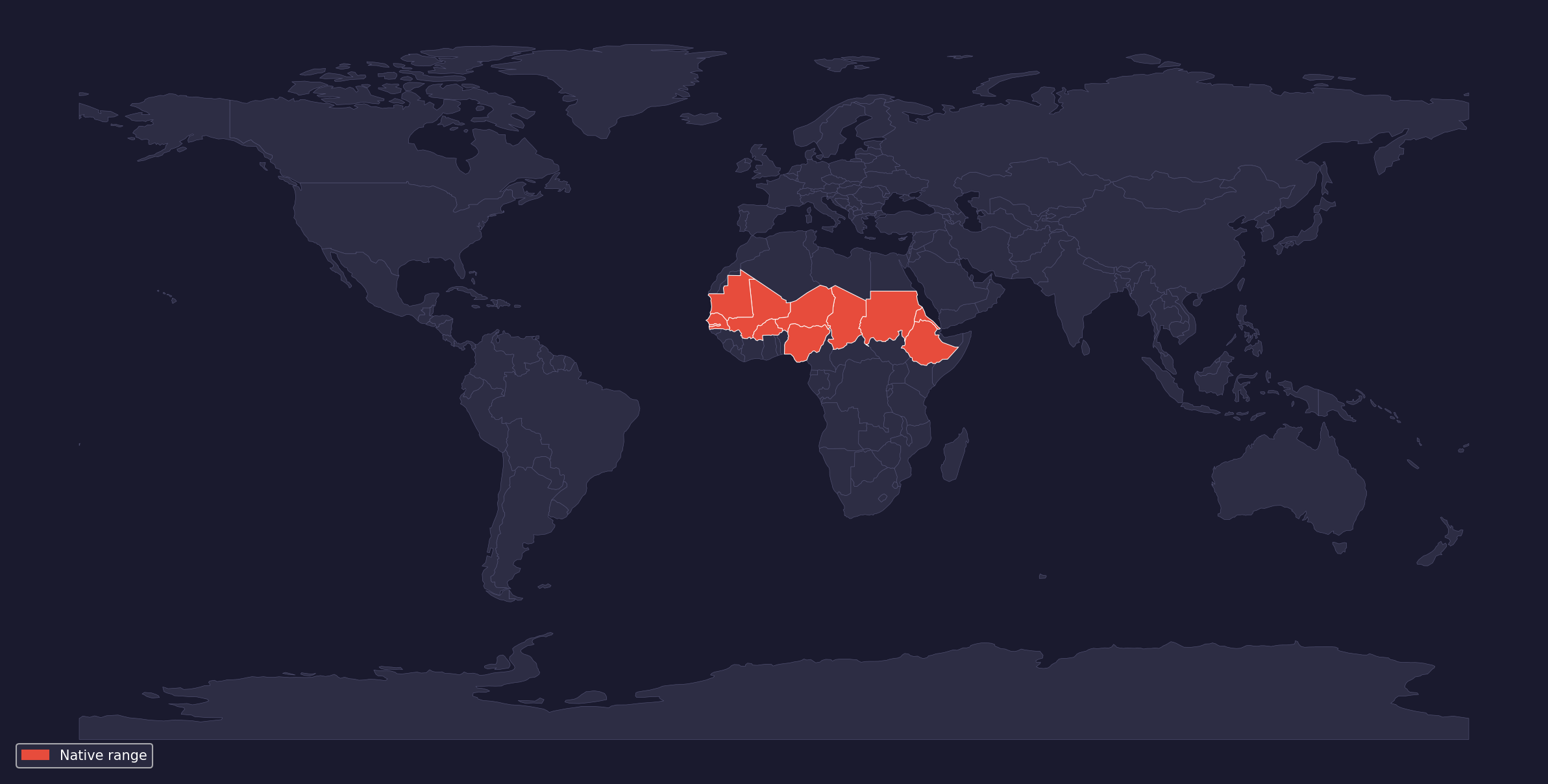
The sulcata tortoise comes from the dry Sahel region of Africa, south of the Sahara. It inhabits dry grasslands, savannas, and semi-arid areas where temperatures are high and rainfall is seasonal.
The natural environment is characterized by:
- Strong sunlight
- Hot daytime temperatures
- Dry periods
- Seasonal rainfall
- Access to grasses and coarse vegetation
- The ability to dig deep shelters
In the wild, this species avoids extreme heat by digging and using underground shelters. In captivity, it must be able to thermoregulate, find shade, and use a secure shelter, not just an exposed hot area.
⚖️ Legal status
As checked against current official sources in April 2026, Centrochelys sulcata is included in CITES Appendix II through the family-level Testudinidae listing. CITES also notes a zero annual export quota for wild-taken Centrochelys sulcata traded for primarily commercial purposes. Under the EU wildlife trade rules, Appendix II tortoises normally fall under Annex B unless a stricter listing applies.
The species is not relevant to the Bern Convention because it is not native to Europe. National and local rules on import, sale, transport, breeding, registration, and proof of legal origin may still apply. Buy only clearly documented captive-bred animals; missing paperwork is not a minor detail and may indicate illegal import or unclear origin.
🤌 Husbandry
The sulcata tortoise has enormous space requirements. Hatchlings and small juveniles can temporarily use a wide open indoor table around 120 x 60 cm, but this is only a starter size. Larger juveniles quickly need 180 x 90 cm or more, and the enclosure should grow before movement becomes restricted.
Adults need room-scale housing. A heated indoor room or pen of at least 3 x 2 m should be treated as an emergency cold-weather minimum for one adult, while a secure outdoor yard of 10 m² or much larger is more realistic for long-term welfare. More space is always better for this powerful, active species.
The outdoor enclosure must be very strong and well secured. The fence should extend into the ground or include protection against digging. The species digs actively and can create deep burrows, especially when seeking coolness or shelter.
In climates with cold winters, the sulcata tortoise cannot be kept outdoors year-round. It needs a heated indoor space with enough room, a dry floor, good ventilation, and clearly defined warm and cooler zones.
💡 Lighting
UVB lighting is essential for indoor keeping. Sulcata tortoises need strong light and UVB to synthesize vitamin D3 and metabolize calcium correctly. Without quality UVB, the risk of metabolic bone disease, shell deformities, and poor growth is very high.
Recommended lighting:
- A quality mercury vapor bulb combining UVB, UVA, and heat
- Alternative: T5 HO UVB lamp at 10-12%, combined with a separate heat lamp
- Photoperiod: 12-14 hours per day, adjusted seasonally
- Lamps should be replaced according to the manufacturer’s recommendations
A mercury vapor bulb is most suitable only when the enclosure is large and open enough to provide a clear temperature gradient and allow the animal to move freely away from the warm zone. One end should also provide an adequate slightly humid area or humid hide, especially for young animals.
Natural sunlight is the best source of UVB. Glass and most clear plastics block a significant amount of UVB, so placing the animal near a window does not substitute for direct sunlight.
For UV planning, treat this species as Ferguson Zone 3. Aim for about UVI 3-4 at the animal’s back or shell height in the basking zone, with a gradient down to shaded areas near zero UVI. This usually points to a stronger 10-12% T5/Desert-style UVB tube, or a suitable mercury vapor system in a large open setup; measure with a Solarmeter 6.5 when possible, because reflector, mesh, distance, and lamp age change the real exposure.
🌡 Heating and temperature
The sulcata tortoise is a heat-loving species and needs a hot basking area, but also a cooler zone where it can retreat. Heating the entire enclosure to the same temperature is not appropriate.
Approximate temperatures:
- Basking spot (surface temperature): 40-45°C
- Warm zone (air): 28-32°C
- Cool zone: 22-26°C
- Night temperature: 20-24°C, without prolonged drops below 18°C
Heating can be provided with halogen, ceramic, or other suitable heat sources placed so the tortoise cannot burn itself. Adult animals often need more than one heat source, because the body is large and a single small lamp does not create a sufficient basking zone.
The species must not be hibernated. When temperatures drop, a heated indoor space should be provided instead of allowing the animal to enter winter rest.
💧 Humidity and water
The sulcata tortoise comes from dry regions, but this does not mean it should be kept dehydrated. For adults, the environment should be mostly dry, with good ventilation and access to water.
Young tortoises are more sensitive to dehydration. In juveniles, overly dry conditions combined with poor diet and insufficient hydration can contribute to uneven growth and shell pyramiding. A slightly humid hide and regular short soaks in shallow lukewarm water are good practice.
A shallow dish of clean water should always be available. For large animals, the dish must be heavy, stable, and easy to clean, because this species quickly soils water and can flip light bowls.
🌿 Enclosure and decoration
The enclosure should allow natural behavior: walking, grazing, digging, hiding, and basking. For this species, an empty room with a lamp is not enough, because lack of movement and enrichment leads to obesity and stress.
Suitable elements include:
- A dry grassy area
- Soil areas for digging
- Large stable shelters
- Shaded areas
- Flat stones in the basking zone
- Edible grasses and wild plants
The substrate may be a mix of clean soil, sand, and clay-like material that allows digging without holding excessive moisture. Scented wood shavings, cedar, pine, cat litter, and slippery flooring are not suitable.
🥬 Feeding
The sulcata tortoise is strictly herbivorous. The core diet should consist of grasses, hay, and coarse leafy plants with a high fiber content. A diet high in protein and sugars leads to overly rapid growth, shell pyramiding, and kidney problems.
Suitable foods include:
- Hay (timothy - Phleum pratense, meadow hay, or orchard grass - Dactylis glomerata), especially for indoor keeping
- Pasture grasses and grass mixes (Poaceae spp.)
- Dandelion (Taraxacum officinale agg.)
- Plantain (Plantago spp.)
- Clover (Trifolium spp.) in moderate amounts
- Mallow (Malva spp.)
- Mulberry leaves (Morus spp.)
- Hibiscus leaves (Hibiscus spp.)
- Arugula (Eruca vesicaria) and chicory (Cichorium intybus) as supplements
- Grapevine leaves (Vitis vinifera), if unsprayed
- Shepherd’s purse (Capsella bursa-pastoris)
- Chickweed (Stellaria media)
- Field bindweed (Convolvulus arvensis) in moderate amounts and only with certain identification
- Flowers of hibiscus (Hibiscus spp.), rose (Rosa spp.), calendula (Calendula officinalis), and nasturtium (Tropaeolum majus)
- A variety of safe wild grasses and weeds
Acceptable supplements:
- Endive (Cichorium endivia), chicory (Cichorium intybus), and Belgian endive (Cichorium intybus var. foliosum)
- Pumpkin (Cucurbita spp.), carrot (Daucus carota subsp. sativus), or sweet potato (Ipomoea batatas) in small amounts
- Spineless prickly pear cactus (Opuntia spp.) if a safe source is available
Avoid:
- Fruit
- Any animal products
- Dog or cat food
- Dairy products, bread, and baked foods
- Legumes and high-protein foods
Calcium is important, especially for growing animals and females. A cuttlefish bone can be available in the enclosure, and food may be periodically dusted with a calcium supplement. Supplements do not compensate for a lack of UVB.
Growth stage matters. Hatchlings and juveniles need the same high-quality, high-fiber diet as adults, but with closer hydration, calcium, UVB, and weight monitoring so growth stays steady rather than forced. Adults should be maintained lean and active on fibrous grazing foods; rich foods, excess protein, and frequent calorie-heavy extras cause shell deformity, obesity, kidney strain, and reproductive problems.
🩺 Common problems
The most common problems in sulcata tortoises are related to too little space, insufficient lighting, incorrect humidity, dehydration, or a diet too high in protein and too low in fiber.
Warning signs include:
- Soft or deformed shell
- Shell pyramiding
- Refusal to eat
- Nasal discharge
- Wheezing or open-mouth breathing
- Swollen eyes
- Lethargy
- Unnaturally fast or uneven growth
- Injuries from digging or pushing against fences
If these signs appear, first check temperature, UVB lighting, humidity, diet, and hydration. If there are respiratory signs, severe weakness, injury, or prolonged refusal to eat, a veterinarian experienced with reptiles should be consulted.
📌 Conclusion
The sulcata tortoise is an impressive and extremely hardy species, but only when kept according to its real needs. It requires a lot of space, strong light, quality UVB, a proper temperature gradient, a dry and well-ventilated environment, and a high-fiber diet.
This is not a tortoise for a small terrarium or a temporary interest. With legal origin, a large secure enclosure, and consistent care, the sulcata tortoise can be a long-lived and active inhabitant, but its size and strength must be planned for before acquisition.
📚 Sources and further reading
- CITES Appendices and Species+ trade database, checked April 2026
- EU wildlife trade regulations and annex references, checked April 2026
- GBIF species backbone and occurrence data for taxonomy and distribution context
- IUCN Red List and specialist husbandry references where applicable