Share

Marginated Tortoise
🔤 Taxonomy
Testudo marginata is the currently accepted scientific name.
In care literature and in trade, this species is usually treated as a distinct Mediterranean Testudo without a major recent genus change.
English common names used in the hobby:
- Marginated tortoise
German common names used in the hobby:
- Breitrandschildkröte
📌 Description
The marginated tortoise (Testudo marginata) is the largest European member of the genus Testudo. It is a diurnal, active, and long-lived Mediterranean species that can live for decades when kept properly.
The body is elongated, with a high carapace and a characteristic flaring of the rear marginal scutes in adult animals. This “skirt” at the back of the shell makes the species easy to recognize. The coloration is usually dark to almost black, with lighter yellowish patches or edges, especially in younger animals.
Adults usually reach 25-35 cm, and large females may become even bigger. Males often have a longer and thicker tail, a more concave plastron, and a more pronounced flaring of the rear carapace.
🌍 Distribution
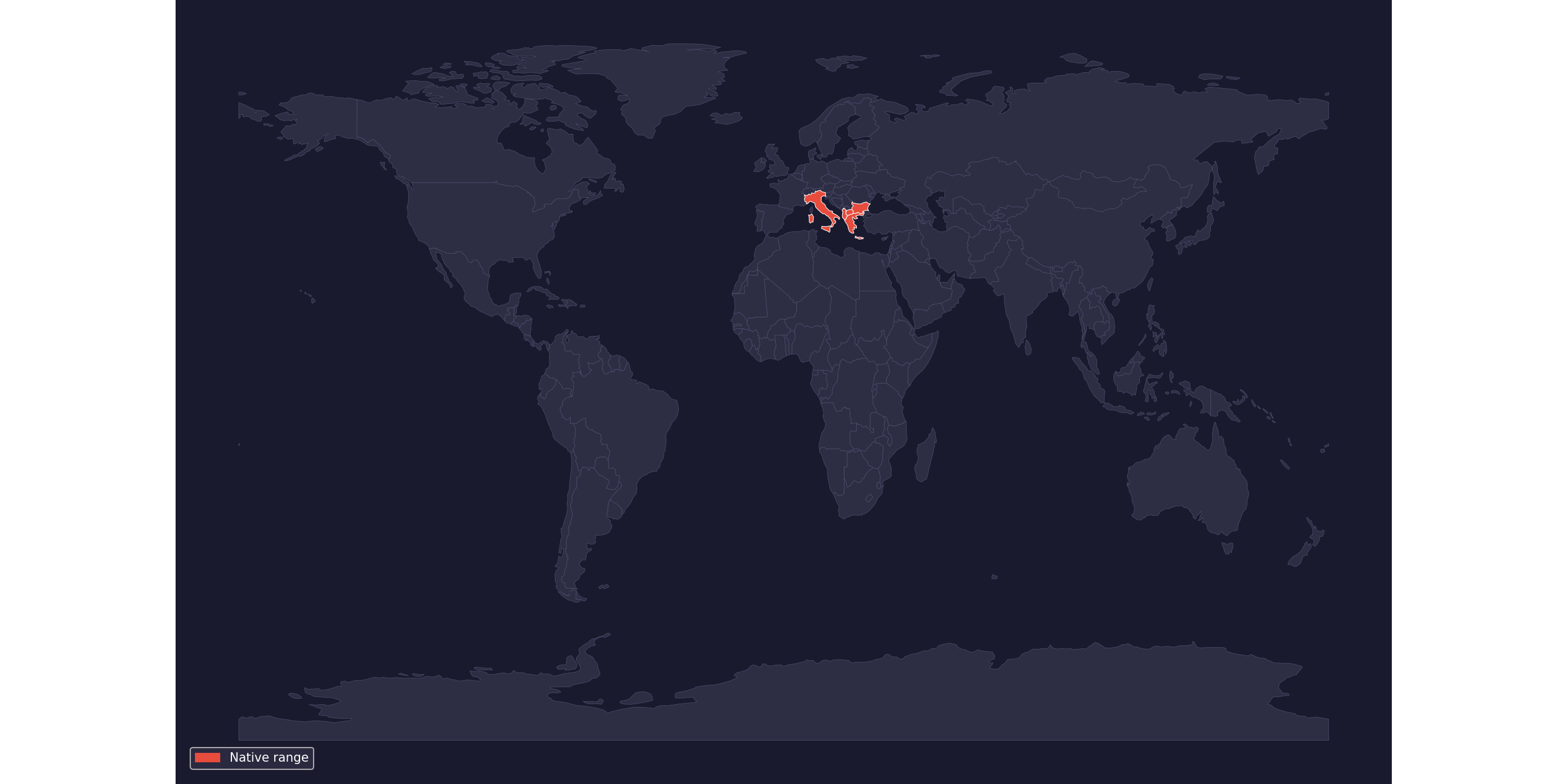
The marginated tortoise is a Mediterranean species naturally found mainly in Greece and parts of the Balkans, as well as in some island populations. It inhabits dry grasslands, rocky slopes, scrub, forest edges, and open sunny areas with low vegetation.
The natural environment is characterized by:
- Plenty of sun
- Warm, dry summers
- Cooler seasonal periods
- Rocky and grassy areas
- Access to shaded shelters
- A variety of wild grasses and leafy plants
In the wild, tortoises actively move between sun, shade, and shelters to regulate body temperature. This behavior must also be possible in captivity.
⚖️ Legal status
The marginated tortoise is a protected species and must not be taken from the wild. Legal keeping should involve only captive-bred animals with the required origin documents.
Within the EU, the species is subject to strict trade and registration rules, and international trade is also regulated through CITES. Documents of origin should always be requested when purchasing. Missing paperwork is not a minor detail; it may indicate an illegally collected animal and creates problems for both the keeper and species conservation.
The Bern Convention is not usually relevant unless a species is native to Europe or covered by local conservation rules; check current national guidance for the country where the animal is kept.
🤌 Husbandry
The best option for this tortoise is an outdoor enclosure during the warm part of the year. The species needs direct sun, space to move, a natural daily rhythm, and a varied environment. Keeping an adult only in a small indoor terrarium is rarely adequate.
The outdoor enclosure must be very secure. These tortoises can dig, push, climb, and work along boundaries persistently. The fence should prevent digging under or squeezing through gaps, and the enclosure should include both sunny and shaded zones.
For one adult, 2-3 m² outdoors is a practical minimum, and 4 m² or more is better. Groups require significantly more room, and males often need to be separated because repeated harassment of females or subordinate animals is common.
Indoor housing can be used for juveniles, quarantine, recovery, or cold periods, but it should be a wide open tortoise table rather than a tall, closed glass terrarium. Hatchlings and small juveniles can start around 90 x 60 cm; larger juveniles and subadults should have at least 120 x 60 cm to 150 x 75 cm. Adults should not be kept permanently indoors unless the pen provides at least 2-3 m² of real floor area.
💡 Lighting
UVB lighting is essential for indoor keeping. Tortoises need UVB to synthesize vitamin D3 and metabolize calcium correctly. Without quality UVB, the risk of metabolic bone disease, shell deformities, and poor growth is very high.
The best choice for indoor keeping is a quality mercury vapor bulb that combines UVB, UVA, and heat. It should only be used in a sufficiently large, open enclosure where the tortoise can freely move away from the warm zone. One end should also provide an adequate slightly humid area or humid hide, especially for young animals.
A good alternative is a linear T5 HO UVB lamp combined with a separate heat lamp. All UVB lamps must be replaced according to the manufacturer’s recommendations, because visible light may remain strong even after UVB output has declined.
Outdoors, natural sunlight is the best source of UVB. Glass and most clear plastics block a significant amount of UVB, so a sunny area behind a window is not a substitute for direct sun.
The photoperiod is usually 10-12 hours of light, adjusted seasonally. Constant lighting at night is unnecessary and disrupts the natural cycle.
For UV planning, treat this species as Ferguson Zone 3. Aim for about UVI 3-4 at the animal’s back or shell height in the basking zone, with a gradient down to shaded areas near zero UVI. This usually points to a stronger 10-12% T5/Desert-style UVB tube, or a suitable mercury vapor system in a large open setup; measure with a Solarmeter 6.5 when possible, because reflector, mesh, distance, and lamp age change the real exposure.
🌡 Heating and temperature
Like all reptiles, the marginated tortoise regulates body temperature through the environment. The enclosure must provide a clear temperature gradient so the animal can choose where to stay.
Approximate indoor temperatures:
- Basking spot: around 32-35°C
- Warm zone: 26-30°C
- Cool zone: 20-24°C
- Night temperature: usually 16-20°C
The heat lamp should create a local basking area, not warm the entire enclosure evenly. The tortoise must be able to move easily to a cooler zone.
Heat rocks are not recommended. They can cause burns and do not provide a natural way for the animal to thermoregulate. Temperatures should be measured with a reliable thermometer, and basking surface temperature is best checked with an infrared thermometer.
💧 Humidity and water
The marginated tortoise inhabits relatively dry habitats, but it should not be kept in a completely dry environment. In young tortoises especially, overly dry conditions can contribute to uneven shell growth.
A shallow dish of clean water should always be available so the tortoise can drink and enter safely. The dish must be shallow enough to avoid drowning risk and heavy enough not to tip over easily.
Regular short soaks in shallow lukewarm water are useful for juveniles. This supports hydration and normal elimination. Outdoor enclosures should include both dry and slightly humid shelters, especially during hot periods.
🌿 Enclosure and decoration
The enclosure should allow natural behavior: walking, digging, grazing, hiding, and basking. An empty box with a lamp is not an appropriate environment for this species.
Suitable elements include:
- A dry grassy area
- Soil areas for digging
- Stones and roots without sharp edges
- Low shrubs and shelters
- Shaded areas
- Edible wild plants
The substrate may be a mix of clean soil, sand, and clay-like material that allows digging without holding excessive moisture. Scented wood shavings, cedar, pine, cat litter, and slippery flooring are not suitable.
Surfaces should not be constantly smooth. If a tortoise lives only on tile, paper, or plastic, the limbs are loaded incorrectly and natural behavior is restricted.
🥬 Feeding
The marginated tortoise is mainly herbivorous. The core diet should consist of low-protein, high-fiber leafy plants similar to the natural diet of land tortoises.
Suitable foods include:
- Dandelion (Taraxacum officinale agg.)
- Plantain (Plantago spp.)
- Clover (Trifolium spp.) in moderate amounts
- Mallow (Malva spp.)
- Mulberry leaves (Morus spp.)
- Hibiscus leaves (Hibiscus spp.)
- Arugula (Eruca vesicaria) and chicory (Cichorium intybus) as supplements
- Grapevine leaves (Vitis vinifera), if unsprayed
- Shepherd’s purse (Capsella bursa-pastoris)
- Chickweed (Stellaria media)
- Field bindweed (Convolvulus arvensis) in moderate amounts and only with certain identification
- Flowers of hibiscus (Hibiscus spp.), rose (Rosa spp.), calendula (Calendula officinalis), and nasturtium (Tropaeolum majus)
- A variety of safe wild grasses and weeds
Acceptable supplements:
- Endive (Cichorium endivia), chicory (Cichorium intybus), and Belgian endive (Cichorium intybus var. foliosum)
- Hay (timothy - Phleum pratense, meadow hay, or orchard grass - Dactylis glomerata), especially for indoor keeping
Avoid:
- Fruit, except very rarely and in minimal amounts
- Spinach, beet leaves, and dock in large amounts
- Any animal products
- Dog or cat food
- Dairy products, bread, and baked foods
- Legumes and high-protein foods
The diet should be varied. Feeding only iceberg lettuce, lettuce, or cucumber is not appropriate because these foods are poor in nutrients and fiber. Fruit should be offered rarely or not at all, because high sugar content can disrupt digestion.
Too rapid growth caused by an improper diet leads to deformities, kidney problems, and poor overall condition.
Calcium is important, especially for growing animals and females. A cuttlefish bone can be available in the enclosure, and food may be periodically dusted with a calcium supplement indoors. Supplements do not compensate for a lack of UVB.
Growth stage matters. Hatchlings and juveniles need the same high-quality, high-fiber diet as adults, but with closer hydration, calcium, UVB, and weight monitoring so growth stays steady rather than forced. Adults should be maintained lean and active on fibrous grazing foods; rich foods, excess protein, and frequent calorie-heavy extras cause shell deformity, obesity, kidney strain, and reproductive problems.
💤 Winter rest
The marginated tortoise is a species that may undergo winter rest in nature. In healthy adults, properly managed hibernation can be a natural part of the yearly cycle. It should not be attempted casually or without preparation.
Only healthy, well-fed, and properly prepared animals should be placed into winter rest. Young, sick, underweight, or newly acquired tortoises are better not hibernated until their condition is clear.
Before hibernation, weight, appetite, droppings, and general behavior should be monitored. Temperature is lowered gradually, and the digestive tract must be empty of food. Incorrect hibernation can be dangerous, so inexperienced keepers should consult a reptile veterinarian or experienced breeder.
🩺 Common problems
The most common problems in land tortoises result from incorrect lighting, poor diet, too little space, or improper preparation for winter rest.
Warning signs include:
- Soft or deformed shell
- Refusal to eat outside normal seasonal slowdown
- Swollen eyes
- Nasal discharge
- Wheezing or open-mouth breathing
- Lethargy
- Unnaturally fast or uneven growth
If these signs appear, first check temperature, UVB lighting, diet, and hydration. If there are respiratory signs, severe weakness, injury, or prolonged refusal to eat, a veterinarian experienced with reptiles should be consulted.
📌 Conclusion
The marginated tortoise is a hardy and impressive Mediterranean species, but only when kept according to its real needs. It requires space, sun or quality UVB lighting, a proper temperature gradient, a high-fiber plant diet, and a secure enclosure.
The best results come from outdoor keeping during the warm season and a carefully planned yearly cycle. With legal origin, a good environment, and consistent care, this species can be a long-lived and active inhabitant, not just an animal placed in a corner with a lamp.
📚 Sources and further reading
- CITES Appendices and Species+ trade database, checked April 2026
- EU wildlife trade regulations and annex references, checked April 2026
- GBIF species backbone and occurrence data for taxonomy and distribution context
- IUCN Red List and specialist husbandry references where applicable