Share

Asian Forest Tortoise
🔤 Taxonomy
Manouria emys is the currently accepted scientific name. Two subspecies, M. e. emys and M. e. phayrei, are often discussed, but practical care still depends on adult size, origin, and humidity management.
Common names used in the hobby:
- Asian forest tortoise
- Asian giant tortoise
📌 Description
A very large humid-forest tortoise from South and Southeast Asia that needs huge floor space, high humidity, soaking access, and robust outdoor-style housing.
Adult size is usually 45-60 cm, with adult weight around 20000-37000 g and a potential lifespan of 50-80 years. Plan the adult enclosure before purchase, not after the juvenile outgrows a starter pen.
🌍 Distribution
The species occurs in humid forest, hill forest, bamboo thickets, and wet leaf-litter habitats from South Asia into Southeast Asia. Captive care should provide warm humid floor space, deep leaf litter, shade, soaking access, clean drainage, and strong barriers.
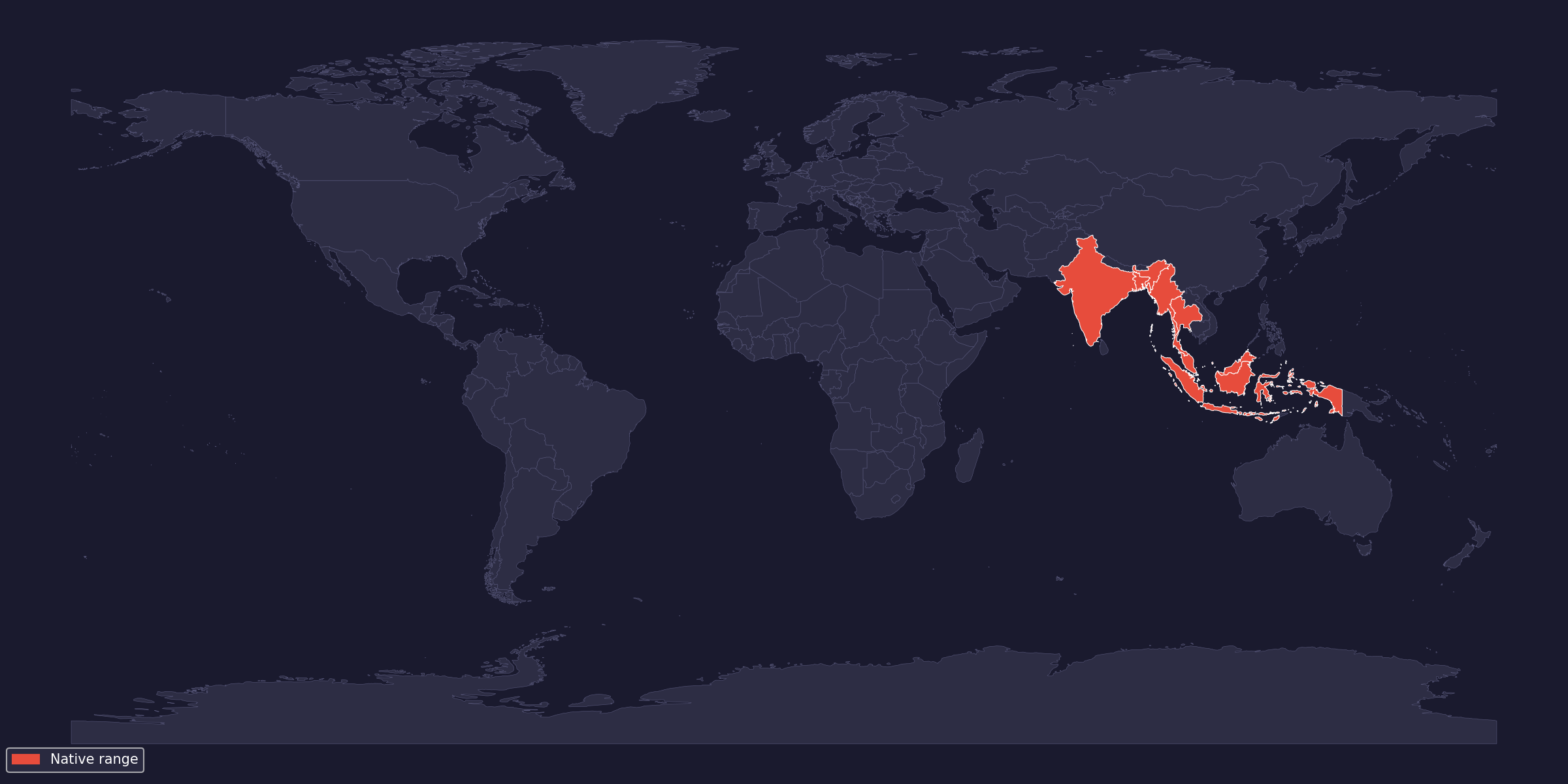
🌡 Climate across the native range
Monthly climate normals from reviewed GBIF occurrence locations:
Phetchaburi — Thailand
| Month | Min °C | Mean °C | Max °C | RH % |
|---|---|---|---|---|
| January | 17.6 | 22.6 | 27.7 | 73 |
| February | 18.9 | 23.8 | 28.7 | 71 |
| March | 20.3 | 25.1 | 29.9 | 70 |
| April | 21.6 | 26.1 | 30.6 | 73 |
| May | 21.5 | 25.5 | 29.5 | 80 |
| June | 21.1 | 24.5 | 27.8 | 84 |
| July | 20.8 | 24.1 | 27.5 | 86 |
| August | 20.8 | 24.1 | 27.3 | 85 |
| September | 20.5 | 24 | 27.6 | 86 |
| October | 20.4 | 24 | 27.7 | 84 |
| November | 19.5 | 23.5 | 27.4 | 76 |
| December | 17.6 | 22.3 | 27.1 | 70 |
Sabah — Malaysia
| Month | Min °C | Mean °C | Max °C | RH % |
|---|---|---|---|---|
| January | 19.8 | 23.1 | 26.5 | 85 |
| February | 19.8 | 23.2 | 26.6 | 85 |
| March | 20 | 23.7 | 27.5 | 82 |
| April | 20.5 | 24.3 | 28.1 | 83 |
| May | 20.5 | 24.5 | 28.4 | 85 |
| June | 20.3 | 24.2 | 28 | 81 |
| July | 20.1 | 23.9 | 27.8 | 83 |
| August | 20 | 24 | 27.9 | 85 |
| September | 20.1 | 24 | 28 | 82 |
| October | 20.2 | 23.9 | 27.7 | 84 |
| November | 20.2 | 23.8 | 27.4 | 86 |
| December | 20 | 23.5 | 26.9 | 85 |
Sarawak — Malaysia
| Month | Min °C | Mean °C | Max °C | RH % |
|---|---|---|---|---|
| January | 22.2 | 25.6 | 29 | 87 |
| February | 22.4 | 26 | 29.5 | 86 |
| March | 22.5 | 26.5 | 30.5 | 84 |
| April | 22.6 | 26.9 | 31.3 | 83 |
| May | 22.8 | 27.3 | 31.7 | 82 |
| June | 22.5 | 27.1 | 31.7 | 81 |
| July | 22.3 | 26.9 | 31.5 | 80 |
| August | 22.2 | 26.8 | 31.5 | 80 |
| September | 22.2 | 26.6 | 31 | 82 |
| October | 22.2 | 26.5 | 30.9 | 83 |
| November | 22.2 | 26.4 | 30.5 | 84 |
| December | 22.2 | 26 | 29.7 | 86 |
Weather data by WorldClim v2.1 · Monthly normals queried by Herpeton Academy from raster values; relative humidity is derived from vapor pressure and mean temperature.
Location references use GBIF.org occurrence data where available; original occurrence records retain their source dataset licenses.
⚖️ Legal status
As of 2026-06-05, this article records the species as CITES Appendix II, EU Annex B, and Bern Convention not relevant. Appendix II and Annex B trade is less restrictive than Appendix I/Annex A, but legal origin and import paperwork still matter. Local ownership, registration, transport, breeding, sale, and import rules may still apply, so keep invoices, breeder details, transfer or import/export documents, and identification photos with the animal’s records.
🤌 Husbandry
Plan a warm humid pen around walking space, deep substrate, shaded retreats, and water access. Small terrariums fail quickly because waste, humidity, and movement needs scale with the animal.
A practical adult starting footprint is about 12 m², with a starting footprint around 400 x 300 cm. Larger adults, females, groups, or outdoor housing need more space and duplicate basking, feeding, and retreat options where relevant.
💡 Lighting
Use a clear 10-12 hour day-night cycle, bright visible light, and measured UVB. Plan UVB around Ferguson Zone 2 at the basking area, with shaded retreats close enough for the tortoise to leave the light.
Indoor animals need a reliable UVB lamp or regular safe outdoor sunlight. Glass and most plastics block useful UVB, so measure the real UVI at shell height.
🌡 Heating and temperature
Typical structured targets are:
- ambient air: 24-29°C
- basking surface: 30-32°C
- cool retreat: 22-24°C
- night: 20-24°C
Use thermostats, separate thermometers, and surface-temperature checks. Heat should create a usable gradient, not one uniform hot box.
💧 Humidity and water
Structured humidity target: 70-90%. Short local access around 80-95% may support hydration, skin, or nesting needs, but the whole enclosure should not become stagnant.
Humidity must be paired with ventilation and drainage. Provide a large shallow soaking area that the tortoise can enter and leave safely, and change water often because large tortoises foul it quickly.
🌿 Enclosure and decoration
Use deep leaf litter, soil, cypress mulch, and clean forest-floor materials over a draining base. Provide open walking lanes, planted or visual cover, several full-body shelters, and barriers that resist pushing and digging.
🥬 Feeding
Feed a broad plant-heavy diet: broadleaf weeds, grasses, edible leaves, squash leaves, hibiscus, mulberry, plantain, and seasonal browse. Some forest-food variety can be useful, but keep the diet high-fiber and controlled for calories.
🥚 Breeding
This is an oviparous species. Typical clutch size is about 20-50 eggs, with incubation around 28-30°C for about 60-100 days.
Manouria is unusual among tortoises because females build nest mounds from leaf litter and vegetation. Do not breed without a legal and welfare plan for many offspring.
🩺 Common problems
Common failures are dry housing, shallow substrate, small pens, dirty soaking water, weak barriers, obesity, shell trauma, and poor quarantine of imported animals.
Quarantine new animals, record weights, and use an experienced reptile veterinarian for nasal discharge, wheezing, swollen eyes, injuries, persistent refusal to eat, shell softness, diarrhea, or sustained weight loss.
📌 Conclusion
The Asian forest tortoise is a large infrastructure animal. It belongs with keepers who can provide warm humid space, water management, strong barriers, and long-term planning for an animal that can become heavy and difficult to move.
📚 Sources and further reading
Key sources checked for this revision:
- CITES Appendices
- Checklist of CITES Species
- European Commission wildlife trade overview
- EAZA Best Practice Guidelines for Manouria emys
- GBIF Backbone Taxonomy
- WorldClim v2.1