Share

Leopard Tortoise
🔤 Taxonomy
Stigmochelys pardalis is the currently accepted scientific name. In older literature and in parts of the pet trade, the species was often listed as Geochelone pardalis.
The latest renames that hobbyists most often encounter are:
- Geochelone pardalis -> Stigmochelys pardalis (modern tortoise taxonomy separates the species from Geochelone)
Older names and combinations associated with the species include:
- Geochelone pardalis
- Testudo pardalis
English common names used in the hobby:
- Leopard tortoise
German common names used in the hobby:
- Leopardschildkröte
📌 Description
The leopard tortoise (Geochelone pardalis) is the second largest land tortoise in Africa and one of the most impressive species kept in captivity. Its name comes from the striking pattern on the carapace — dark spots and patches on a yellow-cream background, resembling the coat of a leopard. The pattern tends to fade with age, and older individuals often have a comparatively uniform shell.
Two subspecies are recognized: G. p. babcocki (more widely kept in captivity, smaller) and G. p. pardalis (larger, with a more southerly distribution). Adults typically reach 40–60 cm in carapace length and 10–20 kg, with larger populations reaching 70 cm and over 30 kg.
The species is exceptionally long-lived — leopard tortoises in captivity can live 50–100 years. This is a significant consideration that should be taken seriously before acquiring one.
🌍 Distribution
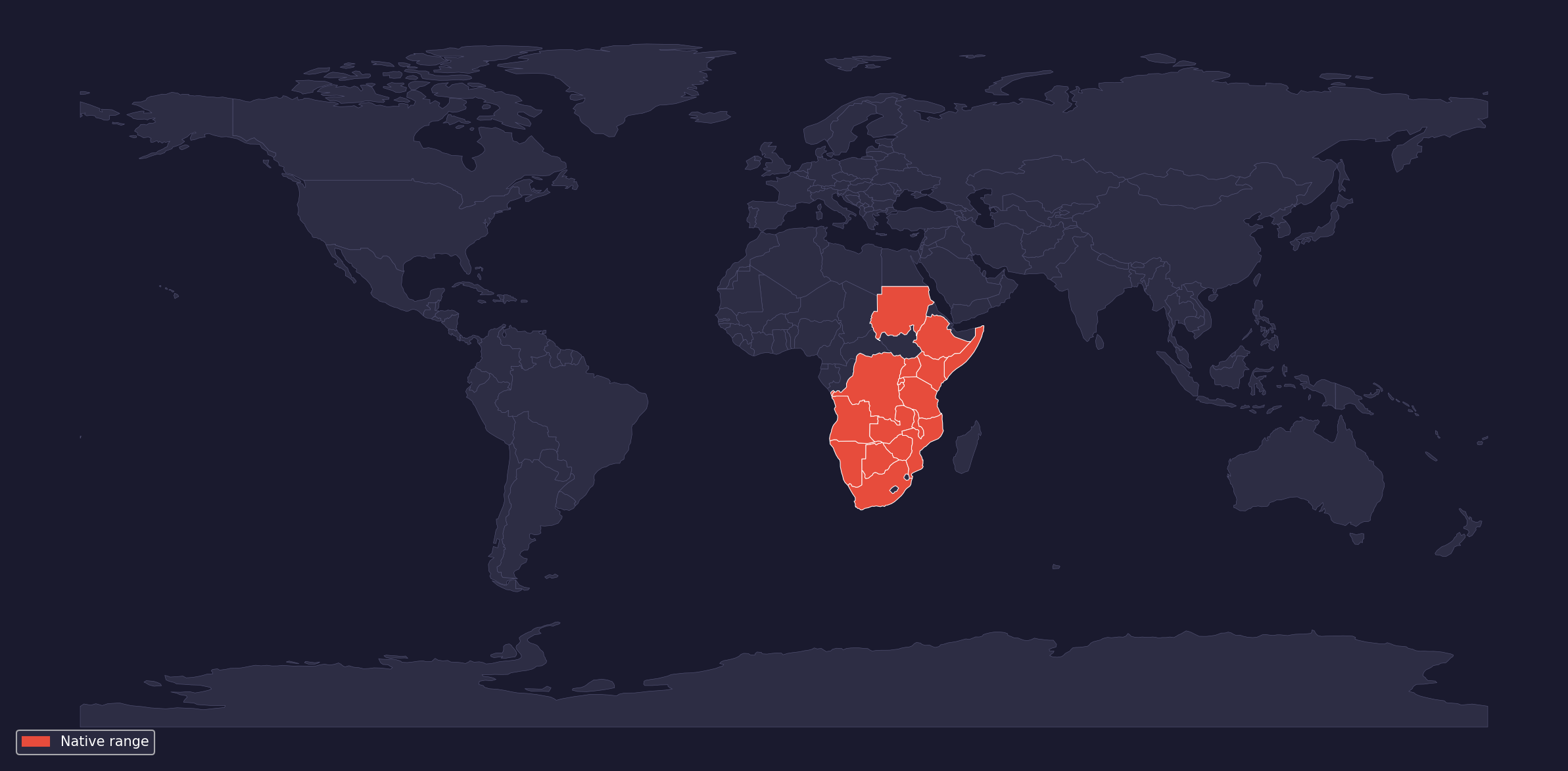
The leopard tortoise is widely distributed across sub-Saharan Africa — from Sudan and Ethiopia in the north to South Africa and Namibia in the south. It inhabits savannas, dry grasslands, thornbush, and semi-arid areas.
Characteristics of the natural climate:
- Warm to hot daytime temperatures (28–38°C)
- Cooler nights (15–22°C)
- A pronounced dry season
- Low to moderate humidity
- Intense sunlight
The leopard tortoise is a diurnal species and spends a significant part of the day basking. It does not hibernate — it originates from regions without a cold winter and should not be subjected to hibernation in captivity.
⚖️ Legal status
As checked against current official sources in April 2026, Stigmochelys pardalis is included in CITES Appendix II through the family-level Testudinidae listing. Under the EU wildlife trade rules, that normally places the species in Annex B unless a stricter listing applies.
The species is not relevant to the Bern Convention because it is not native to Europe. National and local rules on import, sale, transport, breeding, and proof of legal origin may still apply. Buy only clearly documented captive-bred animals and avoid unclear-origin imports.
🤌 Husbandry
The leopard tortoise is a large, active animal with substantial space requirements. Keeping it in a small confined enclosure is a common cause of stress, obesity, and health problems.
For juveniles (up to 15–20 cm), open tortoise tables with minimum dimensions of 100 × 60 cm can be used. Glass aquariums are not suitable — they trap moisture and do not provide adequate ventilation.
For adult specimens, the minimum indoor space is 200 × 100 cm, and even that is an absolute minimum for an animal of this size. An outdoor summer enclosure is not just recommended — it is practically necessary for the animal’s physical and psychological health. A single adult should ideally have at least 6-10 m² outdoors, with much more space preferred for large animals or groups. With access to natural sunlight and grass, the species is significantly more active and healthy.
The substrate must be kept dry. Damp substrate is the primary cause of respiratory infections. Suitable options include a mix of topsoil and sand, coconut fiber (kept dry), or specialized tortoise substrates.
💡 Lighting
The leopard tortoise is a diurnal species with high UVB and light intensity requirements. Insufficient lighting is the leading cause of metabolic bone disease and shell pyramiding in juveniles.
Recommended lighting:
- T5 HO UVB lamp at 10–12%, covering at least two-thirds of the enclosure length
- Alternative: mercury vapor bulb combining UVB, UVA, and heat in one unit
- Photoperiod: 12–14 hours per day (seasonally adjusted)
- Lamp should be replaced every 12 months
Natural sunlight is incomparably better than artificial lighting. Even a few hours outdoors daily during warm months has a significant positive effect. Glass filters out UVB, so placing the animal near a window does not substitute for direct sun exposure.
For UV planning, treat this species as Ferguson Zone 3. Aim for about UVI 3-4 at the animal’s back or shell height in the basking zone, with a gradient down to shaded areas near zero UVI. This usually points to a stronger 10-12% T5/Desert-style UVB tube, or a suitable mercury vapor system in a large open setup; measure with a Solarmeter 6.5 when possible, because reflector, mesh, distance, and lamp age change the real exposure.
🌡 Heating and temperature
The leopard tortoise requires a very hot basking spot and a wide temperature range across the enclosure.
Temperature gradient:
- Basking spot (surface temperature): 45–50°C
- Warm side (ambient air): 28–32°C
- Cool side: 20–24°C
- Night temperature: 18–22°C (not below 15°C)
The basking zone is heated with a halogen or heat lamp of 75–150 W depending on enclosure size. For larger outdoor enclosures, multiple lamps may be needed to create an adequate warm zone.
The species should not hibernate in captivity unless very specific safe hibernation conditions are met — which for G. pardalis is rarely practiced.
💧 Humidity and water
Unlike tropical reptiles, the leopard tortoise originates from dry savannas and requires low humidity — between 30 and 50%.
Chronically high humidity is a primary cause of:
- Respiratory infections
- Skin and shell problems
- Impaired thermoregulation
Exception: hatchlings are more susceptible to dehydration. For them, humidity should be slightly higher (50–60%) and a damp hide should be available.
All individuals must have constant access to a shallow water dish. Additionally, juveniles should be soaked in lukewarm water (15–20 minutes) once a week to ensure hydration and stimulate the urinary system.
🌿 Enclosure and decoration
The enclosure should provide:
- A hot basking area with direct access to the lamp
- One or more hides (sized so the tortoise can enter and exit freely)
- Flat rocks in the basking zone (these absorb and radiate heat)
- Dry substrate at least 8–10 cm deep (the species enjoys digging)
- Plants — live or artificial — for shade and visual enrichment
An outdoor garden enclosure with natural grass is the ideal setup. Dandelion, plantain, clover, and mixed grass species are both a favorite food and accessible directly from the ground.
🥬 Feeding
The leopard tortoise is strictly herbivorous. The diet must be high in fiber, low in protein, and low in sugars. High-protein foods cause kidney damage and shell pyramiding over time.
The core diet should consist of:
- Hay (timothy, meadow, orchard grass) — unlimited, especially important for indoor kept animals
- Grass (when kept outdoors)
- Dandelion (leaves and flowers)
- Plantain, clover, hibiscus, mulberry leaves
Acceptable supplements:
- Endive, chicory, Belgian endive
- Pumpkin, carrot, sweet potato (in moderation)
- Mulberry tree leaves
To be avoided:
- Fruit (fermentable sugars disrupt gut flora)
- Spinach and beetroot in larger quantities (high oxalate content)
- Any animal products
- Legumes and cabbage in larger amounts
Calcium is essential for shell health. A cuttlefish bone can be left freely in the enclosure for the animal to nibble on as needed. Calcium powder without D3 should be dusted on food at most feedings; calcium with D3 should be used more sparingly, especially if the animal receives adequate UVB exposure.
Growth stage matters. Hatchlings and juveniles need the same high-quality, high-fiber diet as adults, but with closer hydration, calcium, UVB, and weight monitoring so growth stays steady rather than forced. Adults should be maintained lean and active on fibrous grazing foods; rich foods, excess protein, and frequent calorie-heavy extras cause shell deformity, obesity, kidney strain, and reproductive problems.
🩺 Common problems
Common leopard tortoise problems include shell growth issues from dry rearing or bad diet, dehydration, respiratory disease from cold damp housing, obesity, and parasite burden in unclear-origin animals. Warning signs include nasal discharge, wheezing, soft shell growth, swollen eyes, weakness, and persistent refusal to eat.
If problems appear, first check temperatures, UVB, humidity balance, hydration, and diet quality. Respiratory signs, repeated weakness, shell deformity, injury, or prolonged anorexia require a reptile veterinarian.
📌 Conclusion
The leopard tortoise is an impressive and charismatic species suited to experienced keepers with sufficient space and a readiness for a long-term commitment. The main challenges are providing a large enough enclosure, high-intensity lighting, and dry conditions. When kept correctly, the species is active, curious, and may accompany its keeper for decades — or outlive them entirely.
📚 Sources and further reading
- CITES Appendices and Species+ trade database, checked April 2026
- EU wildlife trade regulations and annex references, checked April 2026
- GBIF species backbone and occurrence data for taxonomy and distribution context
- IUCN Red List and specialist husbandry references where applicable