Share

Home's Hinge-Back Tortoise
🔤 Taxonomy
Kinixys homeana is the accepted scientific name. The older combination Cinixys homeana and the former subspecies treatment Kinixys belliana homeana may appear in historical literature. No subspecies are currently recognized.
📌 Description
Home’s hinge-back is a small to medium West African forest tortoise, usually 18-22 cm long. The rear of the carapace is steep and hinged, allowing the animal to protect its hindquarters. It is a secretive crepuscular species that spends much of the day beneath leaves, plants, or shelters.
Its moderate size is misleading. The species needs consistently high humidity, warm but not intense heat, subdued yet correctly measured UVB, a mushroom-rich omnivorous diet, and extremely careful quarantine. Wild populations are in severe decline, and the current Appendix I / EU Annex A status makes traceable legal origin essential.
| Adult size | 18-22 cm |
| Expected lifespan | 30-50 years |
| Minimum adult enclosure | About 180 x 90 cm for one; larger preferred |
| Temperature | 24-27°C ambient; 28-30°C optional broad warm patch |
| Humidity | 80-95% with leaf litter, airflow, and drainage |
| Diet | Mushrooms, diverse leaves and vegetables, plus controlled invertebrate foods |
🌍 Distribution
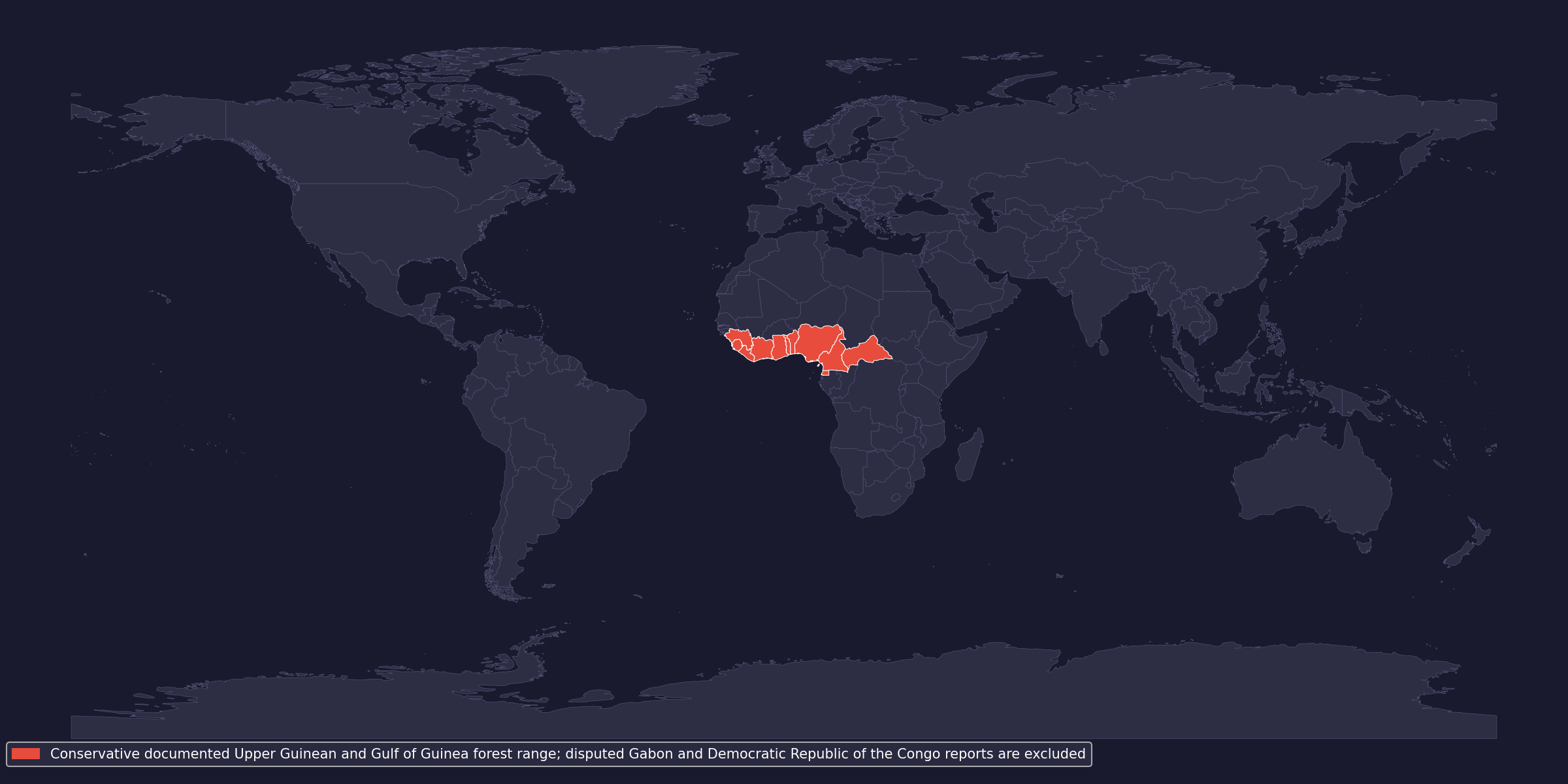
The best-documented core range follows humid forest from Guinea and Sierra Leone through Liberia, Côte d’Ivoire, Ghana, Togo, Benin, and Nigeria to Cameroon, Equatorial Guinea, and parts of the Central African Republic. Reports from Gabon and a disjunct population in the Democratic Republic of the Congo remain uncertain in recent specialist accounts.
The species lives in dense lowland rainforest, secondary forest, swamp margins, plantations adjoining forest, and deep humid litter. Daily life occurs close to the ground among fungi, decaying wood, invertebrates, and shaded water. Country-wide climate averages therefore overstate the light and heat that reach the tortoise’s microhabitat.
🌡 Climate across the native range
Monthly climate normals from reviewed GBIF occurrence locations across the Upper Guinean and Gulf of Guinea forest range:
Bas-Sassandra — Côte d’Ivoire (Upper Guinean rainforest)
| Month | Min °C | Mean °C | Max °C | RH % |
|---|---|---|---|---|
| January | 24.5 | 26.4 | 29.1 | 85 |
| February | 24.8 | 26.7 | 29.3 | 86 |
| March | 24.9 | 26.8 | 29.5 | 87 |
| April | 25 | 26.8 | 29.4 | 87 |
| May | 24.6 | 26.2 | 28.4 | 88 |
| June | 24 | 25.4 | 27.1 | 86 |
| July | 23.5 | 24.8 | 26.4 | 84 |
| August | 23.3 | 24.5 | 26.2 | 84 |
| September | 23.4 | 24.7 | 26.7 | 88 |
| October | 23.7 | 25.3 | 27.4 | 88 |
| November | 24.1 | 25.9 | 28.2 | 87 |
| December | 24.4 | 26.2 | 28.6 | 87 |
Lama Forest — Benin (Dahomey Gap forest refuge)
| Month | Min °C | Mean °C | Max °C | RH % |
|---|---|---|---|---|
| January | 23.6 | 27.7 | 34 | 69 |
| February | 24.8 | 28.5 | 34.6 | 73 |
| March | 25.3 | 28.4 | 33.8 | 77 |
| April | 25 | 27.9 | 32.7 | 80 |
| May | 24.2 | 26.8 | 31.1 | 84 |
| June | 23.2 | 25.5 | 29.2 | 86 |
| July | 22.6 | 24.8 | 28.4 | 85 |
| August | 22.3 | 24.6 | 28.2 | 84 |
| September | 22.7 | 25 | 29 | 86 |
| October | 23 | 25.6 | 29.9 | 86 |
| November | 23.7 | 26.6 | 31.3 | 83 |
| December | 23.7 | 27.4 | 32.9 | 76 |
South Region — Cameroon (Gulf of Guinea rainforest)
| Month | Min °C | Mean °C | Max °C | RH % |
|---|---|---|---|---|
| January | 24.1 | 25.8 | 28.1 | 88 |
| February | 24.3 | 26.1 | 28.5 | 87 |
| March | 24.4 | 26.3 | 28.8 | 87 |
| April | 24.3 | 26.2 | 28.7 | 88 |
| May | 24.1 | 25.8 | 28.2 | 88 |
| June | 23.5 | 24.9 | 27 | 88 |
| July | 22.9 | 24.2 | 26.2 | 87 |
| August | 22.8 | 24.1 | 26.1 | 88 |
| September | 23 | 24.4 | 26.4 | 89 |
| October | 23.2 | 24.8 | 27 | 90 |
| November | 23.4 | 25.1 | 27.5 | 89 |
| December | 23.8 | 25.5 | 27.8 | 89 |
Weather data by Open-Meteo.com · CC BY 4.0 · Monthly normals calculated by Herpeton Academy from daily archive values.
Location references use GBIF.org occurrence data where available; original occurrence records retain their source dataset licenses.
⚖️ Legal status
As checked on 2026-08-30, Kinixys homeana is in CITES Appendix I and EU Annex A following the 2026 implementation of the CITES CoP20 transfer. Commercial international trade in wild specimens is generally prohibited, while movement and commercial use of qualifying captive-bred animals require the appropriate permits and certificates.
Within the EU, sale or other commercial use of an Annex A specimen normally requires a valid Article 10 certificate unless a specific exemption applies. National marking, registration, breeding, and transfer rules may add further duties. Before acquiring an animal, have the competent authority confirm the documents for that individual; retain original certificates, invoices, breeder records, and photographs. The Bern Convention is not relevant because this is not a European native species.
🤌 Husbandry
This is an expert-level conservation-sensitive species, not a general pet tortoise. One adult needs at least 180 x 90 cm of floor space in a closed or partly closed enclosure that holds humidity without becoming airless. Larger pens produce better moisture, feeding, and privacy gradients.
House singly outside carefully managed breeding introductions. Provide several opaque hides, dense plants, deep leaf litter, and sight barriers. The animal should be able to move between a warm humid retreat, a slightly cooler retreat, shallow water, and a brighter feeding area without crossing open ground.
Many traded adults historically arrived wild-caught with dehydration, stress, and heavy parasite burdens. Quarantine in a quiet room with dedicated tools; weigh weekly at first and record food, feces, urates, hydration, eyes, nose, and activity. Arrange reptile-veterinary examination and repeated fecal testing rather than dosing preventively without a diagnosis.
💡 Lighting
Provide gentle daylight and low-level UVB over part of the enclosure. Treat the species as Ferguson Zone 1: about UVI 0.5-1.0 at shell height is a cautious target, with dense shade at zero. A measured shade-dweller or low-output T5 HO system is preferable to a high-intensity desert lamp.
Use an 11-12 hour photoperiod. Live plants benefit from a separate broad LED, but always preserve dim refuges. Sun through glass is not UVB, and direct outdoor sun can overheat this shade-adapted tortoise quickly.
🌡 Heating and temperature
Maintain stable, gentle warmth:
- General daytime air: 24-27°C
- Broad optional warm patch: 28-30°C
- Cool shaded retreat: 23-24°C
- Night: 22-24°C
Avoid prolonged temperatures above 30°C and do not let the enclosure fall below about 21-22°C. Heat the room or a broad overhead zone rather than using a hot narrow spot or under-tank heater. Measure the substrate surface and the interior of hides. Home’s hinge-back tortoises do not hibernate.
💧 Humidity and water
Maintain roughly 80-95% relative humidity with clean, moving air. Mist leaf litter and the upper substrate as needed, then let some surface areas breathe rather than keeping every layer saturated. A drainage layer or free-draining base helps prevent sour substrate and skin damage.
Provide a shallow, stable water tray wide enough for full-body soaking and easy exit. Refresh it at least daily and immediately after defecation. Juveniles require especially stable hydration, but unsupervised deep water is unsafe.
🌿 Enclosure and decoration
Use 15-25 cm of slightly moist cypress mulch, fine orchid bark, pesticide-free soil, and leaf mold, topped generously with whole leaves. Add cork slabs, broad hides, rotting hardwood, living plants, and low obstacles that encourage foraging without creating falls.
Avoid dry tortoise tables, bright open pens, aromatic wood shavings, dusty substrate, pure sand, and permanently soggy coir. A breeding female benefits from 20-25 cm of deeper, compactable nesting material.
🥬 Feeding
Wild diet studies identify fungi as a major food, with invertebrates and plant material also used. Make safe cultivated mushrooms—such as oyster, button, chestnut, and shiitake—a regular part of a varied ration, not the only food. Combine them with dandelion, plantain, mallow, mulberry, hibiscus, endive, escarole, squash, okra, green beans, and seasonal edible flowers.
Offer cultured earthworms, snails, woodlice, or other appropriate invertebrates once or twice weekly for juveniles and about weekly for adults, adjusted to body condition. Avoid wild millipedes because species toxicity and pesticide exposure are hard to control. Fruit should be an occasional small item rather than a method for keeping a stressed animal eating indefinitely.
Feed juveniles daily and adults daily or every other day. Keep cuttlebone available and apply plain calcium lightly to poorly balanced meals; use multivitamins sparingly and account for UVB. Dog food, cat food, raw meat, and rich pellets are poor routine protein sources.
🥚 Breeding
Breeding is best reserved for legally documented animals in a coordinated conservation program. Adults mature slowly, commonly around five to seven years in managed care. Introductions must be watched closely because courtship can include biting and ramming; separate the pair if either animal cannot retreat.
Clutches are small, often 2-4 eggs. Successful keepers report gently fluctuating incubation around 23-28°C and hatching in roughly 90-120 days, but published data remain limited. Maintain moderate moisture and ventilation, do not rotate established eggs, and keep complete parentage, laying, incubation, hatch, marking, and transfer records required by the competent authority.
🩺 Common problems
- Closed or swollen eyes, dry skin, lethargy, or thick urates: dehydration, excessive light, or systemic disease
- Nasal discharge, wheezing, or open-mouth breathing: cold, stale air, or respiratory disease
- Weight loss despite feeding: parasites, oral disease, stress, or gastrointestinal illness
- Loose stool: excessive fruit, abrupt diet change, parasites, or infection
- Soft shell or weak limbs: inadequate UVB/calcium or nutritional imbalance
- Red plastron, skin sores, or foul substrate: excessive wetness, poor drainage, trauma, or infection
Hinge-backs often hide illness until it is advanced. Persistent inactivity, weight loss, breathing signs, or refusal of several meals warrants prompt examination by a reptile-experienced veterinarian.
📌 Conclusion
Home’s hinge-back tortoise belongs with experienced keepers who can combine quiet, high-humidity forest husbandry with formal legal records and veterinary quarantine. Captive breeding can support conservation, but purchasing an undocumented animal directly undermines that goal.
📚 Sources and further reading
- ReptiFiles tortoise and turtle care library (required comparative check; no species-specific ReptiFiles guide was available when checked)
- Luiselli and Diagne 2013, Kinixys homeana species account
- The Reptile Database: Kinixys homeana and GBIF taxon 2441703
- Kinixys Working Group husbandry and breeding account and Tortoise Trust Kinixys husbandry
- Baines et al. 2016, UVB provision for captive reptiles
- CITES Appendices and EU Regulation 2026/1383, checked 2026-08-30