Share

Elongated Tortoise
🔤 Taxonomy
Indotestudo elongata is the currently accepted scientific name. Older books and trade records often use Geochelone elongata or the original combination Testudo elongata. No subspecies are currently recognized.
English common names used in the hobby include:
- Elongated tortoise
- Yellow-headed tortoise
- Yellow tortoise
The common German name is Gelbkopf-Landschildkröte.
📌 Description
The elongated tortoise is a medium-sized South and Southeast Asian tortoise built for warm, seasonal forest rather than an arid Mediterranean setup. Most adults have a straight shell length of about 28-30 cm, while exceptional animals reach 36 cm. A mature animal commonly weighs roughly 1.8-4 kg and may live for more than 50 years.
The yellowish-brown or olive shell has irregular dark blotches, and its long outline gives the species its English name. Mature males usually have a longer, thicker tail and a concave plastron; females have a flatter plastron and broader anal notch. Both sexes can develop pink coloration around the nose and eyes during the breeding season, usually brighter in males.
This is not a sensible first tortoise. It needs much more floor space than a glass terrarium provides, controlled warmth without overheating, humid retreats without stagnant conditions, a varied omnivorous diet, and reliable legal-origin documents. Wild populations are Critically Endangered, so only documented captive-bred animals should be considered.
🌍 Distribution
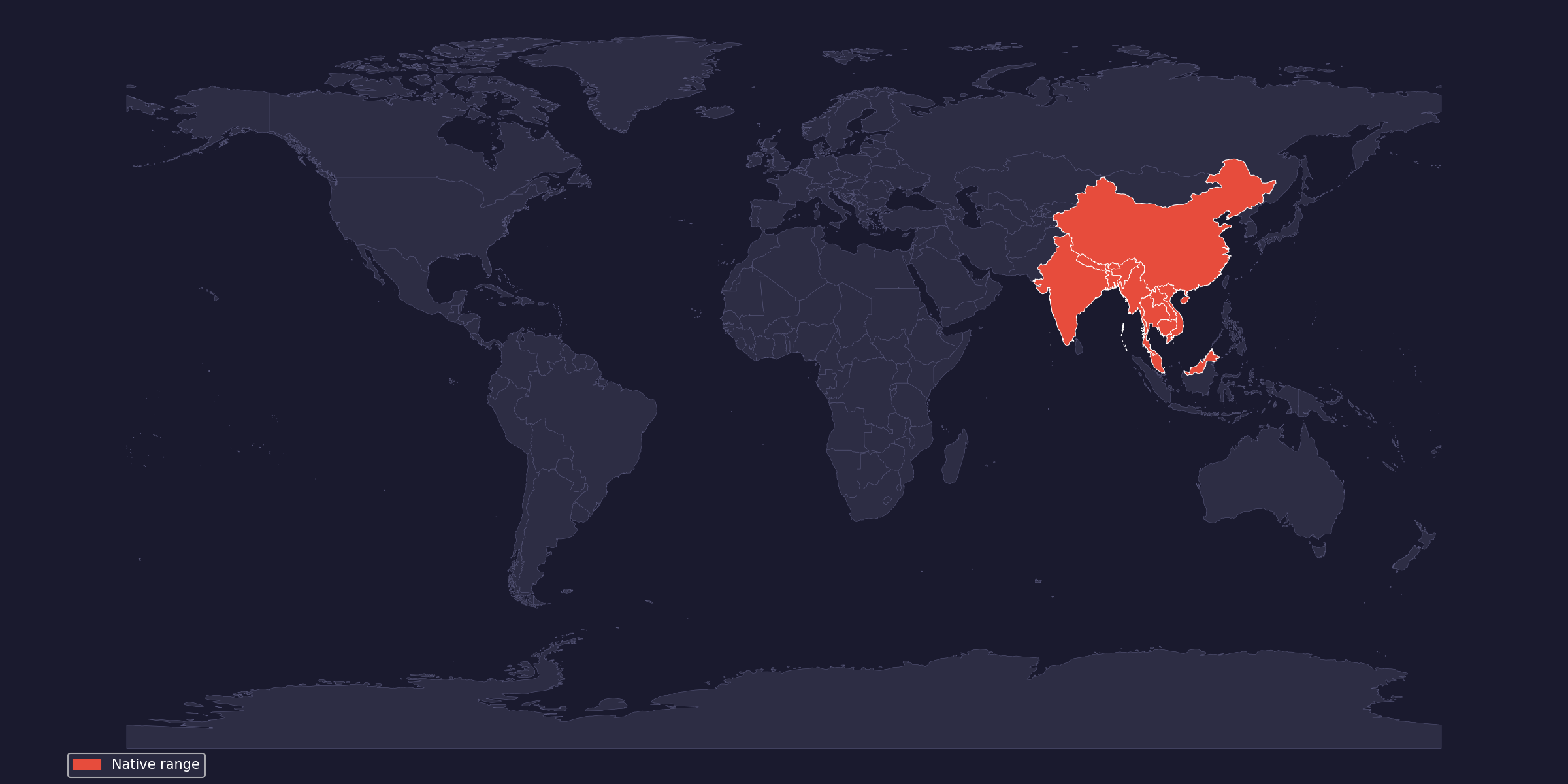
The native range extends from Nepal, Bhutan, Bangladesh, and northern and eastern India through Myanmar, Thailand, Laos, Cambodia, and Vietnam to southern China and northern Peninsular Malaysia.
Across that broad range the species uses open deciduous dipterocarp and sal forest, bamboo forest, secondary forest, grassland, thorn scrub, and some hilly evergreen forest. Much of the range has a monsoonal rhythm: tortoises shelter through hot or dry periods and become most active in cloudy weather, warm rain, and the early morning or evening. In captivity, this translates into shade, leaf litter, moist retreats, drainage, and choice—not a uniformly wet enclosure or exposure to extreme outdoor heat.
🌡 Climate across the native range
Monthly climate normals from reviewed GBIF occurrence locations representing the species’ broad climatic range:
Sylhet — Bangladesh (northeastern humid forest)
| Month | Min °C | Mean °C | Max °C | RH % |
|---|---|---|---|---|
| January | 12.4 | 18.2 | 24.2 | 72 |
| February | 14.7 | 20.7 | 26.9 | 68 |
| March | 18.7 | 24.3 | 30.3 | 68 |
| April | 21.9 | 26.1 | 31.1 | 80 |
| May | 23.7 | 26.9 | 31.1 | 85 |
| June | 25.1 | 27.5 | 30.9 | 86 |
| July | 25.3 | 27.4 | 30.7 | 86 |
| August | 25.2 | 27.5 | 31 | 86 |
| September | 24.6 | 27.1 | 30.7 | 87 |
| October | 22.5 | 25.9 | 29.9 | 84 |
| November | 17.8 | 22.6 | 27.8 | 78 |
| December | 13.9 | 19.3 | 25.1 | 75 |
Nakhon Ratchasima — Thailand (seasonal interior forest)
| Month | Min °C | Mean °C | Max °C | RH % |
|---|---|---|---|---|
| January | 17.3 | 22.5 | 27.6 | 67 |
| February | 18.9 | 24.2 | 29.6 | 66 |
| March | 21.2 | 25.8 | 31.1 | 71 |
| April | 22.7 | 26.6 | 31.5 | 76 |
| May | 23.2 | 26.1 | 30.4 | 82 |
| June | 23 | 25.4 | 29.3 | 84 |
| July | 22.7 | 24.9 | 28.6 | 85 |
| August | 22.5 | 24.7 | 28.3 | 86 |
| September | 22 | 24.4 | 28 | 88 |
| October | 21 | 23.8 | 27.4 | 85 |
| November | 19.3 | 23.1 | 27.2 | 75 |
| December | 17.1 | 21.9 | 26.5 | 68 |
Cardamom Mountains — Cambodia (southern hill forest)
| Month | Min °C | Mean °C | Max °C | RH % |
|---|---|---|---|---|
| January | 19.4 | 23.9 | 29.9 | 73 |
| February | 19.8 | 24.2 | 30.3 | 77 |
| March | 20.9 | 24.6 | 30.1 | 83 |
| April | 21.7 | 24.8 | 29.9 | 87 |
| May | 22.2 | 24.6 | 28.6 | 91 |
| June | 22.1 | 24 | 27.3 | 93 |
| July | 21.8 | 23.6 | 26.7 | 93 |
| August | 21.8 | 23.5 | 26.6 | 94 |
| September | 21.4 | 23.4 | 26.8 | 94 |
| October | 21 | 23.6 | 27.9 | 91 |
| November | 20.8 | 24.1 | 28.9 | 81 |
| December | 20 | 24 | 29.5 | 72 |
Weather data by Open-Meteo.com · CC BY 4.0 · Monthly normals calculated by Herpeton Academy from daily archive values.
Location references use GBIF.org occurrence data where available; original occurrence records retain their source dataset licenses.
⚖️ Legal status
Status checked on 2026-08-19: Indotestudo elongata is listed in CITES Appendix II. It falls under EU Annex B through the family-level listing for Testudinidae; it is not one of the tortoises placed in EU Annex A. The Bern Convention is not relevant because this is not a European native species. Its IUCN Critically Endangered category describes conservation risk and is separate from ownership law.
Appendix II and Annex B regulate trade and require proof of lawful origin; they do not make an undocumented animal acceptable. Keep the invoice or transfer document, breeder details, any CITES import or re-export paperwork, and clear identification photographs for the animal’s lifetime. Local and national registration, marking, breeding, sale, transport, and import rules vary, so check the competent wildlife authority before acquiring or moving an animal.
🤌 Husbandry
The adult enclosure should function as a warm forest-floor pen with open walking lanes, deep cover, several retreats, and a soaking pool. A secure outdoor pen is valuable during suitable weather, but animals in temperate Europe need a large heated indoor area for cool periods.
| Parameter | Practical target |
|---|---|
| Adult size | Usually 28-30 cm; up to 36 cm |
| Expected lifespan | 50+ years |
| Minimum adult floor space | About 275 × 140 cm for one animal; larger is better |
| Ambient temperature | 24-29°C |
| Basking surface | 30-32°C |
| Night temperature | 18-22°C |
| Humidity | 60-80%, with a humid retreat |
| UVB | Ferguson Zone 2; about UVI 1-2 at shell height |
| Diet | Varied leaves, weeds, flowers, fungi, some fruit, and occasional animal matter |
House males separately. A compatible female group can work only in a very large, structured pen with duplicate resources, and any male may harass or ram females during breeding activity. Solitary housing is the safer default.
Quarantine every new arrival for at least 90 days in a separate area with separate tools. Record weight, appetite, feces, activity, and shell condition. Imported or poorly documented animals warrant an examination and fecal testing by an experienced reptile veterinarian before they approach an established collection.
💡 Lighting
Provide a clear 10-12 hour light cycle, bright visible light, and UVB. Although wild elongated tortoises bask infrequently and often avoid strong midday sun, an indoor animal still needs safe access to UVB for vitamin D3 metabolism and calcium use.
Treat the species as Ferguson Zone 2: aim for roughly UVI 1-2 at the top of the shell in the lit warm area, fading to near zero in shaded retreats. A moderate-output T5 UVB tube can work when installed at the manufacturer’s tested distance, but mesh, reflector design, lamp age, and mounting height change the actual exposure. Measure with a suitable UV meter when possible. Sunlight through glass or ordinary plastic does not provide useful UVB.
🌡 Heating and temperature
Create a broad ambient gradient of 24-29°C with a localized 30-32°C basking surface and a shaded 22-24°C retreat. Nights can fall to about 18-22°C for healthy adults. Use thermostatically controlled heat, digital thermometers at animal height, and an infrared thermometer for surface checks.
The species’ ability to survive very hot wild conditions is not a captive target. Forest tortoises avoid extremes by moving into vegetation, hollows, and cooler microhabitats; a pen must always offer the same choice. Outdoor housing is suitable only when shade and shelter are available and nights stay safely warm. Move the animal to heated accommodation before prolonged cold weather.
Do not hibernate this species. A modest seasonal change in day length, rainfall, and nighttime temperature can be used by experienced breeders, but deliberate cold rest is unsafe for juveniles, underweight or ill animals, and recent arrivals.
💧 Humidity and water
Maintain roughly 60-80% relative humidity while keeping the substrate surface variable rather than soaked. Offer at least one humid retreat around 80-95%, especially for hatchlings and juveniles. Deep leaf litter and a moisture-retentive lower substrate layer help create this gradient; cross-ventilation and drainage prevent stale, permanently wet conditions.
Provide a large shallow pool in which the tortoise can sit with its head comfortably above water and leave without climbing a steep edge. Change the water whenever soiled and scrub the container frequently. Regular drinking and soaking are normal, but prolonged inactivity in water, swollen eyes, nasal discharge, or buoyancy problems need veterinary attention rather than extra misting.
🌿 Enclosure and decoration
For one adult, about 275 × 140 cm (3.85 m²) is a minimum starting footprint drawn from published captive-husbandry recommendations. Larger enclosures provide better gradients and exercise, and permanent adult accommodation is usually better designed as an indoor room or greenhouse-style pen than as a conventional vivarium. Opaque walls about 45-60 cm high reduce pacing; gates and corners must resist pushing and digging.
Use 15-25 cm of pesticide-free topsoil mixed with leaf mould, coconut fibre, or fine orchid bark, then add a generous layer of dry and damp leaf litter. The substrate should hold a burrow or nest scrape without becoming muddy. Avoid pure sand, gravel, wood shavings with aromatic oils, crushed walnut shell, and any loose material likely to adhere heavily to wet food.
Include several full-body hides, cork bark, low logs, clumps of sturdy plants, and visual barriers. Keep feeding on a slate or dish to limit substrate ingestion. A laying female needs at least 20 cm of warm, slightly moist, diggable soil even when breeding was not planned.
🥬 Feeding
The species is a generalist omnivore, not a fruit-fed herbivore. Field studies record herbaceous leaves, grasses, fruit, flowers, mushrooms, earthworms, slugs, snails, and carrion. Captive meals should remain plant-dominant and varied:
- Dandelion, plantain, sow thistle, clover, mulberry, grapevine, hibiscus, and other safe broad leaves
- Edible flowers, grasses, squash, pumpkin, and occasional mushroom
- Small portions of papaya, fig, berries, melon, or other fruit rather than fruit at every meal
- An occasional earthworm, snail from a safe parasite-free source, or a small portion of a balanced low-fat tortoise food
Offer food daily, adjusting the amount to body condition and activity. Avoid dog or cat food, processed meat, large servings of egg, and routine high-protein meals; these make it easy to oversupply calories, protein, and phosphorus. Do not collect weeds, fungi, or invertebrates from pesticide-treated or polluted ground.
Keep plain calcium carbonate or cuttlebone available. With measured UVB and a varied diet, a light dusting of calcium without D3 about twice weekly is a reasonable adult baseline; growing juveniles and laying females may need more under veterinary guidance. Use D3-containing calcium or a reptile multivitamin only at label-compatible intervals, commonly every 2-4 weeks, because more is not automatically safer. Review the whole diet and UVB exposure rather than trying to correct poor husbandry with supplements.
🥚 Breeding
Males often have a longer thick tail, a concave plastron, and a narrow V-shaped anal notch; females are rounder, with a flatter plastron and a wider notch. Sexing juveniles below about 15 cm shell length is unreliable. Captive and field data place maturity broadly around six to eight years and roughly 18-24 cm, but growth rate and sex matter.
Females may lay one to ten eggs and can produce more than one clutch in a season. Nests are commonly 10-20 cm deep. Published successful incubation spans approximately 27-30°C and 98-180 days; the wide range reflects different stable and day-night cycling methods. Temperature-dependent sex determination has not been established for this species, so do not manipulate temperature to promise a particular sex.
Breeding requires space to separate an aggressive male, a proper nesting area, legal records for both parents and offspring, and homes for long-lived juveniles. Persistent digging without laying, weakness, hind-limb straining, or sudden appetite loss in a gravid female requires urgent reptile-veterinary assessment for possible egg binding.
🩺 Common problems
- Respiratory infection: nasal bubbles, wheezing, open-mouth breathing, or lethargy can follow cold, stagnant, overly wet conditions. Correct measured temperatures and seek veterinary care.
- Metabolic bone disease and poor shell growth: weak UVB, calcium imbalance, or rapid calorie-rich growth can produce a soft or distorted shell. Review UVB at shell height, diet, and supplementation with a veterinarian.
- Pyramiding and dehydration: persistently dry juvenile housing, low water access, and rapid growth contribute to abnormal scute development. Provide humid retreats and steady, not excessive, growth.
- Obesity and nutritional disease: fruit-heavy and high-protein diets can cause excess weight and place strain on the organs and joints. Follow body condition and monthly weight trends rather than feeding to appetite alone.
- Parasites and enteric disease: wild-caught or mixed-origin animals may carry substantial parasite loads. Diarrhea, visible worms, poor growth, or weight loss need fecal testing; do not medicate blindly.
- Shell and skin infection: dirty pools, abrasive surfaces, and constantly wet substrate can damage the shell or skin. Keep water clean, improve drainage, and have soft, discoloured, foul-smelling, or ulcerated areas examined.
📌 Conclusion
The elongated tortoise suits an experienced keeper who can dedicate several square metres of warm, structured floor space and manage shade, humidity, water hygiene, UVB, diet, and documentation for decades. The most common bad compromise is buying a small juvenile and planning the adult pen later; the full enclosure and legal paper trail should exist before the animal arrives.
📚 Sources and further reading
- IUCN Red List 2019 assessment: Indotestudo elongata
- IUCN/SSC Tortoise and Freshwater Turtle Specialist Group species account
- Ihlow et al. 2016 full species account and captive-husbandry review
- Sriprateep et al. 2013: population structure and reproduction in Thailand
- GBIF Backbone Taxonomy: Indotestudo elongata
- Baines et al. 2016: UV-Tool for captive reptiles
- Official CITES Appendices
- EU wildlife-trade Annexes: Commission Regulation (EU) 2026/1383