Share

Indian Star Tortoise
🔤 Taxonomy
Geochelone elegans is the currently accepted scientific name. In hobby and conservation material, the species is widely known as the Indian star tortoise.
English common names used in the hobby:
- Indian star tortoise
- Star tortoise
German common names used in the hobby:
- Indische Sternschildkrote
📌 Description
Geochelone elegans is a medium-sized Asian tortoise famous for the radiating star pattern on the shell. Adults commonly reach around 20-30 cm depending on sex and origin, and females often become larger than males.
This species is attractive and widely desired, but it is not a casual beginner tortoise. Good care depends on legal captive origin, strong UVB, warmth, clean conditions, and a diet built around fiber-rich plant food.
🌍 Distribution
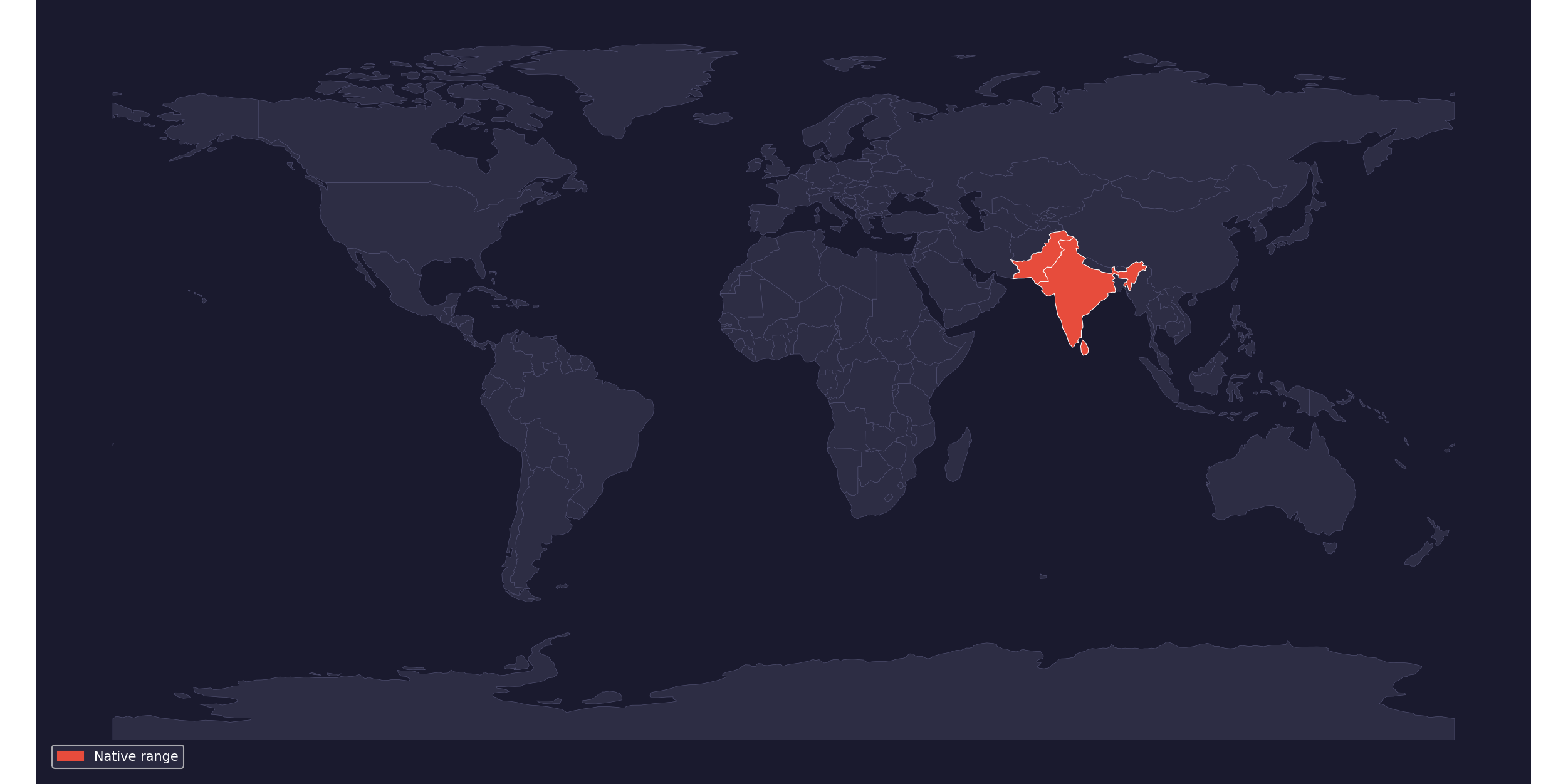
Geochelone elegans occurs in parts of India, Sri Lanka, and Pakistan, where it uses warm habitats that are seasonally dry but not cold and where shelter and grazing plants are available.
In captivity, this usually means:
- Warm stable conditions
- Strong UVB or natural sun
- Dry walking areas with access to shelter
- Good hygiene
- Moderate humidity rather than cold wetness
🌡 Climate across the native range
Monthly climate normals from reviewed GBIF occurrence locations:
Madhya Pradesh — India
| Month | Min °C | Mean °C | Max °C | RH % |
|---|---|---|---|---|
| January | 11.8 | 18 | 24.5 | 55 |
| February | 14.6 | 21.1 | 28 | 45 |
| March | 19.1 | 26.1 | 32.9 | 34 |
| April | 24.1 | 31.1 | 37.8 | 24 |
| May | 27.9 | 33.9 | 39.9 | 28 |
| June | 26.6 | 30.7 | 35.5 | 56 |
| July | 23.8 | 26 | 29 | 82 |
| August | 22.9 | 24.9 | 27.7 | 86 |
| September | 22.4 | 25.6 | 29.3 | 79 |
| October | 20.2 | 25.4 | 30.7 | 58 |
| November | 16.5 | 22.3 | 28.4 | 52 |
| December | 12.8 | 18.8 | 25.4 | 54 |
Anuradhapura — Sri Lanka
| Month | Min °C | Mean °C | Max °C | RH % |
|---|---|---|---|---|
| January | 21.7 | 25.1 | 29.2 | 77 |
| February | 22.1 | 26.3 | 31.3 | 73 |
| March | 23.5 | 28 | 33.6 | 71 |
| April | 24.9 | 28.1 | 32.7 | 79 |
| May | 25.7 | 28 | 31.4 | 81 |
| June | 25.7 | 27.8 | 30.8 | 79 |
| July | 25.4 | 27.6 | 31.2 | 77 |
| August | 25.2 | 27.5 | 31.3 | 77 |
| September | 24.9 | 27.4 | 31.2 | 78 |
| October | 24.1 | 26.5 | 30.2 | 83 |
| November | 23.1 | 25.6 | 29.2 | 86 |
| December | 22.5 | 25.1 | 28.6 | 82 |
Matale — Sri Lanka
| Month | Min °C | Mean °C | Max °C | RH % |
|---|---|---|---|---|
| January | 20.9 | 23.7 | 27.3 | 83 |
| February | 21 | 24.5 | 29 | 80 |
| March | 22 | 26.4 | 31.8 | 74 |
| April | 23.6 | 27.3 | 32.3 | 77 |
| May | 24.6 | 27.3 | 31.7 | 77 |
| June | 24.4 | 26.9 | 31 | 76 |
| July | 24.1 | 26.8 | 31.1 | 74 |
| August | 23.9 | 26.7 | 31.3 | 73 |
| September | 23.8 | 26.7 | 31.4 | 74 |
| October | 23.1 | 25.8 | 30.2 | 80 |
| November | 22.2 | 24.6 | 28.4 | 86 |
| December | 21.5 | 23.9 | 27.2 | 86 |
Weather data by Open-Meteo.com · CC BY 4.0 · Monthly normals calculated by Herpeton Academy from daily archive values.
Location references use GBIF.org occurrence data where available; original occurrence records retain their source dataset licenses.
⚖️ Legal status
As checked against current official sources in April 2026, Geochelone elegans is listed in CITES Appendix I. Under the EU wildlife trade rules, that generally means Annex A.
This is a highly protected species. Commercial movement, sale, and transfer can be much more strictly controlled than for Annex B tortoises, and documentation of lawful origin is especially important. The species is not relevant to the Bern Convention because it is not native to Europe, but national rules on registration, transport, and possession may still apply.
Do not accept an animal described merely as “captive” or accompanied only by a shop receipt. Before paying, ask the competent CITES authority which original certificate, transaction-specific certificate, marking, registration, and transfer records are required in the destination country. Check that the animal’s identification matches every document and keep originals, dated photographs, breeder details, invoices, and veterinary records for its lifetime. An Appendix-I listing does not make every captive-bred transaction automatically lawful.
🤌 Husbandry
This species does best in a secure enclosure with warmth, strong light, clean dry footing, and enough room to walk. Hatchlings and small juveniles can start in a well-controlled indoor table around 90 x 60 cm, but they should be upgraded before the enclosure becomes cramped or hard to keep clean.
Subadults and adults need much more space. For one adult, 2 x 1 m indoors should be treated as an emergency or cold-weather minimum, not an ideal permanent home. In warm weather, a secure outdoor pen of 4-6 m² or larger is much more appropriate, with more space needed for groups.
In suitable climates, outdoor keeping in warm weather is beneficial, but cold and damp conditions are dangerous.
Plan indoor and outdoor accommodation as one system. The indoor area must remain fully functional during cold rain, shoulder seasons, smoke events, quarantine, and illness; a free-roaming room is not a substitute because floors are usually cold, slippery, and impossible to light evenly. An outdoor pen needs opaque escape barriers, buried or inward-facing edges where digging is possible, predator-proof night housing, shade throughout the day, drainage, edible planting, and a dry heated refuge. Measure shaded air and surface temperatures before putting the tortoise outside, and bring it in before conditions fall outside the safe range.
House animals singly unless the enclosure is large enough to provide duplicate basking sites, feeding areas, hides, and visual barriers. Males may persistently chase or ram other tortoises, and a quieter animal can lose access without obvious fighting. Separate immediately for repeated mounting, shell impacts, weight loss, hiding, or feeding suppression.
Quarantine every new tortoise for at least 90 days in a separate room with dedicated tools. Use a simple cleanable setup while retaining correct heat, UVB, humidity shelter, and traction. Record weight weekly at first, appetite, feces, urates, breathing, activity, and shell condition. Arrange an early reptile-veterinary examination and fecal testing; extend quarantine or repeat testing when origin, symptoms, or the veterinarian’s findings justify it. Never medicate an apparently healthy tortoise for parasites without a diagnosis and dose based on an accurate weight.
Handling should be minimal. Lift with two hands supporting the plastron, keep the animal level and close to the ground, and never carry it by a limb or shell edge. Routine interaction is better provided through predictable feeding and enclosure work than repeated picking up.
💡 Lighting
Indian star tortoises need strong light and meaningful UVB when kept indoors.
Practical principles:
- Bright daytime lighting
- Suitable UVB for tortoises
- A clear basking zone
- Shade and retreat options
Natural sunlight is the best UVB source when weather is safe.
For UV planning, treat this species as Ferguson Zone 3. Aim for about UVI 3-4 at the animal’s back or shell height in the basking zone, with a gradient down to shaded areas near zero UVI. This usually points to a stronger 10-12% T5/Desert-style UVB tube, or a suitable mercury vapor system in a large open setup; measure with a Solarmeter 6.5 when possible, because reflector, mesh, distance, and lamp age change the real exposure.
Create a broad lit basking area rather than a narrow intense spot. Position the heat and UVB zones so the tortoise receives both while basking, but retain full-body shade. Measure UVI at shell height at installation and on a schedule, following the lamp maker’s replacement guidance; visible light does not confirm useful UVB output. Glass and most plastics block meaningful UVB, so sunlight through a closed window does not replace outdoor sun or a suitable lamp. Provide about 10-12 hours of bright day light and complete darkness at night.
🌡 Heating and temperature
Suitable approximate temperatures are:
- Basking area: around 32-35°C
- Warm ambient zone: about 27-30°C
- Cooler area: around 24-26°C
- Night: usually best kept above about 22°C
Chronic chilling is a common reason for decline in this species.
Measure the basking surface with an infrared thermometer and air temperatures with digital probes at shell height. Control each heater with an appropriate thermostat, while confirming the final temperatures independently. A large adult may need more than one overhead lamp to create a warm patch broad enough for the whole shell; one small bulb can overheat the centre while leaving the body cold. Guard lamps against contact and fire, and never rely on heat rocks.
Indian star tortoises do not hibernate. Do not apply a Mediterranean-tortoise brumation schedule. During cooler months maintain the same safe gradient indoors and shorten the photoperiod only modestly. A weak, thin, newly arrived, or unwell tortoise should not be seasonally cooled. Persistent inactivity or refusal to bask is a reason to verify measurements and seek veterinary advice, not to assume normal winter rest.
💧 Humidity and water
This species should not be kept in cold damp conditions, but it also should not be managed as a desert tortoise. A balanced approach is safer.
Useful principles:
- Fresh water always available
- Clean dry surface areas
- More humid shelter for young animals if needed
- Good airflow and hygiene
Juveniles often benefit from more controlled hydration than adults.
For adults, provide a generally moderate gradient around 50-70% relative humidity with a more humid retreat. Hatchlings and growing juveniles benefit from a humid hide or sheltered zone around 70-80%, while still having warm, well-ventilated surfaces. The aim is a hydrated microclimate, not cold saturated bedding. Measure humidity near the shell in both the open zone and hide; room readings alone can be misleading.
A shallow water tray must be large enough for the tortoise to enter and leave without tipping, but not deep enough to cover the nostrils. Replace water daily and whenever soiled. Supervised shallow soaking can help a newly arrived or poorly hydrated juvenile, but it does not compensate for dry housing or unavailable drinking water. Track hydration through activity, weight trend, eyes, feces, and urates; gritty urates, repeated straining, sunken eyes, or reduced urine need veterinary review.
🌿 Enclosure and decoration
The enclosure should support walking, grazing, basking, and retreat behavior.
Useful elements include:
- Soil-rich substrate or safe dry footing
- Shelters and shaded zones
- Stable basking space
- Water tray
- Open areas for movement
Smooth, cramped tortoise tables with little cover do not support natural behavior well.
Use approximately 10-15 cm of pesticide-free topsoil-based substrate, deepening a nesting area for mature females. A soil and coco-coir mix can buffer moisture if it remains firm enough for normal walking; the surface can be mostly dry while lower layers and one hide retain moisture. Avoid calcium sand, crushed shell, sharp gravel, aromatic wood, fertilizer, perlite, and permanently wet mulch. Feed from a slate or clean tray so soil does not coat every mouthful, but do not remove all opportunity to graze.
Add low shelters, clumps of edible grass, sight breaks, a textured basking slab, and gentle terrain changes. All structures must be stable against pushing and digging. Inspect the pen for toxic plants, pesticides, slug pellets, standing water, sharp wire, and fire-ant or rodent activity. Outdoor shelters need drainage and an entrance that cannot trap the tortoise during heavy rain.
🥬 Feeding
Geochelone elegans is primarily herbivorous and needs a high-fiber plant-based diet.
Suitable foods include:
- Weeds
- Grasses
- Broadleaf edible plants
- Fiber-rich leafy greens
Important points:
- Avoid sugary feeding
- Avoid animal protein
- Avoid relying on fruit
- Support calcium intake sensibly
Offer a varied rotation of pesticide-free grasses and broadleaf weeds such as plantain, dandelion, sow thistle, mulberry, grape leaves, hibiscus leaves and flowers, and suitable opuntia pads. In areas where safe weeds are seasonal, use fibrous commercial tortoise pellets soaked according to the label and mixed with appropriate leafy greens rather than replacing the diet with watery lettuce. Avoid lawn clippings, which heat and ferment in piles, and confirm every collected plant before feeding.
Dust plant food lightly with plain calcium according to the product label and the reptile veterinarian’s plan, particularly for growing animals and laying females. A cuttlebone may be available for voluntary gnawing but should not be the only calcium strategy. With measured Zone-3 UVB or regular safe sunlight, routine heavy use of vitamin D3 powder is usually unnecessary and can create excess; if UVB access is limited, correct the lighting and obtain veterinary advice rather than guessing a dose. Use a multivitamin only at the planned label frequency, not on top of several fortified products.
Growth stage matters. Hatchlings and juveniles need the same high-quality, high-fiber diet as adults, but with closer hydration, calcium, UVB, and weight monitoring so growth stays steady rather than forced. Adults should be maintained lean and active on fibrous grazing foods; rich foods, excess protein, and frequent calorie-heavy extras cause shell deformity, obesity, kidney strain, and reproductive problems.
Offer food daily in an amount that encourages grazing without leaving a thick spoiled layer. Weigh juveniles weekly and healthy adults monthly under consistent conditions. Review the whole setup when growth accelerates, plateaus, or the shell develops raised scutes; pyramiding is not corrected by calcium alone and must prompt review of hydration, humidity, heat, UVB, diet, and growth rate together.
🥚 Breeding
Females are usually substantially larger and have a short tail and flat plastron; males tend to remain smaller, with a longer, thicker tail and concave plastron. Males commonly mature at about 6-8 years and females around 7-12 years, although body size and condition are more useful than age alone.
Breeding often follows warm, humid seasonal cues. Females need a quiet nesting area of deep, diggable soil that is moist enough to hold its shape. Egg production is demanding, so breeding females require dependable UVB, calcium, hydration, and a stable high-fiber diet. Repeated digging without laying, straining, or sudden weakness requires veterinary assessment.
Clutches contain about 1-10 eggs, and a female may produce more than one clutch. The existing working range is 29-31°C for roughly 90-180 days. Because this species is subject to strict international trade controls, breeding should proceed only with documented animals and a verified plan for registration, hatchling records, and lawful transfer.
🩺 Common problems
Common problems include metabolic bone disease from inadequate UVB or mineral balance, pyramidal shell growth associated with poor hydration and growth management, respiratory disease from chilling, dehydration, gastrointestinal or urinary obstruction, trauma, egg retention, and parasite-related decline in poorly sourced animals.
Warning signs include:
- A soft or flexible shell, jaw weakness, tremors, or inability to lift the body
- Nasal bubbles, discharge, wheezing, open-mouth breathing, or a tilted head
- Swollen or sunken eyes, persistent closed eyes, or facial swelling
- Sustained weight loss, refusal to eat, vomiting, diarrhea, or black feces
- Gritty urates, repeated straining, cloacal prolapse, or little urine
- Shell injury, foul smell, soft discoloured areas, burns, or fly larvae
- Repeated nesting without laying, hind-limb weakness, or sudden collapse
If problems appear, document UVB, surface and air temperatures, humidity, weight, diet, feces, urates, and recent changes while arranging a reptile-veterinary examination. Do not use leftover antibiotics, vitamin injections, forced soaking, oil, or parasite drugs as a substitute for diagnosis. Respiratory signs, prolapse, major trauma, neurologic weakness, or prolonged anorexia require prompt professional care.
📌 Conclusion
Geochelone elegans suits a keeper who can document lawful origin and provide decades of warm indoor space, secure seasonal outdoor access, measured UVB, hydration gradients, grazing food, quarantine, and reptile-veterinary care. Before acquisition, have the adult enclosure plan, instruments, winter electricity budget, permits, and emergency indoor accommodation ready. Its appearance and modest length do not make it an apartment-table tortoise or an impulse purchase.
📚 Sources and further reading
- Animal Diversity Web: Geochelone elegans
- Tortoise Trust: Indian star tortoise care
- Baines et al. 2016: UV-Tool for captive reptiles
- Royal Veterinary College: outdoor tortoise care
- Royal Veterinary College: tortoise feeding and calcium guidance
- WWF responsible pet guide: Indian star tortoise
- CITES Appendices and EU wildlife-trade legislation, checked 2026-05-04
- GBIF species record for Geochelone elegans and occurrence data used for taxonomy and distribution context
💬 Feedback
For questions, corrections, or practical notes, leave us a message in the forum thread.