Share

Yellow-Footed Tortoise
🔤 Taxonomy
Chelonoidis denticulatus is the accepted name. Older husbandry books commonly use Geochelone denticulata or Chelonoidis denticulata; the masculine ending denticulatus follows the current treatment of the genus. No subspecies are recognized.
📌 Description
The yellow-footed tortoise is a large South American forest tortoise with yellow to orange scales on the head and limbs. Adults commonly reach about 40-60 cm and 7-20 kg, with exceptional animals larger. A well-kept individual may live 50-70 years.
It is not a yellow version of a dry-land tortoise. Compared with the red-footed tortoise it is generally larger, more tied to humid forest, and less tolerant of cool, dry accommodation. Adult floor space, high humidity with drainage, and a varied omnivorous diet must all be solved before purchase.
| Adult size | 40-60 cm, occasionally larger |
| Expected lifespan | 50-70 years |
| Minimum indoor adult footprint | About 3 x 2 m for one; larger is strongly preferred |
| Temperature | 25-28°C ambient; 30-32°C local basking area |
| Humidity | 75-90% with airflow, drainage, and dry surface choices |
| Diet | Varied leaves, fungi, flowers, limited fruit, and occasional invertebrate protein |
🌍 Distribution
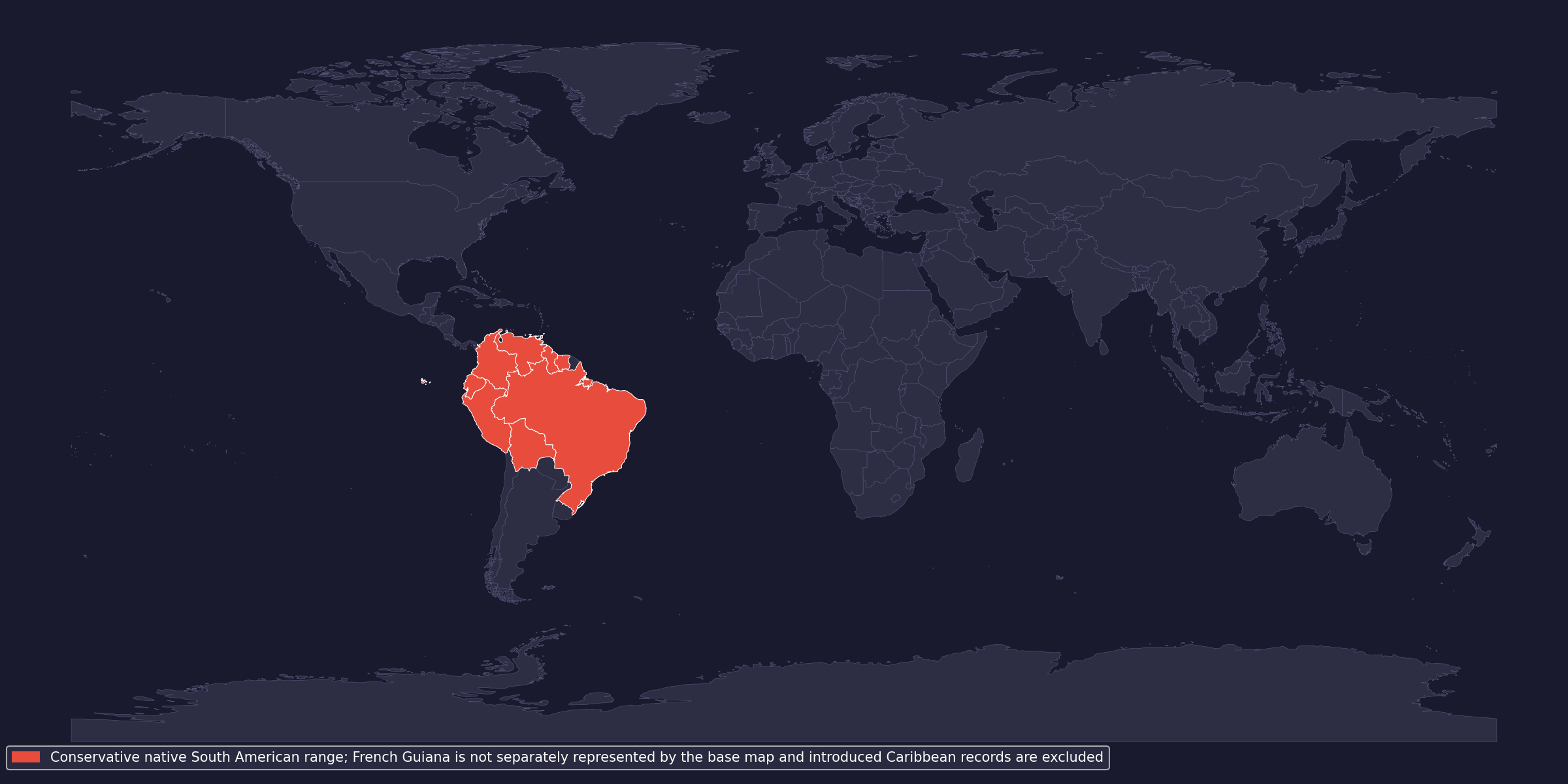
The native range covers much of tropical South America east of the Andes, including the Amazon and Guiana regions of Brazil, Bolivia, Peru, Ecuador, Colombia, Venezuela, Guyana, Suriname, and French Guiana, with a native population on Trinidad. Introduced island reports should not be treated as part of the ecological core range.
This is a tortoise of lowland rainforest, humid woodland, forest margins, leaf litter, and seasonally flooded ground. Shade, warm rain, deep litter, fungi, fallen plant material, and access to water shape its daily choices. Captive humidity must be paired with ventilation and drainage rather than produced by stagnant, saturated bedding.
🌡 Climate across the native range
Monthly climate normals from reviewed GBIF occurrence locations representing equatorial and southern Amazonian forest:
Cayenne region — French Guiana (equatorial Guiana forest)
| Month | Min °C | Mean °C | Max °C | RH % |
|---|---|---|---|---|
| January | 22.6 | 24.7 | 28 | 88 |
| February | 22.7 | 24.8 | 28 | 87 |
| March | 22.9 | 25.2 | 28.6 | 85 |
| April | 23.1 | 25.3 | 28.8 | 87 |
| May | 23 | 25.1 | 28.6 | 91 |
| June | 22.6 | 24.9 | 28.6 | 91 |
| July | 22.3 | 25.1 | 29.2 | 89 |
| August | 22.6 | 25.8 | 30.2 | 86 |
| September | 23 | 26.6 | 31.4 | 82 |
| October | 23.3 | 26.8 | 31.8 | 81 |
| November | 23.2 | 26.1 | 30.4 | 85 |
| December | 22.9 | 25.1 | 28.7 | 89 |
Madre de Dios — Peru (southwestern Amazon forest)
| Month | Min °C | Mean °C | Max °C | RH % |
|---|---|---|---|---|
| January | 23.1 | 25.5 | 29.5 | 89 |
| February | 22.9 | 25.3 | 29.1 | 90 |
| March | 22.9 | 25.4 | 29.3 | 89 |
| April | 22.3 | 25.1 | 29 | 88 |
| May | 21.1 | 24 | 28 | 86 |
| June | 20.4 | 23.6 | 27.8 | 84 |
| July | 19.7 | 23.5 | 28.5 | 80 |
| August | 20.8 | 25 | 30.6 | 74 |
| September | 22 | 25.8 | 31.3 | 78 |
| October | 22.8 | 25.9 | 30.6 | 85 |
| November | 22.8 | 25.5 | 29.6 | 87 |
| December | 23.1 | 25.6 | 29.6 | 89 |
Cochabamba — Bolivia (southern forest margin)
| Month | Min °C | Mean °C | Max °C | RH % |
|---|---|---|---|---|
| January | 21.5 | 24.4 | 28.2 | 90 |
| February | 21.4 | 24.1 | 27.8 | 90 |
| March | 21.1 | 24.1 | 27.8 | 89 |
| April | 20.1 | 23.1 | 26.8 | 88 |
| May | 18 | 21 | 24.6 | 89 |
| June | 16.8 | 20 | 23.7 | 90 |
| July | 15.9 | 19.4 | 23.6 | 88 |
| August | 16.7 | 20.9 | 25.7 | 85 |
| September | 18.3 | 22.5 | 27.4 | 84 |
| October | 20.1 | 23.8 | 28.1 | 86 |
| November | 20.8 | 24.1 | 28.1 | 87 |
| December | 21.4 | 24.3 | 28 | 90 |
Weather data by Open-Meteo.com · CC BY 4.0 · Monthly normals calculated by Herpeton Academy from daily archive values.
Location references use GBIF.org occurrence data where available; original occurrence records retain their source dataset licenses.
⚖️ Legal status
Chelonoidis denticulatus is listed in CITES Appendix II and EU Annex B. International movement requires the relevant CITES permits, and national rules can add import, registration, sale, breeding, or transport conditions. Keep the original invoice, breeder and parentage details where available, import or transfer papers, and dated photographs.
Wild collection and export are additionally controlled in range states. A seller’s statement that an animal is “farm bred” is not a substitute for traceable legal origin. Prefer verifiable captive-bred animals and do not support replacement of wild forest populations. The Bern Convention is not relevant because the species is not native to Europe.
🤌 Husbandry
One adult needs at least about 6 m² of usable indoor floor space; 8-12 m² is more appropriate for permanent accommodation. In a suitable warm climate, a secure planted outdoor pen can provide valuable space, but the animal still needs a heated humid house and must come inside before nights become cool.
House singly unless an exceptionally large, structured group enclosure permits separation. Males fight, and courtship can exhaust females. Walls must be opaque at shell height, secure, and strong enough for a heavy tortoise. Provide shade, a warmer open patch, deep litter, multiple hides, and a water basin that supports the whole animal but permits an easy exit.
Quarantine every arrival in a simple separate room or pen with separate tools. Record weight, appetite, feces, hydration, eyes, nose, gait, and shell. Imported or uncertain-origin forest tortoises have meaningful dehydration and parasite risks, so reptile-veterinary examination and fecal testing are prudent before naturalistic housing or contact with other reptiles.
💡 Lighting
Indoor animals need bright daytime light and measured UVB, despite their shaded natural habitat. Aim for Ferguson Zone 2 exposure, roughly UVI 1-2 at shell height in the lit warm zone, with dense shade near zero. A moderate T5 HO UVB tube and separate broad halogen basking lamp allow better control than a small intense spot.
Run lighting for 11-13 hours. Replace lamps according to measured output or manufacturer guidance. Outdoor direct sun is useful only when temperature, shade, escape prevention, and predator protection are safe; glass and plastic block useful UVB.
🌡 Heating and temperature
Maintain a stable forest gradient:
- General daytime air: 25-28°C
- Broad basking patch: 30-32°C
- Shaded retreat: 23-25°C
- Night: 22-24°C
Avoid hot narrow beams that scorch the top of the shell while the body stays cool. Use several low-wattage lamps over a broad area for a large adult, all thermostatically and physically protected. Chronic temperatures below 22°C, especially with wet substrate, raise respiratory and digestive risk. This tropical species does not hibernate.
💧 Humidity and water
Target roughly 75-90% relative humidity, with higher readings inside humid retreats and natural daily variation. The substrate should remain cool and slightly moist below the surface while leaf litter and some walking routes can dry between misting. Cross-ventilation and drainage are essential.
Provide a shallow basin large enough for soaking at all times and refresh it whenever soiled. Juveniles dehydrate faster and need particularly stable humidity, shallow safe water, and close weight monitoring. Do not rely on forced soaking to compensate for a dry enclosure.
🌿 Enclosure and decoration
Use 15-25 cm of pesticide-free topsoil mixed with cypress mulch, fine orchid bark, and leaf mold or similar materials that hold moisture without collapsing into mud. Add deep leaf litter, cork or wooden shelters, tough edible plants, and visual barriers. Avoid aromatic cedar or pine shavings, pure sand, gravel, artificial turf, smooth tile, and permanently waterlogged coir.
Females need a quiet nesting zone at least 25-30 cm deep, warm, and slightly moist enough to hold a scrape. All lamps, heaters, drains, and electrical connections must be protected from water and the animal’s weight.
🥬 Feeding
Yellow-footed tortoises are forest omnivores, not grass specialists. Base the diet on varied broad leaves and weeds such as dandelion, plantain, sow thistle, mallow, mulberry, grape vine, hibiscus leaves and flowers, endive, escarole, and other safe high-calcium greens. Add cultivated mushrooms and seasonal flowers for useful variety.
Fruit can form a controlled minority of the ration: papaya, mango, berries, melon, fig, and prickly pear are preferable to repeated banana. Offer suitable invertebrate protein such as earthworms or cultured snails occasionally—roughly every one to two weeks for an adult—rather than feeding meat, dog food, or cat food. Wild slugs and snails may carry parasites or pesticides.
Feed juveniles daily and adults daily or every other day according to body condition, leaving fibrous browse rather than a permanently full bowl of sweet food. Keep cuttlebone available and use plain calcium lightly on foods with a poor calcium balance. With measured UVB, routine heavy D3 dosing is unnecessary; use multivitamins conservatively according to the product and veterinary plan.
🥚 Breeding
Males generally have a longer, thicker tail and a more concave plastron; sexing juveniles is unreliable. Adults can be forceful during courtship, so pairing requires close observation and immediate separation if the female cannot retreat.
Clutches commonly contain 4-5 eggs but may be larger. A documented captive range is about 28-30°C for roughly 140-160 days, with high but aerated substrate moisture. Incubation values vary, and eggs must not be rotated after development begins. Because each offspring carries CITES documentation obligations, prepare legal records, separate rearing space, and responsible placements before breeding.
🩺 Common problems
- Nasal discharge, wheezing, open-mouth breathing, or persistent lethargy: chilling, stale damp air, or respiratory disease
- Soft shell, weak limbs, or abnormal shell growth: inadequate UVB/calcium, rapid growth, or dietary imbalance
- Swollen eyes, dry skin, or concentrated urates: dehydration or systemic disease
- Loose stool and weight loss: fruit-heavy diet, parasites, or other gastrointestinal disease
- Shell or skin sores: dirty saturated substrate, abrasion, burns, or infection
- Persistent digging or straining in a female: possible egg retention
Do not treat respiratory disease or parasites with pet-shop remedies. Correct obvious environmental errors and arrange prompt examination by an experienced reptile veterinarian.
📌 Conclusion
The yellow-footed tortoise is appropriate for an experienced keeper with a room-sized humid enclosure and long-term access to varied forest foods. If adult space, warm nights, drainage, and legal origin are not already solved, choose a smaller and better-documented species.
📚 Sources and further reading
- ReptiFiles tortoise and turtle care library and red-footed tortoise guide (comparative check; no species-specific yellow-footed guide was available when checked)
- The Reptile Database: Chelonoidis denticulatus and GBIF taxon 5220281
- Tortoise Trust, yellow-footed tortoise husbandry and breeding and feeding red- and yellow-footed tortoises
- Baines et al. 2016, UVB provision for captive reptiles
- CITES Appendices and EU Regulation 2026/1383, checked 2026-08-30