Share

Xenesthis intermedia
🔤 Taxonomy
Xenesthis intermedia Schiapelli & Gerschman, 1945 is the accepted World Spider Catalog name. It was originally published with the masculine ending Xenesthis intermedius; the 2023 revision used X. intermedia, designated a neotype because the holotype is lost, redescribed the female and described the male for the first time.
Amazon blue bloom is the common English trade name. The label is imprecise: current taxonomic evidence restricts the species to western Venezuela, not a generalized Amazon-wide distribution. Preserve breeder and locality information because Xenesthis species are large, similar and frequently mislabeled in commerce.
📌 Description
This is a very large New World terrestrial and opportunistic burrower. Adults can reach about 18-23 cm diagonal legspan. Females may live 15-20 years; mature males are leggier and much shorter-lived. Dark coloration, pink-violet bloom and pale leg striping change with lighting and molt stage.
Size, speed, a forceful feeding response, moisture-sensitive care and abundant urticating hairs make it an advanced display species. It is not an “aggressive” animal seeking conflict, but a startled individual can turn or bolt far faster than its mass suggests.
| Care point | Practical target |
|---|---|
| Adult legspan | about 18-23 cm |
| Adult enclosure | at least about 45 x 35 x 30 cm |
| Substrate | 15-20 cm, compact and moisture-retentive |
| Day temperature | 22-27°C |
| Moisture | damp lower layers, partly drying surface, strong cross-flow |
| Adult feeding | one substantial invertebrate meal every 10-21 days |
| Handling | none; large catch cup and long tools required |
☠️ Venom
There is no good clinical evidence that X. intermedia venom is medically significant, but its venom is poorly characterized. The large fangs can make deep wounds with pain, swelling and infection risk. Individual reactions are unpredictable.
Urticating hairs are the more common hazard and can be severe in eyes or airways. Do not handle the spider. Keep its enclosure below face level; use gloves and eye protection when removing dry webbed substrate or a molt. After a bite or hair exposure, seek urgent medical help for eye involvement, breathing trouble, faintness, severe or spreading pain, facial swelling or systemic symptoms. Do not use a tourniquet, cut the wound or attempt extraction.
🌍 Distribution
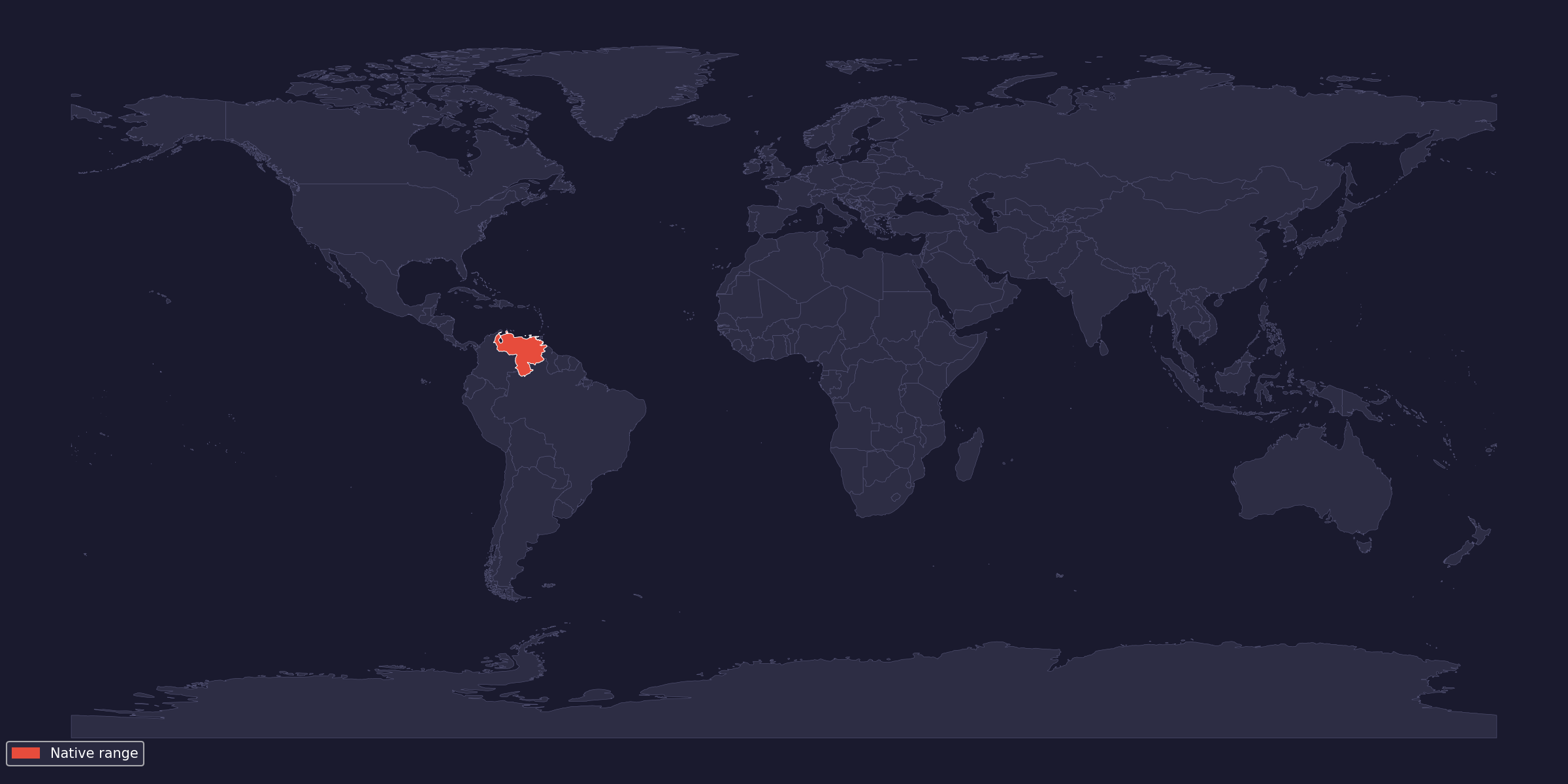
World Spider Catalog and the 2023 genus revision give Venezuela. The lost holotype came from La Unión in the former Department of Escuque, Trujillo; the designated male neotype came from Mérida. These western Andean localities are stronger evidence than recent crowd-sourced records labeled from Colombia, which conflict with the reviewed taxonomic range.
The known localities are humid but elevated and topographically varied. A wild spider regulates itself inside a soil refuge. Provide moisture in depth, clean air and a thermal gradient rather than running the entire enclosure hot and wet.
🌡 Climate across the native range
Monthly normals from the published type and neotype localities in western Venezuela:
La Unión, Trujillo — Venezuela (type locality)
| Month | Min °C | Mean °C | Max °C | RH % |
|---|---|---|---|---|
| January | 14.5 | 18 | 21.7 | 84 |
| February | 14.9 | 18.4 | 22.2 | 84 |
| March | 15.7 | 18.9 | 22.4 | 85 |
| April | 16.3 | 19.2 | 22.5 | 87 |
| May | 16.5 | 19.4 | 22.6 | 87 |
| June | 16.2 | 19.3 | 22.8 | 85 |
| July | 15.8 | 19.2 | 22.7 | 83 |
| August | 16 | 19.5 | 23.1 | 82 |
| September | 16 | 19.4 | 23 | 83 |
| October | 15.9 | 19 | 22.4 | 86 |
| November | 15.7 | 18.6 | 21.7 | 88 |
| December | 14.8 | 18.1 | 21.6 | 86 |
Mérida — Venezuela (neotype locality)
| Month | Min °C | Mean °C | Max °C | RH % |
|---|---|---|---|---|
| January | 16.4 | 19.8 | 24 | 82 |
| February | 16.8 | 20.1 | 24.3 | 82 |
| March | 17.3 | 20.5 | 24.6 | 84 |
| April | 17.7 | 20.9 | 24.8 | 87 |
| May | 17.8 | 21 | 25.1 | 87 |
| June | 17.2 | 20.6 | 24.8 | 86 |
| July | 16.8 | 20.3 | 24.6 | 85 |
| August | 17.1 | 20.7 | 25 | 85 |
| September | 17.4 | 21 | 25.3 | 84 |
| October | 17.4 | 20.8 | 25 | 85 |
| November | 17.2 | 20.4 | 24.4 | 87 |
| December | 16.6 | 20 | 24.1 | 85 |
Weather data by Open-Meteo.com · CC BY 4.0 · Monthly normals calculated by Herpeton Academy from daily archive values.
⚖️ Legal status
No Xenesthis listing was found in the current CITES Appendices or EU wildlife-trade annexes checked on 6 August 2026. The Bern Convention is not relevant. Non-listing does not certify that a specimen was legally collected or exported, and it does not override national dangerous-animal rules.
Choose established captive-bred stock and retain the invoice, breeder identity, scientific name, transaction date and import trail. “South America” or “Amazon” is not adequate origin documentation for this range-restricted identity. Check local law on venomous invertebrates, transport, sale and breeding before purchase.
🤌 Husbandry
House the spider alone. Slings grow quickly when warm and fed, but should begin in secure containers sized so water, prey and molts can be monitored. Provide several centimeters of slightly moist substrate and a starter hide from the beginning; increase depth and floor area with each rehouse.
Quarantine every arrival for at least 90 days in a separate room when possible. Use dedicated tools and record feeding, abdomen condition, molts, webbing and suspected mites. Some animals in trade may be imports or mislabeled congeners. Avoid pesticide or mite chemicals; unexplained decline, fluid loss or serious injury calls for an exotics veterinarian.
Plan rehousing as a containment operation. Work in a large empty tub or closed room, block escape gaps and prepare an oversized catch cup before touching the enclosure. Control the route with barriers and gentle guidance. Never grip a leg, pin the carapace or attempt free handling.
Published captive reproduction data for this species remain thin. The structured clutch and incubation ranges are conservative comparisons with experienced Xenesthis husbandry, not established species-specific limits; breeding belongs with keepers able to document every stage and protect both adults.
💡 Lighting
No UVB or basking lamp is needed. A subdued 10-12-hour day-night cycle is sufficient. Keep the retreat shaded, and prevent sunlight from striking glass or acrylic. Plant lights are optional and must not heat the substrate or dry its upper layers faster than the gradient can be maintained.
🌡 Heating and temperature
Maintain about 22-27°C by day and 20-23°C at night. Avoid persistent temperatures above 28°C. A large humid spider can still dehydrate or overheat rapidly when ventilation is poor.
Warm the room when possible. If an external heat source is unavoidable, use low wattage on one side with a thermostat and a probe at substrate level. Never heat from below; that removes the cool moist retreat the animal would seek. Do not translate outdoor monthly maxima directly into enclosure targets.
💧 Humidity and water
Keep a broad shallow water dish full. Maintain the lower substrate evenly damp—not saturated—while letting the immediate surface partly dry between waterings. Add water down one side or lightly overflow the dish so the spider can choose between zones. Slings require closer monitoring because they lose water quickly.
The target is moist structure plus fresh air, not constant condensation. Stale smell, heavy condensation, mushrooms or exploding mite numbers mean too much water and too little ventilation. A dry crumbling retreat, shrunken abdomen or prolonged water-dish posture signals inadequate hydration.
🌿 Enclosure and decoration
An adult needs at least about 45 x 35 x 30 cm, with 15-20 cm of compact topsoil/coco fiber mix. A little clay can improve tunnel strength. Provide a large cork-bark hide set low, leaf litter, anchor points and the water dish. Secure heavy decor directly so digging cannot undermine it.
Limit the gap above the substrate; a fall can rupture the abdomen of this heavy species. Use robust latches, ventilation on opposing sides and holes smaller than the carapace. Avoid mesh lids, sharp rock, loose gravel and waterlogged moss beds. Position the dish where it can be serviced without reaching over the hide.
Premolt brings fasting, darkening, heavy webbing or retreat closure. Remove all live prey and leave the animal undisturbed. Large adults may fast for weeks or months. Wait until the fangs are black and the body is hard—often 10-14 days for a large adult—before feeding.
🪳 Feeding
Offer captive-reared roaches, locusts or crickets. One substantial item is preferable to a pile of insects. Feed slings every 4-7 days, juveniles every 7-10 days and adults about every 10-21 days. Adjust using abdomen width, growth, temperature and premolt signs.
The feeding response can be explosive. Drop prey with long forceps and close the lid rather than waving food near the spider. Remove survivors within 24 hours and immediately during premolt. Worms must not be allowed to burrow unnoticed. Supplements are unnecessary for a whole-prey predator.
🩺 Common problems
- Urticating hairs: airborne exposure rises during dry clean-outs. Use eye protection, dampen dust lightly and keep the work below face level.
- Fall trauma: large Xenesthis can rupture the abdomen; minimize height and hard surfaces.
- Stagnant enclosure: warmth, saturated substrate and weak ventilation promote mold, mites and respiratory stress.
- Desiccation: completely dry substrate is unsuitable; retain damp lower layers and permanent water.
- Overfeeding: a very large abdomen adds rupture risk and does not improve growth safely.
- Molt interruption: remove prey and never open a sealed retreat or flip a molting spider.
- Misidentification: retain molt photos and origin records; do not breed animals sold only under broad “blue bloom” labels.
📌 Conclusion
Xenesthis intermedia is best for an advanced keeper able to control a large fast spider while maintaining deep humid substrate with strong ventilation. Prepare the full adult enclosure, oversized catch cup, eye protection and quarantine space before purchase. Most preventable failures come from shallow housing, stagnant wet conditions, overfeeding and casual maintenance around urticating hairs.
📚 Sources and further reading
- World Spider Catalog — Xenesthis intermedia
- Sherwood et al. 2023 — revision of Xenesthis
- GBIF — Xenesthis intermedia taxonomy
- The Tarantula Collective — Xenesthis intermedia care
- CITES — current Appendices
- European Commission — EU wildlife trade rules
- EUR-Lex — Commission Regulation (EU) 2026/1383, current wildlife-trade annexes