Share

Tapinauchenius plumipes
🔤 Taxonomy
Tapinauchenius plumipes is the current GBIF-backed name for the South American arboreal tarantula long sold under several orange-tree-spider labels. The animal requested in the todo list as Tapinauchenius gigas belongs here because both GBIF and the World Spider Catalog treat T. gigas as a synonym of T. plumipes.
Important older names and trade labels:
- Mygale plumipes
- Tapinauchenius gigas
- Pseudoclamoris gigas
- Tapinauchenius violaceus
- Tapinauchenius purpureus
English common names used in the hobby:
- Orange tree spider
- Trinidad mahogany tarantula
This name has been messy in the hobby. Some animals historically sold as “orange tree spider” or T. gigas were later discussed under other South American arboreal genera, especially after the 2022 revision of Tapinauchenius, Psalmopoeus, and Amazonius. Use the accepted Latin name, seller records, and locality information when breeding or transferring animals.
📌 Description
Tapinauchenius plumipes is a fast arboreal New World tarantula from the Guiana Shield and nearby Amazonian forest. It is a display species for keepers who like quick tree spiders, heavy webbing, and a compact but active enclosure layout.
Adults are usually around 12-14 cm legspan. Females can live well over a decade under good care, while mature males live much shorter lives. The spider is lighter, faster, and more nervous than many beginner terrestrial species.
Although it is a New World tarantula, it should not be treated like a calm handling species. Tapinauchenius lacks the practical “margin for error” that slower ground species give during maintenance. The main risks are speed, escape, dehydration in overly dry setups, and stress from repeatedly destroying the webbed retreat.
☠️ Venom
This species is venomous. Venom exposure can cause pain, swelling or other systemic effects, and severity varies with species, locality, bite site and the amount delivered. A small wound or apparently dry bite is not proof of safety; every bite or sting requires urgent medical assessment.
If an incident occurs, move away, call emergency services or a poison centre, keep the patient still, remove rings and other constricting items, and follow dispatcher instructions. Do not use a tourniquet, cut or suck the wound, apply ice or electricity, give alcohol or medicines as a home treatment, or attempt to catch the animal. Antivenom choice and dosing are hospital decisions; verify the relevant product and local availability in advance. Sources: WHO snakebite guidance and appropriate species-specific toxinology or medical references listed below.
🌍 Distribution
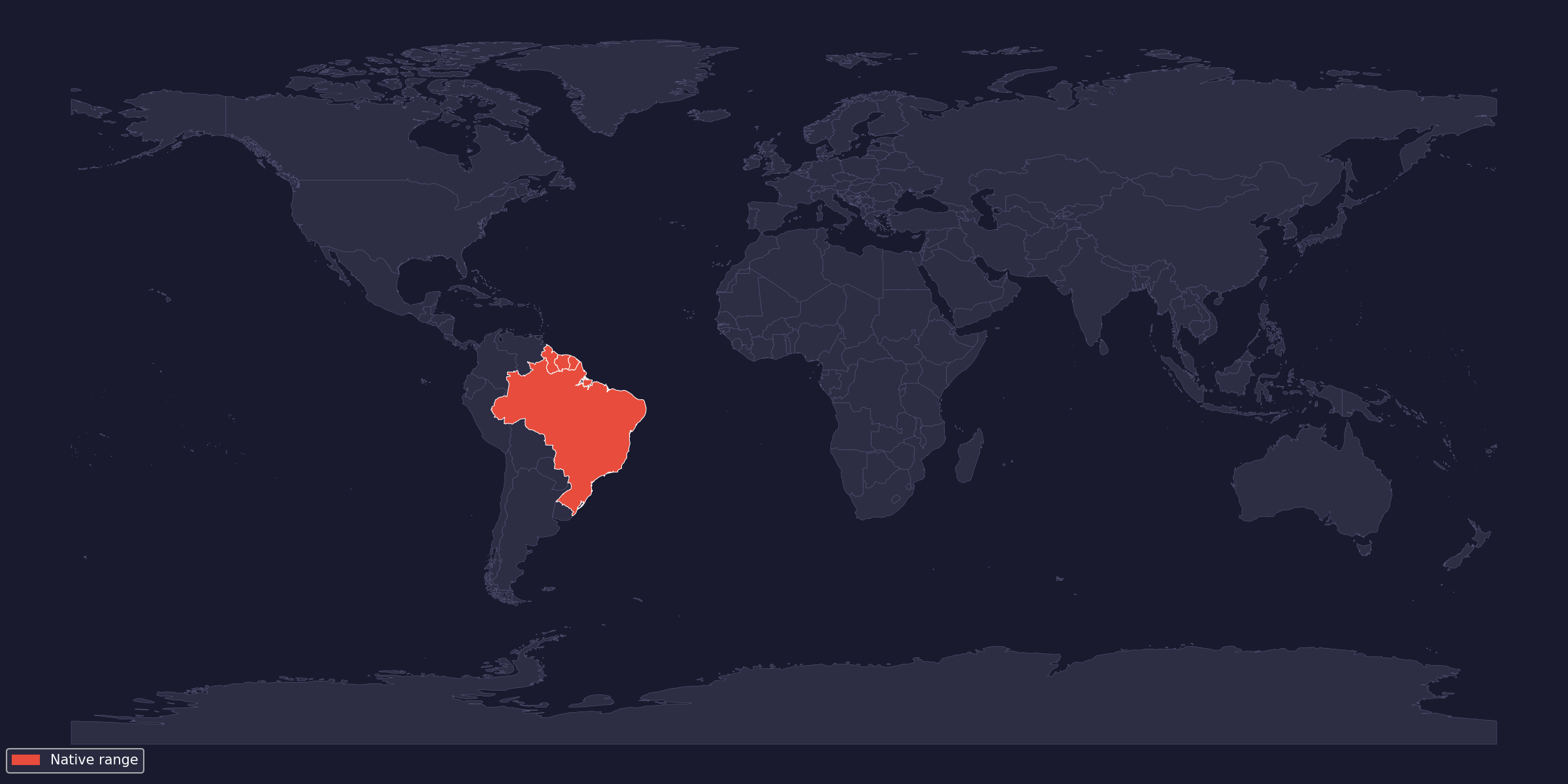
Tapinauchenius plumipes is associated with Guyana, Suriname, French Guiana, and Brazil. In the wild it uses warm forest structure: bark, cavities, vegetation, and protected elevated spaces rather than open ground.
A useful captive setup should provide:
- vertical usable space
- cork bark or a tall retreat
- web anchor points
- fresh water
- moderate humidity with strong airflow
- doors and vents that block sudden bolting
Do not make the enclosure a sealed wet box. The species benefits from moisture support, but stale air and soaked webbing are different from a humid forest retreat.
🌡 Climate across the native range
Monthly climate normals from reviewed GBIF occurrence locations:
Cayenne — French Guiana
| Month | Min °C | Mean °C | Max °C | RH % |
|---|---|---|---|---|
| January | 21.7 | 24.9 | 28 | 88 |
| February | 21.8 | 25 | 28.1 | 86 |
| March | 22.2 | 25.4 | 28.6 | 85 |
| April | 22.5 | 25.7 | 29 | 86 |
| May | 22.2 | 25.6 | 28.9 | 88 |
| June | 21.6 | 25.3 | 29 | 88 |
| July | 21.1 | 25.4 | 29.7 | 86 |
| August | 21.3 | 25.9 | 30.6 | 83 |
| September | 21.2 | 26.2 | 31.3 | 81 |
| October | 21 | 26.2 | 31.3 | 81 |
| November | 21.2 | 25.9 | 30.5 | 83 |
| December | 21.5 | 25.2 | 28.9 | 87 |
Sipaliwini — Suriname
| Month | Min °C | Mean °C | Max °C | RH % |
|---|---|---|---|---|
| January | 20.7 | 24.8 | 28.8 | 86 |
| February | 20.7 | 24.8 | 28.9 | 85 |
| March | 20.8 | 25.1 | 29.3 | 84 |
| April | 21.2 | 25.4 | 29.5 | 85 |
| May | 21.3 | 25.4 | 29.5 | 86 |
| June | 20.8 | 25.2 | 29.6 | 86 |
| July | 20.4 | 25.2 | 30 | 83 |
| August | 20.5 | 25.7 | 30.9 | 81 |
| September | 20.3 | 26 | 31.7 | 79 |
| October | 20.4 | 26.2 | 32 | 77 |
| November | 20.7 | 26.1 | 31.5 | 78 |
| December | 20.8 | 25.4 | 29.9 | 83 |
Commewijne — Suriname
| Month | Min °C | Mean °C | Max °C | RH % |
|---|---|---|---|---|
| January | 22.7 | 26.1 | 29.5 | 81 |
| February | 22.6 | 26.2 | 29.7 | 79 |
| March | 23 | 26.5 | 30 | 78 |
| April | 23.3 | 26.8 | 30.2 | 80 |
| May | 23.4 | 26.8 | 30.1 | 82 |
| June | 23 | 26.6 | 30.2 | 83 |
| July | 22.8 | 26.8 | 30.7 | 80 |
| August | 23.1 | 27.3 | 31.6 | 77 |
| September | 23.3 | 27.9 | 32.5 | 74 |
| October | 23.2 | 27.9 | 32.5 | 75 |
| November | 23.2 | 27.4 | 31.6 | 77 |
| December | 22.8 | 26.5 | 30.2 | 81 |
Weather data by WorldClim v2.1 · Monthly normals queried by Herpeton Academy from raster values; relative humidity is derived from vapor pressure and mean temperature.
Location references use GBIF.org occurrence data where available; original occurrence records retain their source dataset licenses.
⚖️ Legal status
No current CITES listing was found for Tapinauchenius plumipes or its synonym Tapinauchenius gigas in the official CITES sources checked on 2026-06-02. No specific listing for the species was found in Annexes A-D of the EU wildlife trade regulations.
The species is not relevant to the Bern Convention because it is not native to Europe. Local rules on import, sale, transport, exhibition, breeding, and proof of legal origin may still apply.
Keep invoices and origin notes. For this species, records are especially useful because old trade labels may not match current taxonomy.
🤌 Husbandry
Keep Tapinauchenius plumipes alone in a secure arboreal enclosure.
Spiderlings are small and quick, so start them in small arboreal containers with cross-ventilation, a tiny cork or bark anchor, a little substrate moisture, and a feeding opening that does not give them a straight path out. Adults can use a 30 x 30 x 45 cm enclosure or similar, provided the height is filled with usable structure rather than empty air.
Adult setup priorities:
- vertical cork bark tube or slab
- branches or foliage for web support
- water dish
- side and top ventilation
- a maintenance route that avoids destroying the main retreat
- catch cup and long tools ready before opening
This is not a species for frequent rehousing. Prepare the final arboreal layout before the animal outgrows the juvenile setup, and move it with a deliberate catch-cup plan.
💡 Lighting
Normal room lighting is enough. UVB is not required, and strong basking lamps are unnecessary.
Display lighting should be indirect and gentle. A bright lamp over a tall arboreal setup can dry the upper webbed retreat quickly and may push the spider into hiding.
🌡 Heating and temperature
Aim for warm, stable room temperatures:
- Daytime: about 23-27°C
- Night: about 20-23°C
If the room is too cool, warm the room or one side of the enclosure with a controlled method. Avoid under-tank heat, because this species spends much of its time above ground and because heat from below can dry the water-buffering lower substrate.
Hot stagnant air is more dangerous than a mild night drop.
💧 Humidity and water
Provide fresh water at all times. For juveniles and adults, a small water dish is more reliable than misting alone.
The enclosure should stay moderately humid but breathable. Lightly moisten part of the substrate or overflow the water dish occasionally, then allow surfaces to dry. The webbed retreat should not stay wet.
Practical signs of a better balance:
- the spider has a stable elevated retreat
- the abdomen is not shrinking from dehydration
- there is no moldy smell or condensation film
- webbing remains usable and dry enough
- the water dish is serviced without flooding the enclosure
🌿 Enclosure and decoration
Use cork bark, branches, and foliage to create a vertical escape route inside the enclosure, not outside it. The spider should be able to retreat behind bark immediately after disturbance.
Substrate depth can be modest, but it still helps buffer humidity and cushions falls. Avoid wide mesh that can catch tarsi, heavy loose decor, and door gaps large enough for a thin fast spider to exploit.
For a display build, place most visual cover high and toward the back or side. This lets the spider settle in a predictable zone and makes feeding and water maintenance safer.
🪳 Feeding
Tapinauchenius plumipes is insectivorous. Suitable prey includes:
- crickets
- roaches
- locusts where available
- occasional mealworms or soft larvae in moderation
Spiderlings can be fed small prey every few days. Juveniles usually do well once or twice weekly. Adults usually take appropriately sized prey every 7-14 days, adjusted to abdomen condition and molt cycle.
Offer prey near the webbed retreat when possible. Remove uneaten prey, especially before molt. Do not use wild-caught insects or vertebrate prey.
🩺 Common problems
Common problems include escape during maintenance, dehydration in overly dry enclosures, stagnant wet air, fall injuries, stuck molts, and stress from repeated web destruction.
Warning signs include weak grip, a shrinking abdomen, unusual floor sitting, excessive frantic movement after every opening, failed molts, and hiding in a corner with no stable retreat.
If the spider is unsettled, check enclosure security and retreat quality before changing temperature or humidity. Many problems come from a layout that looks attractive but gives the animal no private, usable tube.
📌 Conclusion
Tapinauchenius plumipes suits experienced keepers who want a fast New World arboreal display tarantula and are comfortable with careful maintenance. Buy it under the accepted name where possible, keep old T. gigas labels in your records, and prepare the enclosure before the spider has a chance to turn a routine water change into a chase.
📚 Sources and further reading
- World Spider Catalog: Tapinauchenius genus catalog
- GBIF species backbone: Tapinauchenius plumipes
- Cifuentes & Bertani, 2022, taxonomic revision of Tapinauchenius, Psalmopoeus, and Amazonius
- Northwest Zoological Supply: Arboreal Tarantula Care
- CITES Appendices, checked 2026-06-02
- EU wildlife trade regulations overview, checked 2026-06-02