Share

Pterinochilus murinus
🔤 Taxonomy
Pterinochilus murinus is the currently accepted scientific name. GBIF lists the original Pocock 1897 name and several synonyms that still appear in older care sheets, import labels, and image captions.
Older names associated with the species include:
- Pterinochilus hindei Hirst, 1907
- Pterinochilus leetzi Schmidt, 2002
- Pterinochilus mamillatus Strand, 1906
English common names used in the hobby:
- Orange baboon tarantula
- Usambara orange baboon tarantula
- Mombasa golden starburst tarantula
- OBT
The species is sold in orange, brown, gray, and locality-labeled forms. Keep those labels in records, but do not assume that color form alone proves locality or taxonomic identity.
📌 Description
Pterinochilus murinus is a fast, defensive Old World tarantula from eastern, central, and southern Africa, known for its heavy webbing and variable orange, brown, or gray coloration. It is one of the most recognizable African hobby species and is often called simply OBT.
Adult size is usually about 4-6 cm body length and about 11-13 cm legspan, with females typically heavier than mature males.
This is not a beginner handling species. It does not have urticating hairs like New World tarantulas, but it is fast, defensive, and capable of strong threat displays and bites if cornered. The safest care style is to never put hands into the enclosure while the spider has access to them.
☠️ Venom
Pterinochilus murinus should be treated as a medically significant tarantula. A bite can cause intense local pain, swelling and, in some cases, wider symptoms such as muscle pain, cramping, nausea, dizziness or prolonged discomfort.
Routine pet care does not use a species-specific antivenom for these bites. Avoid handling, work the enclosure so contact is unlikely, and seek medical advice after a serious bite, allergic reaction, breathing difficulty, spreading symptoms, or any bite involving a child or vulnerable person.
🌍 Distribution
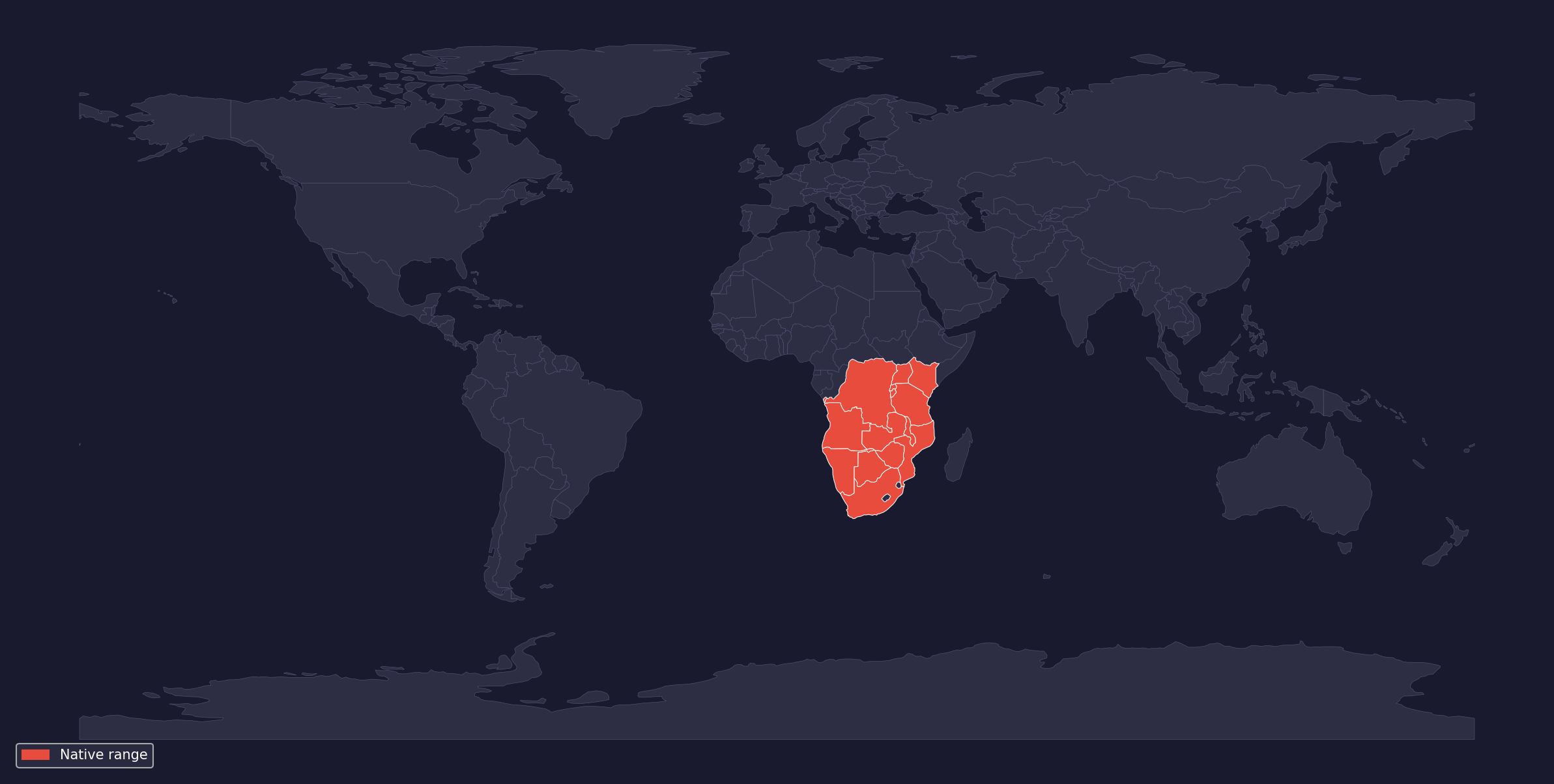
Pterinochilus murinus is native to eastern, central and southern Africa. Records and hobby forms are associated with countries including Kenya, Tanzania, Democratic Republic of the Congo, Angola, Zambia, Mozambique, Zimbabwe, and South Africa. In the wild it is associated with dry to seasonally dry savanna, scrub and woodland edges with retreats and many web anchor points.
For keepers, the useful habitat cues are:
- a low terrestrial enclosure with more floor space than height
- enough substrate for digging or reshaping a retreat
- dry to moderately dry surface conditions with a water dish available
- strong ventilation and stable warm room temperatures
- fall prevention, because heavy terrestrial tarantulas are easily injured
Captive care should emphasize shelter and web structure rather than bare dryness. Even dry-country Old World tarantulas use buffered retreats, so a small moisture choice and fresh water still matter.
🌡 Climate across the native range
Monthly climate normals from reviewed GBIF occurrence locations:
Machinga — Malawi
| Month | Min °C | Mean °C | Max °C | RH % |
|---|---|---|---|---|
| January | 21.8 | 24.7 | 28.6 | 85 |
| February | 21.5 | 24.6 | 28.6 | 84 |
| March | 21.1 | 24.4 | 28.6 | 82 |
| April | 19.2 | 23.3 | 27.9 | 77 |
| May | 17.1 | 21.9 | 27.2 | 70 |
| June | 15.2 | 20.2 | 25.6 | 68 |
| July | 14.4 | 19.6 | 25.2 | 66 |
| August | 15.4 | 21.6 | 27.7 | 60 |
| September | 17.8 | 24.5 | 30.9 | 52 |
| October | 20.5 | 26.8 | 32.8 | 52 |
| November | 22.2 | 27.5 | 33 | 59 |
| December | 22 | 25.7 | 30.2 | 78 |
Kilifi — Kenya
| Month | Min °C | Mean °C | Max °C | RH % |
|---|---|---|---|---|
| January | 24.7 | 27 | 30.3 | 77 |
| February | 24.7 | 27.2 | 30.7 | 76 |
| March | 25.2 | 27.7 | 30.9 | 77 |
| April | 25 | 27 | 29.5 | 81 |
| May | 24.3 | 25.8 | 27.8 | 82 |
| June | 23.7 | 25.1 | 26.9 | 78 |
| July | 22.9 | 24.4 | 26.3 | 77 |
| August | 22.7 | 24.3 | 26.5 | 78 |
| September | 23 | 24.8 | 27.2 | 78 |
| October | 23.6 | 25.6 | 28.1 | 79 |
| November | 24.1 | 26.4 | 29 | 81 |
| December | 24.7 | 27 | 30 | 79 |
Central — Zambia
| Month | Min °C | Mean °C | Max °C | RH % |
|---|---|---|---|---|
| January | 17.6 | 20.9 | 25.2 | 84 |
| February | 17.4 | 20.9 | 25.3 | 84 |
| March | 17.2 | 20.8 | 25.4 | 82 |
| April | 15.5 | 19.9 | 25.1 | 73 |
| May | 13.2 | 18.6 | 24.7 | 63 |
| June | 11 | 16.7 | 23.2 | 60 |
| July | 10.5 | 16.3 | 22.9 | 57 |
| August | 12.7 | 19.1 | 26 | 48 |
| September | 15.9 | 22.6 | 29.5 | 39 |
| October | 18.4 | 24.6 | 31 | 41 |
| November | 18.8 | 23.8 | 29.4 | 59 |
| December | 17.9 | 21.5 | 26.1 | 80 |
Weather data by Open-Meteo.com · CC BY 4.0 · Monthly normals calculated by Herpeton Academy from daily archive values.
Location references use GBIF.org occurrence data where available; original occurrence records retain their source dataset licenses.
⚖️ Legal status
Pterinochilus murinus is not currently listed in the CITES Appendices. No specific current listing for this species was found in Annexes A-D of the EU wildlife trade regulations during the May 2026 check.
The species is not relevant to the Bern Convention because it is not native to Europe. Local rules on import, sale, transport, exhibition, and breeding may still apply, so proof of legal origin is advisable.
Because locality and color-form labels are common in trade, keep seller records and avoid mixing unclear lines in breeding projects.
🤌 Husbandry
Pterinochilus murinus should be housed alone in a very secure enclosure. Adults can be kept in a terrestrial or semi-arboreal setup with enough anchor points for webbing.
Young spiders should be raised in secure, simple containers first, with larger housing introduced only when they can use the extra space safely.
Build the enclosure around:
- Dry substrate
- Cork bark or a secure retreat
- Excellent ventilation
- A water dish
- Plenty of web anchor points
For adults, a 30 x 30 x 30 cm enclosure can work if the interior is usable, but many keepers prefer extra height only when it is filled with cork, branches, and web anchors. Empty vertical space is less useful and can increase fall risk during sudden movement.
Before opening the enclosure, have a catch cup ready and know where the spider can retreat. Most escapes happen during routine feeding, watering, or rehousing, not because the spider “wanted out.”
💡 Lighting
Keep lighting simple: ordinary room light and a consistent day-night cycle are enough.
🌡 Heating and temperature
Practical temperature targets are:
- Daytime: around 24-28°C
- Night: slight drop acceptable
Cool, damp conditions are more problematic than moderate dryness. Avoid pushing heat above the high 20s Celsius in a small enclosure; overheating and dehydration can happen quickly.
💧 Humidity and water
Pterinochilus murinus is usually kept on the dry side. The enclosure should not be damp overall, but fresh water should still be available.
Good ventilation is essential, and only a small area needs to stay slightly more humid, if any.
A useful routine is to keep most substrate dry, overflow the water dish slightly or moisten one corner when needed, then allow that area to dry again. Avoid frequent misting that leaves webbing wet and stale.
🌿 Enclosure and decoration
This species webs heavily, so the enclosure should include cork bark, angled hides, branches, or other structures that allow silk tunnels. Substrate depth can be moderate, but stability matters more than decoration.
The key is security: a well-seated lid, safe access for maintenance, and no need for frequent disturbance.
Do not remove established webbing for appearance. The silk tunnel is the animal’s main security structure and also makes maintenance more predictable because the spider has a preferred retreat.
🪳 Feeding
Pterinochilus murinus is insectivorous and usually feeds readily. Suitable prey includes:
- Crickets
- Roaches
- Locusts where available
- Mealworms or superworms in moderation
Young spiders can be fed more often, while adults usually need a 7-14 day rhythm adjusted to abdomen size, recent molts, and prey size.
Do not leave prey inside a sealed web tunnel during premolt. Offer, observe, and remove if the spider does not take the prey promptly.
🩺 Common problems
Common problems include escapes during maintenance, overly damp stagnant conditions, poor ventilation, dehydration, and stress from excessive disturbance.
Warning signs include lethargy, poor feeding response in a declining animal, repeated frantic running, and failed molts.
Repeated frantic running during maintenance usually means the enclosure workflow is too exposed. Rework the setup so water and prey can be added without forcing the spider into open space.
📌 Conclusion
Pterinochilus murinus is a striking and fascinating display tarantula, but it is best suited to keepers who respect fast, defensive Old World species. A secure dry enclosure, strong ventilation, web anchor points, and calm maintenance are essential.
📚 Sources and further reading
- CITES Appendices and Species+ trade database, checked May 2026
- EU wildlife trade regulations and annex references, checked May 2026
- GBIF species backbone entry for Pterinochilus murinus
- IUCN Red List and specialist husbandry references where applicable
💬 Feedback
For questions, corrections, or practical notes, leave us a message in the forum thread.