Share

Pterinochilus lugardi
🔤 Taxonomy
Pterinochilus lugardi Pocock, 1900 is the accepted scientific name in the World Spider Catalog. Gallon’s revisions placed several previously described taxa in its synonymy, so old labels can look unrelated to the current name.
Older names associated with the species include:
- Idiothele pluridentatum Hewitt, 1919
- Harpactirella flavipilosa Lawrence, 1936
- Eucratoscelus tenuitibialis Schmidt & Gelling, 2000
English common names used in the hobby:
- Fort Hall baboon spider
- Grey starburst baboon
- Dodoma baboon tarantula
- Tanzanian blonde baboon
These common names are inconsistent and several refer to single places despite the species’ wide range. Use the scientific name for transfers and keep any reliable locality label without assuming that colour alone proves origin.
📌 Description
Pterinochilus lugardi is a burrowing Old World tarantula with a pale tan, grey, or pink-brown base colour and a dark starburst on the carapace. It is smaller and usually less orange than P. murinus, but identification should never rest on colour alone.
Adult size is usually about 4-5 cm body length and roughly 10-13 cm diagonal leg span. Females may live around 12-15 years under steady care; mature males are slimmer and much shorter-lived.
This is not a beginner or handling species. It lacks New World urticating hairs and can move far faster than its reserved posture suggests. Many individuals prefer retreating to biting, but that tendency is not a safety guarantee. The enclosure must allow feeding and watering without hands entering the spider’s accessible space.
☠️ Venom
No adequate species-specific human bite series exists for P. lugardi, so exact severity cannot be ranked confidently. Treat the bite risk as medically significant. Clinical reports involving the related P. murinus and other Old World theraphosids include intense pain, swelling, and delayed or prolonged muscle cramps; large fangs also produce deep punctures.
No species-specific antivenom is used in routine treatment. Avoid handling and hand-feeding. After a bite, secure the enclosure without further contact, wash the wound, contact a poison centre or medical service, and seek urgent help for breathing difficulty, spreading pain, repeated cramps, weakness, vomiting, or a bite involving a child or vulnerable person.
🌍 Distribution
The World Spider Catalog records P. lugardi from Tanzania, Zambia, Namibia, Botswana, Zimbabwe, and South Africa. Reviewed GBIF records extend from Iringa in Tanzania through the Zambezi region and Hwange to Namibia and northeastern South Africa. This broad seasonal savanna range includes major wet-dry cycles, but the spider buffers them in a deep silk-lined burrow, sometimes with a door-like entrance.
For keepers, the useful habitat cues are:
- a low terrestrial enclosure with more floor space than height
- enough substrate for digging or reshaping a retreat
- dry to moderately dry surface conditions with a water dish available
- strong ventilation and stable warm room temperatures
- fall prevention, because heavy terrestrial tarantulas are easily injured
Captive care should emphasize a stable burrow rather than exposed dryness. Fresh water, a dry surface, slightly more moisture low in one corner, and ventilation give the spider choices without turning the enclosure wet.
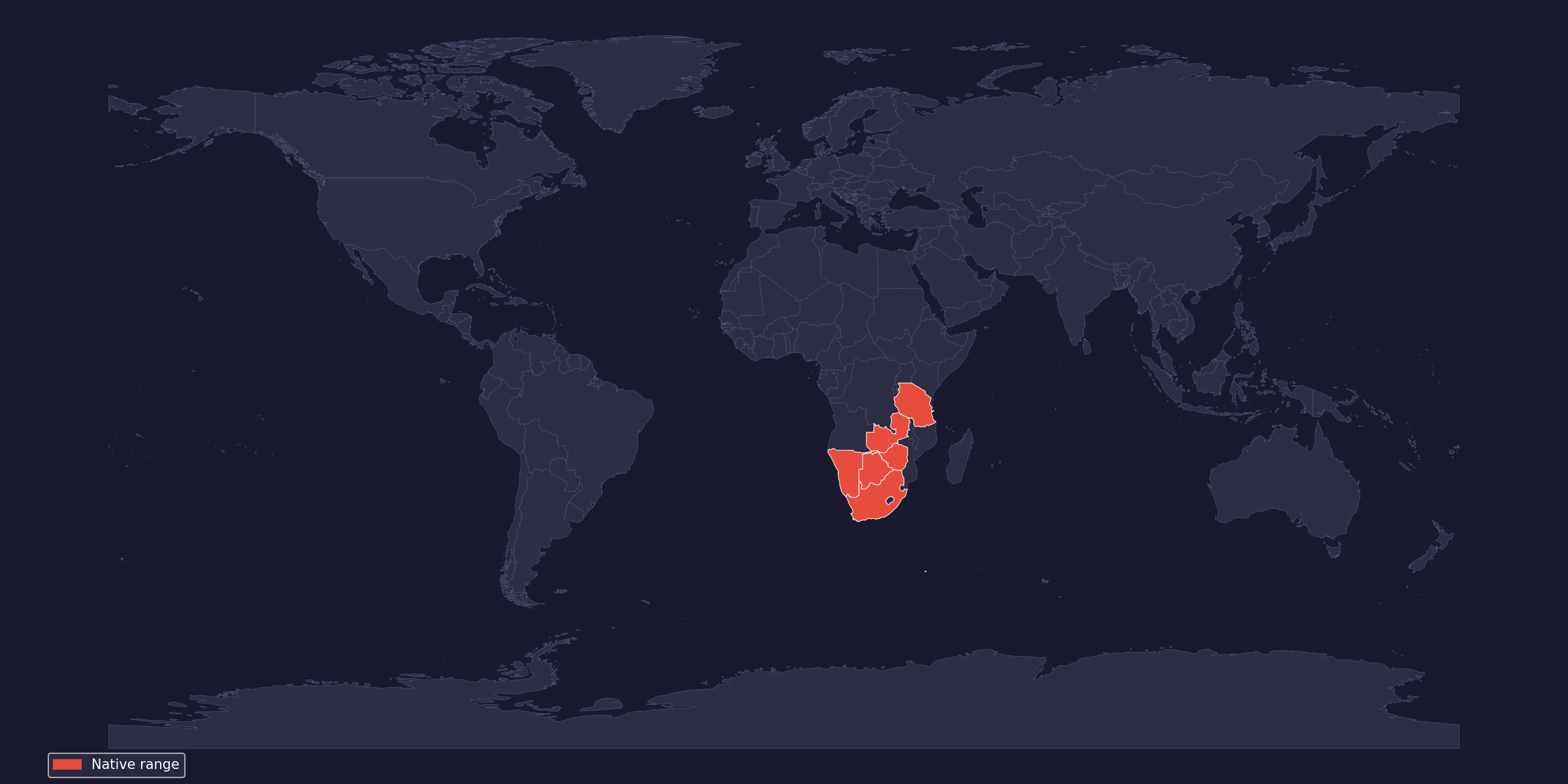
🌡 Climate across the native range
Monthly climate normals from reviewed GBIF occurrence locations:
Iringa — Tanzania
| Month | Min °C | Mean °C | Max °C | RH % |
|---|---|---|---|---|
| January | 18.7 | 23.4 | 28.1 | 75 |
| February | 18.5 | 23.4 | 28.4 | 77 |
| March | 18.2 | 23.2 | 28.3 | 78 |
| April | 17.9 | 22.9 | 28 | 74 |
| May | 16.2 | 21.8 | 27.4 | 69 |
| June | 14.5 | 20.6 | 26.7 | 62 |
| July | 13.9 | 20 | 26 | 61 |
| August | 14.8 | 20.7 | 26.7 | 62 |
| September | 16.2 | 22.2 | 28.3 | 58 |
| October | 17.7 | 23.7 | 29.7 | 57 |
| November | 18.9 | 24.6 | 30.3 | 59 |
| December | 19.3 | 24.2 | 29.2 | 67 |
Hwange National Park — Zimbabwe
| Month | Min °C | Mean °C | Max °C | RH % |
|---|---|---|---|---|
| January | 18.5 | 24.2 | 29.9 | 71 |
| February | 18.3 | 24 | 29.7 | 72 |
| March | 17.3 | 23.7 | 30 | 69 |
| April | 15.1 | 22.6 | 30 | 59 |
| May | 10.4 | 19.2 | 27.9 | 54 |
| June | 7.2 | 16.3 | 25.5 | 53 |
| July | 7 | 16.3 | 25.6 | 49 |
| August | 9.8 | 19.2 | 28.6 | 42 |
| September | 14.6 | 23.7 | 32.8 | 35 |
| October | 18.6 | 26.7 | 34.8 | 37 |
| November | 18.9 | 25.9 | 32.8 | 50 |
| December | 18.7 | 24.6 | 30.5 | 67 |
Onguma Game Reserve — Namibia
| Month | Min °C | Mean °C | Max °C | RH % |
|---|---|---|---|---|
| January | 18.8 | 25.1 | 31.5 | 54 |
| February | 18 | 24.2 | 30.5 | 61 |
| March | 17.4 | 23.8 | 30.2 | 61 |
| April | 15.3 | 22.7 | 30 | 52 |
| May | 10.8 | 19.4 | 28 | 42 |
| June | 7.2 | 16.4 | 25.6 | 38 |
| July | 6.9 | 16.3 | 25.8 | 33 |
| August | 9.5 | 19.2 | 28.9 | 27 |
| September | 14.2 | 23.5 | 32.9 | 22 |
| October | 17.5 | 25.8 | 34.1 | 28 |
| November | 18.7 | 26.1 | 33.5 | 38 |
| December | 18.4 | 25.5 | 32.6 | 45 |
Weather data by WorldClim v2.1 · Monthly normals queried by Herpeton Academy from raster values; relative humidity is derived from vapor pressure and mean temperature.
Location references use GBIF.org occurrence data where available; original occurrence records retain their source dataset licenses.
⚖️ Legal status
The official CITES Appendices and the EU annexes in Regulation (EU) 2026/1383 were checked on 5 August 2026. Pterinochilus lugardi is not CITES-listed and no species-specific entry was found in EU Annexes A-D.
The species is not relevant to the Bern Convention because it is not native to Europe. Local rules on import, sale, transport, exhibition, and breeding may still apply, so proof of legal origin is advisable.
Because locality and color-form labels are common in trade, keep seller records and avoid mixing unclear lines in breeding projects.
🤌 Husbandry
Pterinochilus lugardi should be housed alone in a very secure fossorial enclosure. It may web above the burrow, but that does not make an empty tall or arboreal enclosure appropriate.
Young spiders should be raised in secure, simple containers first, with larger housing introduced only when they can use the extra space safely.
Build the enclosure around:
- 12-15 cm of compact, burrow-holding substrate
- Cork bark or a secure retreat
- Excellent ventilation
- A water dish
- Plenty of web anchor points
For adults, about 30 x 30 x 30 cm works when 12-15 cm of the height is filled with compact unfertilized soil, coco fibre, and a small clay or sand fraction. Start a burrow beneath angled cork and add low web anchors. Pure sand, fluffy fibre, and deep open fall space are poor choices. Raise slings in smaller ventilated containers with a reachable damp corner. Quarantine new stock for at least 60-90 days, use separate tools, and log feeding, molts, waste, and mites before placing it near other arachnids.
Before opening the enclosure, have a catch cup ready and know where the spider can retreat. Most escapes happen during routine feeding, watering, or rehousing, not because the spider “wanted out.”
💡 Lighting
Keep lighting simple: ordinary room light and a consistent day-night cycle are enough.
🌡 Heating and temperature
Practical temperature targets are:
- Daytime: around 22-27°C
- Night: around 18-22°C is acceptable
Cool, damp conditions are more problematic than moderate dryness. Avoid pushing heat above the high 20s Celsius in a small enclosure; overheating and dehydration can happen quickly.
💧 Humidity and water
Pterinochilus lugardi is usually kept with a mostly dry surface and a moisture reserve below. A broad 50-65% room-humidity reference is useful, but the water dish, substrate gradient, and airflow matter more than forcing a number.
Good ventilation is essential, and only a small area needs to stay slightly more humid, if any.
A useful routine is to keep most substrate dry, overflow the water dish slightly or moisten one corner when needed, then allow that area to dry again. Avoid frequent misting that leaves webbing wet and stale.
🌿 Enclosure and decoration
This species webs heavily, so the enclosure should include cork bark, angled hides, branches, or other structures that allow silk tunnels. Substrate depth can be moderate, but stability matters more than decoration.
The key is security: a well-seated lid, safe access for maintenance, and no need for frequent disturbance.
Do not remove established webbing for appearance. The silk tunnel is the animal’s main security structure and also makes maintenance more predictable because the spider has a preferred retreat.
🪳 Feeding
Pterinochilus lugardi is insectivorous and usually feeds readily. Suitable prey includes:
- Crickets
- Roaches
- Locusts where available
- Mealworms or superworms in moderation
Young spiders can be fed more often, while adults usually need a 7-14 day rhythm adjusted to abdomen size, recent molts, and prey size.
Do not leave prey inside a sealed web tunnel during premolt. Offer, observe, and remove if the spider does not take the prey promptly.
🩺 Common problems
Common problems include escapes during maintenance, overly damp stagnant conditions, poor ventilation, dehydration, and stress from excessive disturbance.
Warning signs include lethargy, poor feeding response in a declining animal, repeated frantic running, and failed molts.
Repeated frantic running during maintenance usually means the enclosure workflow is too exposed. Rework the setup so water and prey can be added without forcing the spider into open space.
📌 Conclusion
Pterinochilus lugardi is a striking and fascinating display tarantula, but it is best suited to keepers who respect fast, defensive Old World species. A secure dry enclosure, strong ventilation, web anchor points, and calm maintenance are essential.
📚 Sources and further reading
- World Spider Catalog — Pterinochilus lugardi — accepted name, synonymy, and six-country range
- GBIF — Pterinochilus lugardi — taxonomy and reviewed occurrence records used for climate context
- Gallon 2002 — revision of Pterinochilus and Eucratoscelus — synonymy and diagnostic context
- The Tarantula Collective — Pterinochilus murinus care — explicitly comparative genus-level enclosure and web-anchor guidance; not evidence for species-specific limits
- Fuchs et al. 2010 — muscle spasms after Old World tarantula bites — includes P. murinus; risk context rather than a P. lugardi bite series
- Official CITES Appendices and Regulation (EU) 2026/1383 — legal status checked 5 August 2026