Share

Omothymus schioedtei
🔤 Taxonomy
Omothymus schioedtei is the currently accepted scientific name used for the taxonomy profile in this article.
The requested trade name Cyriopagopus schioedtei still appears in older hobby lists, import paperwork, and seller labels. Keep both names with the animal’s records so older documents remain traceable.
Older names and combinations associated with the article label:
- Cyriopagopus schioedtei
- Cyriopagopus thorelli
- Omothymus thorelli
English common names and hobby labels:
- Malaysian earth tiger
- Asian chevron tarantula
- Malaysische Erdtygervogelspinne
📌 Description
Omothymus schioedtei is a large Old World arboreal tarantula best treated as a display animal rather than a handling pet. Adults usually reach about 20-25 cm legspan, and females can live much longer than mature males when the enclosure stays stable and stress is kept low.
The main care decision is not a rare special trick; it is matching the enclosure to the spider’s natural retreat style. It needs a secure vertical retreat, high escape control, moderate humidity, and maintenance that keeps hands away from the animal. A keeper should be able to feed, water, remove waste, and rehouse the animal without dismantling the primary retreat every week.
This article uses conservative care values from current taxonomy, the existing Herpeton tarantula corpus, and specialist husbandry references. Where the trade name is taxonomically messy, the article states that uncertainty instead of pretending that every imported or captive line has perfect locality data.
☠️ Venom
Omothymus schioedtei is venomous. It should not be handled for routine care, photography, or demonstrations. The practical risks are speed, escape potential, defensive behavior, and a bite that may be more painful than most New World species.
Use long tools, a catch cup, and a clear work area before opening the enclosure. If the spider moves toward the door, close the enclosure and reset rather than chasing it. Children should not maintain this species unsupervised, and no tarantula should be placed on skin as proof of temperament.
🌍 Distribution
Omothymus schioedtei is recorded from peninsular Malaysia and southern Thailand. It has long appeared in the hobby as Cyriopagopus schioedtei or Cyriopagopus thorelli, so old labels should be checked against current taxonomy.
For enclosure design, the useful habitat cues are:
- vertical cork tube or bark slab close to the lid
- humid but ventilated retreat
- water reachable without dismantling the webbed hide
- limited fall distance with usable climbing structure
- escape planning before every maintenance session
Wild tarantulas avoid extremes by moving through burrows, hollows, bark layers, leaf litter, and shaded retreats. A small enclosure cannot reproduce a full landscape, so it must offer safe local choices: a secure retreat, clean water, usable warmth, ventilation, and enough space to move without falls.
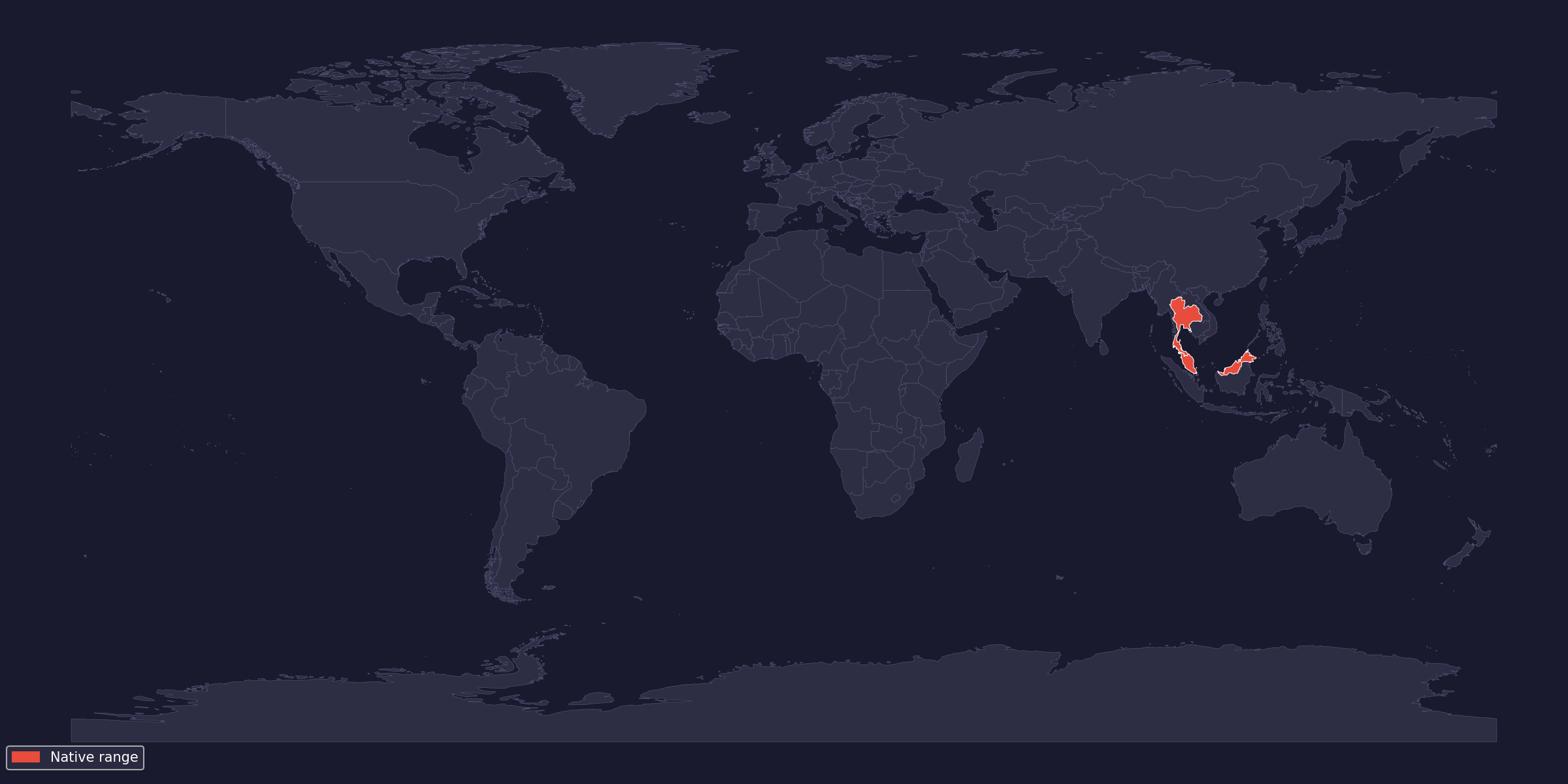
🌡 Climate across the native range
Monthly climate normals from reviewed GBIF occurrence locations:
Kedah — Malaysia (verified GBIF occurrence in northwestern Peninsular Malaysia)
| Month | Min °C | Mean °C | Max °C | RH % |
|---|---|---|---|---|
| January | 24.8 | 27.1 | 30.4 | 73 |
| February | 25.1 | 27.9 | 31.6 | 69 |
| March | 25.6 | 28.2 | 31.5 | 74 |
| April | 25.8 | 27.9 | 30.5 | 81 |
| May | 25.9 | 27.8 | 29.9 | 84 |
| June | 25.9 | 27.8 | 29.7 | 83 |
| July | 25.6 | 27.4 | 29.3 | 83 |
| August | 25.4 | 27.3 | 29.2 | 83 |
| September | 25.1 | 26.9 | 28.8 | 85 |
| October | 24.8 | 26.5 | 28.5 | 86 |
| November | 24.9 | 26.5 | 28.7 | 85 |
| December | 24.8 | 26.5 | 29 | 80 |
Yala — Thailand (verified GBIF occurrence in the southern Thai range)
| Month | Min °C | Mean °C | Max °C | RH % |
|---|---|---|---|---|
| January | 21.9 | 24.7 | 28.6 | 87 |
| February | 21.9 | 25.5 | 30.3 | 83 |
| March | 22.7 | 26.6 | 31.9 | 82 |
| April | 23.6 | 27.1 | 32.2 | 84 |
| May | 23.9 | 27.1 | 31.8 | 86 |
| June | 23.7 | 26.9 | 31.5 | 86 |
| July | 23.4 | 26.7 | 31.4 | 85 |
| August | 23.3 | 26.6 | 31.3 | 85 |
| September | 23.1 | 26.1 | 30.7 | 87 |
| October | 23 | 25.5 | 29.7 | 91 |
| November | 22.9 | 25.1 | 28.6 | 92 |
| December | 22.5 | 24.6 | 27.9 | 91 |
Weather data by Open-Meteo.com · CC BY 4.0 · Monthly normals calculated by Herpeton Academy from daily archive values.
Location references use GBIF.org occurrence data where available; original occurrence records retain their source dataset licenses.
⚖️ Legal status
No current CITES listing or species-specific EU wildlife-trade annex listing was found for Omothymus schioedtei in the official sources checked on 2026-06-04. The species is not relevant to the Bern Convention because it is not native to Europe.
This does not make ownership, import, sale, transport, or breeding automatically unrestricted. Local animal-welfare, dangerous-animal, import, and proof-of-origin rules may still apply. Keep invoices, breeder or seller details, advertised origin, transfer records, and the older names that appear on paperwork.
🤌 Husbandry
House one animal per enclosure. Tarantulas in this group are not communal projects, and forced cohabitation turns feeding and cleaning into avoidable risk.
Start spiderlings in small secure containers where prey, molts, and hydration can be checked. Move them up after molts rather than putting tiny spiderlings into adult displays where feeders disappear and molts are hard to inspect.
A practical adult enclosure is about 30 x 30 x 45 cm or larger, with most of the height made usable by cork and web anchors. Build it before the animal needs it, and test every lid, vent, sliding door, cable gap, and feeding port. The water dish should be reachable with minimal opening.
Useful setup elements:
- vertical cork tube or broad cork slab
- 5-8 cm substrate for humidity buffering
- cross-ventilation
- stable water dish
- secure lid and catch cup
💡 Lighting
No UVB or specialist basking lamp is required. A normal room day-night rhythm is enough for observation and feeding routines.
Avoid bright heat lamps on small tarantula enclosures. They can dry the retreat, overheat the animal, and create a dangerous hot ceiling before the keeper notices. If the room is too cool, warm the room or one side of the enclosure gently and measure the result.
🌡 Heating and temperature
Use a stable range around 23-27°C by day with a night range around 20-23°C. Short mild drops are usually safer than overheating a sealed enclosure.
Measure where the spider actually lives: at the retreat, the open area, and the water or damp corner. Do not use heat rocks. Floor heat is also a poor default for tarantulas that retreat downward because it can heat the escape route instead of the display surface.
Change one variable at a time. Extra spraying, extra heat, and repeated feeding attempts can create a disturbance cycle where the spider never settles.
💧 Humidity and water
Aim for 65-80% humidity as a gradient, not as a permanently wet box. Keep fresh water available at all times and let exposed surfaces dry between maintenance.
For spiderlings, a tiny water dish, damp corner, or carefully managed moisture patch can prevent dehydration, but the container still needs air exchange. For adults, overflow the dish or dampen one area when needed instead of spraying the whole enclosure every day.
Stale wet substrate, sour smell, permanent condensation, and heavy mold mean the enclosure is too wet or too poorly ventilated. Chronic dryness, a shriveled abdomen, and bad molts mean hydration and water access need correction.
🌿 Enclosure and decoration
For this species, vertical structure is more important than a decorative open display. Place the main retreat so the spider can web it heavily while the keeper still has a safe service route.
Use cork bark, bark tubes, firm substrate, branches, leaf litter, and visual barriers to make maintenance safer. Decoration is useful when it creates retreats, web anchors, walking surfaces, and a protected route to water. Loose heavy objects, excessive height, and mesh that catches claws are avoidable hazards.
Do not destroy clean functional webbing or a stable burrow just because it looks untidy. Remove boluses, dead feeders, moldy remains, and soaked waste, but leave working structure alone when it is clean.
🪳 Feeding
Feed appropriately sized roaches, crickets, locusts where legal, and other safe feeder insects. Prey should usually be no larger than the spider’s body length, and uneaten prey should be removed.
Spiderlings can eat small prey more often. Juveniles and adults usually do well with a suitable meal every 7-14 days, adjusted by abdomen size, molt timing, temperature, and growth. Never leave live prey with a tarantula in premolt, freshly molted, weak, or trapped in a retreat.
A missed meal is not automatically a problem. Recheck temperature, recent disturbance, water access, abdomen condition, and molt timing before repeatedly offering food.
🩺 Common problems
Common preventable problems include escapes during watering, stale wet retreats, defensive bolting, bite exposure, and damaged webs after unnecessary cleaning. Many of these are not species mysteries; they are enclosure-access problems.
If the spider looks wrong, first verify temperature, water access, ventilation, recent molts, prey size, hide fit, and recent disturbance. Serious trauma, leaking hemolymph, persistent abnormal posture, severe dehydration, or a trapped molt needs an experienced exotic-veterinary opinion when one is available.
Keep a simple notebook of feeding, molts, water changes, and unusual behavior. Baseline records make later changes easier to interpret.
📌 Conclusion
Omothymus schioedtei suits keepers who want a large, impressive Old World arboreal tarantula and can manage no-contact maintenance. Buy only when the adult enclosure plan, maintenance tools, and legal-origin records are ready.
The common failure is buying the spider first and solving access later. A good setup lets the animal retreat, drink, molt, and feed while the keeper can work slowly and safely.
📚 Sources and further reading
- GBIF Backbone Taxonomy
- World Spider Catalog
- Gabriel & Sherwood 2019, revised placement of Omothymus
- Tom’s Big Spiders tarantula husbandry topic index
- CITES Checklist
- CITES Appendices
- EU wildlife trade regulations
- Bern Convention appendices