Share

Nhandu carapoensis
🔤 Taxonomy
Nhandu carapoensis is the accepted scientific name and the type species of the genus Nhandu. Older references may list the name Nhandu tripartitus, which has been treated as a synonym.
English common names used in the hobby:
- Brazilian red tarantula
- Carapo tarantula
- Brazilian giant red
📌 Description
Nhandu carapoensis is a large, heavy-bodied South American terrestrial tarantula. It is impressive, food-responsive, and capable of dramatic defensive displays, but it is not a handling animal.
Adults commonly need the same planning expected for other large Nhandu: a low enclosure, real floor area, deep substrate, a large hide, fresh water, and a routine that avoids forcing the spider into the open. Females can live for many years, while mature males are much shorter-lived.
☠️ Venom
The venom is not usually treated as medically significant, but a bite from a large Nhandu can be mechanically serious. Urticating hairs are the more common day-to-day risk and can irritate skin, eyes, and airways. Use tools, keep hands out of the enclosure, and avoid face-level work over the spider.
🌍 Distribution
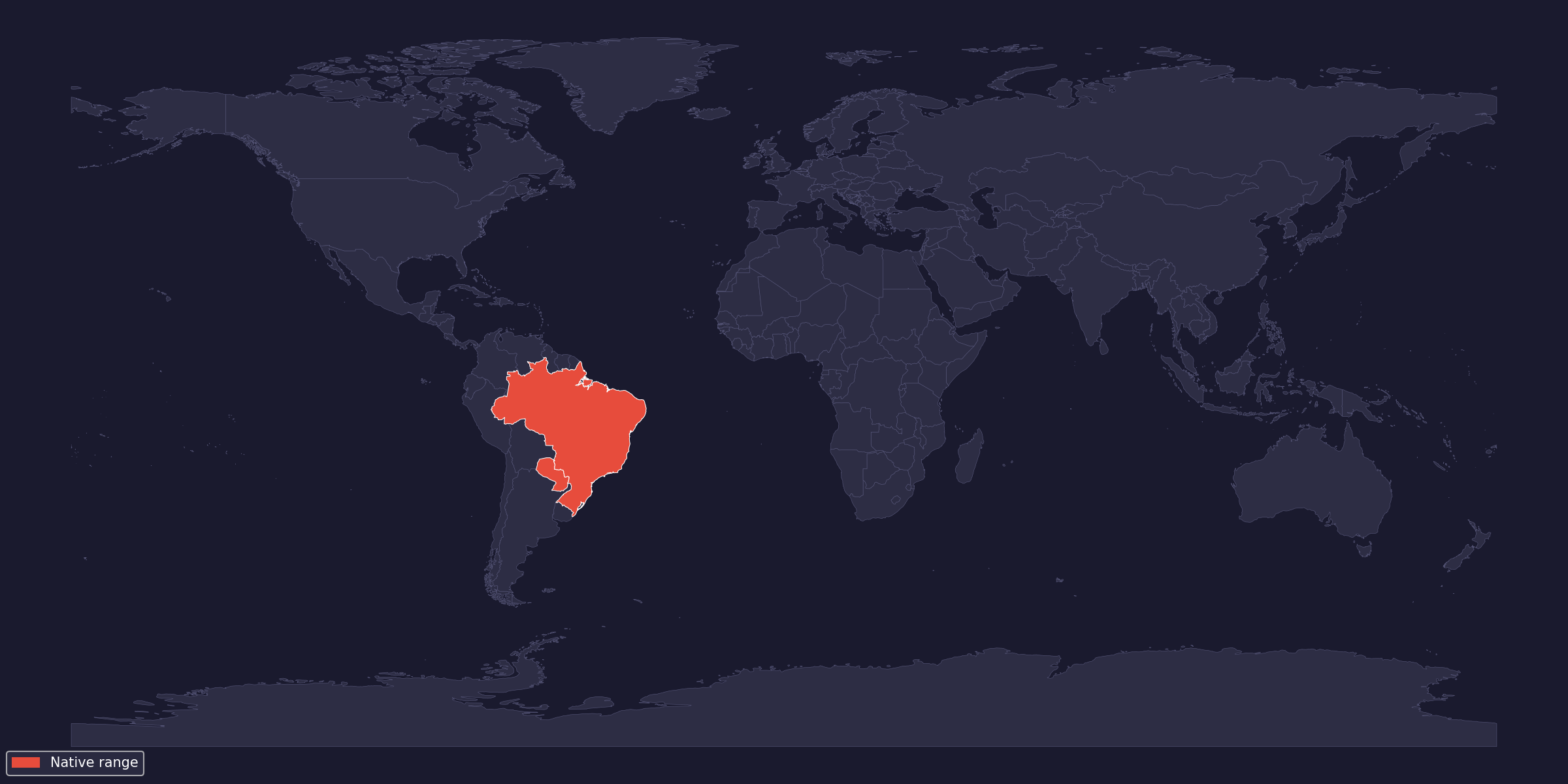
Nhandu carapoensis is recorded from Brazil and Paraguay. Captive care should treat it as a warm, seasonally humid terrestrial species that uses retreats and can dig or reshape its substrate.
The enclosure must stay low enough to reduce fall injury. Moisture should be available in the lower substrate and around one area, but the surface should not become dirty, wet, and stagnant.
🌡 Climate across the native range
Monthly climate normals from reviewed GBIF occurrence locations:
Mato Grosso do Sul — Brazil (reviewed GBIF occurrence)
| Month | Min °C | Mean °C | Max °C | RH % |
|---|---|---|---|---|
| January | 21.6 | 24.7 | 28.7 | 80 |
| February | 21.5 | 24.6 | 28.7 | 81 |
| March | 21 | 24.4 | 28.7 | 79 |
| April | 19.8 | 23.5 | 28 | 74 |
| May | 17.1 | 20.9 | 25.7 | 71 |
| June | 16.3 | 20.2 | 25.4 | 69 |
| July | 15.7 | 20.2 | 25.9 | 61 |
| August | 17.5 | 22.4 | 28.5 | 52 |
| September | 19.6 | 24.3 | 30 | 57 |
| October | 21 | 24.9 | 29.8 | 69 |
| November | 21 | 24.6 | 29.1 | 73 |
| December | 21.6 | 24.9 | 29 | 78 |
Concepción — Paraguay (reviewed GBIF occurrence)
| Month | Min °C | Mean °C | Max °C | RH % |
|---|---|---|---|---|
| January | 24.5 | 28.1 | 32.6 | 72 |
| February | 24 | 27.5 | 31.9 | 74 |
| March | 23.2 | 26.8 | 31.3 | 73 |
| April | 21.1 | 24.8 | 29.5 | 72 |
| May | 17.8 | 21.2 | 25.7 | 74 |
| June | 16.9 | 20.2 | 24.8 | 73 |
| July | 15.8 | 19.6 | 24.7 | 68 |
| August | 17.4 | 21.8 | 27.7 | 61 |
| September | 19.2 | 23.8 | 29.5 | 61 |
| October | 21.9 | 25.9 | 31 | 68 |
| November | 22.3 | 26.3 | 31.2 | 69 |
| December | 23.8 | 27.6 | 32.1 | 72 |
Weather data by Open-Meteo.com · CC BY 4.0 · Monthly normals calculated by Herpeton Academy from daily archive values.
Location references use GBIF.org occurrence data where available; original occurrence records retain their source dataset licenses.
⚖️ Legal status
As checked against current official CITES Appendices and EU wildlife-trade references on 2026-06-03, no current CITES listing or species-specific EU Annex listing was found for Nhandu carapoensis. The species is not relevant to the Bern Convention because it is not native to Europe.
Brazilian, Paraguayan, national, and local rules on collection, export, import, sale, transport, breeding, and proof of legal origin may still apply. Captive-bred animals with clear seller records are the responsible default.
🤌 Husbandry
Keep this species alone. It does not need social contact and should not be tested in groups.
Young animals should start in smaller secure containers where prey, water, and molts can be monitored. Larger juveniles and adults need a low terrestrial enclosure with substantial substrate, a hide that fits the whole spider, and enough floor area that maintenance can happen without crowding the animal.
Useful care priorities:
- Large low enclosure
- Deep firm substrate
- Full-body hide
- Heavy water dish
- No tall fall hazards
💡 Lighting
No specialist lighting or UVB is required. A normal room day-night rhythm is enough. Display lighting should not overheat the enclosure or dry the hide.
🌡 Heating and temperature
Keep daytime temperatures around 23-27°C, with nights around 20-23°C. Stable room warmth is better than a hot spot.
Avoid heat rocks, strong overhead bulbs over small enclosures, and heat mats under the substrate. A heavy terrestrial tarantula can dehydrate or injure itself if it is pushed toward unsafe heat.
💧 Humidity and water
Aim for about 65-80% with good ventilation and constant fresh water. Keep part of the substrate slightly moist, especially below the surface, but do not keep the entire enclosure wet.
A large water dish and a moister lower layer are more useful than daily spraying. Let the top layer dry enough to reduce mold and stale air.
🌿 Enclosure and decoration
An adult should have at least about 60 x 45 cm of floor space where possible, with modest height and 12-15 cm or more of substrate. Use cork bark or a sturdy hide, leaf litter, and simple decor that cannot collapse.
Avoid tall branches, stacked rocks, and slick climbing surfaces. Falls are a major risk for large heavy-bodied tarantulas.
🪳 Feeding
Feed large roaches, crickets, locusts where legal, and other suitable insects. Juveniles can be fed more often while growing; adults usually do well with appropriately sized prey every 7-14 days or longer if the abdomen is already full.
Do not feed only because the spider reacts strongly. Overfeeding increases fall risk, makes molts harder, and can produce an oversized abdomen.
🩺 Common problems
Common problems include obesity, dehydration, hair irritation, falls, stagnant damp substrate, prey left during molts, and injuries during maintenance. A sealed hide entrance or a long fast is often normal, especially before a molt.
A tarantula on its back is usually molting and should not be touched. For leaking hemolymph, serious falls, failed molts, or severe dehydration, keep handling minimal and consult an experienced exotic-animal veterinarian or arachnid keeper where possible.
📌 Conclusion
Nhandu carapoensis is best for keepers who can house a large, defensive, hair-flicking terrestrial tarantula safely. Prepare the adult enclosure early and treat the animal as a hands-off display spider with clear records.
📚 Sources and further reading
- GBIF species backbone entry for Nhandu carapoensis
- World Spider Catalog
- CITES Appendices — legal-status reference checked 2026-06-03
- EU wildlife trade overview — legal-status reference checked 2026-06-03
- Bern Convention appendices