Share

Monocentropus balfouri
🔤 Taxonomy
Monocentropus balfouri is the currently accepted scientific name used for this care guide. In hobby listings, use the Latin name carefully because common names are informal and may be reused for related Old World tarantulas.
Names used in the hobby:
- Socotra island blue baboon
- Socotra blue baboon
- Socotra-Blautiger-Vogelspinne
📌 Description
Monocentropus balfouri is an Old World tarantula associated with dry to semi-arid conditions, deep burrows, and heavy webbing. Adults are usually about 5-6 cm body length and 12-14 cm legspan. Females often live 12-15 years or more, while mature males live much shorter lives. The species is known for tolerating group keeping better than most tarantulas, but that does not make it risk-free.
Group keeping makes sense only when the animals have clear origin, similar size, and backup enclosures are ready. Cannibalism, uneven feeding, and stress are possible even in this species. Keeping one animal alone is simpler, safer, and entirely normal.
Before buying, decide whether you are keeping one animal or a group. That choice determines enclosure size, number of retreats, feeding points, and the need for backup containers.
Provide dry to moderate conditions, clean water, protected retreats, and good ventilation. Track feeding, molts, and visible body condition, especially if more than one animal is housed together.
☠️ Venom
Respect the bite risk. Old World tarantulas can be fast, defensive, and capable of painful bites that may produce swelling, cramps, nausea, dizziness, or stronger individual reactions. Maintenance should be planned so hands never need to share space with the spider.
🌍 Distribution
Monocentropus balfouri is native to Socotra, Yemen. In captivity this means a drier main environment, stable retreats, many web anchor points, and constant water. Do not turn the enclosure into a tropical wet setup; a small moister area with good ventilation is more useful.
A practical captive setup should provide:
- secure retreats and visual cover
- a measured thermal gradient instead of one uniform temperature
- humidity that matches the species without stale wet air
- clean water and predictable hygiene
- enough usable structure for normal movement
The range tells you what problems to solve, not exact weather to copy. Provide shelter, gradients, and clean water so the animal can regulate itself.
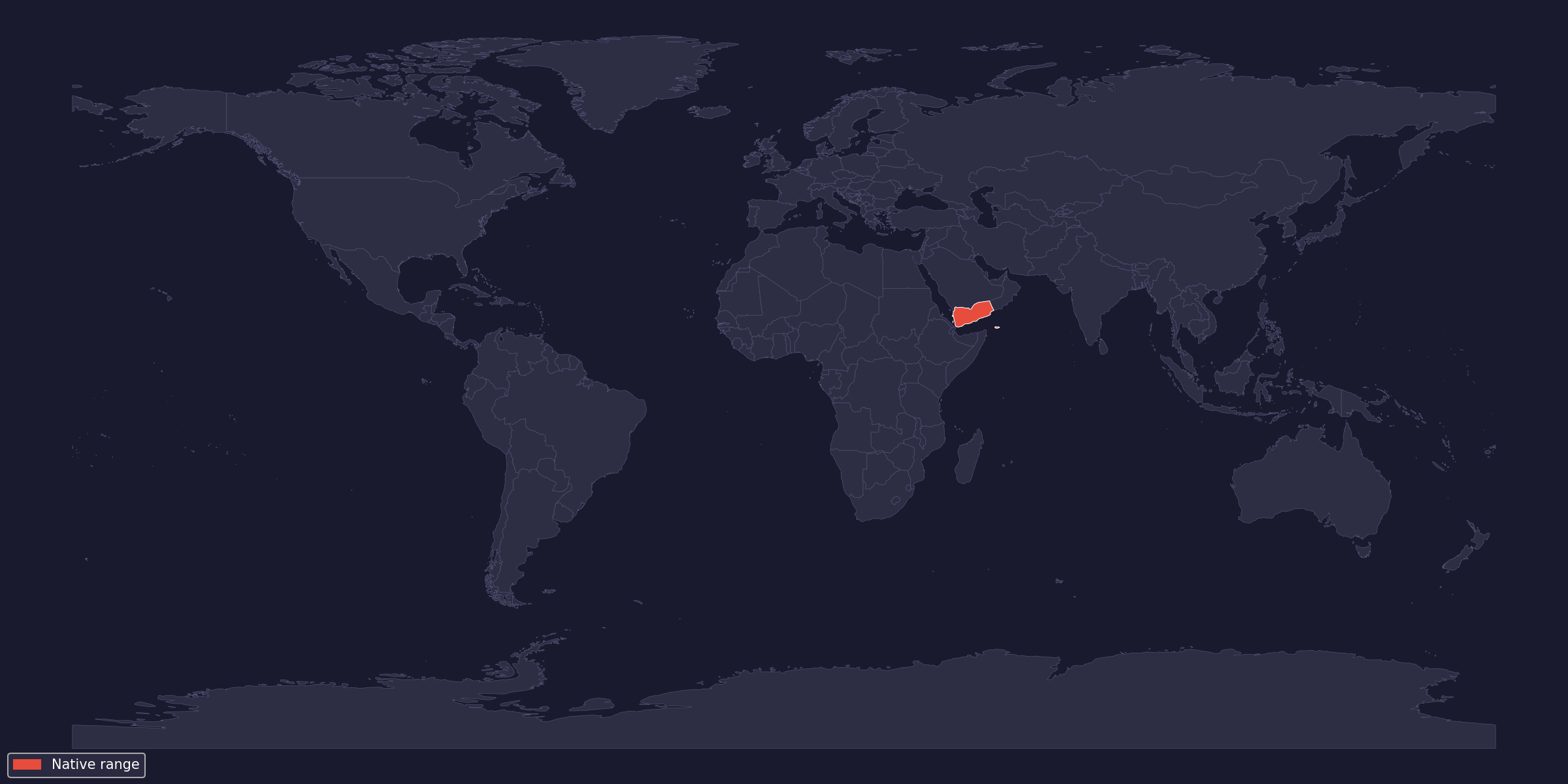
🌡 Climate across the native range
Monthly climate normals from reviewed GBIF occurrence locations:
Socotra — Yemen
| Month | Min °C | Mean °C | Max °C | RH % |
|---|---|---|---|---|
| January | 17.6 | 21.6 | 25.6 | 74 |
| February | 18.4 | 22.1 | 25.9 | 71 |
| March | 19.4 | 23.7 | 28 | 66 |
| April | 21 | 25.2 | 29.3 | 70 |
| May | 22.3 | 26.1 | 29.9 | 69 |
| June | 22.2 | 25.6 | 29 | 67 |
| July | 20.6 | 23.6 | 26.6 | 72 |
| August | 20.3 | 23.3 | 26.3 | 72 |
| September | 20 | 23.2 | 26.5 | 73 |
| October | 19.7 | 23.5 | 27.3 | 73 |
| November | 18.9 | 22.9 | 26.9 | 75 |
| December | 18.4 | 22.1 | 25.7 | 76 |
Weather data by WorldClim v2.1 · Monthly normals queried by Herpeton Academy from raster values; relative humidity is derived from vapor pressure and mean temperature.
Location references use GBIF.org occurrence data where available; original occurrence records retain their source dataset licenses.
⚖️ Legal status
As checked against current CITES, Species+ and EU wildlife-trade references on 31 May 2026, no current CITES listing or species-specific EU Annex listing was found for Monocentropus balfouri. The species is outside the scope of the Bern Convention because it is not native to Europe. National and local rules on import, ownership, sale, breeding, transport, animal welfare, and proof of legal origin may still apply.
Good records start before the animal comes home. Save breeder or seller details, molt and sexing notes, locality claims, transfer documents, and clear photos of the animal.
🤌 Husbandry
For one adult, plan at least 30 x 30 x 30 cm with deep substrate, cork, web anchor points, and excellent lid security. Slings should start in smaller containers so they can find prey easily and establish a retreat.
For group keeping, increase floor area, anchor points, retreats, and feeding stations substantially. Feed so prey does not concentrate only around one entrance. Monitor the group regularly, but do not tear apart the webbing constantly just to count animals.
Make routine work predictable. Secure the lid and vents, remove collapse risks, and plan feeding, watering, and cleaning so the enclosure is never held open longer than necessary.
💡 Lighting
Keep lighting simple: ordinary room light and a consistent day-night cycle are enough. Avoid direct lamps that overheat or dry the enclosure too aggressively. Quarantine new arrivals in a simple secure setup before moving them into a display enclosure.
🌡 Heating and temperature
Practical temperature targets: 24-28 °C by day, with a mild night drop. Measure with reliable instruments. Stable warmth is useful, but overheating and stagnant hot air are more dangerous than a mild night drop. Change one variable at a time and avoid correcting every minor behavior with extra heat or repeated feeding attempts.
💧 Humidity and water
Keep the main enclosure dry to moderate. Leave one slightly moister area around part of the retreat, and provide a constant dish of clean water. After heavier moistening, the surface should be able to dry; stagnant moisture and heavy air are mistakes.
🌿 Enclosure and decoration
The enclosure should allow digging and webbing. Provide deep substrate, stable cork, several starter retreats, clean water, and web anchor points. Do not remove the central webbing at every cleaning.
Dense webbing is expected and should be treated as part of the habitat. Place water and service points at the edge of the webbed zone so the central retreat does not have to be torn open.
🪳 Feeding
Suitable diet: crickets, roaches, locusts, and other suitable insects sized to the spider. Remove uneaten prey and food remains. Feed according to body condition, not only appetite, and avoid leaving live prey during premolt. A fasting spider is not automatically in trouble, but refusal with weight loss, dehydration, or weakness needs a husbandry check.
🥚 Breeding
Do not breed just because a pair is available. Confirm identity, condition both animals, prepare offspring housing, and avoid hybrids or uncertain locality crosses. For defensive Old World species, pairing and separation should be planned before the animals are introduced.
🩺 Common problems
For a single animal, the common problems are dehydration, an enclosure kept too wet, poor ventilation, and escapes during maintenance. In a group, add another risk: one animal may stay thin, be pushed away from retreats, or feed worse than the others.
That is not personality; it is a sign that the group is not working well. Separate weak or pressured animals early, and do not add new animals to an unstable group. For serious injury, leaking hemolymph, or a difficult molt, seek an exotic-veterinary professional when possible.
Keep short notes on feeding, molts, and the number of animals. With group keeping, memory is not enough, because the problem often becomes obvious only after one animal has already lost condition.
📌 Conclusion
Monocentropus balfouri is a very interesting species, but its reputation as a “communal” tarantula should not mislead keepers. Single housing is the safest option; a group should be attempted only with a plan, backup enclosures, and regular observation.
Keep provenance documents and record feeding, molts, water, cleaning, and changes in the group. This makes care easier during absences, problems, or future transfers.
📚 Sources and further reading
The husbandry notes above were cross-checked against taxonomy and trade-status references on 31 May 2026. ReptiFiles was checked first as required by the site workflow; no species-specific ReptiFiles care page was found for this species at the time of review.
- GBIF species backbone entry for Monocentropus balfouri
- World Spider Catalog species entry for Monocentropus balfouri
- CITES Checklist of Species
- EU wildlife trade overview
- Bern Convention appendices