Share

Kochiana brunnipes
🔤 Taxonomy
Kochiana brunnipes (C. L. Koch, 1841) is the accepted name. The species began as Mygale brunnipes, was long treated as doubtful, and was redescribed in 2008 as the type species of Kochiana. A 2024 revision added another species to the genus, so “Kochiana” and “dwarf pink leg” are no longer unambiguous labels on their own.
Older names useful for searches:
- Mygale brunnipes
- Mygale brunneipes — an unjustified later spelling
📌 Description
This Brazilian dwarf terrestrial tarantula generally reaches about 5-7 cm diagonal legspan. It has dark coloration with contrasting pinkish or reddish setae on the legs and is much smaller than the common large Brazilian terrestrial species. Females may live around 6-8 years; mature males often have only a few years in total.
The principal difficulty is not heat or feeding but scale. Small ventilation gaps become escape routes, water dishes can become hazards, and one oversized cricket can injure a molting spider. Individuals are often shy and quick, and should be regarded as display animals rather than handled pets.
| Care point | Practical range |
|---|---|
| Adult legspan | about 5-7 cm |
| Adult enclosure | about 18 x 18 x 18 cm |
| Substrate | 8-10 cm, compact and diggable |
| Day temperature | 22-26°C |
| Night temperature | 20-22°C |
| Moisture | lightly moist lower corner, airy surface |
| Adult feeding | small prey every 5-10 days |
☠️ Venom
The venom has not been studied well enough to promise a predictable reaction. No evidence supports treating K. brunnipes as medically significant, but every bite can cause pain, swelling, puncture injury, or an allergic response. The spider’s small size reduces the mechanical injury compared with a giant species, not the need for sensible precautions.
Handling is unnecessary and increases both escape and fall risk. Use a catch cup, a small transfer vial, and soft guidance with a brush. Urticating hairs can irritate skin and eyes; wash exposed skin and never rub the eyes. Seek medical advice for systemic symptoms, severe or spreading pain, breathing difficulty, or eye exposure.
🌍 Distribution
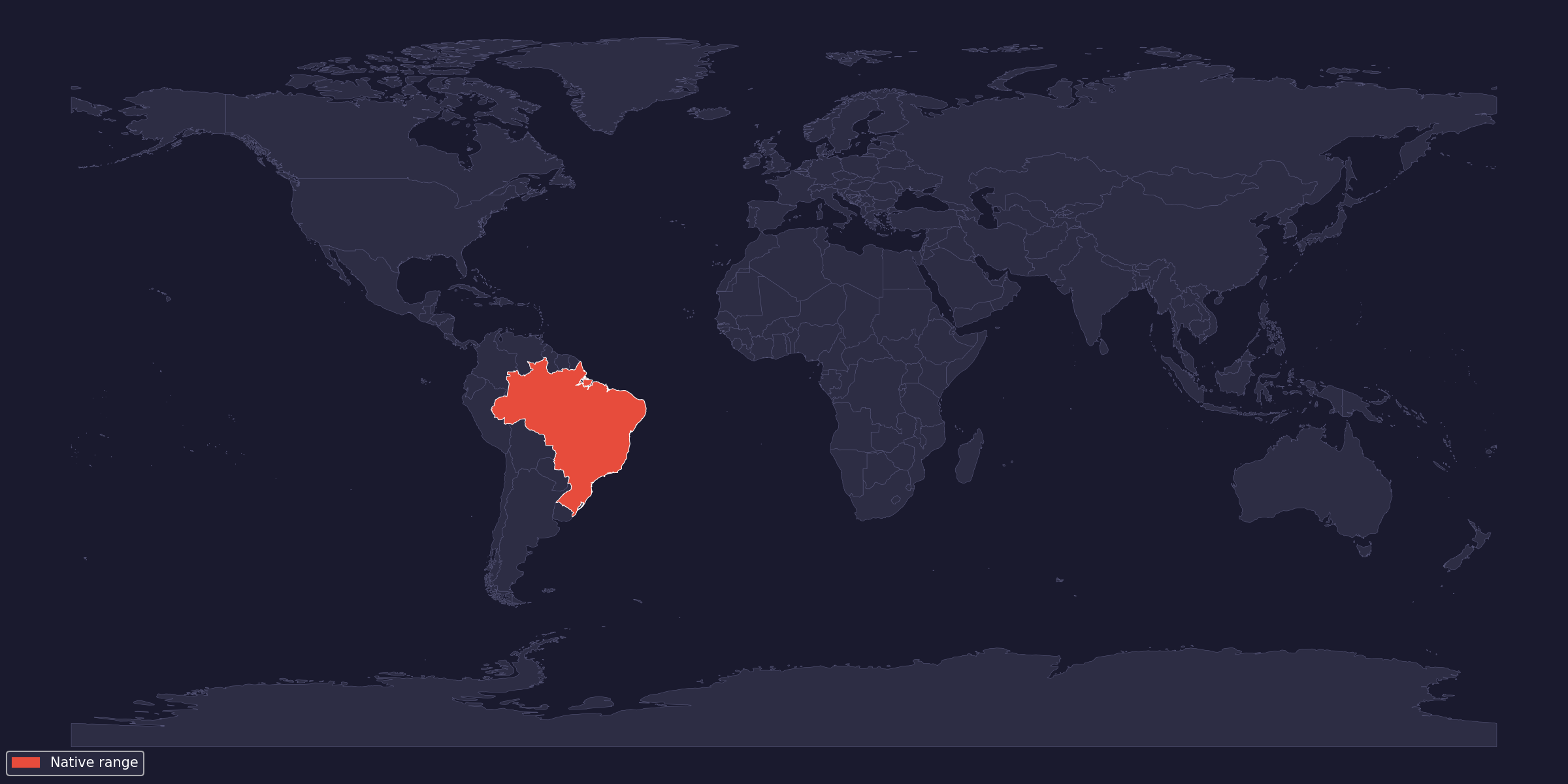
World Spider Catalog records the species from Brazil. The 2008 redescription was based on historical material without precise locality, while newer records and revision work place Kochiana in northeastern Brazilian Atlantic Forest environments, including Alagoas. The exact native range of K. brunnipes remains less securely mapped than a country-level pet label suggests.
For care, use a shaded, soil-based, moderately humid retreat with leaf litter and airflow. Do not convert uncertainty about the range into a false exact humidity target, and do not use a broad Brazil map as evidence that the species occupies every Brazilian biome.
🌡 Climate across the native range
Monthly climate normals from the precise Murici rediscovery locality documented in the 2008 redescription:
Murici Ecological Station, Alagoas — Brazil (2008 redescription rediscovery locality)
| Month | Min °C | Mean °C | Max °C | RH % |
|---|---|---|---|---|
| January | 21.9 | 25 | 29.4 | 77 |
| February | 22.1 | 25.1 | 29.3 | 78 |
| March | 22.1 | 25.1 | 29.3 | 80 |
| April | 21.8 | 24.6 | 28.4 | 82 |
| May | 21.2 | 23.6 | 26.9 | 86 |
| June | 20.2 | 22.4 | 25.5 | 87 |
| July | 19.4 | 21.6 | 24.7 | 86 |
| August | 19 | 21.6 | 24.9 | 84 |
| September | 19.5 | 22.3 | 25.9 | 82 |
| October | 20.3 | 23.4 | 27.5 | 79 |
| November | 21.1 | 24.4 | 28.9 | 76 |
| December | 21.7 | 24.9 | 29.5 | 75 |
Weather data by Open-Meteo.com · CC BY 4.0 · Monthly normals calculated by Herpeton Academy from daily archive values.
⚖️ Legal status
The official CITES Appendices and current EU wildlife-trade annexes were checked on 2026-08-05; Kochiana brunnipes was not found in them. It is not relevant to the Bern Convention because it is not native to Europe. CITES non-listing is not a permit to remove or export Brazilian wildlife.
Brazil controls collection, commercial breeding, transport, and international movement of native fauna through national and state rules. In Europe, buy a captive-produced spider with a dated invoice, breeder identity, scientific name, and a documented chain of transfer. Local rules may regulate venomous invertebrates even where wildlife-trade annexes do not.
🤌 Husbandry
House the spider alone. A clear enclosure around 18 x 18 x 18 cm is ample for an adult; a much larger tank makes it difficult to find a tiny spider, control prey, and notice a leak. Spiderlings belong in secure vials or small cups with holes too small for the carapace and with enough depth to make a retreat.
Fill roughly half the adult enclosure with 8-10 cm of pressed unfertilized soil and coco fibre. Add a small amount of clay if the mixture will not hold a tunnel. Set a curved cork chip partly into the substrate and make a starter hole. Keep the remaining drop short so a fall cannot rupture the abdomen.
Quarantine new specimens for 6-8 weeks away from the collection. Use dedicated tongs and water tools, inspect for mites, phorid flies, mold, injury, and coordination, and record the source, size, feeding, refusals, and molts. Scientific labels matter because the genus now contains more than one described species.
Before opening, place the enclosure inside a larger tub and prepare a small catch cup. Do not chase the spider with tongs or uncover a sealed retreat. Rehousing is easiest when the cork and surrounding substrate can be moved as one unit.
💡 Lighting
No UVB or basking light is needed. Use indirect room light for 10-12 hours and provide darkness at night. The spider may be visible at its burrow entrance after lights-out; coloured night bulbs disturb the natural dark period and add no care benefit.
Plant lights should remain outside the enclosure and be checked for heat. Direct sunlight can overheat an 18 cm container within minutes.
🌡 Heating and temperature
A stable 22-26°C daytime range with a 20-22°C cooler area or night period is suitable. Published species-specific thermal limits are sparse, so these are conservative captive values rather than a precision optimum.
Warm the room rather than the container. If a cold room requires local heat, attach a thermostatically controlled low-power source to one side and leave an unheated escape zone. Never heat beneath burrowing substrate: the spider normally digs down to escape warmth.
💧 Humidity and water
Keep a lower corner lightly moist and allow most of the surface to dry. A nominal 60-75% range is a useful warning against extremes, but condensation is not a goal. Cross-ventilation, a stable moisture gradient, and clean water are more informative than a cheap dial hygrometer.
Adults and larger juveniles should have a shallow water dish. For tiny spiderlings, press a very small dish into the substrate or place droplets on webbing and one wall without flooding the retreat. Add water to one side in measured amounts. Persistent wetness, sour smell, or mites around prey remains means the setup is too wet or poorly ventilated.
🌿 Enclosure and decoration
A cork hide, leaf fragments, and one or two light anchor points are enough. Keep the front open for prey placement and observation. Avoid sharp stones, heavy decor, loose sand, fertilizer, aromatic wood, and mesh on which claws can snag.
The lid must close without a feeding gap. Check ventilation holes after every molt because a spider that seemed too large to escape as a juvenile may still flatten through a seam. Place the enclosure where an accidental bolt can be contained, not on an open shelf above furniture.
🪳 Feeding
Use fruit flies, pinhead crickets, tiny roach nymphs, or freshly killed prey pieces for spiderlings. Juveniles may take a small feeder every 3-5 days; adults generally need appropriately small prey every 5-10 days. A feeder should be no longer than the abdomen, and abdomen condition should decide whether the next meal is due.
Place food at the retreat entrance and remove leftovers within 24 hours. Mealworms must be crushed or offered in a dish so they cannot burrow and later attack a molting spider. Stop feeding after repeated refusals or when the entrance is sealed. Resume only after the new fangs are black and the body has hardened. No calcium or vitamin dust is needed.
🩺 Common problems
- Escape usually results from a vent or lid seam sized for a larger species.
- A shriveled abdomen, slow coordination, or tight tucked posture can indicate dehydration; offer water and check the moist lower corner.
- Persistent wall climbing suggests a wet, unsuitable, or unburrowable substrate.
- Mold and mites usually follow excess water and unretrieved prey remains, not a lack of cleaning chemicals.
- A sealed retreat and weeks without feeding commonly indicate premolt. Do not excavate it.
- Hemolymph leakage, fall injury, a stuck molt, or sustained loss of coordination needs urgent specialist advice.
Keep aerosols, flea treatments, pesticides, essential oils, and cleaning fumes out of the room.
📌 Conclusion
Kochiana brunnipes is a manageable dwarf species for a careful intermediate keeper. Success depends on tiny escape-proof housing, prey scaled to the spider, and a moisture gradient that never becomes swampy. Its small enclosure requirement should not be confused with beginner-proof care.
📚 Sources and further reading
- World Spider Catalog entry for Kochiana brunnipes — taxonomy and country range, accessed 2026-08-05
- GBIF species entry for Kochiana brunnipes
- Fukushima, Nagahama & Bertani 2008: redescription and the genus Kochiana
- Moeller, Galleti-Lima & Guadanucci 2024: Brazilian Hapalopini revision
- Tom’s Big Spiders: moisture-dependent tarantulas — comparative moisture method
- CITES Appendices, EU wildlife-trade regulation, and IBAMA fauna import/export guidance — checked 2026-08-05