Share

Hysterocrates gigas
🔤 Taxonomy
Hysterocrates gigas is the currently accepted scientific name used for this care guide. In hobby listings, use the Latin name carefully because common names are informal and may be reused for related Old World tarantulas.
Names used in the hobby:
- Cameroon red baboon
- giant baboon spider
- Kamerun-Rotvogelspinne
📌 Description
Hysterocrates gigas is a large Old World fossorial tarantula. It uses deep retreats in humid forest soils and often webs heavily around the burrow entrance. Adults usually reach about 7-8 cm body length and 16-20 cm legspan. Females may live over 15 years, while mature males live much shorter lives.
The adult size changes the care problem. This is a heavy, powerful fossorial spider, so shallow substrate, tall fall space, and casual rehousing are poor choices. The enclosure should be treated like a burrow system with access points for the keeper, not like a display box that is rearranged often.
Buy this species only if you have space for an adult, deep substrate, a secure lid, long tools, and a realistic plan for cleaning without panic.
Give the spider choices inside the enclosure: a warmer and cooler area, drier surface zones, a moister lower layer, and clean water. Record feeding, molts, cleaning, and visible changes in body condition.
☠️ Venom
Do not handle this spider. Without urticating hairs, many Old World tarantulas rely on speed and biting when cornered, and bites can be painful with wider symptoms in some people. Use tools, catch cups, and calm enclosure work; get medical advice after serious reactions.
🌍 Distribution
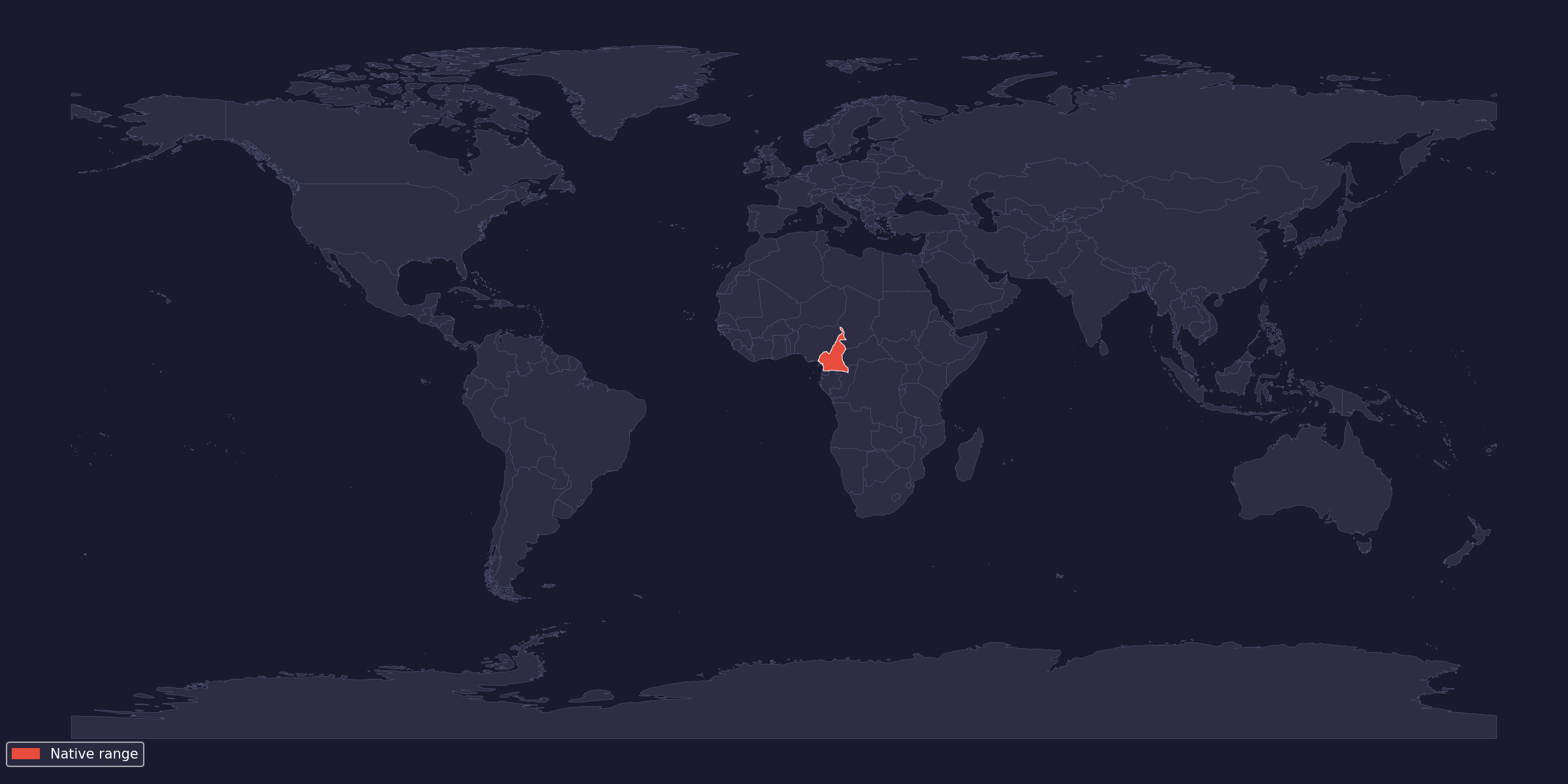
Hysterocrates gigas is native to Cameroon and nearby Central African forest regions. In captivity this points to a deep stable burrow, warm conditions, clean water, and humidity that does not choke ventilation. Do not copy outdoor weather literally; the spider uses protected underground microhabitats.
For keepers, the useful habitat cues are:
- secure retreats and visual cover
- a measured thermal gradient instead of one uniform temperature
- humidity that matches the species without stale wet air
- clean water and predictable hygiene
- enough usable structure for normal movement
The range tells you what problems to solve, not exact weather to copy. Provide shelter, gradients, and clean water so the animal can regulate itself.
🌡 Climate across the native range
Monthly climate normals from reviewed GBIF occurrence locations:
Southwest Region — Cameroon
| Month | Min °C | Mean °C | Max °C | RH % |
|---|---|---|---|---|
| January | 20.5 | 24.4 | 28.4 | 85 |
| February | 20.7 | 24.9 | 29 | 86 |
| March | 20.7 | 24.9 | 29.1 | 87 |
| April | 20.7 | 24.7 | 28.8 | 87 |
| May | 20.5 | 24.3 | 28.1 | 89 |
| June | 20.1 | 23.5 | 26.9 | 89 |
| July | 19.3 | 22.4 | 25.4 | 93 |
| August | 19.6 | 22.4 | 25.2 | 93 |
| September | 19.8 | 22.9 | 26 | 91 |
| October | 20 | 23.4 | 26.8 | 89 |
| November | 20.4 | 24 | 27.6 | 91 |
| December | 20.4 | 24.2 | 28 | 88 |
Northwest Region — Cameroon
| Month | Min °C | Mean °C | Max °C | RH % |
|---|---|---|---|---|
| January | 15.3 | 21.7 | 28.1 | 48 |
| February | 16.1 | 22.7 | 29.4 | 47 |
| March | 17 | 22.7 | 28.4 | 59 |
| April | 16.8 | 21.7 | 26.7 | 72 |
| May | 16.4 | 21.1 | 25.7 | 85 |
| June | 15.5 | 20 | 24.4 | 83 |
| July | 14.8 | 18.9 | 23 | 87 |
| August | 14.6 | 18.6 | 22.7 | 88 |
| September | 14.6 | 19.2 | 23.8 | 84 |
| October | 15.1 | 19.6 | 24.2 | 81 |
| November | 15.6 | 20.8 | 26.1 | 67 |
| December | 14.3 | 20.4 | 26.5 | 58 |
Weather data by WorldClim v2.1 · Monthly normals queried by Herpeton Academy from raster values; relative humidity is derived from vapor pressure and mean temperature.
Location references use GBIF.org occurrence data where available; original occurrence records retain their source dataset licenses.
⚖️ Legal status
As checked against current CITES, Species+ and EU wildlife-trade references on 31 May 2026, no current CITES listing or species-specific EU Annex listing was found for Hysterocrates gigas. The species is outside the scope of the Bern Convention because it is not native to Europe. National and local rules on import, ownership, sale, breeding, transport, animal welfare, and proof of legal origin may still apply.
Keep provenance simple and traceable: seller or breeder name, molt history when known, sexing confidence, advertised locality or parentage, and any transfer or import documents.
🤌 Husbandry
For an adult, plan at least 40 x 30 x 30 cm, with more floor area preferred. The base should be deep, compactable substrate and a stable retreat that cannot be undermined easily. Slings should start in smaller containers and be upgraded gradually. Keep this species singly.
Give more floor area than the minimum when possible, because the spider may build a deep angled retreat and still need space for water and feeding. Pack the substrate firmly in layers. Good moisture does not mean a swampy bottom with a dry crust on top; aim for slightly moister lower layers, drier surface zones, and steady ventilation.
Treat enclosure security as part of husbandry. Test the lid, doors, vents, and access points, then arrange decor so cleaning and feeding can be done without dismantling the retreat.
💡 Lighting
Keep lighting simple: ordinary room light and a consistent day-night cycle are enough. Avoid direct lamps that overheat or dry the enclosure too aggressively. Quarantine new arrivals in a simple secure setup before moving them into a display enclosure.
🌡 Heating and temperature
Practical temperature targets: 24-28 °C by day, with a mild night drop. Measure with reliable instruments. Stable warmth is useful, but overheating and stagnant hot air are more dangerous than a mild night drop. Change one variable at a time and avoid correcting every minor behavior with extra heat or repeated feeding attempts.
💧 Humidity and water
Maintain moderate to moderately high moisture deeper in the substrate, while keeping the surface from staying constantly wet. A dish of clean water should always be available. If the substrate smells, clumps heavily, or constant condensation sits on the glass, the enclosure is too wet.
🌿 Enclosure and decoration
The enclosure should be built around the burrow. Provide deep substrate, a stable bark piece or hide, water access, and enough open working space for maintenance without destroying the main tunnel.
Do not build an aquatic section because of old claims about this species entering water. A shallow water dish and moisture-retentive lower substrate are safer and more useful than standing water. Heavy decor must rest on the enclosure floor or be buried before substrate is added so the spider cannot undermine it and cause a collapse.
🪳 Feeding
Suitable diet: large crickets, roaches, locusts, and other suitable insects matched to body size. Remove uneaten prey and food remains. Feed according to body condition, not only appetite, and avoid leaving live prey during premolt. Missed meals are common; remove prey, review conditions, and try again later rather than leaving insects in the enclosure.
🥚 Breeding
Pairing should be deliberate: mature animals, known identity, room for spiderlings, and a plan to separate adults safely. Do not mix unclear localities or similar species. For defensive Old World species, pairing and separation should be planned before the animals are introduced.
🩺 Common problems
The most common problems are burrow collapse, substrate kept too wet, dehydration, difficult molts, and escapes during deep cleaning. If the animal sits exposed, refuses food for a long time, or looks thin, first check water, temperature, deep substrate moisture, ventilation, and retreat stability.
If a deep clean is unavoidable, plan it like a transfer: catch container, second secure enclosure or tub, long tools, and a clear work area. With a large defensive specimen, slow preparation is safer than quick improvisation. For serious injury, leaking hemolymph, or a difficult molt, seek an exotic-veterinary professional when possible.
📌 Conclusion
Hysterocrates gigas is for a keeper who can provide a deep, stable enclosure and work slowly around a large defensive tarantula. The priorities are a secure burrow, correct substrate moisture, and a safe maintenance plan.
A short log of feeding, molts, water, cleaning, and temperatures helps separate normal hiding from a real problem. Keep the origin documents as well.
📚 Sources and further reading
The husbandry notes above were cross-checked against taxonomy and trade-status references on 31 May 2026. ReptiFiles was checked first as required by the site workflow; no species-specific ReptiFiles care page was found for this species at the time of review.
- GBIF species backbone entry for Hysterocrates gigas
- World Spider Catalog species entry for Hysterocrates gigas
- CITES Checklist of Species
- EU wildlife trade overview
- Bern Convention appendices