Share

Heteroscodra maculata
🔤 Taxonomy
Heteroscodra maculata is the name used for the animal covered here. The species is usually sold under Heteroscodra maculata; older common names vary widely. Use the Latin name when comparing labels, origin documents, and close relatives.
Names used in the hobby:
- Togo starburst baboon
- Togo-Starburst-Vogelspinne
📌 Description
Heteroscodra maculata is a very fast Old World arboreal tarantula. In nature it uses bark, hollow wood, and densely webbed retreats in warm, humid parts of West Africa. Adults are usually about 5-6 cm body length and 12-15 cm legspan. Females often live 10-12 years, while mature males live much shorter lives.
In captivity, this species does not need a tall empty box. It does best with a vertical cork tube, curved bark, or other tall retreat around which it can build webbing. From that retreat it should be able to reach water, prey, and warmer or cooler areas without being forced to sit in the open.
Before buying one, prepare the adult enclosure, secure access points, long tools, and a rehousing plan. Improvising during maintenance is how this species ends up loose.
Good care means a secure retreat, stable warmth, clean water, moderate humidity with good ventilation, and minimal disturbance.
☠️ Venom
Bites are possible and should be avoided. Tarantula venom can cause pain, swelling, cramps, nausea, or stronger reactions in sensitive people, so this is a display animal, not a handling animal.
🌍 Distribution
Heteroscodra maculata is native to West Africa; in the hobby, animals are often associated with Ghana, Togo, and Benin-region material. In captivity this means a warm, well ventilated enclosure with a permanent retreat, clean water, and moderate humidity rather than a constantly wet environment.
A practical captive setup should provide:
- secure retreats and visual cover
- a measured thermal gradient instead of one uniform temperature
- humidity that matches the species without stale wet air
- clean water and predictable hygiene
- enough usable structure for normal movement
Outdoor climate data is only a starting point. In the wild these spiders use protected retreats; captivity should reproduce that choice rather than one flat set of conditions.
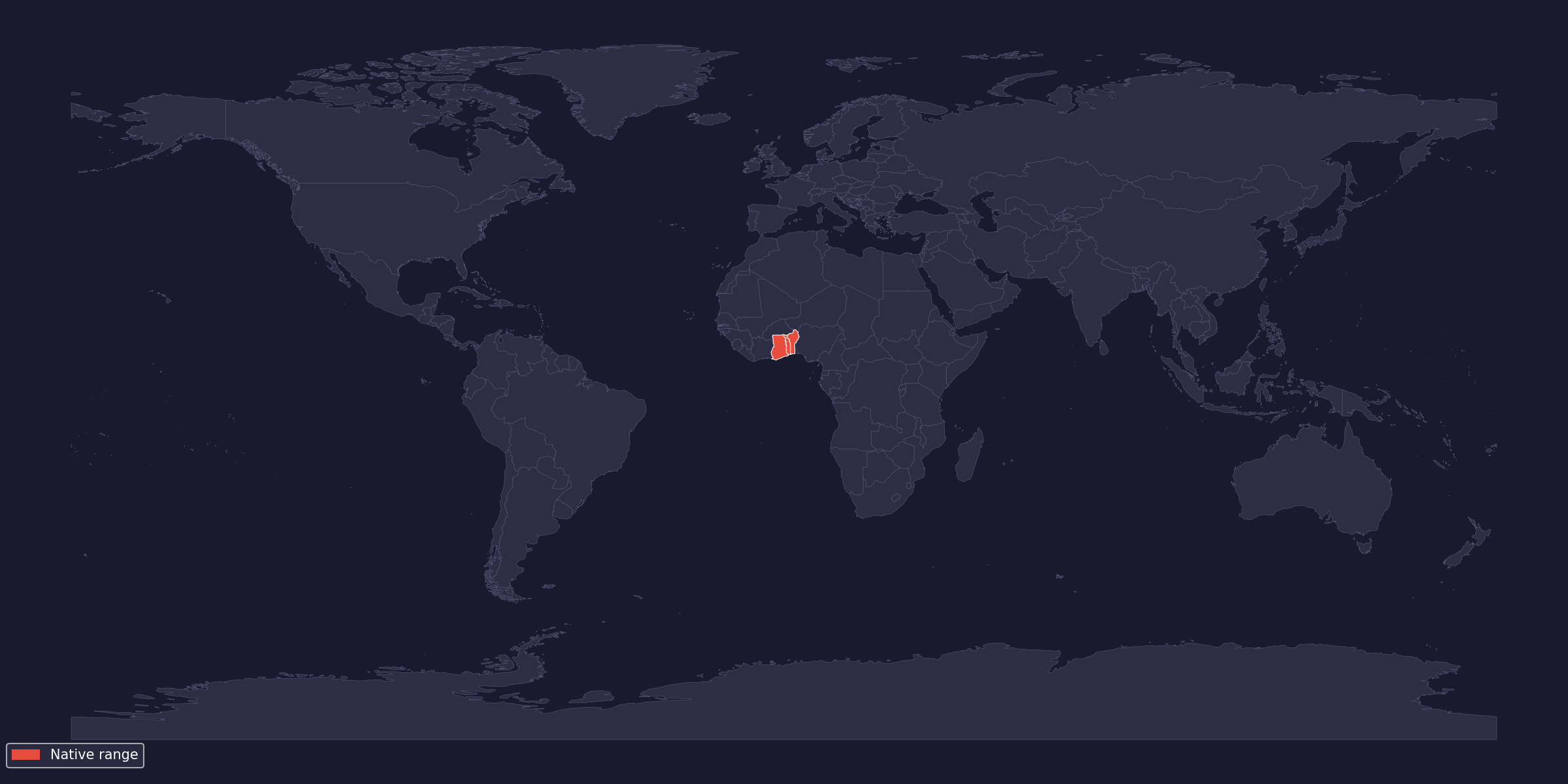
🌡 Climate across the native range
Monthly climate normals from reviewed GBIF occurrence locations:
Atlantique — Benin
| Month | Min °C | Mean °C | Max °C | RH % |
|---|---|---|---|---|
| January | 23.1 | 27.6 | 32.1 | 74 |
| February | 24.4 | 28.7 | 33 | 76 |
| March | 24.8 | 28.8 | 32.9 | 78 |
| April | 24.4 | 28.4 | 32.4 | 81 |
| May | 24 | 27.7 | 31.5 | 83 |
| June | 23.2 | 26.4 | 29.7 | 86 |
| July | 22.7 | 25.5 | 28.2 | 87 |
| August | 22.4 | 25.2 | 27.9 | 86 |
| September | 22.8 | 26.1 | 29.3 | 84 |
| October | 22.9 | 26.6 | 30.2 | 85 |
| November | 23.6 | 27.6 | 31.6 | 82 |
| December | 23.1 | 27.5 | 31.8 | 78 |
Ghana
| Month | Min °C | Mean °C | Max °C | RH % |
|---|---|---|---|---|
| January | 21.3 | 26.3 | 31.3 | 73 |
| February | 22.4 | 27.5 | 32.6 | 73 |
| March | 22.8 | 27.5 | 32.3 | 77 |
| April | 23 | 27.4 | 31.8 | 79 |
| May | 23.1 | 27.1 | 31.2 | 80 |
| June | 22.5 | 25.9 | 29.3 | 84 |
| July | 22.1 | 25 | 27.9 | 84 |
| August | 21.8 | 24.7 | 27.5 | 84 |
| September | 22.2 | 25.4 | 28.6 | 83 |
| October | 22.4 | 26.1 | 29.8 | 82 |
| November | 22.3 | 26.6 | 31 | 81 |
| December | 22 | 26.4 | 30.8 | 79 |
Weather data by WorldClim v2.1 · Monthly normals queried by Herpeton Academy from raster values; relative humidity is derived from vapor pressure and mean temperature.
Location references use GBIF.org occurrence data where available; original occurrence records retain their source dataset licenses.
⚖️ Legal status
As checked against current CITES, Species+, and EU wildlife-trade references on 31 May 2026, no current CITES listing or species-specific EU Annex listing was found for Heteroscodra maculata. The species is outside the scope of the Bern Convention because it is not native to Europe. National and local rules on import, sale, breeding, transport, animal welfare, and proof of legal origin may still apply.
Before purchase, ask for seller or breeder details, molt history when known, sexing confidence, stated locality or parentage, and provenance documents.
🤌 Husbandry
For an adult, plan at least 20 x 20 x 30 cm, with a larger secure enclosure preferred where practical. The core of the setup should be a vertical cork tube or bark slab, firmly anchored and wide enough to function as a retreat. Slings should start smaller so they can find prey easily. Keep one tarantula per enclosure.
Use a front-opening or carefully controlled top-opening enclosure and plan all access points before the spider arrives. Anchor cork securely so it cannot rotate or fall, and leave a service gap that lets you refill water and remove remains without dismantling the web. If the spider repeatedly rests on the lid or exposed glass, review cover, ventilation, heat, and disturbance before assuming the enclosure is too small.
Make routine work predictable. Secure the lid and vents, remove collapse risks, and plan feeding, watering, and cleaning so the enclosure is never held open longer than necessary.
💡 Lighting
Use ambient room light for a predictable day-night cycle; bright basking lamps are unnecessary. Avoid direct lamps that overheat or dry the enclosure too aggressively.
A short quarantine period is useful for observation: feeding response, hydration, waste, mites, injuries, and general posture are easier to read in a simple secure enclosure.
🌡 Heating and temperature
Practical temperature targets: 24-28 °C by day, slight night drop acceptable. Measure with reliable instruments. Stable warmth is useful, but overheating and stagnant hot air are more dangerous than a mild night drop.
Seasonal changes should be small and deliberate. Appetite, activity, and hiding can shift, but large swings in heat or moisture are a poor substitute for stable husbandry.
💧 Humidity and water
Keep humidity moderate to moderately high, but only with good ventilation. A dish of clean water should always be available. Lightly moistening part of the substrate or the area near the retreat is enough; wet walls, condensation, and heavy stale air mean the conditions are wrong.
🌿 Enclosure and decoration
Design the enclosure around vertical cover and safe access. The spider needs routes and web anchors, but the keeper also needs a clear way to refill water and remove remains without opening the whole enclosure.
A good adult enclosure has more height than a terrestrial setup, but it should not be a bare tall box. Give a vertical cork tube or curved bark, bark-to-wall web anchors, leaf cover, and a water dish that can be serviced from the safest door. Keep the substrate modest but not sterile; it buffers humidity and catches waste without turning the enclosure into a wet chamber.
🪳 Feeding
Suitable diet: crickets, roaches, locusts, and other suitable insects offered with escape prevention in mind. Remove uneaten prey and food remains. Feed according to body condition, not only appetite, and avoid leaving live prey during premolt.
A fasting tarantula may be normal if body condition remains good. Escalate only when refusal comes with weight loss, dehydration, weakness, or obvious enclosure problems.
🥚 Breeding
Breed only mature, established animals with clear identity, and plan housing for the offspring before pairing. Avoid hybrids and uncertain locality crosses.
🩺 Common problems
The riskiest moments with Heteroscodra maculata are usually maintenance moments. If every water refill or cleanup requires the enclosure to be wide open, the chance of a sudden bolt and escape is high. Place the water dish and feeding area where they can be reached with minimal opening and without tearing apart the main webbed retreat.
Watch for stale humid air, mold around food remains, a visibly shrunken abdomen, long periods exposed during the day, and difficult molts. Falls are also a real risk in a tall enclosure, so avoid hard or sharp objects below the spider’s normal routes along cork and glass.
A bite from this species should be avoided, not treated as a routine part of care. For serious injury, leaking hemolymph, severe weakness, breathing signs, or a difficult molt, seek an exotic-veterinary professional when possible. For rehousing, use a prepared catch container or controlled tube method; do not chase the spider across an open room.
📌 Conclusion
Heteroscodra maculata is for keepers who can work calmly around a fast defensive arboreal tarantula. The most important parts of care are a secure vertical enclosure, safe maintenance access, and the habit of planning every opening in advance.
Keep provenance documents and short notes on feeding, molts, water, cleaning, and temperatures. Those records are more useful than trying to read every hidden period as a problem.
📚 Sources and further reading
The husbandry notes above were cross-checked against taxonomy and trade-status references on 31 May 2026. ReptiFiles was checked first as required by the site workflow; no species-specific ReptiFiles care page was found for this species at the time of review.
- GBIF species backbone entry for Heteroscodra maculata
- World Spider Catalog species entry for Heteroscodra maculata
- CITES Checklist of Species
- EU wildlife trade overview
- Bern Convention appendices