Share

Harpactira namaquensis
🔤 Taxonomy
Harpactira namaquensis Purcell, 1902 is the currently accepted scientific name in the World Spider Catalog. No taxonomic synonym important to ordinary hobby records is currently listed, so provenance should stay under this exact name.
English common names used in the hobby:
- Namaqua baboon spider
- Namaqua bronze baboon tarantula
German common names used in the hobby:
- Namaqua-Vogelspinne
The common names are useful for trade recognition, but the Latin name is safer for records. Similar “baboon” tarantulas in African genera can look superficially alike as slings.
📌 Description
Harpactira namaquensis is a sandy brown to bronze Old World baboon spider from the arid southwest of Africa. Its muted pattern is camouflage for pale soil and rocky ground, not the blue-legged coloration of H. pulchripes. It spends much of its time in or near a silk-lined burrow and may disappear for long periods after disturbance.
Adult females commonly reach about 5-6 cm body length and roughly 10-13 cm diagonal leg span. Reliable species-specific longevity data are limited; a conservative planning range is up to about 12-15 years for females, with mature males much shorter-lived.
Like other African baboon spiders, it lacks New World urticating hairs and relies on retreat, speed, threat posture, and biting. Individual temperament varies, but its ability to bolt rapidly means it is appropriate only for keepers already comfortable with catch cups, long tongs, and planned Old World rehousing.
Occasionally described as comparatively reserved for an Old World species, it must not be sold as harmless or beginner-safe. A calm individual can still react instantly when its tunnel is opened.
☠️ Venom
There is no robust human bite series for H. namaquensis, so claims about exact venom potency are uncertain. The safe position is to treat every bite as potentially medically significant. Clinical literature on African and other Old World theraphosids documents severe local pain and, in some cases, delayed or prolonged muscle cramps and systemic symptoms; the fangs can also produce deep punctures.
Never handle or hand-feed this species. Arrange maintenance so the spider always has a retreat and the keeper never places a hand between it and that retreat. After a bite, wash the wound and contact a poison centre or medical service; seek urgent help for breathing difficulty, widespread pain, repeated cramps, weakness, vomiting, or a bite involving a child or vulnerable person. No species-specific antivenom is used in routine treatment.
🌍 Distribution
The World Spider Catalog records H. namaquensis from Namibia and South Africa. Its name refers to Namaqualand, the dry region spanning southern Namibia and South Africa’s Northern and Western Cape. Museum and modern GBIF records include Namaqualand localities and drier inland Western Cape sites. The spider uses compact soil burrows to escape exposed heat, cold nights, and very low surface humidity.
The care setup should reflect those conditions with:
- a low terrestrial enclosure with more floor space than height
- enough substrate for digging or reshaping a retreat
- dry to moderately dry surface conditions with a water dish available
- strong ventilation and stable warm room temperatures
- fall prevention, because heavy terrestrial tarantulas are easily injured
Arid origin does not mean the enclosure should be dehydrating. Wild burrows buffer temperature and moisture, so captive care should offer a dry surface, fresh water, and a small, adjustable moisture reserve below the surface rather than an evenly damp terrarium.
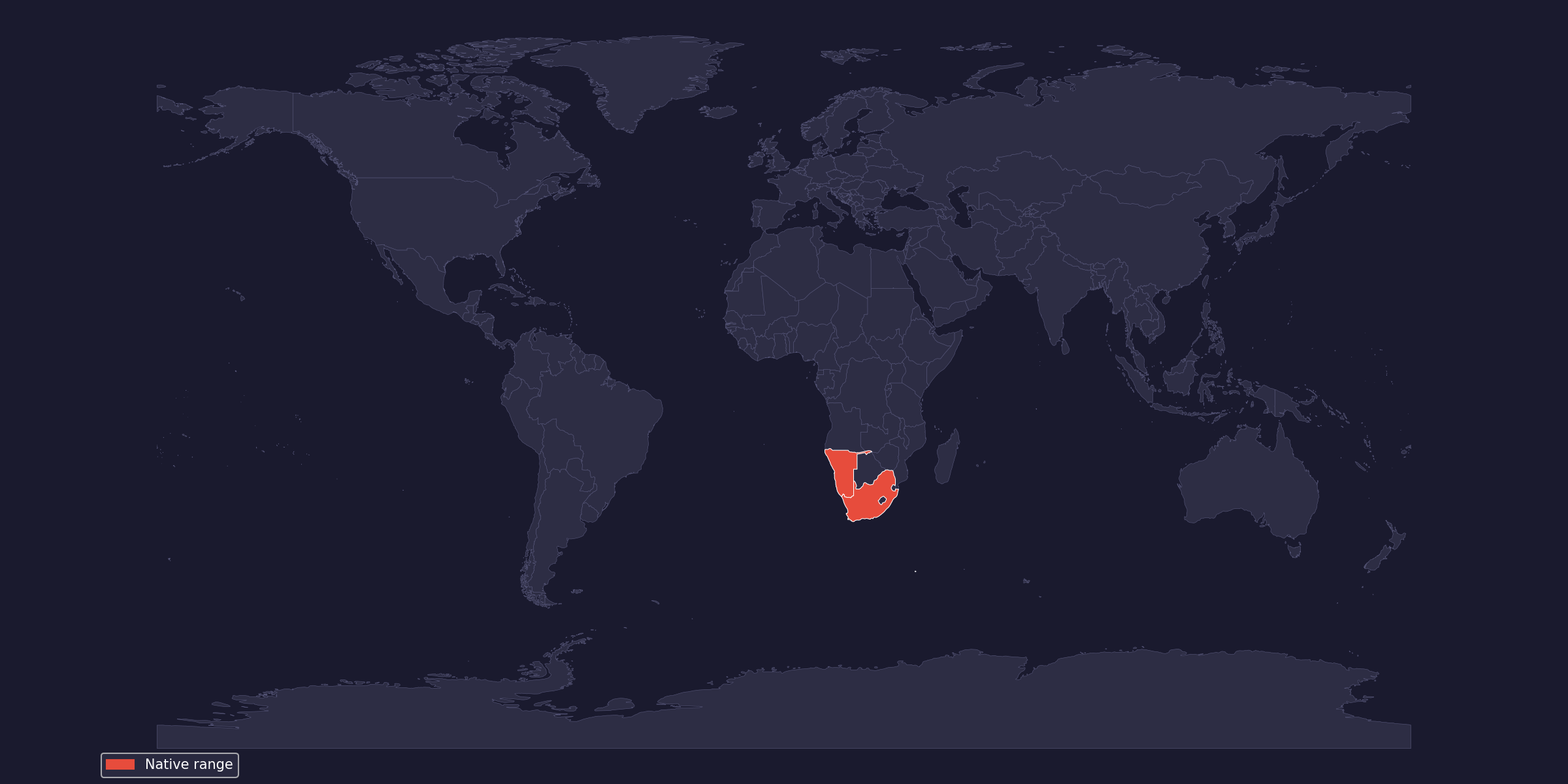
🌡 Climate across the native range
Monthly climate normals from reviewed GBIF occurrence locations:
Okiep, Namaqualand — Northern Cape — South Africa
| Month | Min °C | Mean °C | Max °C | RH % |
|---|---|---|---|---|
| January | 14.5 | 22.6 | 30.6 | 48 |
| February | 15 | 22.7 | 30.5 | 49 |
| March | 14.5 | 21.8 | 29.2 | 48 |
| April | 12.4 | 19.5 | 26.6 | 49 |
| May | 10.1 | 16.6 | 23.1 | 52 |
| June | 8.1 | 14.2 | 20.4 | 52 |
| July | 7.5 | 13.7 | 19.9 | 51 |
| August | 7.4 | 14 | 20.6 | 52 |
| September | 8.6 | 15.8 | 22.9 | 50 |
| October | 10.5 | 18 | 25.6 | 47 |
| November | 12 | 19.7 | 27.5 | 47 |
| December | 13.5 | 21.3 | 29.1 | 49 |
Western Cape — South Africa
| Month | Min °C | Mean °C | Max °C | RH % |
|---|---|---|---|---|
| January | 13.5 | 21.3 | 29.2 | 47 |
| February | 13.7 | 21.1 | 28.6 | 50 |
| March | 12 | 19.1 | 26.2 | 53 |
| April | 8.5 | 15.6 | 22.6 | 55 |
| May | 5.2 | 12 | 18.9 | 52 |
| June | 2.7 | 9.4 | 16.2 | 51 |
| July | 1.8 | 8.8 | 15.8 | 48 |
| August | 2.8 | 10.2 | 17.6 | 44 |
| September | 4.9 | 12.5 | 20.2 | 42 |
| October | 7.7 | 15.3 | 22.9 | 45 |
| November | 10.2 | 17.7 | 25.3 | 45 |
| December | 12.5 | 20.3 | 28 | 45 |
Weather data by WorldClim v2.1 · Monthly normals queried by Herpeton Academy from raster values; relative humidity is derived from vapor pressure and mean temperature.
Location references use GBIF.org occurrence data where available; original occurrence records retain their source dataset licenses.
⚖️ Legal status
The official CITES Appendices and the EU annexes in Regulation (EU) 2026/1383 were checked on 5 August 2026. Harpactira namaquensis is not CITES-listed and no species-specific entry was found in EU Annexes A-D. It is not relevant to the Bern Convention because it is not native to Europe.
Local rules on import, sale, transport, and proof of legal origin may still apply. Captive-bred stock is preferable.
Keep purchase records and advertised locality or breeder-line information. This is especially useful for African theraphosids, where trade names are less stable than scientific labels.
🤌 Husbandry
This species should be kept alone in a secure fossorial setup. A practical adult enclosure is about 30 x 30 x 30 cm, with more emphasis on substrate depth and a safe working layout than on empty height.
Small juveniles do best in modest, secure rearing tubs at first; upgrade gradually instead of putting a tiny spider straight into an adult display enclosure.
Useful basics include:
- Deep packed substrate
- A starter burrow or hide
- Strong lid security
- Good cross ventilation
- Minimal disturbance
For slings, provide a starter burrow against the side of the cup so hydration and molts can be monitored without destroying the retreat. Adults should receive 12-15 cm or more of compacted unfertilized soil, coco fibre, and clay or fine sand, with cork angled into the substrate. The mix must hold a tunnel; pure loose sand is unsafe because it collapses. Quarantine a new spider for at least 60-90 days, ideally away from the main collection, with separate tools and records for prey acceptance, molts, waste, and mites.
Work with the enclosure closed whenever possible. Open it only after the animal has a clear retreat path and a catch cup is ready.
💡 Lighting
Ambient room lighting is sufficient, with no need for UVB or basking lamps.
Strong lighting is unnecessary and may increase stress.
🌡 Heating and temperature
Suitable approximate temperatures are:
- Daytime: around 22-27°C
- Night: around 18-22°C is acceptable
Avoid chronic overheating. Moderate warmth is safer than pushing very hot conditions, especially in small rearing containers where a heat source can dry the entire setup quickly.
💧 Humidity and water
This species is generally best kept on the drier side with fresh water available. A room reading around 45-60% RH is a useful check, but substrate condition and ventilation matter more than chasing a single number.
Useful principles:
- Mostly dry upper substrate
- Water dish always present
- Avoid frequent heavy spraying
- Slightly more stable moisture lower down if needed
Overflowing the water dish occasionally into one corner is usually safer than misting the whole enclosure. The spider should be able to choose between a dry surface and a more buffered burrow zone.
🌿 Enclosure and decoration
The enclosure should support burrowing and retreat behavior.
Useful elements include:
- Deep compact substrate
- Cork bark or a pre-started burrow
- A shallow water bowl
- Minimal stable decoration
Tall decor and fall hazards should be avoided.
This species may web around the burrow entrance and anchor points. Leave that structure in place unless it is moldy or blocks safe access to water.
🪳 Feeding
Harpactira namaquensis is insectivorous.
Suitable foods include:
- Crickets
- Roaches
- Locusts where available
- Mealworms in moderation
As a rough guide, feed slings every 3-5 days, juveniles once or twice weekly, and adults every 7-14 days when body condition supports it.
Do not leave live prey with a spider that has sealed itself in for premolt. A missed meal is normal; prey damage during molt is preventable.
🩺 Common problems
Common problems include dehydration from missing water, overheating, insecure lids, and stress from excessive disturbance.
Warning signs include:
- Persistent frantic climbing
- Wrinkled abdomen
- Weak posture
- Failed molt
- Refusal to eat combined with decline
Most problems come from three preventable causes: escape opportunities during maintenance, overheating in a dry setup, or a retreat that is too exposed for the animal to settle.
Because this is a fast Old World species, interventions should stay calm and minimal. Visible injury or severe molt trouble needs experienced help.
📌 Conclusion
Harpactira namaquensis is a rewarding display baboon tarantula when the keeper plans for speed, deep substrate, dry-surface husbandry, and secure maintenance. It should be bought for its behavior and long-term care needs, not only for its color.
📚 Sources and further reading
- World Spider Catalog — Harpactira namaquensis — accepted name and Namibia-South Africa range
- GBIF — Harpactira namaquensis — taxonomy and reviewed occurrence records used for climate context
- South African National Survey of Arachnida atlas — documented South African localities
- The Tarantula Collective — Harpactira pulchripes care — explicitly comparative genus-level substrate and burrow guidance; not evidence for species-specific limits
- Fuchs et al. 2010 — muscle spasms after Old World tarantula bites — clinical risk context; not a species-specific bite series
- Official CITES Appendices and Regulation (EU) 2026/1383 — legal status checked 5 August 2026