Share

Ephebopus rufescens
🔤 Taxonomy
Ephebopus rufescens is the accepted scientific name for this South American theraphosid. The genus Ephebopus is useful to keep separate from ordinary New World terrestrial tarantulas because its defensive urticating setae are carried on the palps rather than only on the abdomen.
English common names used in the hobby:
- Red skeleton tarantula
- Burgundy skeleton tarantula
- Red skeleton
📌 Description
Ephebopus rufescens is a medium-sized fossorial New World tarantula with reddish to burgundy leg markings, a strong feeding response, and a much more secretive routine than many display tarantulas. Adults are usually around 11-14 cm legspan, with females living much longer than mature males.
This is not a handling species. The spider should be planned as a burrow animal that may be visible only at the entrance, especially after it settles. The main care decisions are deep substrate, stable moisture below the surface, enough ventilation, and maintenance that does not force the tarantula out of its retreat.
☠️ Venom
The venom is not usually treated as medically significant in the same way as many Old World tarantulas, but a bite can still be painful and should be avoided. Defensive hair exposure is also a real concern. Ephebopus species can rub urticating setae from the palps, so face, eyes, and airways need protection during maintenance.
🌍 Distribution
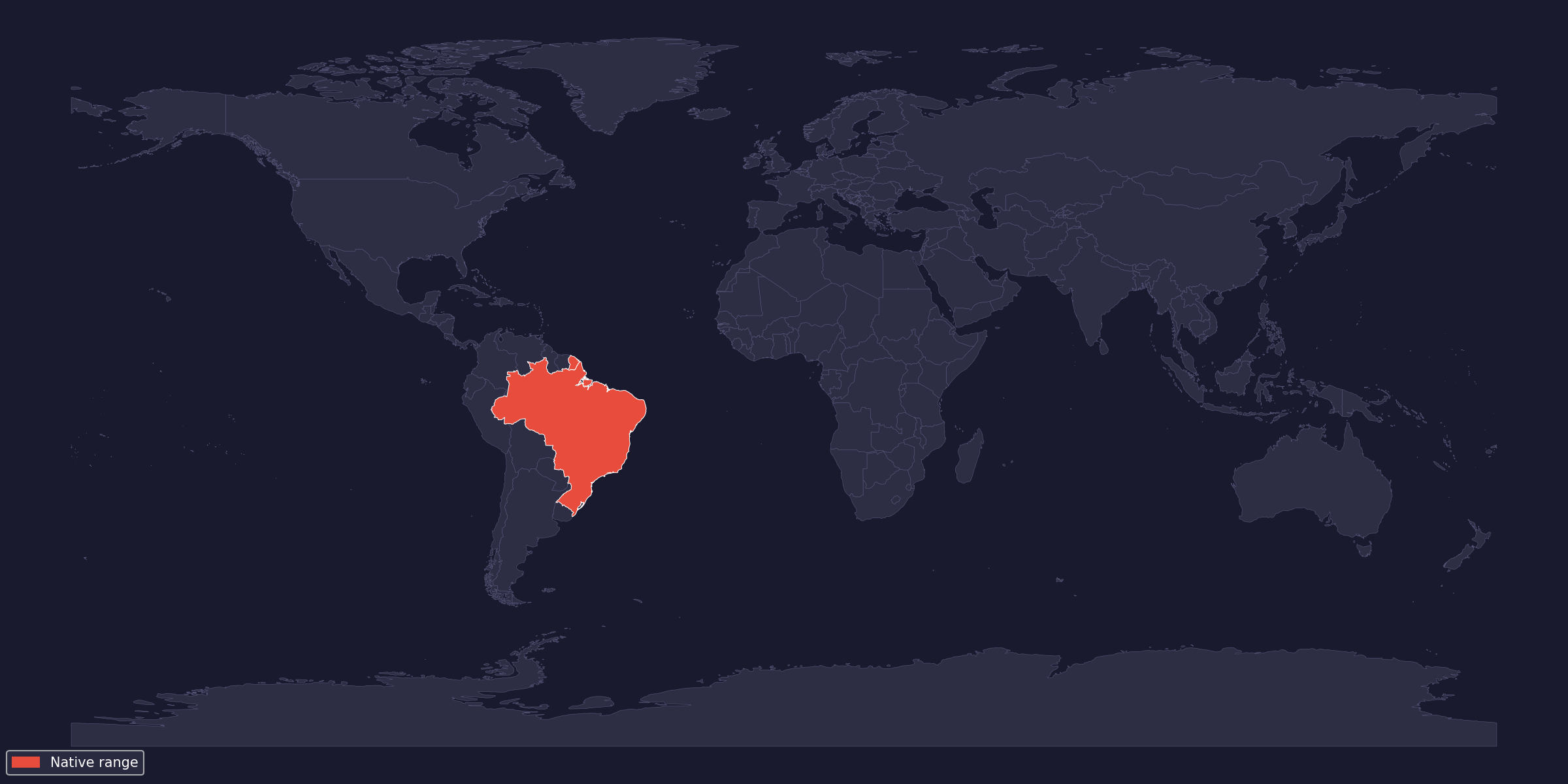
Ephebopus rufescens is recorded from French Guiana and Brazil. In captivity it should be kept as a humid forest-floor burrower, not as an open dry terrestrial tarantula.
The enclosure should give the spider a firm, deep substrate column, a protected starter burrow, clean water, and a surface that can dry between moisture additions. A shallow display cage with only a thin substrate layer removes the behavior that keeps this species secure.
🌡 Climate across the native range
Monthly climate normals from reviewed GBIF occurrence locations:
Cayenne — French Guiana (reviewed GBIF occurrence)
| Month | Min °C | Mean °C | Max °C | RH % |
|---|---|---|---|---|
| January | 21.2 | 23.3 | 26.6 | 88 |
| February | 21.3 | 23.4 | 26.7 | 86 |
| March | 21.5 | 23.8 | 27.3 | 85 |
| April | 21.7 | 23.9 | 27.4 | 87 |
| May | 21.6 | 23.7 | 27.2 | 91 |
| June | 21.2 | 23.5 | 27.2 | 91 |
| July | 21 | 23.7 | 27.8 | 89 |
| August | 21.2 | 24.4 | 28.8 | 86 |
| September | 21.6 | 25.2 | 30 | 82 |
| October | 21.9 | 25.4 | 30.4 | 81 |
| November | 21.8 | 24.7 | 29 | 85 |
| December | 21.5 | 23.7 | 27.3 | 89 |
Amapá — Brazil (reviewed GBIF occurrence)
| Month | Min °C | Mean °C | Max °C | RH % |
|---|---|---|---|---|
| January | 20.7 | 23.1 | 27.2 | 85 |
| February | 20.6 | 23.1 | 27.3 | 85 |
| March | 20.8 | 23.5 | 27.9 | 83 |
| April | 21 | 23.5 | 27.9 | 86 |
| May | 21 | 23.4 | 27.6 | 88 |
| June | 20.6 | 23.3 | 27.5 | 87 |
| July | 20.2 | 23.5 | 27.9 | 84 |
| August | 20.5 | 24.5 | 29.5 | 77 |
| September | 21.1 | 25.9 | 31.7 | 66 |
| October | 21.5 | 26.3 | 32.1 | 64 |
| November | 21.6 | 25.7 | 31.1 | 69 |
| December | 21.2 | 24.3 | 28.9 | 79 |
Amazonas — Brazil (reviewed GBIF occurrence)
| Month | Min °C | Mean °C | Max °C | RH % |
|---|---|---|---|---|
| January | 23.1 | 25.4 | 28.8 | 87 |
| February | 23.1 | 25.3 | 28.7 | 88 |
| March | 23.2 | 25.3 | 28.8 | 88 |
| April | 23.1 | 25.2 | 28.6 | 89 |
| May | 23 | 25.2 | 28.5 | 89 |
| June | 22.7 | 25.2 | 28.7 | 87 |
| July | 22.6 | 25.4 | 29.2 | 85 |
| August | 23.1 | 26.3 | 30.4 | 82 |
| September | 23.5 | 26.7 | 30.9 | 82 |
| October | 23.9 | 26.9 | 30.9 | 82 |
| November | 23.8 | 26.4 | 30.2 | 85 |
| December | 23.4 | 25.8 | 29.2 | 87 |
Weather data by Open-Meteo.com · CC BY 4.0 · Monthly normals calculated by Herpeton Academy from daily archive values.
Location references use GBIF.org occurrence data where available; original occurrence records retain their source dataset licenses.
⚖️ Legal status
As checked against current official CITES Appendices and EU wildlife-trade references on 2026-06-03, no current CITES listing or species-specific EU Annex listing was found for Ephebopus rufescens. The species is not relevant to the Bern Convention because it is not native to Europe.
National and local rules on import, sale, transport, exhibition, breeding, animal welfare, and proof of legal origin may still apply. Keep invoices, seller details, import or transfer records, and the scientific name with the animal.
🤌 Husbandry
House Ephebopus rufescens alone. Start young animals in small secure containers with enough depth to dig and enough access to prey that food is not lost in a large setup.
For an adult, plan a low enclosure around 30 x 30 x 30 cm or larger, with much of the height used as substrate depth. A cork-bark starter hide pressed partly into the substrate helps the spider establish a safe burrow. Leave the burrow structure alone unless it collapses, molds badly, or traps waste.
Useful care priorities:
- Deep compact substrate
- Tight starter hide
- Constant fresh water
- Ventilation without drying the burrow
- Catch cup ready before opening
💡 Lighting
No specialist lighting or UVB is required. A normal room day-night rhythm is enough. Strong lamps over a small humid enclosure can overheat the surface and dry the burrow entrance too quickly.
🌡 Heating and temperature
Keep the enclosure at about 23-27°C by day, with nights around 20-23°C. Stable warm room temperatures are safer than a hot spot.
Avoid heating from below. A burrowing tarantula retreats downward to regulate itself; an under-tank heater can make the safest area the hottest and driest part of the enclosure.
💧 Humidity and water
Aim for roughly 70-85% relative humidity with good airflow. The lower substrate should hold moisture, while the surface should not stay wet and stale.
A water dish should always be available for juveniles and adults. Instead of frequent heavy spraying, moisten one side or pour water near the dish so moisture moves down through the substrate. Let the surface breathe.
🌿 Enclosure and decoration
Use compact coco fiber, unfertilized soil, or a soil/clay mix that can support a tunnel. Add cork bark, leaf litter, and a few anchor points near the burrow entrance, but avoid heavy rocks that can shift.
Keep fall height low. Even a medium tarantula can be injured if it climbs slick walls and falls onto hard decor.
🪳 Feeding
Feed appropriately sized roaches, crickets, locusts where legal, and similar feeder insects. Young animals may take smaller prey more often; adults usually do well with one suitable item every 7-14 days, adjusted for abdomen size and molt cycle.
Offer prey near the burrow entrance and remove uneaten insects. Do not leave live prey in the enclosure when the spider is sealed in or likely to molt.
🩺 Common problems
Common problems include collapsed burrows, stale wet substrate, dehydration from a dry lower layer, hair irritation, and escapes during maintenance. A hidden tarantula is not automatically a sick tarantula; repeated digging-out usually creates more stress than it solves.
A tarantula on its back is usually molting and should not be touched. For falls, leaking hemolymph, failed molts, or serious dehydration, keep handling minimal and consult an experienced exotic-animal veterinarian or arachnid keeper where possible.
📌 Conclusion
Ephebopus rufescens suits keepers who want to maintain a secretive, defensive, humid-burrow tarantula and are comfortable seeing only part of the animal much of the time. Buy it for its behavior and enclosure design, not for handling or constant display.
📚 Sources and further reading
- GBIF species backbone entry for Ephebopus rufescens
- World Spider Catalog
- CITES Appendices — legal-status reference checked 2026-06-03
- EU wildlife trade overview — legal-status reference checked 2026-06-03
- Bern Convention appendices