Share

Dolichothele diamantinensis
🔤 Taxonomy
Dolichothele diamantinensis is the currently accepted scientific name. The species was originally described as Oligoxystre diamantinensis and was later transferred to Dolichothele. That older combination still appears in older listings and care notes.
Older names and combinations associated with this species include:
- Oligoxystre diamantinensis
English common names used in the hobby:
- Brazilian blue dwarf beauty
- Brazilian blue beauty
- Blue diamond tarantula
- Dwarf green bottle blue
📌 Description
Dolichothele diamantinensis is a small, bright, fast-moving New World tarantula from Brazil. It is famous for blue legs, a greenish-blue carapace, orange to reddish abdominal hairs, and dense web tunnels. It offers strong display value in a compact enclosure, but it is not a handling spider and is usually better for keepers who already understand fast slings and web-heavy setups.
Adults are much smaller than the large terrestrial species many keepers start with, often around 8-10 cm legspan. Males mature quickly and live much shorter lives, while females can live many years when kept stable.
This species is often compared with Chromatopelma cyaneopubescens because of its colors and webbing. The care style is not identical: D. diamantinensis is smaller, faster, and often builds low tunnels and webbed retreats around bark, substrate, and anchor points rather than using a broad dry display enclosure alone.
It is a New World tarantula, but keepers should not rely on urticating hairs as the main risk signal. The practical concerns are speed, escape, dehydration in tiny slings, and poor ventilation if the enclosure is kept too wet.
☠️ Venom
This species is venomous. Venom exposure can cause pain, swelling or other systemic effects, and severity varies with species, locality, bite site and the amount delivered. A small wound or apparently dry bite is not proof of safety; every bite or sting requires urgent medical assessment.
If an incident occurs, move away, call emergency services or a poison centre, keep the patient still, remove rings and other constricting items, and follow dispatcher instructions. Do not use a tourniquet, cut or suck the wound, apply ice or electricity, give alcohol or medicines as a home treatment, or attempt to catch the animal. Antivenom choice and dosing are hospital decisions; verify the relevant product and local availability in advance. Sources: WHO snakebite guidance and appropriate species-specific toxinology or medical references listed below.
🌍 Distribution
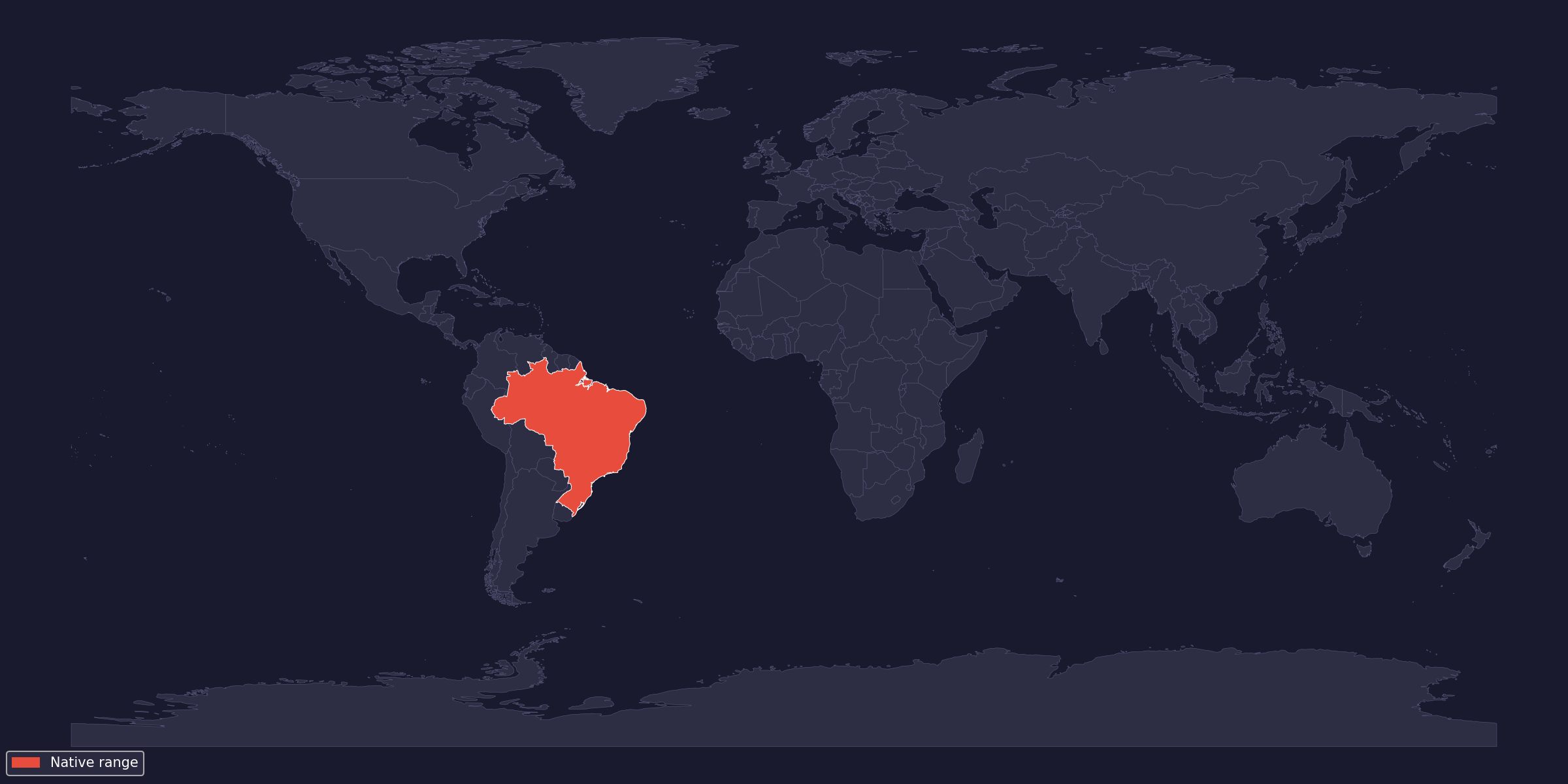
The World Spider Catalog lists Dolichothele diamantinensis from Brazil. The original description and later hobby material connect the species with rocky, open Brazilian habitats where spiders can use crevices, low retreats, and webbed shelter.
In captivity, the useful habitat cues are:
- a low secure enclosure
- dry to moderately dry surface conditions
- a water dish and a small moisture zone
- cork, bark, twigs, or plants as web anchors
- enough substrate for shallow burrowing and tunnel building
- ventilation strong enough to prevent mold in heavy webbing
🌡 Climate across the native range
Monthly climate normals from reviewed GBIF occurrence locations:
Diamantina region, Minas Gerais — Brazil
| Month | Min °C | Mean °C | Max °C | RH % |
|---|---|---|---|---|
| January | 15.2 | 20.5 | 25.8 | 80 |
| February | 15.7 | 20.7 | 25.6 | 78 |
| March | 15.8 | 20.5 | 25.2 | 80 |
| April | 14.2 | 19.1 | 23.9 | 79 |
| May | 12.7 | 18 | 23.4 | 78 |
| June | 10.3 | 16.2 | 22 | 75 |
| July | 9.5 | 15.5 | 21.5 | 73 |
| August | 10.6 | 16.8 | 23 | 69 |
| September | 12.2 | 18 | 23.8 | 71 |
| October | 14.2 | 19.4 | 24.6 | 74 |
| November | 15.2 | 19.8 | 24.4 | 80 |
| December | 15.2 | 20 | 24.8 | 82 |
Weather data by WorldClim v2.1 · Monthly normals queried by Herpeton Academy from raster values; relative humidity is derived from vapor pressure and mean temperature.
Location references use GBIF.org occurrence data where available; original occurrence records retain their source dataset licenses.
⚖️ Legal status
As checked against current official CITES and EU wildlife-trade references on 2026-06-04, no current CITES listing or specific EU Annex listing was found for Dolichothele diamantinensis. The species is not relevant to the Bern Convention because it is not native to Europe.
This does not remove the need for legal sourcing. Local rules on import, sale, transport, exhibition, breeding, and proof of origin may still apply. Keep purchase records and breeder information, especially because small colorful tarantulas are frequently moved through online trade.
🤌 Husbandry
House this species alone. It is not a communal tarantula.
Spiderlings are tiny, quick, and easy to lose. Start them in small, escape-proof containers with air holes that cannot be widened by chewing feeders or warped plastic. Add a small piece of cork, a few web anchors, and a lightly damp corner. Do not place a tiny sling into a large enclosure where feeding and hydration cannot be monitored.
Juveniles and adults can be kept in low terrestrial enclosures with enough anchor points for web tunnels. A 25 x 25 x 25 cm enclosure is workable for many adults; a larger enclosure can be used if it remains secure and the spider can find prey.
A good setup includes:
- 8-12 cm of substrate where possible
- cork bark partly buried into the substrate
- twigs, bark pieces, or artificial plants for webbing
- a small water dish
- cross-ventilation
- low fall risk
Expect the spider to cover much of the enclosure in silk. This is normal and should not be constantly removed.
💡 Lighting
No UVB or specialist lighting is required. Use a normal room day-night cycle. Strong lamps are unnecessary and can dry small enclosures too quickly.
🌡 Heating and temperature
Aim for steady warm room temperatures around 21-27°C. A mild night drop to about 19-22°C is acceptable. The spider is small, so enclosure temperatures can change quickly; avoid direct lamps or heat mats that create a hot dry patch against the webbed retreat.
If extra heat is needed, warm the room or shelf rather than the enclosure wall. Always check the temperature at the level where the main web tunnel sits.
💧 Humidity and water
Keep the enclosure mostly dry to moderately dry with a small moisture zone and fresh water. A practical range is about 45-65% humidity, with a slightly higher local moisture peak around molts.
The common mistake is making the whole enclosure wet because the species is Brazilian. Heavy webbing traps moisture and can mold if airflow is poor. Overflow the water dish occasionally or dampen one corner, then let the surface dry again.
🌿 Enclosure and decoration
Decoration should create web anchors, not clutter. Cork bark, dry leaves from safe sources, thin branches, and artificial plants all work if they are stable. Avoid tall open space, heavy rocks, or decor that can collapse under webbing or during maintenance.
Do not destroy the web every time the enclosure looks messy. The web is the spider’s shelter, hunting system, and molt security.
🪳 Feeding
Feed small roaches, crickets, locusts where legal, fruit flies for very small slings, and other suitable feeder insects. Spiderlings may feed every few days, juveniles every 5-7 days, and adults every 7-14 days depending on body condition.
Use prey that the spider can overpower safely. For tiny slings, pre-killed or crushed prey may be safer than lively insects. Remove uneaten prey, especially before a molt.
🩺 Common problems
Common problems include escapes through oversized vents, dehydration in small slings, mold from wet webbing, feeder insects hiding in dense silk, and fall injuries in enclosures that are too tall.
A spider that hides in a sealed web tunnel may be in premolt. Do not cut open the tunnel unless there is a clear emergency. Watch body condition, water access, and airflow. Weak posture, a shrinking abdomen, or repeated failed molts usually means the basics need review immediately.
📌 Conclusion
Dolichothele diamantinensis is a compact, colorful display tarantula with heavy webbing and fast movement. It suits keepers who want an active web-builder and can manage small, quick spiders without handling. Success comes from a secure low enclosure, web anchors, moderate dryness, water access, and restraint during molts.
📚 Sources and further reading
- World Spider Catalog: Dolichothele diamantinensis
- GBIF species entry for Dolichothele diamantinensis
- Original ZooKeys description
- The Tarantula Collective: Dolichothele diamantinensis care
- Tom’s Big Spiders: Dolichothele diamantinensis care
- CITES Appendices — legal-status references checked 2026-06-04
- EU wildlife trade regulations — legal-status references checked 2026-06-04