Share

Cyriocosmus elegans
🔤 Taxonomy
Cyriocosmus elegans is the currently accepted scientific name. It is a very small New World theraphosid, and hobby labels should not be shortened to only “dwarf tiger” because several small South American tarantulas are traded under similar descriptive names.
English common names used in the hobby:
- Trinidad dwarf tiger tarantula
- Trinidad dwarf tarantula
📌 Description
Cyriocosmus elegans is a tiny terrestrial to fossorial tarantula from Trinidad, Tobago, and nearby northern South America. It is attractive, fast to mature, and often visible at the entrance of a small burrow, but its size makes enclosure management more delicate than with a larger beginner species.
Adults are usually only about 4-5 cm legspan. A female can live several years, while mature males are much shorter lived. The keeper’s main challenge is scale: prey, ventilation gaps, water, and substrate moisture all have to be managed in miniature.
☠️ Venom
The bite is not treated as medically significant, but the spider is small and should not be handled. Urticating hairs and sudden bolting are more realistic routine issues than venom. Use a catch cup or transfer vial rather than fingers.
🌍 Distribution
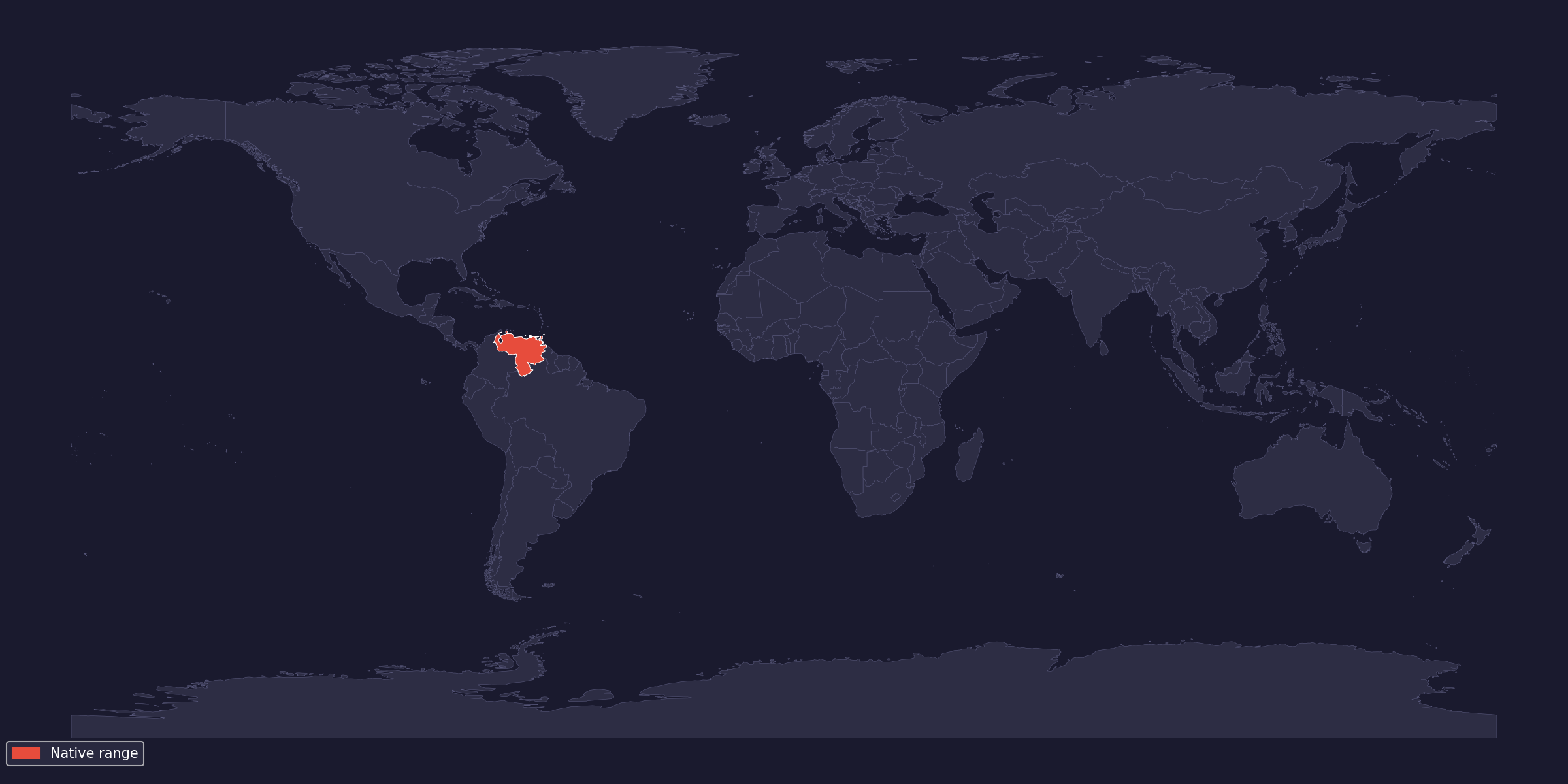
Cyriocosmus elegans is associated with humid tropical habitats in Trinidad and Tobago, Venezuela, and nearby records in the southern Caribbean region. In care this points to a small, secure, moderately humid enclosure with a retreat and good airflow, not a large wet display box.
Because the species is so small, microclimate matters more than room averages. A dry corner, a slightly moister burrow base, and a water source scaled to the animal are safer than soaking the whole container.
🌡 Climate across the native range
Monthly climate normals from reviewed GBIF occurrence locations:
Portuguesa — Venezuela
| Month | Min °C | Mean °C | Max °C | RH % |
|---|---|---|---|---|
| January | 21.1 | 27 | 32.9 | 66 |
| February | 21.9 | 27.7 | 33.5 | 62 |
| March | 22.8 | 28.4 | 33.9 | 61 |
| April | 23.2 | 28.1 | 32.9 | 72 |
| May | 23 | 27.3 | 31.5 | 78 |
| June | 22.3 | 26.4 | 30.5 | 80 |
| July | 21.8 | 26.1 | 30.5 | 79 |
| August | 22 | 26.6 | 31.1 | 77 |
| September | 22.2 | 26.9 | 31.7 | 78 |
| October | 22.4 | 27.2 | 31.9 | 76 |
| November | 22.3 | 27.2 | 32 | 74 |
| December | 21.7 | 26.9 | 32.2 | 70 |
Carabobo — Venezuela
| Month | Min °C | Mean °C | Max °C | RH % |
|---|---|---|---|---|
| January | 15.4 | 21.5 | 27.7 | 73 |
| February | 15.7 | 21.8 | 28 | 71 |
| March | 16.4 | 22.6 | 28.7 | 69 |
| April | 17.7 | 23.2 | 28.6 | 78 |
| May | 18.2 | 23.1 | 28 | 80 |
| June | 18.2 | 22.6 | 26.9 | 80 |
| July | 17.7 | 22.2 | 26.7 | 80 |
| August | 17.7 | 22.4 | 27.1 | 79 |
| September | 17.5 | 22.6 | 27.6 | 80 |
| October | 17.7 | 22.7 | 27.7 | 80 |
| November | 17.1 | 22.4 | 27.6 | 80 |
| December | 16.2 | 21.8 | 27.4 | 75 |
Diego Martin — Trinidad and Tobago
| Month | Min °C | Mean °C | Max °C | RH % |
|---|---|---|---|---|
| January | 21.7 | 25.5 | 29.2 | 78 |
| February | 21.8 | 25.5 | 29.3 | 75 |
| March | 22.4 | 26 | 29.7 | 73 |
| April | 23.3 | 26.7 | 30.2 | 75 |
| May | 23.9 | 27.2 | 30.5 | 77 |
| June | 23.5 | 26.7 | 29.9 | 81 |
| July | 23.2 | 26.6 | 30 | 80 |
| August | 23.2 | 26.8 | 30.5 | 80 |
| September | 23.4 | 27.1 | 30.7 | 80 |
| October | 23.2 | 26.9 | 30.7 | 80 |
| November | 22.8 | 26.5 | 30.2 | 81 |
| December | 22.2 | 25.8 | 29.5 | 79 |
Weather data by WorldClim v2.1 · Monthly normals queried by Herpeton Academy from raster values; relative humidity is derived from vapor pressure and mean temperature.
Location references use GBIF.org occurrence data where available; original occurrence records retain their source dataset licenses.
⚖️ Legal status
As checked against current official CITES Appendices and EU wildlife-trade Annex references on 2026-06-01, no current CITES listing or specific EU Annex listing was found for Cyriocosmus elegans. The species is not relevant to the Bern Convention because it is not native to Europe.
Local and national rules on collection, export, import, sale, transport, breeding, exhibition, and proof of legal origin may still apply. Captive-bred animals from traceable sources are preferred, especially because tiny juveniles and similar dwarf species can be mislabeled.
🤌 Husbandry
Keep this species alone. Spiderlings and adults are both tiny enough to exploit gaps that would not matter for a larger tarantula, so every air hole, lid seam, and feeding port should be checked before the animal is introduced.
Start spiderlings in small vials or deli cups with ventilation that cannot trap the legs. Use enough substrate for a shallow burrow and offer a small cork chip, leaf fragment, or starter hole. Adults do not need a large enclosure; too much space makes feeding and hydration harder to monitor.
Useful care priorities:
- Small escape-proof container
- Shape-holding substrate
- Tiny hide or starter burrow
- Lightly moistened lower layer
- Prey sized for the spider, not for the keeper’s convenience
Routine care for Cyriocosmus elegans should be calm, repetitive, and documented. Check the enclosure from the outside first: posture, abdomen shape, webbing, water level, prey remains, mold, condensation, and whether the hide entrance has been sealed. These small observations tell you more than trying to make the tarantula move.
A useful weekly rhythm is simple. Refresh water before it is dirty, remove boluses and uneaten feeders, confirm that ventilation is open, and adjust one moisture area if the enclosure is trending too dry or too wet. Do not rebuild the enclosure every time the spider changes where it sits. Webbing, closed burrow entrances, and long fasts are normal parts of tarantula life, especially around molts.
Keep a short record with the acquisition date, source, molt dates, feeding dates, refused meals, rehousings, and any unusual behavior. The record is not bureaucracy: it helps identify a slow dehydration trend, a molt interval that has changed, or a mature male that has stopped feeding for normal biological reasons. Photos taken during routine checks can also preserve identity features without handling.
Maintenance should be planned before opening the enclosure. Have the feeder cup, long tongs, water bottle, catch cup, lid, and a clear working surface ready. For fast or defensive species, work inside a larger plastic tub or another contained area. The goal is not to test temperament but to finish the job with the spider still secure and unstressed.
Choose captive-produced animals whenever possible and ask for the scientific name used by the breeder, the approximate age or size, molt history if known, and whether the animal is confirmed female, unsexed, or male. Common names are useful for hobby conversation, but they are not enough for records because several unrelated tarantulas share similar trade labels.
Quarantine new arrivals away from the main collection for at least several weeks. Use simple equipment, disposable towels around the work area if needed, and separate feeding tools when there is any concern about mites, phorid flies, mold, or unknown substrate. Quarantine is also a settling period: the spider can establish a retreat, drink, and feed once without being disturbed by display changes.
Inspect the animal without forcing contact. A healthy tarantula should be coordinated, able to grip, and not leaking fluid. A thin abdomen after shipping may improve with water and time, but a collapsed posture, repeated failed molts, visible injury, or heavy parasite load needs experienced help. Do not attempt home treatments with oils, disinfectants, or insecticides inside the enclosure.
Keep invoices, breeder messages, import papers, and photos of the animal and container label. This is especially important for species with recent name changes, corrected spellings, or old hobby names. Good records protect the keeper, help future buyers, and make it easier to update the article and collection label when taxonomy changes.
💡 Lighting
No specialist lighting or UVB is required. A normal room day-night rhythm is enough. Any plant or display lighting should stay outside the enclosure or be weak enough that it does not overheat or dry the retreat.
🌡 Heating and temperature
A practical daytime range is about 22-26°C, with a small night drop around 20-22°C. Stable room warmth is safer than a lamp aimed at a small container.
Tiny enclosures change temperature quickly. Keep them away from sunny windows, radiator shelves, and hot racks. If the animal stops feeding, check temperature and hydration before adding more prey.
💧 Humidity and water
Aim for moderate tropical moisture without wetting the whole container. The lower substrate can stay slightly moist while the entrance and surface breathe.
For very small spiders, flooding is a bigger risk than a brief dry surface. Add water in drops to one side, use a tiny water source only when safe, and watch the abdomen for hydration clues.
🌿 Enclosure and decoration
Use compacted coco fiber, fine soil mix, or another safe substrate that can hold a small tunnel. Avoid loose, dusty material that collapses or sticks to prey.
The enclosure should be simple enough to inspect without digging up the spider. A clear side burrow, cork chip, and small open feeding area are more useful than heavy decoration.
🪳 Feeding
Feed very small prey: fruit flies, pinhead crickets, tiny roaches, cut prey, or prekilled pieces for the smallest spiderlings. Juveniles may eat every few days; adults usually do well with small meals once or twice a week, adjusted to abdomen size.
Remove uneaten prey quickly. A cricket that seems small to a keeper can still injure a molting dwarf tarantula.
🩺 Common problems
Common problems include escape, desiccation, flooding, oversized prey, mites in wet leftovers, and missed molts because the spider is so small.
A tarantula sealed in a small burrow may simply be preparing to molt. Do not dig it out unless there is a clear emergency. Keep records of feeding and molts so normal fasting is not mistaken for decline.
📌 Conclusion
Cyriocosmus elegans is best for keepers who enjoy small, detailed setups and who can feed and hydrate a tiny spider without flooding it. It is charming, but it is not easier just because it is small.
📚 Sources and further reading
- CITES Appendices — legal-status references checked 2026-06-01
- EU wildlife trade regulations — legal-status references checked 2026-06-01
- GBIF species backbone entry for Cyriocosmus elegans
- World Spider Catalog
- UWI Trinidad and Tobago species account