Share

Cilantica devamatha
🔤 Taxonomy
Cilantica devamatha (Prasanth & Sunil Jose, 2014) is the current accepted World Spider Catalog name. It was described as Haploclastus devamatha, the name still dominant in the hobby, and was transferred to the new genus Cilantica in the 2024 Western Ghats revision. Thrigmopoeus psychedelicus was described later in 2014 and is treated by WSC as a junior synonym.
GBIF’s main taxonomic backbone had not yet incorporated Cilantica when checked on 6 August 2026. The taxonomy widget therefore shows GBIF’s traceable legacy Haploclastus devamatha hierarchy (species key 8184432), not an invented Cilantica key. The title and prose follow current WSC taxonomy.
Common trade names include psychedelic earth tiger, Indian rainbow tarantula and Indian violet earth tiger. Color varies, and a trade name is not proof of identity.
📌 Description
This is a fossorial Old World tarantula known from a small part of the Western Ghats in southern Kerala, India. Adults reach roughly 13-15 cm diagonal legspan. Females may live around 12-15 years; mature males are shorter-lived. Published observations describe blue-black and pinkish color forms, unbranched silk-lined burrows and leaf-decorated entrances.
It is fast, defensive, reclusive and without urticating hairs. Most of a well-kept individual’s life is seen as web, excavation and feeding at the burrow mouth. It belongs with expert keepers who can manage an unseen spider, a high-speed rehouse and a bite of uncertain but potentially serious clinical importance.
| Care point | Practical target |
|---|---|
| Adult legspan | about 13-15 cm |
| Adult enclosure | about 25 x 25 x 35 cm |
| Substrate | 18-25 cm, compact and moisture-retentive |
| Day temperature | 22-26°C |
| Moisture | moist lower profile, breathable surface and cross-ventilation |
| Adult feeding | suitable prey every 7-14 days, judged at the entrance |
| Handling | none; expert no-contact management |
☠️ Venom
No robust clinical series establishes a precise venom potency for C. devamatha. It is an Old World thrigmopoeine that lacks urticating hairs and may respond with speed and biting. Treat any bite as medically significant: related Asian theraphosids can cause severe pain, swelling, muscle cramps and systemic symptoms, while the large fangs also create deep puncture wounds.
Never handle it or put fingers into the enclosure. Use long tools, a catch cup and a second containment tub. Rehouse in a closed, uncluttered room with door gaps blocked and another responsible adult aware of the procedure. After a bite, wash the wound, remove rings, contact poison-control or medical services, and seek urgent help for severe pain, spreading swelling, cramps, weakness, vomiting, breathing difficulty or neurological signs. Do not use a tourniquet, cut the wound or attempt venom extraction.
🌍 Distribution
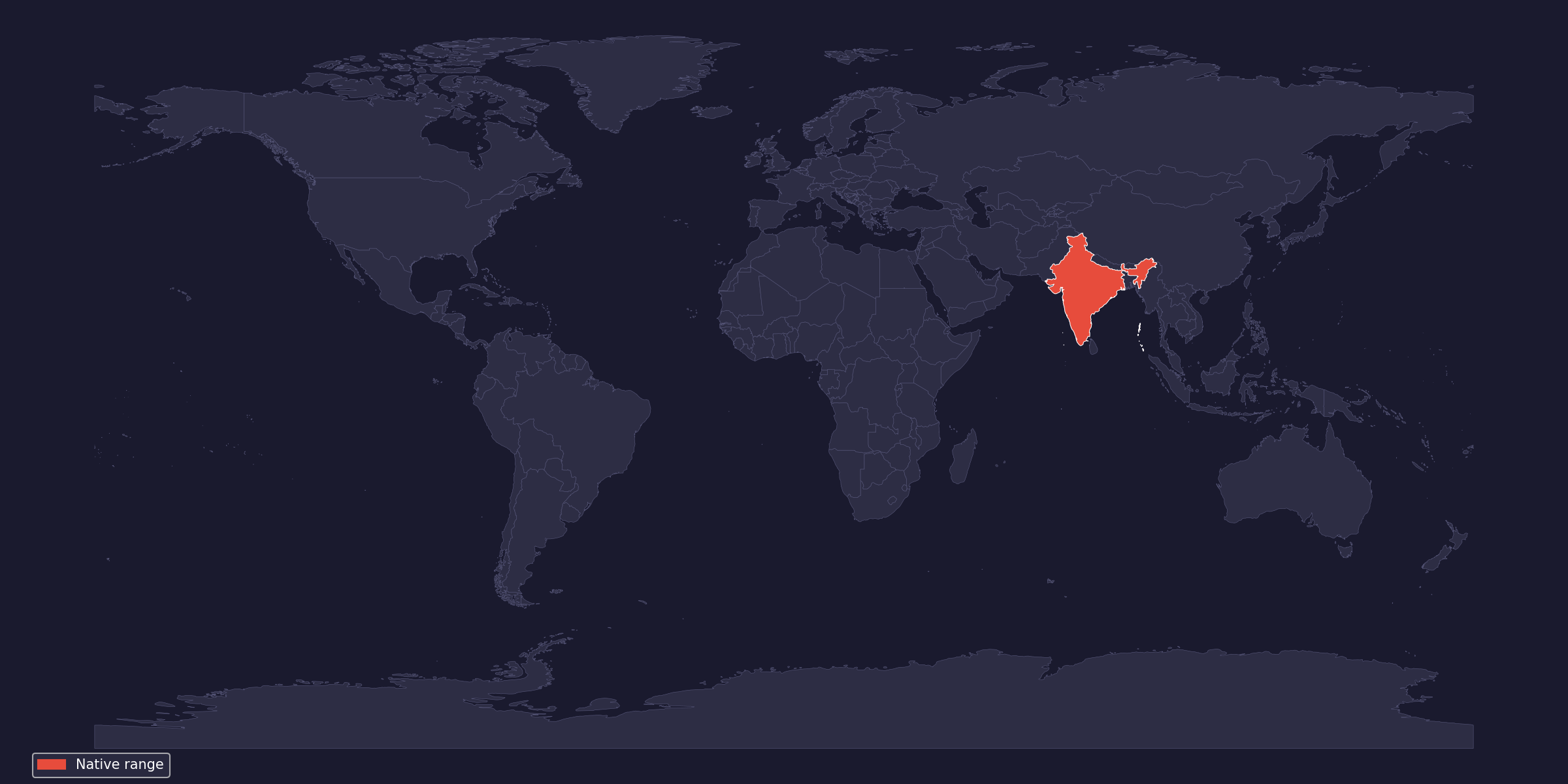
WSC lists India. Primary records narrow the documented range to Kollam and Pathanamthitta districts in southern Kerala, including Kulathupuzha Forest Reserve and Thenmala. Specimens were found in forest and roadside mud banks at roughly 134-567 m. Burrows were single-entrance, silk-lined tubes, often placed into compact vertical soil and disguised with leaves.
The range remains restricted and incompletely surveyed. The climate points below are published specimen localities, not a claim that the species fills all southern India. Captive care should reproduce the buffered burrow—deep moist soil with air exchange—not monsoon rain on an exposed surface.
🌡 Climate across the native range
Monthly normals from two published specimen localities in southern Kerala:
Kulathupuzha Forest Reserve, Kerala — India (type locality)
| Month | Min °C | Mean °C | Max °C | RH % |
|---|---|---|---|---|
| January | 20.8 | 25.7 | 32.1 | 67 |
| February | 21.3 | 26.6 | 33.8 | 67 |
| March | 22.1 | 27.1 | 34.4 | 74 |
| April | 23.1 | 26.7 | 32.3 | 84 |
| May | 23.3 | 26 | 30.2 | 88 |
| June | 22.7 | 24.6 | 28 | 91 |
| July | 22.3 | 24.3 | 27.8 | 90 |
| August | 22.1 | 24.3 | 27.9 | 89 |
| September | 22 | 24.5 | 28.5 | 89 |
| October | 21.7 | 24.5 | 28.7 | 89 |
| November | 21.6 | 24.7 | 29 | 86 |
| December | 21.1 | 25 | 29.9 | 76 |
Thenmala, Kerala — India (published specimen locality)
| Month | Min °C | Mean °C | Max °C | RH % |
|---|---|---|---|---|
| January | 17.4 | 22.7 | 28.6 | 68 |
| February | 18.4 | 24.2 | 30.9 | 63 |
| March | 19.9 | 25.5 | 32.6 | 65 |
| April | 21.2 | 25.2 | 31.1 | 77 |
| May | 21.1 | 24.2 | 28.9 | 84 |
| June | 20.7 | 22.8 | 26.3 | 89 |
| July | 20.2 | 22.4 | 25.9 | 88 |
| August | 19.9 | 22.4 | 26.2 | 87 |
| September | 19.7 | 22.6 | 26.9 | 86 |
| October | 19.7 | 22.5 | 26.8 | 87 |
| November | 19.3 | 22.4 | 26.4 | 85 |
| December | 18 | 22 | 26.6 | 78 |
Weather data by Open-Meteo.com · CC BY 4.0 · Monthly normals calculated by Herpeton Academy from daily archive values.
⚖️ Legal status
No listing for Cilantica, Haploclastus devamatha or its accepted synonym was found in the current CITES Appendices or EU wildlife-trade annexes checked on 6 August 2026. It is not relevant to the Bern Convention. That absence does not establish legal collection, export or possession.
India regulates native wildlife collection and export, and legal private trade in a narrow-range Indian tarantula should never be assumed. Buy only a demonstrably captive-bred specimen with an invoice, breeder chain, scientific-name history and any import papers. Verify national dangerous-animal and import rules before purchase; some jurisdictions regulate venomous invertebrates independently of CITES.
🤌 Husbandry
One spider per enclosure is mandatory. Give even a small sling enough depth to make a complete retreat, while keeping the container narrow enough to monitor feeding. Build a starter tunnel against one side and add leaf litter or cork at the entrance; the spider usually completes and webs the structure.
Quarantine for at least 90 days, preferably in a separate room, because specimens may have long trade chains. Use dedicated tools and record prey acceptance, visible body condition, web changes and molts. Do not pour pesticides, mite treatments or cleaning chemicals into an occupied burrow. Persistent weakness, abnormal fluid or suspected injury requires an experienced exotics veterinarian.
For a rehouse, place both enclosures in a large smooth-sided tub, remove obstacles, pre-open the catch cup and control every exit before disturbing webbing. Never dig rapidly toward the spider. Expose the tunnel from the far end in small stages and expect a bolt in any direction.
Species-specific captive breeding and incubation evidence is sparse. The structured clutch and incubation ranges above are conservative theraphosid husbandry comparisons, not published limits for C. devamatha; breeding should be treated as expert work and documented carefully.
💡 Lighting
UVB and basking lamps are unnecessary. Provide a subdued 10-12-hour room light cycle and keep the retreat shaded. Direct sun and bright lamps can heat a dark fossorial enclosure dangerously. A plant light is acceptable only if it produces no measurable rise at the substrate surface.
🌡 Heating and temperature
Keep the enclosure about 22-26°C by day and 20-23°C at night. The published Kerala sites are warm and seasonal, but a deep burrow damps daily extremes. Avoid forcing monsoon or dry-season cycles on a new, thin, immature or unwell spider.
Room heating is safest. If supplemental heat is unavoidable, place a thermostatically controlled low-wattage source outside one side, never under the burrow. Measure within the enclosure. Temperatures near 30°C combined with poor ventilation can be rapidly fatal.
💧 Humidity and water
Maintain a permanent shallow water dish and a moisture gradient. The lower two-thirds of the substrate should remain lightly moist enough to hold a tunnel; the upper surface and entrance should be allowed to breathe and partly dry. Add water slowly down one side rather than spraying the spider or flooding its chamber.
Humidity percentages are less useful than substrate condition, clean air and behavior. Condensation, sour smell and mites signal stagnant overwatering. Dry collapsing soil and a shrunken spider signal insufficient moisture. Good cross-ventilation is essential even though this is a humid-forest species.
🌿 Enclosure and decoration
For an adult, use an escape-proof enclosure around 25 x 25 x 35 cm filled with 18-25 cm of compact substrate. A mix of pesticide-free topsoil and coco fiber with a little clay or excavator soil can hold tunnels; test that it compacts without becoming mud. Anchor cork bark at an angle to start a burrow and add leaf litter for web attachment.
Ventilation holes must be smaller than the carapace and present on opposing sides. Secure every lid. Avoid mesh, loose stones, sharp decor and unsupported heavy wood. Keep the service area simple so the water dish can be reached with forceps without crossing the tunnel entrance.
Premolt may appear only as a sealed entrance and prolonged refusal. Remove live prey and wait. Never open a sealed burrow. After a molt, wait until the fangs are black and the spider is firm—commonly 7-10 days for an adult—before feeding.
🪳 Feeding
Offer roaches, crickets or locusts that fit the spider; prey around half to two-thirds of its body length is adequate. Feed slings small or pre-killed portions every 4-7 days, juveniles every 7-10 days and adults roughly every 7-14 days. Place prey near the entrance with long forceps, then close the enclosure before observing the response.
Remove uneaten prey within 24 hours and immediately if the burrow is sealed. Do not probe to confirm a kill. An invisible spider may still be healthy; use web repair, prey disappearance and periodic safe views as evidence. No calcium or vitamin dust is needed.
🩺 Common problems
- Escape during maintenance: this is the highest-consequence preventable event. Prepare containment before opening the lid.
- Collapsed burrow: shallow or fluffy substrate denies normal behavior and can trap the spider. Provide deep, firmly packed soil.
- Stagnant moisture: waterlogged, poorly ventilated setups support mold and mites and may stress respiration.
- Desiccation: completely dry substrate is inappropriate for this Kerala fossorial species; keep the lower profile moist and water available.
- Molt interference: prey left in a tunnel can injure a soft spider. Respect sealed entrances and fasting.
- Taxonomic and origin uncertainty: old labels may use three different names. Preserve invoices, molt photos and breeder records; never mix breeding stock of uncertain identity.
📌 Conclusion
Cilantica devamatha is for an expert who wants to maintain a deep burrow system, not handle a brightly colored spider. Before acquisition, secure legal-origin documentation, a deep ventilated enclosure, long tools and a written escape and bite plan. The central care challenge is balancing moist tunnel structure with airflow while never forcing access to the occupant.
📚 Sources and further reading
- World Spider Catalog — Cilantica devamatha
- Mirza 2024 — revision establishing Cilantica
- Sankaran & Sebastian 2018 — synonymy, range and natural history
- The Tarantula Collective — Cilantica devamatha care
- CITES — current Appendices
- European Commission — EU wildlife trade rules
- EUR-Lex — Commission Regulation (EU) 2026/1383, current wildlife-trade annexes