Share

Ceratogyrus darlingi
🔤 Taxonomy
Ceratogyrus darlingi is the currently accepted scientific name. GBIF lists older synonymy that still matters in older books, import lists, and keeper records.
Older names and combinations associated with the species include:
- Ceratogyrus bechuanicus Purcell, 1902
- Ceratogyrus schultzei Purcell, 1908
English common names used in the hobby:
- Darling’s horned baboon tarantula
- Rear-horned baboon tarantula
- African horned baboon tarantula
German common names used in the hobby:
- Darings Hornvogelspinne
The “horn” is not a reliable sexing shortcut and may be less obvious in young animals. Use molts or experienced ventral assessment for sexing, and avoid mixing uncertain Ceratogyrus stock in breeding projects.
📌 Description
Ceratogyrus darlingi is an Old World African tarantula known for the horn-like projection on the carapace in larger specimens. It is a defensive display species with fast movement and medically significant bite risk, not a handling spider.
Adult size is usually about 5-6 cm body length and about 12-14 cm legspan, with females typically heavier than mature males.
This species is appealing to advanced keepers because of its unusual appearance, strong feeding response, and heavy webbing around the retreat entrance. Those same traits make maintenance more demanding: the enclosure should be designed so water and food can be managed without destroying the retreat.
☠️ Venom
Treat this fast Old World tarantula as a bite hazard; neither a shy individual nor the rear-facing horn makes handling safe. Venom experiments on C. darlingi demonstrate biological activity but do not establish the course or severity of a human bite. They cannot justify specific claims about human clotting disorders or a safe bite threshold.
Prevent contact during maintenance and never use a hand to block an escape. After a bite, obtain medical advice; breathing difficulty, collapse or rapidly worsening symptoms require emergency help. Give clinicians the scientific name rather than trying to capture the spider. Laboratory study · General tarantula bite guidance
🌍 Distribution
Ceratogyrus darlingi is native to southern Africa. Records and trade references most often place it around Botswana, Zimbabwe, Mozambique, South Africa, and neighboring savanna or woodland regions. In the wild it is associated with dry to seasonally dry soils where it uses burrows and silk-lined retreats.
For keepers, the useful habitat cues are:
- a low terrestrial enclosure with more floor space than height
- enough substrate for digging or reshaping a retreat
- dry to moderately dry surface conditions with a water dish available
- strong ventilation and stable warm room temperatures
- fall prevention, because heavy terrestrial tarantulas are easily injured
Seasonal does not mean unstable captive care. A secure burrow with a dry surface, a small moisture reserve, and good airflow is more useful than repeated whole-enclosure spraying.
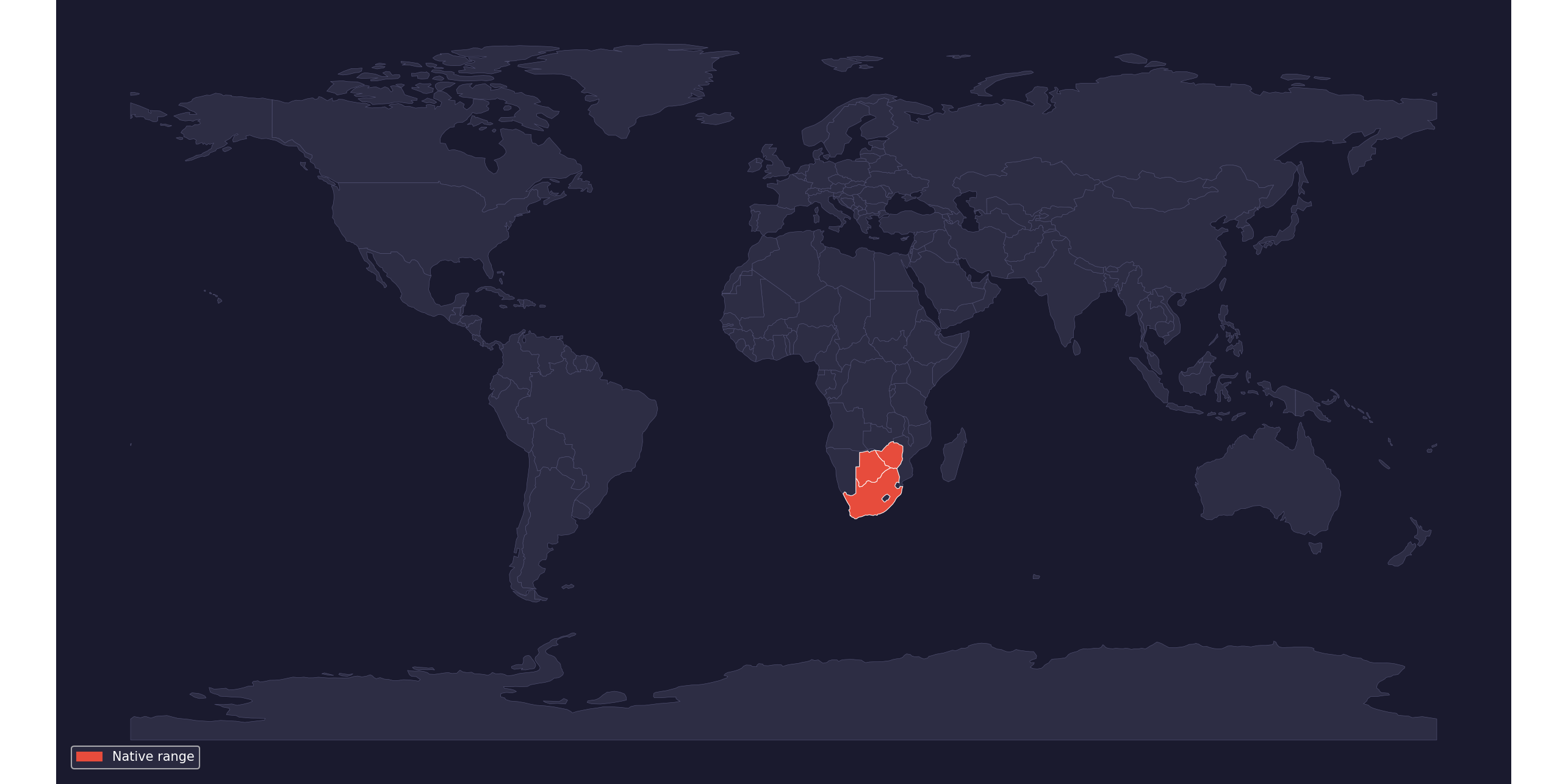
🌡 Climate across the native range
Monthly climate normals from reviewed GBIF occurrence locations:
Limpopo — South Africa
| Month | Min °C | Mean °C | Max °C | RH % |
|---|---|---|---|---|
| January | 20.4 | 25 | 30 | 66 |
| February | 20.5 | 25 | 30.2 | 66 |
| March | 19.5 | 24.2 | 29.5 | 65 |
| April | 16.9 | 22 | 27.5 | 64 |
| May | 13.7 | 19.6 | 25.9 | 59 |
| June | 10.9 | 17.2 | 23.9 | 56 |
| July | 10.4 | 16.8 | 23.4 | 55 |
| August | 12.3 | 18.8 | 25.6 | 53 |
| September | 15 | 21.4 | 28.1 | 53 |
| October | 16.9 | 22.7 | 28.7 | 57 |
| November | 18.4 | 23.7 | 29.3 | 62 |
| December | 19.8 | 24.8 | 30.1 | 64 |
Mpumalanga — South Africa
| Month | Min °C | Mean °C | Max °C | RH % |
|---|---|---|---|---|
| January | 21.9 | 26.3 | 31.2 | 69 |
| February | 22 | 26.4 | 31.5 | 69 |
| March | 21.1 | 25.7 | 30.9 | 68 |
| April | 18.7 | 23.6 | 29 | 66 |
| May | 15.9 | 21.4 | 27.4 | 63 |
| June | 13.6 | 19.2 | 25.5 | 62 |
| July | 13 | 18.7 | 25 | 61 |
| August | 14.6 | 20.6 | 27.1 | 57 |
| September | 16.8 | 22.9 | 29.4 | 56 |
| October | 18.4 | 24.1 | 30 | 60 |
| November | 20 | 25.3 | 30.7 | 63 |
| December | 21.3 | 26.4 | 31.6 | 65 |
Weather data by Open-Meteo.com · CC BY 4.0 · Monthly normals calculated by Herpeton Academy from daily archive values.
Location references use GBIF.org occurrence data where available; original occurrence records retain their source dataset licenses.
⚖️ Legal status
As checked against current official sources in May 2026, no current CITES listing or specific EU wildlife trade Annex listing was found for Ceratogyrus darlingi. The species is not relevant to the Bern Convention because it is not native to Europe.
Local rules on import, sale, transport, and proof of legal origin may still apply. Captive-bred animals remain preferable.
Keep records for seller, advertised locality, molt history, and sexing confidence. The older name C. bechuanicus may still appear in inherited records, so note any label changes rather than overwriting them silently.
🤌 Husbandry
This species should be kept alone. A practical adult setup usually emphasizes safe floor space and substrate depth rather than decorative height.
Small juveniles do best in modest, secure rearing tubs at first; upgrade gradually instead of putting a tiny spider straight into an adult display enclosure.
Useful basics include:
- Deep packed substrate
- A secure hide or started burrow
- Strong enclosure security
- Minimal disturbance
- A water dish
For an adult, use deep compact substrate and offer a starter burrow or cork shelter partly buried at an angle. For slings, smaller containers with a pre-started retreat make feeding and molt checks safer. Expect the spider to web heavily around the entrance; avoid unnecessary teardown.
Before opening the enclosure, locate the spider and decide which part of the surface can be reached without crossing the burrow entrance. Keep the water dish on that service side; a heavily webbed entrance is not a convenient place to push in tools. Prepare a catch cup before moving any lid. If the spider disappears beneath loose decor, stop rather than lifting successive pieces to find it. Record feeding and molt observations from outside, and keep a newly acquired animal’s tools separate from those used for established stock.
💡 Lighting
Ambient room lighting is sufficient, with no need for UVB or basking lamps.
Bright direct lighting is unnecessary.
🌡 Heating and temperature
Suitable approximate temperatures are:
- Daytime: around 24-28°C
- Night: slight drops are acceptable
It is safer to avoid overheating than to chase extreme heat.
💧 Humidity and water
Ceratogyrus darlingi is generally kept fairly dry with access to fresh water.
Useful principles:
- Dry upper substrate
- Clean water dish
- Good airflow
- No swampy or constantly sprayed setup
Keep one lower area lightly more humid for molt support, especially in juveniles. Stale damp air is more dangerous than a dry surface with accessible water.
🌿 Enclosure and decoration
The enclosure should support digging and webbed retreat building.
Useful elements include:
- Compact substrate with depth
- Cork bark or a starter hide
- Minimal stable decor
- No dangerous climbing height
A low, front-opening enclosure is convenient only if it closes securely and lets the keeper work without placing hands near the retreat. Top-opening tubs can be safe for juveniles when the lid seals tightly and ventilation holes are too small for escape.
🪳 Feeding
This species is insectivorous and feeds readily on common feeder insects.
Suitable foods include:
- Crickets
- Roaches
- Locusts where available
- Mealworms in moderation
As a rough guide, feed slings every 3-5 days, juveniles once or twice weekly, and adults every 7-14 days when body condition supports it.
Prey should be removed if not taken. A sealed retreat is often premolt or settling behavior, not a reason to leave crickets loose in the enclosure.
🩺 Common problems
Common problems include falls, overheating, dehydration, poor enclosure security, and failed molts under bad conditions.
Warning signs include:
- Lethargic posture
- Wrinkled abdomen
- Persistent stress climbing
- Visible injury
- Failed molt
Old World tarantulas should not be managed casually. If serious problems arise, interventions should be deliberate and minimal.
📌 Conclusion
Ceratogyrus darlingi is best kept as a secure fossorial display species: deep substrate, a stable retreat, dry-surface husbandry, fresh water, and calm tool-based maintenance. It is not suitable for handling or casual rehousing.
📚 Sources and further reading
- World Spider Catalog — accepted name and synonymy
- Tom’s Big Spiders — species husbandry
- Garcia-Arredondo et al. 2015 — experimental venom pharmacology, not human bite outcomes
- MedlinePlus — general tarantula medical guidance
- CITES appendices — historical May 2026 reference
- Official EU wildlife-trade annexes — Regulation 2026/1383
💬 Feedback
For questions, corrections, or practical notes, leave us a message in the forum thread.