Share

Brachypelma baumgarteni
🔤 Taxonomy
Brachypelma baumgarteni Smith, 1993 is the accepted name in the World Spider Catalog. The 2020 revision kept it in Brachypelma rather than moving it to Tliltocatl. It has no important taxonomic synonym, although poorly documented captive animals have sometimes been confused with other orange-legged Mexican species or described as hybrids without evidence.
Common trade names include Mexican orange beauty and, in German, Orangebein-Vogelspinne. Common names are not reliable identification: an animal offered without a breeder record or locality trail should not be assumed pure merely from color.
📌 Description
This is a heavy-bodied terrestrial tarantula from south-eastern Michoacán, Mexico. Adults commonly reach about 14-17 cm diagonal legspan. Females grow slowly and may live 20-25 years; mature males are slimmer and usually live only several years in total.
The orange-brown legs, dark femora, black abdomen and contrasting carapace make adults distinctive, but juveniles change as they grow. Most specimens prefer retreat to confrontation. They can still bolt, bite or kick urticating hairs when cornered. The species is a good first tarantula only for a keeper who accepts no handling, live prey and a potentially decades-long commitment.
| Care point | Practical target |
|---|---|
| Adult legspan | about 14-17 cm |
| Adult enclosure | about 35 x 30 x 25 cm |
| Substrate | 10-15 cm, compact and mostly dry at the surface |
| Day temperature | 20-25°C |
| Moisture | dry surface, slightly moist lower corner, full water dish |
| Adult feeding | one suitable meal every 10-21 days, adjusted to condition |
| Handling | none; use tools and a catch cup |
☠️ Venom
B. baumgarteni is venomous, as are tarantulas generally, but no clinical evidence shows its venom to be medically significant to a healthy adult. A bite can nevertheless cause puncture injury, pain, swelling and infection, and an allergic or unusually severe reaction cannot be predicted.
Urticating abdominal hairs are the likelier exposure. They can cause intense itching and become an emergency in an eye or airway. Do not handle the spider. Keep it below face level, use long forceps for maintenance, and wash hands and tools after contact with substrate or webbing. For eye exposure, rinse without rubbing and obtain prompt medical advice; seek urgent care after a bite if pain spreads, breathing becomes difficult, facial swelling develops, or systemic symptoms appear. Do not apply a tourniquet or cut the wound.
🌍 Distribution
The species is endemic to Mexico. Conservation work places its small range in the coastal Sierra Madre del Sur west of the Balsas River basin in south-eastern Michoacán, including subtropical dry forest near Lázaro Cárdenas, roughly 110-1360 m elevation. It shelters in soil burrows where shade and depth buffer much hotter and wetter outdoor readings.
The useful captive lesson is not to reproduce exposed weather. Provide a dry, ventilated surface, a deeper refuge, a modest moisture gradient and uninterrupted drinking water.
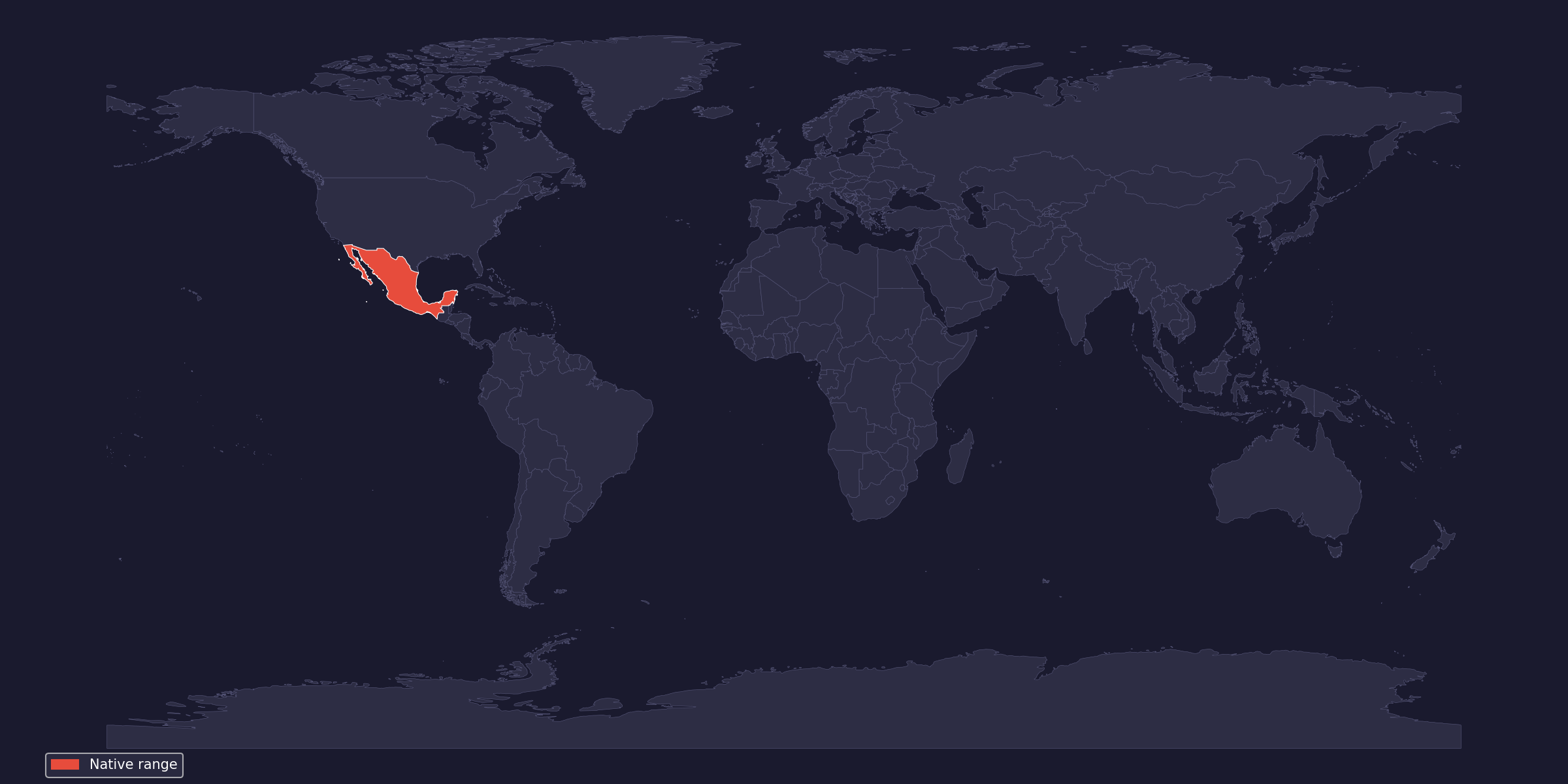
🌡 Climate across the native range
Monthly normals from a representative climate point within the documented south-eastern Michoacán range:
Lázaro Cárdenas area, Michoacán — Mexico (representative range location)
| Month | Min °C | Mean °C | Max °C | RH % |
|---|---|---|---|---|
| January | 21.2 | 25 | 29.9 | 73 |
| February | 20.8 | 25 | 30 | 72 |
| March | 20.7 | 25.1 | 30.1 | 71 |
| April | 21.4 | 25.8 | 30.8 | 69 |
| May | 23.4 | 27.1 | 31.7 | 70 |
| June | 24.7 | 27.4 | 30.9 | 78 |
| July | 24.8 | 27.5 | 30.9 | 82 |
| August | 24.8 | 27.2 | 30.4 | 84 |
| September | 24.3 | 26.4 | 29.3 | 87 |
| October | 24.3 | 26.5 | 29.5 | 86 |
| November | 23.4 | 26.2 | 30.1 | 81 |
| December | 21.9 | 25.4 | 29.9 | 77 |
Weather data by Open-Meteo.com · CC BY 4.0 · Monthly normals calculated by Herpeton Academy from daily archive values.
⚖️ Legal status
All Brachypelma species are listed in CITES Appendix II; B. baumgarteni is in EU Annex B. International movement can require permits, and proof of legal acquisition matters inside the EU even when a transaction does not require an Article 10 certificate. The Bern Convention is not relevant because the species is not native to Europe.
Buy a clearly identified captive-bred animal. Keep the invoice, scientific name, breeder or seller details, date, and any import or transfer documents for the spider’s lifetime. Mexico restricts wildlife collection and export, and this narrow-range species has been assessed as Endangered; an unsupported “farm-bred” or wild-origin claim is a reason to walk away. National rules for venomous animals, registration, transport, breeding and sale still vary. Legal status checked 6 August 2026.
🤌 Husbandry
House one spider per enclosure. Start a sling in a small, well-ventilated container that makes hydration and prey removal easy. Move it up gradually; oversized enclosures make tiny spiders harder to monitor and leave more room for prey to hide.
Quarantine every arrival for at least 60-90 days in a separate area with dedicated forceps and water equipment. Record feeding, refusals, molts, appearance and any mites. Remove prey remains promptly. An animal of uncertain origin, persistent weight loss or unusual discharge warrants advice from an experienced exotics veterinarian rather than improvised chemical treatment.
Rehousing should happen inside a larger empty tub or closed room. Prepare the destination, catch cup, lids and tools before opening the old enclosure. Guide the spider; never pin it, lift it with forceps or chase it with bare hands.
💡 Lighting
No UVB or basking lamp is required. Ordinary indirect room light on a 10-12-hour day-night cycle is adequate. Direct sun can overheat a small enclosure within minutes. A low-output plant light may be used above a planted display only if a thermometer confirms that it does not warm or desiccate the spider’s retreat.
🌡 Heating and temperature
Maintain roughly 20-25°C by day, with 18-21°C acceptable at night. Stable room warmth is safer than an intense local hot spot. Below-range conditions slow digestion and development; persistent temperatures approaching 28-30°C raise dehydration and heat-stress risk.
If the room needs heating, warm the room. A thermostatically controlled low-wattage source outside one side of the enclosure is a second choice, never beneath the substrate. Measure at substrate level with a digital probe and leave a cooler retreat. Outdoor climate tables describe regional seasonality, not a target for forced cycling.
💧 Humidity and water
Keep a clean shallow water dish available at all sizes; use a tiny dish or water droplets on webbing for the smallest slings without flooding them. For juveniles and adults, let most of the surface dry, then overflow the dish lightly or moisten one lower corner. The lower substrate may retain some moisture while the hide entrance remains breathable.
Do not chase a humidity number by spraying the whole enclosure. Condensation, sour substrate, persistent wetness and fungus gnats indicate excessive moisture or inadequate air exchange. A shriveled abdomen, weakness or prolonged hovering over the dish can indicate dehydration and requires an immediate check of water and temperature.
🌿 Enclosure and decoration
An adult enclosure around 35 x 30 x 25 cm provides useful floor area without a dangerous fall. Pack 10-15 cm of pesticide-free topsoil/coco fiber mix so it holds a shallow burrow. Leave no more than about one body length between the substrate and lid. Heavy terrestrial tarantulas can rupture the abdomen in a short fall.
Provide a cork-bark starter hide partly buried at one end, leaf litter and a stable water dish. Ventilation on opposing sides is better than a few holes only in the lid. Avoid mesh lids that can trap claws, sharp stone, loose gravel, calcium sand, fertilizers and waterlogged sphagnum. Decorations must not collapse if the spider digs beneath them.
During premolt the spider may refuse food, darken, web over the entrance or close the retreat. Remove live prey and leave it undisturbed. Never dig it out to “check.” Wait until the fangs are fully black and the body has hardened—often 7-10 days for a large adult, less for small slings—before offering food.
🪳 Feeding
Offer captive-cultured roaches, crickets or locusts no larger than the spider’s abdomen; large adults can take one substantial item rather than several. Feed slings one or two small or pre-killed prey portions every 4-7 days, juveniles about every 7-10 days, and adults every 10-21 days. These are starting points, not quotas.
Use abdomen condition and molt stage to adjust. A very swollen abdomen increases rupture risk, so lengthen the interval. Remove uneaten prey within 24 hours and immediately when premolt is suspected. Mealworms and superworms can burrow; crush the head or use a dish. Tarantulas obtain minerals from whole prey and do not need calcium or vitamin powder.
🩺 Common problems
- Falls and abdominal rupture: prevent excess headroom and hard decor. A leaking abdominal wound is an emergency; minimize movement and contact an exotics veterinarian.
- Urticating hairs: reduce disturbance and never brush shed skins or dry substrate near the face.
- Stale wet substrate: persistent saturation encourages mold, mites and respiratory stress. Improve cross-ventilation and replace foul substrate without drying the entire lower layer abruptly.
- Dehydration or overheating: verify water, measured temperature and ventilation before assuming disease.
- Molt disturbance: prey can injure a soft spider. Remove it, and do not pull retained exuviae from the animal.
- Overfeeding: an oversized abdomen is not a sign of superior care; reduce meal size and frequency.
📌 Conclusion
Brachypelma baumgarteni suits a patient keeper who wants a slow-growing Mexican display species and can document its legal origin. Have the low fall-safe enclosure, deep substrate, water dish, catch cup and long-term care plan ready before purchase. The most avoidable failures are buying an undocumented specimen, keeping it too wet, and treating calm behavior as permission to handle it.
📚 Sources and further reading
- World Spider Catalog — Brachypelma baumgarteni
- Fukushima et al. — conservation profile and documented range
- The Tarantula Collective — Brachypelma baumgarteni care
- CITES — current Appendices
- CITES identification guide for listed tarantulas
- European Commission — EU wildlife trade rules
- EUR-Lex — Commission Regulation (EU) 2026/1383, current wildlife-trade annexes