Share

Avicularia “braunshauseni” (trade label)
🔤 Taxonomy
Avicularia braunshauseni Tesmoingt, 1999 is not an accepted species in the current World Spider Catalog. It is a nomen dubium: a published name whose identity cannot be established reliably. Fukushima and Bertani reported in their 2017 revision that the supposed holotype had never been deposited in the stated museum, and the description alone was insufficient to diagnose the species.
GBIF retains a discoverable record for the historical binomial but marks it as a synonym and resolves its accepted usage to the genus Avicularia, not to an accepted species. This page therefore addresses animals carrying the hobby label “A. braunshauseni”; it does not certify that those animals form a valid species or correspond to the lost type.
Important label notes:
- World Spider Catalog status: nomen dubium
- GBIF status: synonym record resolving to Avicularia
- Husbandry below: conservative genus-level fallback, not species-specific evidence
📌 Description
Animals sold under this name are usually presented as medium to large arboreal pinktoe tarantulas, but size, longevity, colour, temperament, and reproductive reports cannot be assigned securely to a diagnosable species. Different captive lines may represent ordinary variation within an accepted Avicularia, a misidentified species, or mixed stock.
That uncertainty changes how the guide should be used. Measure the actual spider, examine its climbing and web-building behaviour, and scale the enclosure to the individual. The values below are cautious working conditions used for medium-sized Avicularia, chosen to prevent common enclosure failures while the identity remains unresolved.
| Care point | Conservative fallback |
|---|---|
| Identity | unresolved trade label; not an accepted species |
| Adult enclosure | about 30 x 30 x 45 cm for a medium-large arboreal specimen |
| Day temperature | 21-26°C |
| Night temperature | 20-23°C |
| Moisture | water dish and local reserve; surfaces allowed to dry |
| Adult feeding | suitable prey every 7-14 days, adjusted to condition |
| Records | preserve seller, line, date, photos, molts, and every locality claim |
☠️ Venom
Treat every animal sold under this label as a venomous tarantula. No evidence supports describing the bite of this uncertain stock as medically significant, but its identity and venom are not characterized. A large specimen can produce painful punctures, local swelling, or an individual systemic response.
Assume it also has the contact urticating hairs typical of Avicularia. Do not handle it or bring old webbing close to the eyes. Its speed, climbing ability, and capacity to jump make escape the everyday risk. Prepare long tools, a clear catch cup, and a larger working tub before opening the enclosure. Clean bites and obtain medical advice for severe or spreading symptoms. Flush eye exposure and seek urgent care; never use a tourniquet or cut a bite.
🌍 Distribution
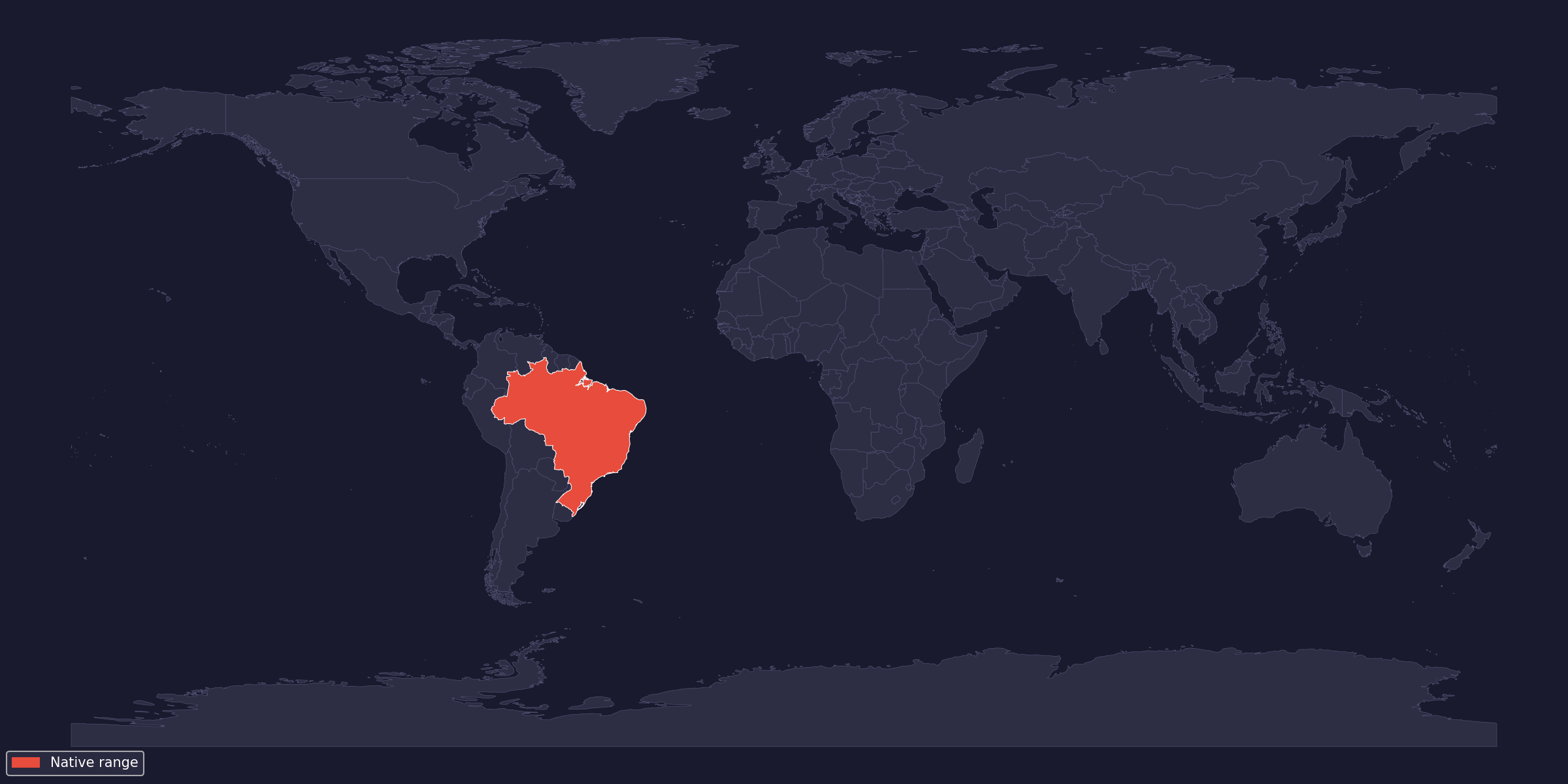
The original name was described from Brazil, and the World Spider Catalog repeats Brazil as the historical country attached to the doubtful name. Because the type material is unavailable and the name cannot be diagnosed, this is not a confirmed native distribution for captive animals sold under the label. No habitat or climate requirement should be inferred from the country alone.
The map highlights Brazil solely as historical country context. It is not a verified range map for a currently accepted species and should not be used to validate a seller’s locality claim.
⚖️ Legal status
The official CITES Appendices and Commission Regulation (EU) 2026/1383 were checked on 2026-08-06. The historical name Avicularia braunshauseni was not found in the CITES Appendices or EU Annexes A-D. The Bern Convention is not relevant. Because this is not an accepted species name, non-listing is especially poor evidence of legal origin or correct identity.
Keep the original invoice, seller identity, date, photographs, declared breeding line, and all import or transfer records. Do not replace the received label with an invented accepted name. National dangerous-animal, transport, exhibition, sale, and tenancy rules can still apply, and border authorities may require a valid identification rather than a doubtful hobby label.
🤌 Husbandry
Use a well-ventilated arboreal Avicularia setup only after confirming that the animal behaves and appears like a pinktoe-type tree tarantula. If it is strongly terrestrial, fossorial, or anatomically inconsistent with Avicularia, pause and obtain identification help instead of forcing it into this template.
House it alone. For a medium-large specimen, begin around 30 x 30 x 45 cm; smaller animals need proportionally smaller containers, and a truly large individual may require more space. Provide cross-ventilation on opposing sides at upper and lower levels. All gaps must be narrower than the carapace, and the door should open without tearing the main web.
Place vertical cork, foliage, and slender branches in the upper half. Give 5-8 cm of absorbent substrate, a shallow water dish, and a shaded retreat. Do not leave a tall empty glass box or rely on top-only mesh ventilation. Secure all decor against sudden movement during maintenance.
Quarantine for at least 8 weeks because misidentified and imported stock creates both pest and record risks. Use separate tools and record posture, feeding, fecal spots, molts, mites, flies, and any abnormalities. Preserve exuviae when possible: a specialist may use mature morphology to reassess identity. Never merge two lines merely because their trade labels match.
💡 Lighting
No UVB or basking lamp is needed for the genus-level setup. Provide 10-12 hours of indirect ambient light and an uninterrupted dark period. Direct sun and strong lamps can overheat the upper web rapidly.
A plant LED may be used outside the enclosure at low output if a shaded route remains. Measure temperatures at the retreat, not only on the room wall. Avoid coloured night bulbs and prolonged flashlight exposure.
🌡 Heating and temperature
A cautious working range is 21-26°C by day with nights around 20-23°C. This is comparative Avicularia husbandry, not a reconstructed climate for “A. braunshauseni.” Do not perform seasonal cycling or breeding-temperature changes based on the historical Brazil label.
Warm the room where possible. If extra heat is essential, put a thermostatically controlled low-power source on one exterior side and preserve a cooler escape route. Never heat beneath the substrate or block ventilation with a mat. Persistent temperatures above about 28°C increase dehydration risk and require immediate review.
💧 Humidity and water
Provide fresh water at all times. Overflow the dish lightly into one corner, then allow upper surfaces to dry. In a very dry room, add a few droplets to foliage or part of the web after dark, but never spray the spider or saturate the whole retreat. The 60-80% metadata range describes a broad operating window for ventilated Avicularia housing, not a species-specific target.
Watch physical conditions instead of chasing a hygrometer. Persistent condensation, sour substrate, spreading mold, or wet webbing means ventilation is inadequate or watering is excessive. A wrinkled abdomen and repeated drinking suggest dehydration. Small juveniles need more frequent checks because their containers change rapidly.
🌿 Enclosure and decoration
Use clean unfertilized topsoil, coco fibre, or a soil-coco blend. A 5-8 cm base buffers water and makes spot cleaning possible; deep burrowing layers are not required unless the animal’s behaviour shows otherwise. Exclude fertilizer, pesticides, aromatic woods, sharp wire, and loose snagging fibre.
Cork bark, artificial leaves, and twigs should form several possible web anchors. Leave a maintenance channel to reach water without destroying the silk tube. Avoid unsecured rocks and mesh that can trap tarsal claws. If the animal consistently rejects elevated retreats and excavates instead, reassess the identification.
Spot-clean prey remains and visible waste. Do not dismantle a closed web merely to retrieve a molt. Full substrate replacement is appropriate only for contamination, persistent pests, or a planned rehouse.
🪳 Feeding
Offer captive-reared roaches, crickets, or locusts where legal, normally no longer than the abdomen. Spiderlings can take small prey or freshly killed pieces twice weekly; growing juveniles often feed every 5-7 days; a well-conditioned adult usually needs a suitable item every 7-14 days. Adjust to actual size and abdomen condition.
Place prey near the web entrance and remove it within 24 hours if ignored. Stop feeding after repeated refusal, darkening, or closure of the retreat. Never force prey into a webbed-shut tube. After molting, wait until the fangs are black and the body is firm—often several days for juveniles and 7-10 days for adults.
Do not power-feed stock to reach a size advertised for the name. Overfeeding increases abdominal mass and fall risk. Calcium and vitamin dusts are unnecessary for a whole-prey tarantula diet.
🩺 Common problems
- Taxonomic drift occurs when a seller’s label is copied as fact; keep the nomen-dubium warning with every transfer.
- Wet stagnant housing can cause decline in pinktoe-type tarantulas; cross-ventilation and drying surfaces are essential.
- A wrinkled abdomen, weak posture, or prolonged drinking points to dehydration or excess heat.
- A sealed retreat and fasting are normal premolt signs; opening the web can produce molt failure.
- Mold, phorid flies, or dense mites usually follow waste, feeder remains, and chronic dampness.
- Falls, leaking hemolymph, marked incoordination, eye exposure, or a clearly arrested molt need advice from an arachnid-experienced exotics veterinarian.
Never apply household pesticide, essential oil, or vertebrate mite medication around the enclosure.
📌 Conclusion
“Avicularia braunshauseni” can remain useful as a traceable captive-line label, but it must not be presented as a verified species. The responsible approach is conservative ventilated arboreal care, solitary housing, exact records, and no taxonomic or locality claims that the missing type cannot support. Breeding under this label should be reserved for specialists who can prevent doubtful stock from being marketed as scientifically authenticated.
📚 Sources and further reading
- World Spider Catalog record for Avicularia braunshauseni — nomen dubium status and historical Brazil context, checked 2026-08-06
- Fukushima & Bertani 2017 Avicularia revision — missing type and reason the name cannot be diagnosed
- GBIF synonym record for Avicularia braunshauseni — resolves accepted usage to genus Avicularia
- Tom’s Big Spiders: Avicularia husbandry notes — comparative genus-level ventilation and moisture practice
- The Tarantula Collective: Avicularia avicularia care sheet — comparative accepted-species arboreal care
- CITES Appendices and EU wildlife-trade annexes, Regulation (EU) 2026/1383 — official legal sources checked 2026-08-06