Share

Avicularia avicularia
🔤 Taxonomy
Avicularia avicularia is the currently accepted scientific name and the type species of the genus Avicularia. Older literature and trade labels may use several historic names, and many pinktoe-type tarantulas have been reclassified or separated from Avicularia in modern revisions.
Older names and combinations associated with the species include:
- Aranea avicularia
- Mygale avicularia
- Avicularia vestiaria
- Avicularia velutina
English common names used in the hobby:
- Pinktoe tarantula
- Common pinktoe tarantula
- Guyana pinktoe tarantula
Because many pinktoe tarantulas look similar when young, avoid mixing uncertain Avicularia lines in breeding projects.
📌 Description
Avicularia avicularia is an arboreal New World tarantula from northern South America and nearby Caribbean islands. It has the classic pinktoe look: a dark body, lighter pinkish toe tips, and a webbed elevated retreat.
Adult size is usually about 11-15 cm legspan. Females are shorter-lived than many heavy terrestrial tarantulas, while mature males live much shorter lives.
This species is often sold to new keepers, but it is not a simple “starter spider.” The main care challenge is not aggression; it is ventilation. Poorly ventilated, wet enclosures have caused many avoidable losses in pinktoe tarantulas.
Individuals vary: one may retreat predictably while another jumps or runs when the door moves. Pinktoes can also expel feces toward a disturbance. These are reasons to service the enclosure with space, a catch cup, and slow movements rather than interpreting a calm specimen as safe to handle.
Healthy adults normally spend much of their time in or beside an elevated silk retreat. A newly arrived spider may pace while choosing a site, but persistent roaming after it should have settled is a prompt to check cover, heat, airflow, and whether the door repeatedly destroys its chosen web.
☠️ Venom
This species is venomous. Venom exposure can cause pain, swelling or other systemic effects, and severity varies with species, locality, bite site and the amount delivered. A small wound or apparently dry bite is not proof of safety; every bite or sting requires urgent medical assessment.
If an incident occurs, move away, call emergency services or a poison centre, keep the patient still, remove rings and other constricting items, and follow dispatcher instructions. Do not use a tourniquet, cut or suck the wound, apply ice or electricity, give alcohol or medicines as a home treatment, or attempt to catch the animal. Antivenom choice and dosing are hospital decisions; verify the relevant product and local availability in advance. Sources: WHO snakebite guidance and appropriate species-specific toxinology or medical references listed below.
🌍 Distribution
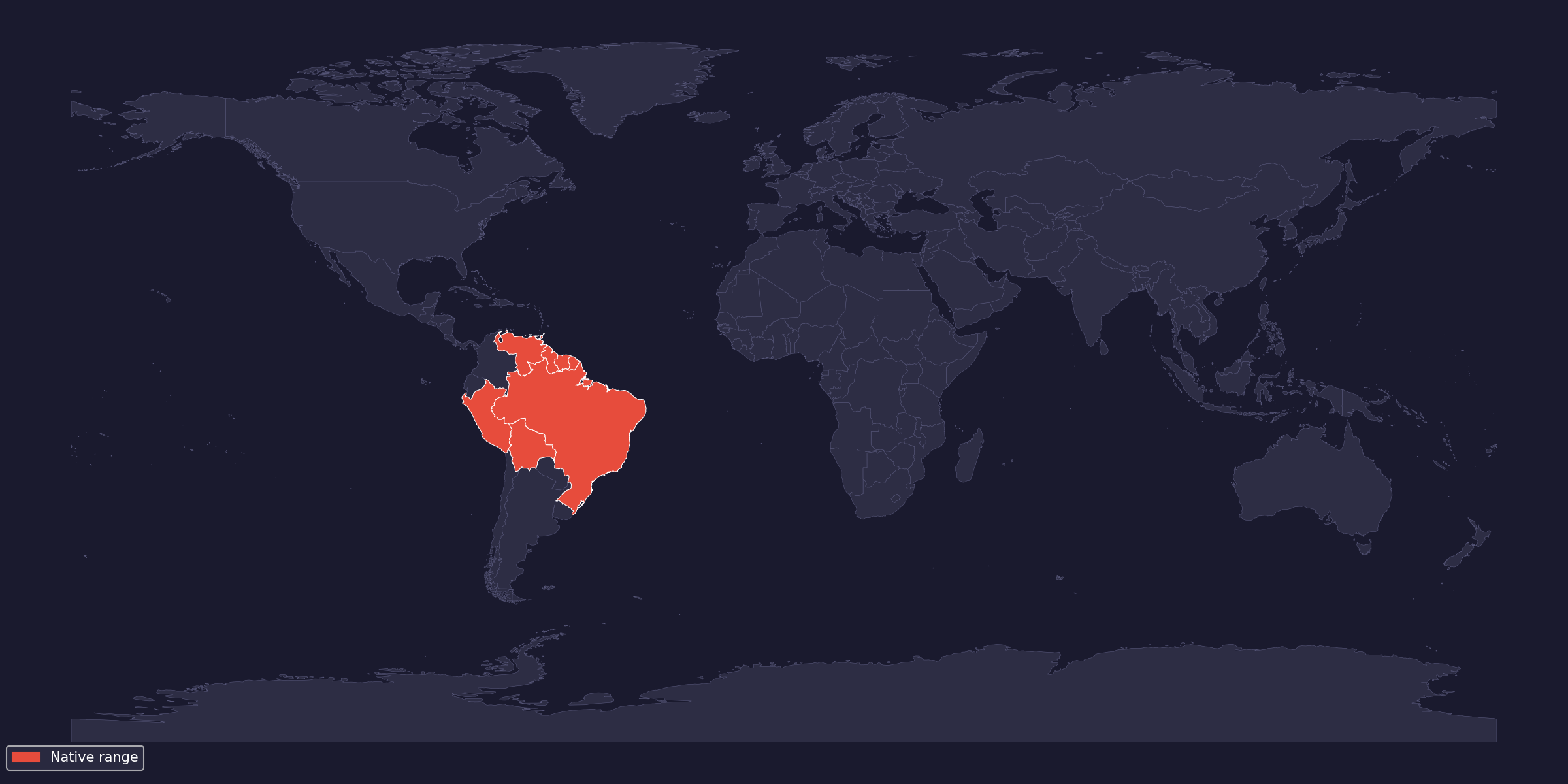
Avicularia avicularia is native to parts of northern South America and Trinidad and Tobago, with records and range references including Venezuela, Guyana, Suriname, French Guiana, Brazil, Peru, and Bolivia.
In the wild it is associated with vegetation, tree trunks, bark spaces, and elevated retreats. Captive care should prioritize:
- a vertical enclosure
- strong cross-ventilation
- elevated cork or foliage cover
- fresh water
- moderate humidity without stale wet air
- secure doors and small-gap protection
🌡 Climate across the native range
Monthly climate normals from reviewed GBIF occurrence locations:
Madre de Dios — Peru
| Month | Min °C | Mean °C | Max °C | RH % |
|---|---|---|---|---|
| January | 21.7 | 26.1 | 30.4 | 82 |
| February | 21.5 | 25.9 | 30.3 | 82 |
| March | 21.4 | 26 | 30.6 | 81 |
| April | 20.6 | 25.5 | 30.4 | 81 |
| May | 19.6 | 24.5 | 29.5 | 81 |
| June | 18.3 | 23.5 | 28.8 | 81 |
| July | 17.4 | 23.4 | 29.5 | 77 |
| August | 18.4 | 24.7 | 31 | 75 |
| September | 19.6 | 25.6 | 31.7 | 74 |
| October | 20.8 | 26.4 | 31.9 | 77 |
| November | 21.2 | 26.2 | 31.2 | 80 |
| December | 21.5 | 26.1 | 30.8 | 81 |
Tunapuna/Piarco — Trinidad and Tobago
| Month | Min °C | Mean °C | Max °C | RH % |
|---|---|---|---|---|
| January | 21.5 | 25.3 | 29.1 | 79 |
| February | 21.4 | 25.4 | 29.4 | 76 |
| March | 22 | 25.9 | 29.8 | 75 |
| April | 22.9 | 26.6 | 30.3 | 76 |
| May | 23.5 | 27.1 | 30.6 | 78 |
| June | 23.2 | 26.6 | 30 | 82 |
| July | 23 | 26.5 | 30 | 81 |
| August | 22.8 | 26.7 | 30.5 | 81 |
| September | 23.1 | 26.9 | 30.7 | 80 |
| October | 22.9 | 26.8 | 30.6 | 80 |
| November | 22.6 | 26.3 | 30 | 82 |
| December | 22 | 25.7 | 29.4 | 80 |
Cayenne — French Guiana
| Month | Min °C | Mean °C | Max °C | RH % |
|---|---|---|---|---|
| January | 22 | 25 | 28 | 87 |
| February | 22 | 25 | 28.1 | 86 |
| March | 22.2 | 25.4 | 28.5 | 85 |
| April | 22.4 | 25.6 | 28.8 | 86 |
| May | 22.3 | 25.5 | 28.8 | 88 |
| June | 21.5 | 25.3 | 29 | 88 |
| July | 21.1 | 25.4 | 29.7 | 86 |
| August | 21.1 | 25.8 | 30.5 | 84 |
| September | 21.2 | 26.2 | 31.3 | 81 |
| October | 21.1 | 26.3 | 31.5 | 80 |
| November | 21.2 | 25.9 | 30.6 | 83 |
| December | 21.6 | 25.3 | 29 | 86 |
Weather data by WorldClim v2.1 · Monthly normals queried by Herpeton Academy from raster values; relative humidity is derived from vapor pressure and mean temperature.
Location references use GBIF.org occurrence data where available; original occurrence records retain their source dataset licenses.
⚖️ Legal status
Avicularia avicularia is not currently listed in the CITES Appendices. No specific current listing for this species is typically applied in Annexes A-D of the EU wildlife trade regulations.
The species is not relevant to the Bern Convention because it is not native to Europe. Local rules on import, sale, transport, exhibition, and breeding may still apply.
Keep purchase records and breeding-line information, especially because pinktoe tarantulas are frequently mislabeled in trade.
🤌 Husbandry
House Avicularia avicularia alone in a secure vertical enclosure.
Spiderlings need small arboreal containers with ventilation on more than one side. Adults need height, a secure upper retreat, anchor points for webbing, and a water source that can be serviced without disturbing the spider’s web tube.
Useful adult priorities:
- Tall enclosure
- Strong cross-ventilation
- Cork bark or elevated hide
- Foliage or web anchor points
- Water dish
- Drying surfaces between moisture additions
Do not keep this species in a sealed humid enclosure. A pinktoe setup should breathe.
For a typical adult, an enclosure near 30 x 30 x 45 cm gives useful height without making feeding and inspection difficult. Dimensions are less important than interior layout: cork should rise close to the top, the door must not cut through the likely web site, and vents should create air exchange across the occupied upper zone. A bare tall box provides volume but little security.
Quarantine new spiders away from the established collection. Use separate tools, inspect the animal and enclosure for mites or unusual waste, and record feeding, molts, and any decline. Do not dismantle a secure retreat merely to make routine checks; observe through the web and service water from a clear route.
Rehousing should be prepared before the old enclosure opens. Place both containers inside a larger clear work area, block room exits, and guide the spider with a long soft brush toward the new retreat. Never try to stop a bolt with bare hands or by pinning the animal.
💡 Lighting
Ambient room lighting is enough. UVB and basking lamps are unnecessary.
Bright lamps can overheat and dry arboreal enclosures quickly, so display lighting should be gentle and indirect.
🌡 Heating and temperature
Aim for steady warm room temperatures:
- Daytime: around 24-27°C
- Night: slight drop acceptable
Avoid hot stagnant air. If supplemental heat is needed, warm the room or use a controlled side-mounted approach rather than placing heat under the enclosure.
💧 Humidity and water
This species needs access to water and moderate humidity, but the enclosure must remain well ventilated.
Practical rules:
- provide a water dish
- lightly moisten part of the enclosure when needed
- let surfaces dry between waterings
- keep side and top ventilation open
- avoid soaking the web retreat
Misting alone is not hydration. A water dish and good airflow are more reliable than repeated spraying.
Place the dish where it can be refilled without flooding the retreat. If room air is very dry, overflow a small amount into one lower corner and watch how quickly it disappears; add water again only after the surface has largely dried. Persistent condensation, wet webbing, mold, or a sour smell means the enclosure is receiving more water than its ventilation can remove.
🌿 Enclosure and decoration
Use cork bark, branches, and artificial or live foliage to create elevated cover. The spider should be able to build a web tube near the upper half of the enclosure.
Substrate can be modest; it helps buffer humidity but should not become swampy. Avoid mesh that can catch claws and avoid heavy decor that may shift during maintenance.
Use roughly 5-8 cm of unfertilized soil-based mix or coco/soil blend, pressed firmly enough that decor cannot tip. Leave a clear vertical route behind or beside the cork. Plastic foliage is easy to disinfect; live plants are acceptable only if their watering does not keep the entire enclosure saturated.
🪳 Feeding
Avicularia avicularia is insectivorous. Suitable prey includes:
- crickets
- roaches
- locusts where available
- occasional mealworms or soft-bodied larvae in moderation
Spiderlings usually eat every few days. Juveniles can be fed once or twice weekly. Adults usually do well with appropriately sized prey every 7-14 days.
Offer prey near the webbed area when possible, and remove uneaten insects after feeding attempts.
Choose prey no larger than the spider’s abdomen and reduce frequency when the abdomen becomes very broad. During premolt the spider may refuse food, thicken or seal its tube, and become less active. Remove prey and wait. After a molt, do not feed until the fangs are dark and the spider moves normally—several days for juveniles and often about a week for adults.
🩺 Common problems
Common problems include poor ventilation, stagnant humidity, dehydration, falls, escape during maintenance, and stress from repeated web destruction.
Warning signs include a shrinking abdomen, spending unusual time on the floor, weak grip, failed molts, and decline after being kept in wet stagnant conditions.
If a pinktoe tarantula is doing poorly, check airflow, water access, temperature, and retreat security before adding more moisture.
A tarantula hanging inverted or lying on its back is often beginning a normal molt. Do not turn it over. A fall, leaking hemolymph, severe weakness, repeated loss of grip, or a genuinely trapped molt warrants minimal disturbance and prompt advice from an exotics veterinarian familiar with invertebrates where available.
📌 Conclusion
Avicularia avicularia is a classic arboreal display tarantula. It can do well for keepers who understand cross-ventilation, moderate humidity, and low-disturbance care, but it should not be treated as a simple handling pet.
📚 Sources and further reading
- World Spider Catalog for current taxonomy
- GBIF species backbone: Avicularia avicularia
- Fukushima & Bertani, 2017, taxonomic revision of Avicularia and related genera
- The Tarantula Collective: Avicularia avicularia care guide
- Royal Veterinary College: invertebrate veterinary service and tarantula care
- CITES Appendices, checked 2026-06-02
- EU wildlife trade regulations overview, checked 2026-06-02