Share

Asp Viper
🔤 Taxonomy
Vipera aspis is the accepted name for the asp or aspic viper. Several regional forms are used in literature and trade, including V. a. atra, francisciredi, hugyi, and zinnikeri. Some authors have proposed species status for certain forms, but major current databases retain them under V. aspis.
Locality documentation matters because appearance, seasonal ecology, conservation law, and venom composition vary geographically. Do not infer a subspecies from colour alone, and do not mix undocumented stocks.
📌 Description
Most adults measure 50-70 cm; exceptional animals approach 90 cm. The upturned snout, angular head, and variable zigzag or barred pattern distinguish it from neighbouring European vipers only when used with scale characters and locality. Well-managed animals may live 12-20 years.
The bite is medically significant and can produce major swelling, systemic illness, coagulopathy, and in some regional populations neurological signs. This is not an entry-level venomous snake. It belongs only in a legally authorised facility with protected contact and a receiving-hospital plan.
📋 Quick reference
| Care point | Practical target |
|---|---|
| Adult enclosure | At least 120 x 60 x 60 cm, with two lockable shift hides |
| Temperature | Air 21-26°C; basking 29-32°C; cool retreat 18-21°C |
| Night | 15-20°C according to season; reliable summer cooling |
| Humidity | 45-65%; humid hide at 65-80% during shedding |
| Feeding | Moderate frozen-thawed rodents; adults every 10-21 days |
| Safety | Display-only; protected contact, bite plan, escape plan, two-person rule |
| Quarantine | At least 90 days with separate tools and parasite screening |
☠️ Venom
This species is venomous. Venom exposure can cause pain, swelling or other systemic effects, and severity varies with species, locality, bite site and the amount delivered. A small wound or apparently dry bite is not proof of safety; every bite or sting requires urgent medical assessment.
If an incident occurs, move away, call emergency services or a poison centre, keep the patient still, remove rings and other constricting items, and follow dispatcher instructions. Do not use a tourniquet, cut or suck the wound, apply ice or electricity, give alcohol or medicines as a home treatment, or attempt to catch the animal. Antivenom choice and dosing are hospital decisions; verify the relevant product and local availability in advance. Sources: WHO snakebite guidance and appropriate species-specific toxinology or medical references listed below.
🌍 Distribution
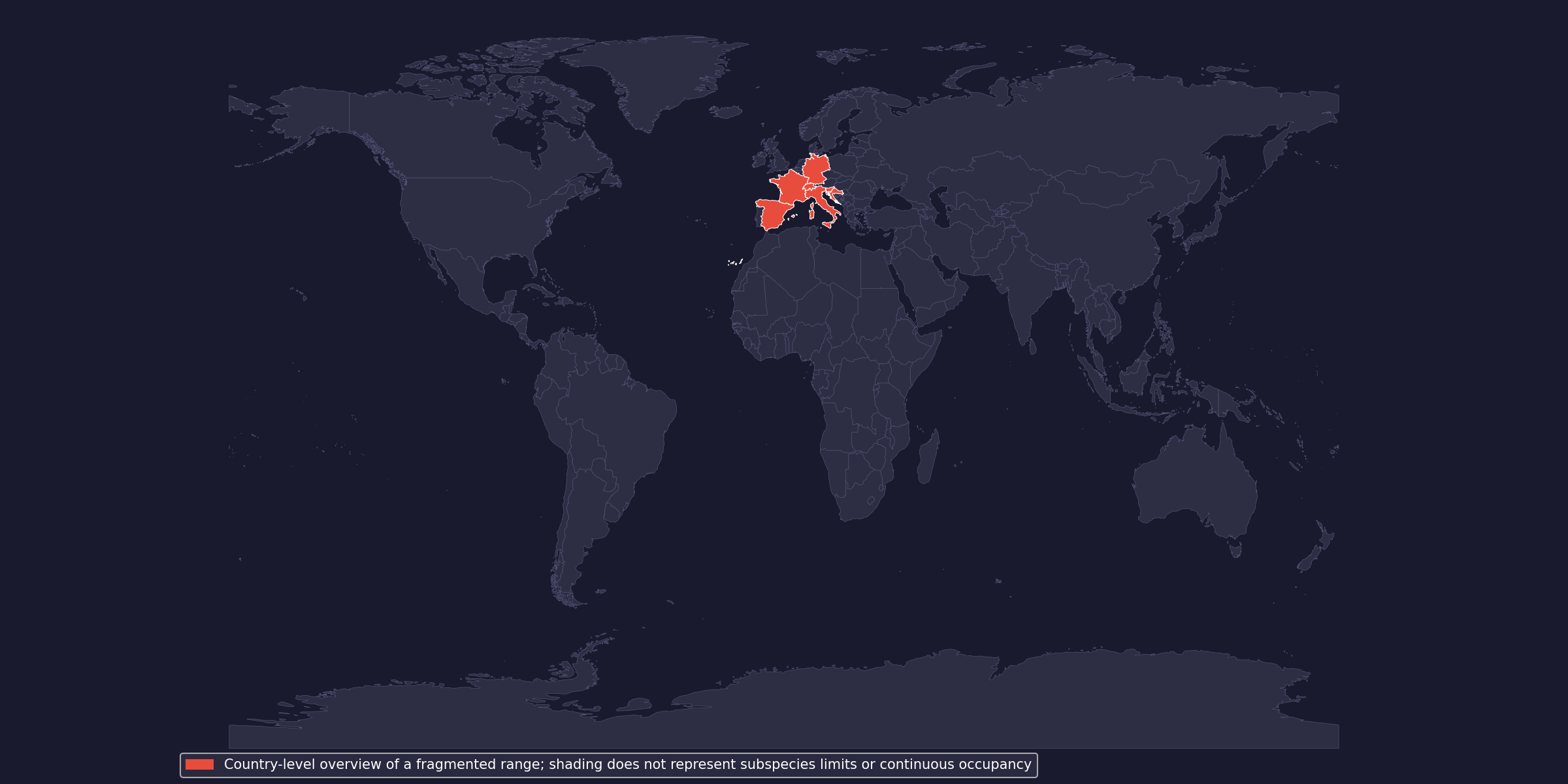
The asp viper occurs in northeastern Spain, France, Switzerland, southwestern Germany, Italy, western Slovenia, and northwestern Croatia. It ranges from warm Mediterranean scrub and hedgerows to woodland edges, rocky slopes, and cool Alpine sites. Island and mountain populations can have particularly narrow distributions.
Captive care must preserve both local radiant warmth and a genuinely cool retreat. A country-level map is broad and cannot represent subspecies boundaries or isolated protected populations.
⚖️ Legal status
The official CITES Appendices and EU wildlife-trade annexes checked on 29 August 2026 do not specifically list Vipera aspis. It is protected fauna under Appendix III of the Bern Convention. This does not authorise collection, possession, sale, or transport.
National and regional law across its range can strictly protect wild specimens and require captive-origin proof, registration, licensing, inspection, or emergency arrangements. Verify rules with both wildlife and public-safety authorities before acquisition. Keep the invoice, breeder identity, parentage and locality evidence, photographs, transfer papers, and this legal-check date. Never collect an animal from the wild.
🤌 Husbandry
House singly in a restricted venomous room with secondary containment and two lockable shift hides across the thermal gradient. Water and all routine cleaning must be possible only after the snake is positively located and secured behind a barrier.
Quarantine for at least 90 days in simple housing, preferably separate airspace. Use dedicated tools and record weight, meals, sheds, faeces, respiration, and activity. Poorly documented animals require reptile-veterinary examination and parasite testing.
Seasonal management must follow locality and body condition. A Sicilian V. a. hugyi and a high Alpine V. a. atra should not receive the same winter programme. Cohabitation reduces control over feeding and safe servicing.
💡 Lighting
Provide about 14 hours of visible light in summer, grading toward 10 hours in the cool season, with full darkness at night and shaded retreats. Fixtures belong outside primary containment or behind guards.
Whole-prey snakes do not have a demonstrated dietary requirement for UVB, but low-level Ferguson Zone 1 exposure may be offered over part of the basking area. The animal must be able to thermoregulate without UV exposure.
🌡 Heating and temperature
During the active season maintain air at 21-26°C, a basking surface at 29-32°C, a cool hide at 18-21°C, and nights around 15-20°C. Thermostat every heater and verify surface temperatures. Reliable room cooling is essential during heat waves.
Reproductive females need voluntary access to suitable warmth: controlled research found that gestation failed under constant 23°C but succeeded more often at 28°C. This does not justify a uniformly hot enclosure; a gradient allows the animal to choose.
Brumation around 5-9°C is an advanced, locality-dependent breeding procedure. Only established, clinically healthy adults with empty digestive tracts should be considered after gradual preparation. Do not cool juveniles, thin, sick, recently acquired, or pregnant animals.
💧 Humidity and water
Maintain 45-65% humidity with a local 65-80% shedding retreat. Keep lower substrate slightly moisture-retentive but allow the surface to dry. Stagnant wet housing promotes dermatitis and respiratory disease, while excessive dryness contributes to dehydration and poor sheds.
Provide clean water in a stable bowl that can be exchanged through protected access. Monitor drinking, urates, and body mass during warm weather and reproduction.
🌿 Enclosure and decoration
Use at least 120 x 60 x 60 cm. Provide two snug shift hides, firmly fixed rock-like basking surfaces, cork, low branches, grasses or artificial cover, and clear service routes. The snake must remain visible enough to confirm its full position.
Use 6-10 cm of low-dust soil, fine bark, leaf mould, and mineral material that buffers local moisture. Paper is safer during quarantine. Avoid aromatic wood, sharp gravel, unstable rocks, adhesive décor, and deep inaccessible clutter. Mechanically lock every opening.
🐁 Feeding
Offer appropriately sized frozen-thawed mice or small rats. Adults usually need a modest meal every 10-21 days; juveniles eat smaller prey more often. Track weight and body shape because temperate vipers become obese readily when kept warm and fed year-round.
Present prey with long tongs from a protected position. Shift before removing refusals and never leave a live rodent with the snake. Balanced whole prey needs no routine supplementation.
🛡 Operational safety and emergencies
Never free-handle, pin, neck, or manually restrain this species for routine work. Use lockable shifts, rigid transparent barriers, appropriate hooks, protected ports, and two trained adults whenever primary containment opens. Veterinary procedures require a pre-arranged professional plan.
Before acquisition, coordinate written bite and escape plans with the receiving hospital or poison centre. Include exact locality, photographs, transport route, and regional venom variation. Confirm how antivenom advice will be obtained; do not assume local stock and never self-administer antivenom.
A bite is an immediate emergency. Move away, call emergency services, remove constricting objects, keep still, immobilize the limb, and follow poison-centre advice. Do not cut, suck, ice, shock, tightly tourniquet, or wait for symptoms.
🥚 Breeding notes
The species is viviparous and generally produces 2-15 live young. Female reproduction may be annual in warm regions but only every second or third year in cooler populations. There are no eggs for the keeper to incubate.
Breeding requires verified locality, suitable female condition, lawful offspring placements, and individual locked neonate housing prepared before pairing. Pregnancy makes access to a correct voluntary thermal gradient especially important.
🩺 Common problems
- Overheating: persistent exposure, frantic movement, or decline requires an immediate check of air and surfaces.
- Respiratory disease: bubbles, gaping, repeated head elevation, or wheeze need urgent veterinary care.
- Dermatitis and scale rot: associated with wet substrate and weak ventilation.
- Dysecdysis and dehydration: review water, humid refuge, temperature, and health; do not manually peel a venomous snake.
- Parasites and stomatitis: mites, abnormal faeces, weight loss, oral swelling, or discharge are especially concerning in undocumented animals.
- Obesity and reproductive depletion: prevent through seasonal feeding, weight records, and adequate recovery between litters.
📌 Conclusion
Vipera aspis belongs only in a licensed facility that can document lawful captive origin and locality, provide a cool seasonal gradient, and coordinate a bite response in advance. Its European origin increases legal responsibility; it does not make the animal suitable for casual private keeping.
📚 Sources and further reading
- ReptiFiles — checked first on 29 August 2026; no species-specific care guide was found.
- The Reptile Database: Vipera aspis
- GBIF species record
- Marseille Poison Centre experience with V. aspis
- Thermal effects on gestation
- Italian clinical guidance for Vipera bites
- Baines et al. — UV lighting guidance
- CITES Appendices
- EU wildlife-trade annexes, Commission Regulation (EU) 2026/1383
- Bern Convention appendices