Share

Nose-horned Viper
🔤 Taxonomy
Vipera ammodytes is the nose-horned viper, also called the European sand viper. “Sand viper” is misleading because much of the species inhabits rocky slopes, scrub and open woodland rather than dunes.
The subspecies nomenclature is undergoing active revision. Recent work relocated the origin of the Linnaean type to the Istanbul area and changed how the names ammodytes, illyrica, meridionalis and the former montandoni are applied. This guide uses the species-level name accepted by GBIF and the Reptile Database; captive animals should retain exact locality and parental records rather than being reassigned from appearance alone.
📌 Description
The nose-horned viper is a robust European viper, usually 50–70 cm long and occasionally around 85 cm or more. It is identified by the soft scale-covered projection on its snout and a dark dorsal zigzag. Colour and body size vary substantially among regions and islands. Captive animals can live beyond 20 years.
This is a medically significant species capable of severe and fatal envenomation. A calm-looking animal can turn and strike rapidly, and its body strength makes manual restraint especially hazardous. It is suitable only for trained professionals in a licensed facility with double containment and a medical emergency plan. It must never be free-handled.
| Quick reference | Adult target |
|---|---|
| Enclosure | At least 100 × 50 × 50 cm, plus secure shift box |
| Basking surface | 30–33 °C |
| Cool retreat | 20–23 °C |
| Night | 16–20 °C in the active season |
| General humidity | 50–70%, with ventilation and local moisture |
| Feeding | Appropriately sized thawed rodents every 10–21 days |
| Winter | Locality-specific managed cooling only for healthy established animals |
| Handling | None; protected-contact maintenance only |
☠️ Venom
This species is venomous. Venom exposure can cause pain, swelling or other systemic effects, and severity varies with species, locality, bite site and the amount delivered. A small wound or apparently dry bite is not proof of safety; every bite or sting requires urgent medical assessment.
If an incident occurs, move away, call emergency services or a poison centre, keep the patient still, remove rings and other constricting items, and follow dispatcher instructions. Do not use a tourniquet, cut or suck the wound, apply ice or electricity, give alcohol or medicines as a home treatment, or attempt to catch the animal. Antivenom choice and dosing are hospital decisions; verify the relevant product and local availability in advance. Sources: WHO snakebite guidance and appropriate species-specific toxinology or medical references listed below.
🌍 Distribution
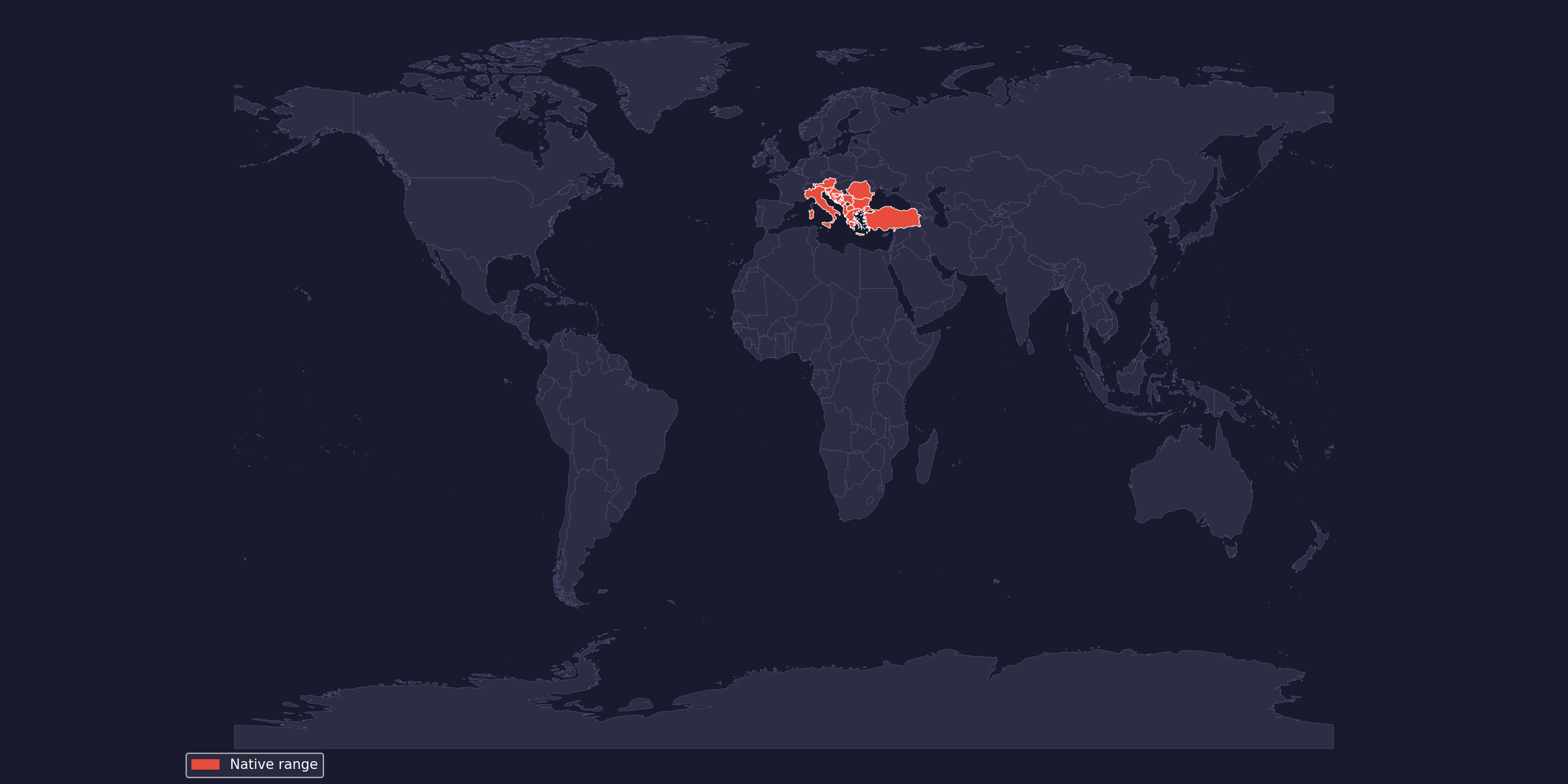
The species complex occupies southeastern Europe, from northeastern Italy and southern Austria through Slovenia, Croatia, Bosnia and Herzegovina, Serbia, Montenegro, North Macedonia, Albania, Romania, Bulgaria and Greece, including several Adriatic and Aegean islands. Populations also occur around European Turkey; the limits toward Anatolia and the Caucasus depend on how currently disputed taxa are treated.
Habitats include sunlit rocky slopes, dry-stone walls, scrub edges, woodland clearings and broken ground with both basking sites and deep refuges. Because populations span Mediterranean coasts, continental valleys and cooler mountains, locality matters when setting seasonal temperatures.
🌡 Climate across the native range
Monthly climate normals from a verified Balkan occurrence; other localities can differ substantially:
Blagoevgrad Province — Bulgaria (verified occurrence)
| Month | Min °C | Mean °C | Max °C | RH % |
|---|---|---|---|---|
| January | -0.6 | 3.1 | 7.1 | 77 |
| February | 0.7 | 4.6 | 8.8 | 76 |
| March | 3.8 | 8.3 | 12.7 | 73 |
| April | 7.9 | 12.9 | 17.6 | 71 |
| May | 13.1 | 18.1 | 22.5 | 70 |
| June | 17 | 22.1 | 26.5 | 68 |
| July | 19 | 24.4 | 28.9 | 64 |
| August | 19.5 | 24.7 | 29.4 | 62 |
| September | 15.4 | 20.1 | 24.7 | 66 |
| October | 10.7 | 14.9 | 19.5 | 74 |
| November | 5.7 | 9.4 | 13.5 | 78 |
| December | 1.2 | 4.6 | 8.4 | 78 |
Weather data by Open-Meteo.com · CC BY 4.0 · Monthly normals calculated by Herpeton Academy from daily archive values.
Location references use GBIF.org occurrence data where available; original occurrence records retain their source dataset licenses.
⚖️ Legal status
The official CITES Appendices and EU wildlife-trade Annexes were checked on 14 August 2026; no specific listing for Vipera ammodytes was found. It is, however, listed in Appendix II of the Bern Convention as strictly protected fauna and in Annex IV of the EU Habitats Directive. National implementations, reservations and non-EU laws differ.
Never collect a wild nose-horned viper or move one across a border on the assumption that a CITES non-listing permits it. Native-wildlife protection, dangerous-animal laws, transport rules and protected-area legislation can apply simultaneously. Before acquisition, obtain written confirmation from the competent authorities for the place of keeping and origin. Retain the invoice, breeder and parent records, proof of captive breeding, permits and every transfer document.
🤌 Husbandry
The animal room must be access-controlled and form a locked second containment barrier. Use a front-opening enclosure with keyed locks, protected ventilation, sealed service holes and a lockable shift box that closes from outside the animal space. Arrange water, hides and removable furnishings so routine servicing can be completed under protected contact.
No care task should require pinning, necking or touching the snake. Only staff trained under a formal venomous-snake procedure should work with it, with competent backup under the facility’s rules. Use clear enclosure identification and maintain an exact count.
Before acquisition, coordinate a written emergency plan with local medical and poison-information services. Identify the appropriate hospital, emergency transport and the medically supervised route for locating suitable antivenom. Do not store or self-administer antivenom as a substitute for professional treatment. Treat any suspected bite as an emergency and follow emergency-service instructions.
House specimens separately outside controlled breeding introductions. Quarantine new animals behind separate containment with dedicated equipment, weight and feeding records, faecal assessment and veterinary review. Wild-caught animals should not enter private trade; uncertain-origin animals also present disproportionate parasite and legal risks.
💡 Lighting
Use a seasonally adjusted photoperiod, roughly 12–14 hours in summer and 8–10 hours during the cooler active margins. Provide bright visible light over the basking area and deep shade in hides. Low-level UVB is recommended where the snake can leave the irradiated zone completely.
All lamps and heaters must be inaccessible behind robust guards or mounted outside the enclosure. Thermostats, fixed probes and independent high-temperature alarms are basic safety equipment.
🌡 Heating and temperature
During the main active season, provide a 30–33 °C basking surface, warm-side air of 24–28 °C and a cool retreat of 20–23 °C. Night temperatures can fall to 16–20 °C. Do not keep the whole enclosure hot: field research shows that these vipers use structure and microhabitats to reach similar body temperatures under very different climates.
Some established adults are seasonally cooled by professional collections, particularly for reproductive cycling. The regime must match locality and veterinary assessment. A gradual reduction toward approximately 10–15 °C is used in published captive work, but cooling is inappropriate for juveniles, underweight or sick animals, recent arrivals, or snakes that have not fully cleared the gut. Sudden or improvised winter cooling can be fatal.
💧 Humidity and water
Maintain moderate humidity around 50–70% with good air exchange. The floor should not remain wet. Provide a stable bowl of fresh water and a locally humid hide or slightly moist refuge during shedding. Mountain and woodland localities may need more access to local humidity than Mediterranean coastal animals, but none benefits from stagnant, saturated housing.
Retained shed suggests that hydration, refuge moisture or temperature needs correction. Persistent dampness combined with low temperature increases the risk of skin and respiratory disease.
🌿 Enclosure and decoration
For one adult, provide at least 100 × 50 × 50 cm of usable space. Use 6–10 cm of compactable soil–sand substrate with leaf litter or flat stone in selected areas. During quarantine, use paper so waste and parasites can be monitored.
Include tight warm and cool hides, stable low rock or cork structure, visual cover and an open basking patch. All heavy pieces must rest directly on the enclosure floor and must not create blind service cavities. A textured background and cover reduce glass-pushing, while a clear front zone allows staff to locate the snake before unlocking anything.
🪳 Feeding
Adults normally accept appropriately sized thawed mice or small rats every 14–21 days; growing juveniles may eat every 7–10 days. The natural diet shifts from lizards toward mammals as body size increases, but wild reptiles should never be used as feeders. Captive-bred young should be acquired only after the breeder has documented reliable feeding on safe captive prey.
Feed with long tools under the facility’s protected-contact procedure. Never leave live rodents with the snake. Adjust meal size and interval to body condition because this ambush predator becomes obese easily. Whole vertebrate prey needs no routine supplementation.
💤 Winter rest
A managed cool period may support the seasonal biology of healthy, established animals, especially in a breeding programme, but there is no single schedule for every locality. Preparation includes veterinary review, stable body condition, cessation of feeding with enough warm time for digestion, and a gradual fall in heat and light. Continue access to clean water and monitor remotely.
Only a temperature-controlled system with redundant measurement is acceptable. Bring temperatures and photoperiod back up gradually. If the snake loses excessive weight, develops respiratory signs or fails to resume normal behaviour, end the programme under veterinary direction.
🥚 Breeding
This species is viviparous. A study of Balkan museum material recorded an average of 9.1 developed embryos, with a range of 5–17, and found that females may reproduce only every second or third year. Breeding therefore places a substantial energetic demand on females.
Pair only mature, well-conditioned animals with documented locality and compatible legal status. Introductions require continuous remote observation and a separation plan. Each neonate is fully venomous and must have an individual secure enclosure ready before mating takes place. Do not produce locality hybrids or offspring without lawful, expert placements.
🩺 Common problems
Common captive problems include obesity, retained shed, respiratory infection after cool damp housing, thermal burns, mouth trauma, internal parasites and injuries from unstable rockwork. Reproductive females may develop dystocia or severe loss of condition. Neurological signs, regurgitation and persistent anorexia require prompt investigation rather than forced feeding.
Observe remotely for wheezing, nasal discharge, open-mouth breathing, incomplete shed, swelling, abnormal posture, repeated soaking, unusual inactivity or sustained weight change. Do not conduct a manual examination. Contact a veterinarian with the facilities, training and legal authority to receive a medically significant venomous snake.
📌 Conclusion
Vipera ammodytes rewards careful observation of seasonal basking and refuge use, but its regional variation, protected status and medical risk leave no margin for casual ownership. A lawful captive-bred animal, documented locality, protected-contact enclosure and medically coordinated emergency plan must all exist before acquisition.
📚 Sources and further reading
- Reptile Database: Vipera ammodytes
- GBIF species record
- Reproductive characteristics, diet and fat reserves
- Dwarf vipers: body size, diet and fecundity
- Predictors of body temperature across populations
- UK advisory standards for reptile housing and care
- CITES Appendices, checked 2026-08-14
- European Commission wildlife-trade guidance, checked 2026-08-14
- Bern Convention Appendix II, checked 2026-08-14
- EU Habitats Directive, consolidated text, checked 2026-08-14