Share

Wagler's Pit Viper
🔤 Taxonomy
Tropidolaemus wagleri is the accepted name for Wagler’s pit viper, also called the temple pit viper. Older literature may use Trimeresurus wagleri. The name was formerly applied broadly to several strikingly patterned Southeast Asian populations; modern revisions separate species such as T. subannulatus and T. laticinctus. A trade label without locality and parental records is therefore not reliable identification.
📌 Description
Wagler’s pit viper is a heavy-headed, prehensile-tailed arboreal viper with hinged front fangs, heat-sensing facial pits, and medically significant venom. Sexual and age-related colour differences are dramatic: adult females are usually much larger and boldly black, yellow, and green, while males and juveniles remain slimmer and predominantly green. Adults range roughly from 60 to 130 cm.
This is not a handling animal and not a first venomous species. Its stationary posture can create false confidence, yet it can strike rapidly from a branch and the consequences of an error are serious. Long-term survival data are limited; a 10-15 year commitment is a prudent planning range.
📋 Quick reference
| Care point | Practical target |
|---|---|
| Adult enclosure | At least 90 x 60 x 120 cm for one adult female; locked shift box required |
| Day temperatures | 24-28°C ambient; 28-30°C limited warm perch; 22-24°C cool retreat |
| Night temperatures | 22-25°C |
| Humidity | Usually 70-85%, with droplets followed by drying and constant ventilation |
| Lighting | 10-12 hours; optional measured low-level UVB with deep shade |
| Feeding | Moderate frozen-thawed whole prey; established adults usually every 14-21 days |
| Social housing | Solitary outside a controlled expert breeding introduction |
| Safety | Medically significant venom; protected-contact servicing only |
☠️ Venom
This species is venomous. Venom exposure can cause pain, swelling or other systemic effects, and severity varies with species, locality, bite site and the amount delivered. A small wound or apparently dry bite is not proof of safety; every bite or sting requires urgent medical assessment.
If an incident occurs, move away, call emergency services or a poison centre, keep the patient still, remove rings and other constricting items, and follow dispatcher instructions. Do not use a tourniquet, cut or suck the wound, apply ice or electricity, give alcohol or medicines as a home treatment, or attempt to catch the animal. Antivenom choice and dosing are hospital decisions; verify the relevant product and local availability in advance. Sources: WHO snakebite guidance and appropriate species-specific toxinology or medical references listed below.
🌍 Distribution
The strict-sense species occurs in southern Thailand, Peninsular Malaysia, Singapore, Sumatra, and nearby Indonesian islands including the Riau, Lingga, Bangka, Mentawai, and Natuna groups. Many older Bornean, Philippine, Sulawesi, and eastern Indonesian records placed under T. wagleri refer to other members of the genus.
It inhabits lowland and hill rainforest, swamp forest, forest edges, and mature secondary vegetation. Animals often rest on low branches near streams or humid ground. The enclosure should reproduce the useful choices—secure elevated cover, a cooler retreat, air movement, and access to water—rather than keeping every surface continuously wet.
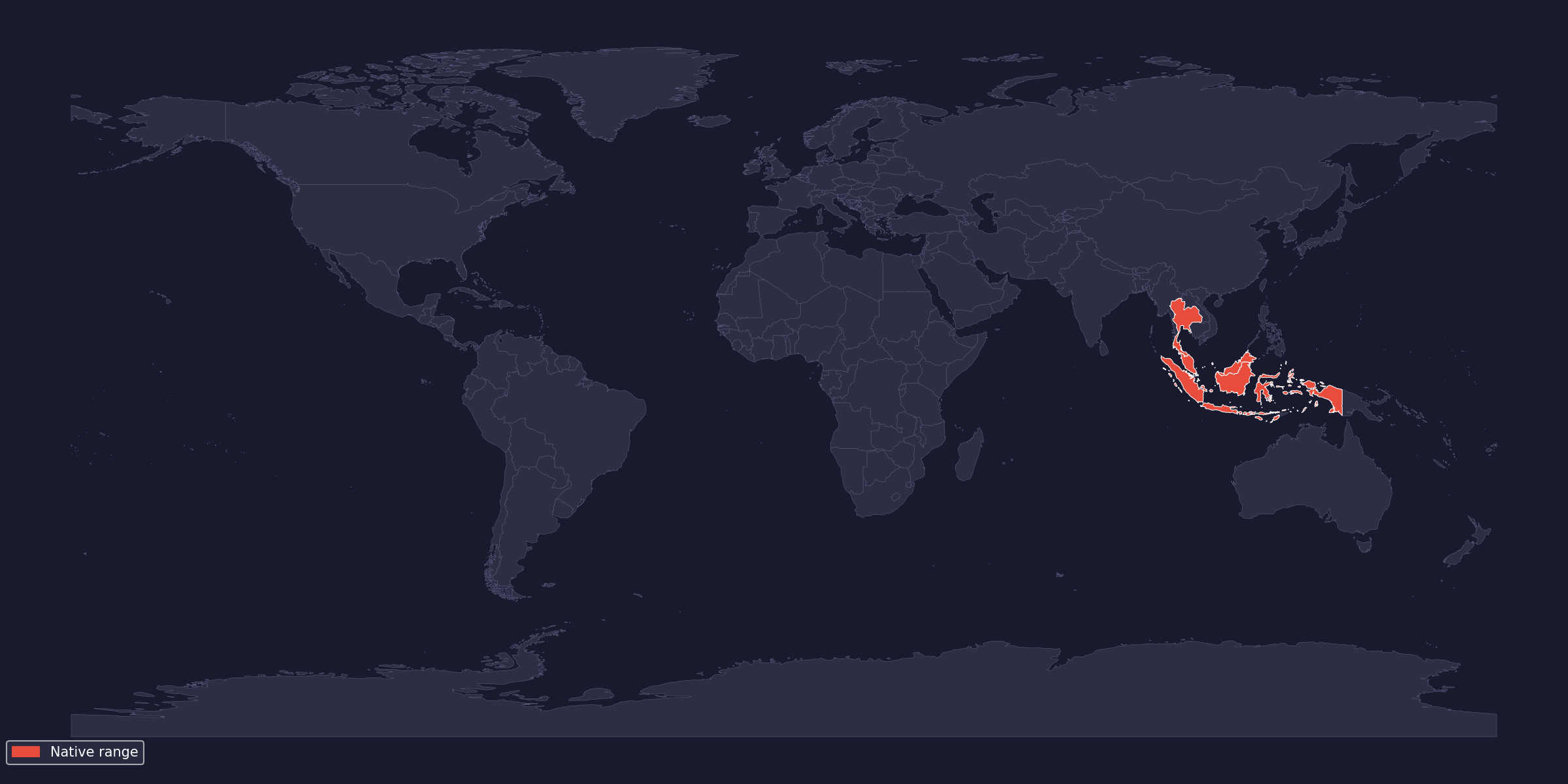
🌡 Climate across the native range
Monthly climate normals from a verified lowland occurrence in Singapore:
North — Singapore (verified occurrence)
| Month | Min °C | Mean °C | Max °C | RH % |
|---|---|---|---|---|
| January | 23.8 | 25.5 | 27.9 | 85 |
| February | 24 | 25.9 | 28.6 | 83 |
| March | 24.4 | 26.4 | 29.1 | 84 |
| April | 24.8 | 26.7 | 29.1 | 86 |
| May | 25.3 | 27 | 28.9 | 86 |
| June | 25.3 | 27 | 28.8 | 85 |
| July | 25.1 | 26.7 | 28.4 | 84 |
| August | 25 | 26.6 | 28.3 | 84 |
| September | 24.8 | 26.6 | 28.5 | 84 |
| October | 24.6 | 26.4 | 28.5 | 85 |
| November | 24.3 | 25.9 | 28.1 | 87 |
| December | 24 | 25.6 | 27.9 | 87 |
Weather data by Open-Meteo.com · CC BY 4.0 · Monthly normals calculated by Herpeton Academy from daily archive values.
Location references use GBIF.org occurrence data where available; original occurrence records retain their source dataset licenses.
⚖️ Legal status
As checked on 16 August 2026, Tropidolaemus wagleri is not listed in CITES Appendices I-III and no species-specific entry was found in EU wildlife-trade Annexes A-D. The Bern Convention is not relevant because this is not a European native species.
Absence from trade annexes does not authorize possession. Venomous-animal licences, inspected rooms, transport approval, insurance, escape plans, or a complete local ban may apply. Verify the accepted name and older Trimeresurus wagleri with the competent authority before acquisition. Retain invoices, breeder and locality records, import or transfer papers, photographs, and the date of every legal check.
🤌 Husbandry
The complete protected-contact system must be working before arrival: locked primary enclosure, secure secondary room, hazard labels, dedicated tools, and a shift box that can be closed from outside. Keep the snake singly. Cohabitation obstructs individual observation and makes feeding and servicing unnecessarily dangerous.
Quarantine for at least 90 days in separate airspace where practical. Use simple furnishing, paper substrate, and dedicated bowls, hooks, tongs, and cleaning equipment. Record weight, meals, sheds, faeces, and drinking. Imports or animals of uncertain origin warrant examination and faecal testing by an experienced reptile veterinarian.
Do not confuse immobility with tractability. Routine cleaning, water changes, and inspection should occur only after visual confirmation and secure shifting behind a solid barrier.
💡 Lighting
Provide bright visible light on a regular 10-12 hour day. Low-level UVB is not proven essential for a whole-prey-fed snake but may be offered across part of the canopy, measured within Ferguson Zone 1, with dense shade and retreats. Lamps and cables belong outside the enclosure or behind fixed guards.
Night should be dark. If heat is needed after lights-out, use a guarded lightless source controlled by a thermostat. Avoid coloured night bulbs and intense display lighting that removes concealment.
🌡 Heating and temperature
Maintain 24-28°C ambient air, a small warm perch at 28-30°C, a 22-24°C cool retreat, and 22-25°C at night. Measure air and perch surfaces at several heights. Every heater needs a thermostat and an independently checked probe that the snake cannot dislodge.
This humid tropical species is vulnerable when heat accumulates through the whole upper enclosure. A female coiled high in the display still needs a genuinely cooler option. Seasonal rain and small night changes may be represented, but deliberate cooling is not a routine breeding shortcut for juveniles, thin animals, or new arrivals.
💧 Humidity and water
Target a ventilated 70-85% relative humidity, with brief rises toward 80-90% during shedding. Mist leaves and branches to provide drinking droplets, then let surfaces and the upper substrate dry. Keep a clean, stable water bowl available at all times and position it for protected-access replacement.
Persistent condensation, sour substrate, skin lesions, or musty air indicate excessive moisture or insufficient exchange. Cross-ventilation and drainage are as important as misting. Paper is preferable in quarantine; established displays can use a moisture-buffering soil and leaf-litter layer about 5 cm deep.
🌿 Enclosure and decoration
For one adult female provide at least 90 x 60 x 120 cm; a smaller male still benefits from usable height and should not be confined to a narrow display tube. Install several firmly anchored horizontal and diagonal perches of different diameters, elevated cork or foliage retreats, visual barriers, a ground hide, and an unobstructed shift entrance.
Use keyed or tool-operated locks, secured vents and mesh, guarded equipment, and blocked cable gaps. Furnishings must allow a complete visual check before a door opens. Plants can improve cover but must not conceal access points or prevent cleaning. Audit tracks, vents, drains, locks, and the shift closure on a schedule.
🐁 Feeding
Wild prey includes rodents, birds, frogs, and lizards. Captive adults can generally be maintained on appropriately sized frozen-thawed rodents with occasional suitable whole avian prey. A meal should not exceed the snake’s widest body section. Juveniles may require smaller, locality-appropriate prey or scenting; force-feeding belongs to a veterinary or institutional team.
Feed juveniles about every 7-10 days and established adults every 14-21 days, adjusting for sex, activity, weight, and body condition. Large females become obese when fed merely because they remain responsive. Whole vertebrate prey normally needs no vitamin or calcium powder, and live prey adds avoidable injury and servicing risk.
🥚 Breeding
The species is viviparous. Published observations describe litters commonly around 15, with reported extremes reaching roughly 7-41 young. Every neonate is venomous at birth and needs an individual secure enclosure, records, tools, and a lawful destination.
Breeding requires confirmed species identity, locality, sex, health, and a separation plan. Male and female introductions must remain controlled and temporary. Do not produce a large litter before secure capacity and documented recipients exist.
🛡️ Handling and emergency planning
Treat every individual as display-only. Do not free-handle, tail, pin, neck, or manually restrain it for routine husbandry or photography. A lockable shift box, appropriate hooks, barriers, and a second trained adult for higher-risk operations are the working system; gloves do not make the fangs safe.
Before acquisition, coordinate a written plan with emergency services, a poison centre or medical toxicologist, and a receiving hospital. Include accepted and older scientific names, origin, keeper location, contacts, and the transport route. Antivenom choice, stocking, and administration are clinical and institutional decisions, never a home protocol.
Any bite needs immediate emergency assessment. Move clear, prevent a second exposure, remove rings and tight objects, keep the patient still, immobilize the limb, and call emergency services. Do not cut, suck, ice, apply chemicals or electricity, use an arterial tourniquet, or wait for swelling before seeking care.
🩺 Common problems
- Dehydration and overheating: repeated floor use, restlessness, or poor sheds may mean the canopy is too hot or drinking opportunities are inadequate.
- Respiratory disease: nasal discharge, bubbles, wheeze, gaping, or unusual head elevation requires prompt reptile-veterinary assessment; stagnant saturated air is a frequent contributor.
- Dysecdysis and skin disease: review hydration, the mist-dry cycle, ventilation, temperature, and hygiene instead of manually peeling the snake.
- Obesity and regurgitation: large or frequent meals, excessive heat, and disturbance after feeding are preventable causes.
- Parasites: imports may carry mites and internal parasites; quarantine and diagnostics are safer than blind medication.
- Rostral abrasion: exposed glass, insufficient cover, overheating, or poor enclosure geometry can cause persistent rubbing.
- Unsafe routine: a near miss during spraying or water replacement means the shift system or procedure must be redesigned.
📌 Conclusion
Wagler’s pit viper belongs only with a legally authorized expert who has redundant containment, protected-contact experience, veterinary access, and a rehearsed bite plan. The central husbandry challenge is not simply high humidity: it is providing ventilated moisture, stable covered perches, moderate heat, restrained feeding, and servicing that never depends on the snake remaining still.
📚 Sources and further reading
- ReptiFiles was searched before drafting; no species-specific Tropidolaemus wagleri care guide was located: https://reptifiles.com/
- The Reptile Database, Tropidolaemus wagleri: https://reptile-database.reptarium.cz/Tropidolaemus/wagleri
- GBIF Backbone Taxonomy, Tropidolaemus wagleri: https://www.gbif.org/species/2443722
- Singapore NParks, Tropidolaemus wagleri: https://www.nparks.gov.sg/florafaunaweb/fauna/4/9/490
- Singapore Biodiversity Online, life history and reproduction: https://singapore.biodiversity.online/taxo4254/mainSpace/Tropidolaemus%20wagleri.html
- McCleary et al., reproduction in Singapore: https://www.biotaxa.org/hn/article/download/13683/17600
- Baines et al., UV-Tool: https://doi.org/10.19227/jzar.v4i1.150
- WHO, Guidelines for the management of snakebites: https://www.who.int/southeastasia/publications/i/item/9789290225300
- Swiss Animal Welfare Ordinance, venomous-snake enclosure standards: https://www.fedlex.admin.ch/eli/cc/2008/416/en
- CITES Appendices and checklist: https://cites.org/eng/app/appendices.php and https://checklist.cites.org/
- Commission Regulation (EU) 2026/1383, current EU wildlife-trade annexes: https://eur-lex.europa.eu/eli/reg/2026/1383/oj/eng
- Council of Europe, Bern Convention appendices: https://www.coe.int/en/web/bern-convention/appendices