Share

White-lipped Island Pit Viper
🔤 Taxonomy
The white-lipped island pit viper is currently classified as Trimeresurus insularis. It was described as the subspecies Trimeresurus albolabris insularis and was later treated as Cryptelytrops insularis; both combinations still appear in older books, veterinary records, and trade documents.
Other English names include Lesser Sunda pit viper, Indonesian pit viper, and Sunda white-lipped pit viper. “Blue viper” is a colour-trade label, not a separate species or a guarantee of origin. Green, turquoise-blue, and yellow animals occur in different island populations, and colour alone is insufficient for locality identification.
📌 Description
This is a slender, nocturnal, arboreal pit viper with hinged front fangs, heat-sensitive facial pits, a prehensile tail, and medically significant venom. Published bites have required hospital treatment, and venom studies show effects on blood coagulation. Its beauty and modest size do not make it suitable for a novice: it is a display-only species for trained, legally authorised venomous-snake keepers.
Males commonly remain near 60 cm, while females often approach 80 cm and exceptional animals can exceed 1 m. Chester Zoo gives an indicative lifespan of 9-11 years; planning for 15 years avoids treating that figure as a deadline. Females are usually larger and more robust, but sex should be confirmed without unsafe manual probing.
📋 Quick reference
| Care point | Practical target |
|---|---|
| Adult enclosure | At least 75 x 60 x 90 cm for one adult, with locks and a shift box |
| Day temperatures | 24-28°C ambient; 28-30°C limited warm perch; 22-24°C cool retreat |
| Night temperatures | 21-24°C |
| Humidity | Usually 60-80%, with drinking droplets and full drying between misting cycles |
| Lighting | 10-12 hours; optional low-level UVB with deep shade |
| Feeding | Appropriately sized frozen-thawed whole prey; established adults commonly every 14-21 days |
| Social housing | Solitary except during a controlled expert breeding introduction |
| Safety | Medically significant venom; protected-contact servicing only |
☠️ Venom
This species is venomous. Venom exposure can cause pain, swelling or other systemic effects, and severity varies with species, locality, bite site and the amount delivered. A small wound or apparently dry bite is not proof of safety; every bite or sting requires urgent medical assessment.
If an incident occurs, move away, call emergency services or a poison centre, keep the patient still, remove rings and other constricting items, and follow dispatcher instructions. Do not use a tourniquet, cut or suck the wound, apply ice or electricity, give alcohol or medicines as a home treatment, or attempt to catch the animal. Antivenom choice and dosing are hospital decisions; verify the relevant product and local availability in advance. Sources: WHO snakebite guidance and appropriate species-specific toxinology or medical references listed below.
🌍 Distribution
The species occurs in Indonesia and Timor-Leste, from eastern Java and Bali through the Lesser Sunda archipelago. Documented islands include Lombok, Sumbawa, Komodo, Rinca, Padar, Flores, Adonara, Alor, Sumba, Roti, Timor, Wetar, and Romang. Island provenance matters because colour and venom composition vary geographically.
It uses monsoon forest, coastal forest, bushland, agricultural margins, rice-field vegetation, and other structurally complex habitats. Although strongly adapted for climbing, field surveys in Timor-Leste also found animals on the ground at night in wet habitat while ambushing frogs. Captive design should therefore supply dense elevated cover and usable floor-level retreat rather than assuming the snake will remain on one exposed branch.
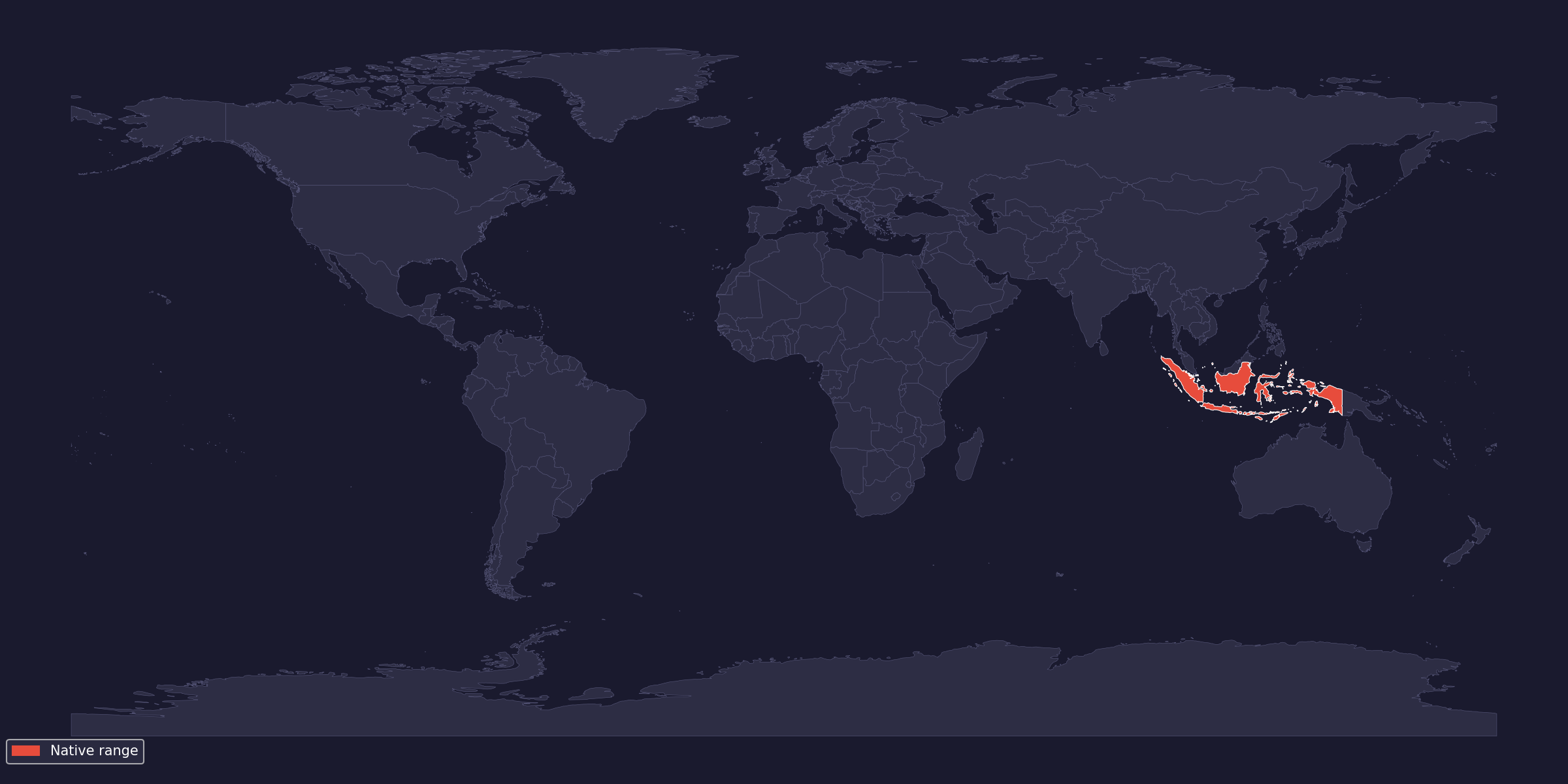
🌡 Climate across the native range
Monthly climate normals from a verified occurrence in the Lesser Sunda Islands:
East Nusa Tenggara — Indonesia (verified occurrence)
| Month | Min °C | Mean °C | Max °C | RH % |
|---|---|---|---|---|
| January | 24.5 | 25.9 | 27.6 | 88 |
| February | 24.4 | 25.8 | 27.5 | 89 |
| March | 24.6 | 26.1 | 28.1 | 87 |
| April | 24.8 | 26.4 | 28.6 | 84 |
| May | 24.7 | 26.3 | 28.7 | 81 |
| June | 24.1 | 25.8 | 28.3 | 78 |
| July | 23.4 | 25.4 | 28.1 | 76 |
| August | 23.2 | 25.4 | 28.3 | 74 |
| September | 23.8 | 25.9 | 28.8 | 77 |
| October | 24.7 | 26.7 | 29.3 | 80 |
| November | 25.2 | 27 | 29.3 | 83 |
| December | 24.8 | 26.3 | 28.2 | 87 |
Weather data by Open-Meteo.com · CC BY 4.0 · Monthly normals calculated by Herpeton Academy from daily archive values.
Location references use GBIF.org occurrence data where available; original occurrence records retain their source dataset licenses.
⚖️ Legal status
As checked on 14 August 2026, Trimeresurus insularis is not listed in CITES Appendices I-III and has no specific entry in EU wildlife-trade Annexes A-D. The Bern Convention is not relevant because the species is not native to Europe.
National and local dangerous-animal law remains the decisive issue. A licence, inspection, secure-room standard, insurance, transport permission, emergency plan, or complete prohibition may apply even though the species is absent from CITES. Check the current and older names with the competent authority before acquisition. Retain the invoice, breeder and island-provenance claim, transfer or import papers, photographs, and legal-check date.
🤌 Husbandry
Prepare the complete system before the animal arrives: locked primary enclosure, legally acceptable secondary containment, species and hazard labels, dedicated tools, a lockable shift box, and a written bite and escape procedure. The room must exclude children, visitors, and untrained helpers.
House animals singly. Permanent cohabitation makes feeding, health observation, and safe servicing harder and exposes both snakes during competition or courtship. A well-designed shift box allows routine cleaning and water changes while a solid barrier remains between keeper and snake; free-hand interaction has no place in normal care.
Quarantine every new animal for at least 90 days, preferably in separate airspace. Use dedicated hooks, tongs, bowls, and cleaning supplies. Record weight, meals, sheds, defecation, and drinking, and seek reptile-veterinary examination and fecal testing for imports, animals of uncertain origin, or symptomatic individuals.
💡 Lighting
Provide bright visible light on a stable 10-12 hour cycle. Low-output UVB is optional but recommended as a choice within the enclosure; measure a low Ferguson Zone 1 exposure at the highest accessible perch and retain deep foliage shade. Blue colouration is not a reason to omit all light or to expose the snake strongly for display.
Night must be dark. If room temperatures fall below the safe night range, use a guarded, lightless heat source controlled by a thermostat. Any lamp, cable, or probe must remain inaccessible to the snake.
🌡 Heating and temperature
Maintain 24-28°C ambient air with a restricted upper warm perch at 28-30°C and a 22-24°C cool retreat. Nights around 21-24°C suit routine maintenance. The archipelago includes different local climates, so provenance and the animal’s documented history should refine these values.
Measure air and perch surfaces at several heights with independent instruments. Thermostat every heater, secure every probe, and avoid turning the entire canopy into a 30°C hot zone. Persistent exposure to heat plus saturated air removes the snake’s ability to regulate and promotes illness.
💧 Humidity and water
Use a 60-80% baseline with brief rises toward 75-90% during shedding. Mist foliage to create drinking droplets, then allow leaves, branches, and the surface layer to dry. Supply a clean bowl even when the animal usually drinks from leaves.
Humidity must not mean stagnant wetness. Use cross-ventilation, drainage, and a 5 cm moisture-buffering substrate; discard any substrate that becomes sour, waterlogged, or mouldy. Paper is safer during quarantine because droppings, mites, and abnormal discharge are visible.
🌿 Enclosure and decoration
Provide at least 75 x 60 x 90 cm for one adult, larger for a large female and wherever local standards require it. Use multiple firmly mounted horizontal and diagonal branches, elevated cork or foliage retreats, visual barriers, a ground hide, and a stable water bowl. Plants may help humidity and cover but must not obstruct a complete visual check.
Use keyed or tool-operated locks, guarded heating and lighting, secured mesh, and blocked cable gaps. Install a shift box that closes from outside the enclosure. Arrange removable furnishings so that routine work never requires reaching behind foliage to discover where the snake is. Audit doors, tracks, drains, vents, and locks regularly.
🥗 Feeding
Wild prey includes small mammals, birds, frogs, and lizards. Captive adults can usually be maintained on appropriately sized frozen-thawed rodents, with occasional suitable whole avian prey if desired. Very small juveniles may require species-appropriate scenting or smaller prey, but unsafe force-feeding must be left to an experienced reptile veterinarian or specialist team.
Juveniles commonly take a small meal every 7-10 days; established adults usually need feeding every 14-21 days, with longer intervals for inactive or heavy animals. Use prey no wider than the snake’s broadest body section, track weight and body shape, and avoid power feeding. Do not use live prey as routine husbandry.
Whole vertebrate prey normally requires no added calcium or vitamins. Record prey type and mass, date, refusal, defecation, and weight. Before repeated offerings, investigate heat, cover, disturbance, reproductive state, parasites, and oral or respiratory disease.
🥚 Breeding
Trimeresurus insularis is viviparous. Females may bear 7-17 young, and on Komodo births are reported near the start of the rainy season. Every neonate is venomous from birth and needs an individual escape-proof enclosure, secure tools, records, and lawful placement.
Breeding should be attempted only after documented locality, sex, health, and legal status are established. Introductions require continuous observation and a separation plan. Do not cool or cycle juveniles, thin animals, new arrivals, or snakes with unresolved disease. Producing a large litter without safe long-term destinations is a serious welfare and public-safety failure.
🛡️ Handling and emergency planning
Treat every individual, including a neonate, as display-only. Routine work should use a lockable shift box, appropriate hooks, barriers, and a second trained adult for higher-risk tasks. Do not free-handle, tail, pin, or neck the snake for maintenance or photographs; bite-resistant gloves do not neutralise the fangs.
Before acquisition, develop a written plan with the relevant emergency service, poison centre or medical toxicology contact, and receiving hospital. Include the accepted and older scientific names, provenance if known, expected clinical effects, exact keeper location, emergency contacts, and route to hospital. Antivenom selection and treatment are clinical decisions, not a keeper’s home protocol.
Any bite requires immediate emergency assessment, even when symptoms seem mild. Move away from the snake, secure the scene without risking another bite, remove rings or tight objects, keep the person still, immobilize the limb, and call emergency services. Do not cut, suck, ice, or chemically treat the wound, apply an arterial tourniquet, or wait for swelling or bleeding.
🩺 Common problems
- Overheating and dehydration: an exposed, restless snake or repeated movement to the floor can indicate a lost cool retreat or inadequate drinking opportunities.
- Respiratory disease: nasal fluid, bubbles, wheezing, gaping, or unusual head elevation needs prompt reptile-veterinary assessment; stale saturated air is a common husbandry factor.
- Dysecdysis and skin disease: review the mist-dry cycle, water access, temperature, ventilation, and hygiene before attempting physical intervention.
- Obesity and regurgitation: frequent or oversized meals are preventable causes. Follow serial weight and body condition, not appetite alone.
- Parasites: wild-caught animals may carry gastrointestinal worms and other parasites; quarantine and diagnostic testing matter more than blind treatment.
- Rostral abrasion and escape attempts: inadequate cover, exposed doors, overheating, or poor enclosure geometry can cause rubbing and repeated pushing.
- Unsafe routine: a near miss during spraying, feeding, or cleaning is a system failure. Stop and redesign the shift and access procedure.
📌 Conclusion
The white-lipped island pit viper is appropriate only for an authorised expert who already has protected-contact skills, redundant containment, veterinary access, and a rehearsed envenomation plan. The enclosure must offer ventilated humidity, dense secure perches, a real thermal gradient, and safe servicing. Colour is never a reason to compromise provenance checks or public safety.
📚 Sources and further reading
- ReptiFiles was searched before drafting; no species-specific Trimeresurus insularis care guide was located: https://reptifiles.com/
- The Reptile Database, Trimeresurus insularis: https://reptile-database.reptarium.cz/Trimeresurus/insularis
- GBIF Backbone Taxonomy, Trimeresurus insularis: https://www.gbif.org/species/7656866
- Chester Zoo, white-lipped island pit viper: https://www.chesterzoo.org/animals/white-lipped-island-pit-viper
- O’Shea et al., herpetological diversity and natural history in Timor-Leste: https://www.markoshea.info/downloads/oshea_et_al_2015_timor_2nd_update.pdf
- Venom composition across the Lesser Sunda archipelago: https://doi.org/10.1021/acs.jproteome.8b00994
- T. insularis envenomation treated with Thai green pit-viper antivenom: https://pubmed.ncbi.nlm.nih.gov/38525877/
- WHO, Guidelines for the management of snakebites: https://www.who.int/southeastasia/publications/i/item/9789290225300
- Baines et al., UV-Tool: https://doi.org/10.19227/jzar.v4i1.150
- Swiss Animal Welfare Ordinance, arboreal venomous-snake enclosure standards: https://www.fedlex.admin.ch/eli/cc/2008/416/en
- CITES Appendices and species checklist: https://cites.org/eng/app/appendices.php and https://checklist.cites.org/
- Commission Regulation (EU) 2026/1383, current EU wildlife-trade annexes: https://eur-lex.europa.eu/eli/reg/2026/1383/oj/eng
- Council of Europe, Bern Convention appendices: https://www.coe.int/en/web/bern-convention/appendices