Share

Southern Twig Snake
🔤 Taxonomy
Thelotornis capensis is the accepted name for the southern twig or vine snake. A 2026 integrative revision elevated T. oatesi and confirmed T. mossambicanus as separate species, leaving T. capensis associated primarily with southern coastal-thicket habitats. Older books used T. capensis for a much wider African assemblage.
Locality and photographs must accompany every animal. Labels such as “savanna vine snake” or the old subspecies T. c. mossambicanus are not adequate identification after the revision.
📌 Description
This extremely slender arboreal snake usually reaches about 90-120 cm and may approach 150 cm. Its angular head, horizontal keyhole-like pupil, cryptic grey-brown colour, and swaying posture break up its outline among branches. Captive lifespan is not well quantified; 10-15 years is a cautious planning range.
The rear fangs can deliver medically significant, strongly procoagulant venom. Serious effects may be delayed while early pain and swelling remain modest, and no dedicated twig-snake antivenom is available. This is an expert-only display species for an authorised facility with a hospital-coordinated bite plan.
📋 Quick reference
| Care point | Practical target |
|---|---|
| Adult enclosure | At least 150 x 75 x 180 cm; broad inspectable canopy and two lockable shifts |
| Temperature | Air 23-27°C; basking branch 29-31°C; cool retreat 21-23°C |
| Humidity | 50-70%, with a ventilated 70-80% shedding refuge |
| Light | 11-13 hours; low-level UVB may be offered over one basking route |
| Feeding | Varied frozen-thawed lizards, frogs, and occasional other whole vertebrates |
| Safety | Display-only; delayed coagulopathy plan and two-person protected contact |
| Quarantine | At least 90 days with separate airspace and parasite screening |
☠️ Venom
This species is venomous. Venom exposure can cause pain, swelling or other systemic effects, and severity varies with species, locality, bite site and the amount delivered. A small wound or apparently dry bite is not proof of safety; every bite or sting requires urgent medical assessment.
If an incident occurs, move away, call emergency services or a poison centre, keep the patient still, remove rings and other constricting items, and follow dispatcher instructions. Do not use a tourniquet, cut or suck the wound, apply ice or electricity, give alcohol or medicines as a home treatment, or attempt to catch the animal. Antivenom choice and dosing are hospital decisions; verify the relevant product and local availability in advance. Sources: WHO snakebite guidance and appropriate species-specific toxinology or medical references listed below.
🌍 Distribution
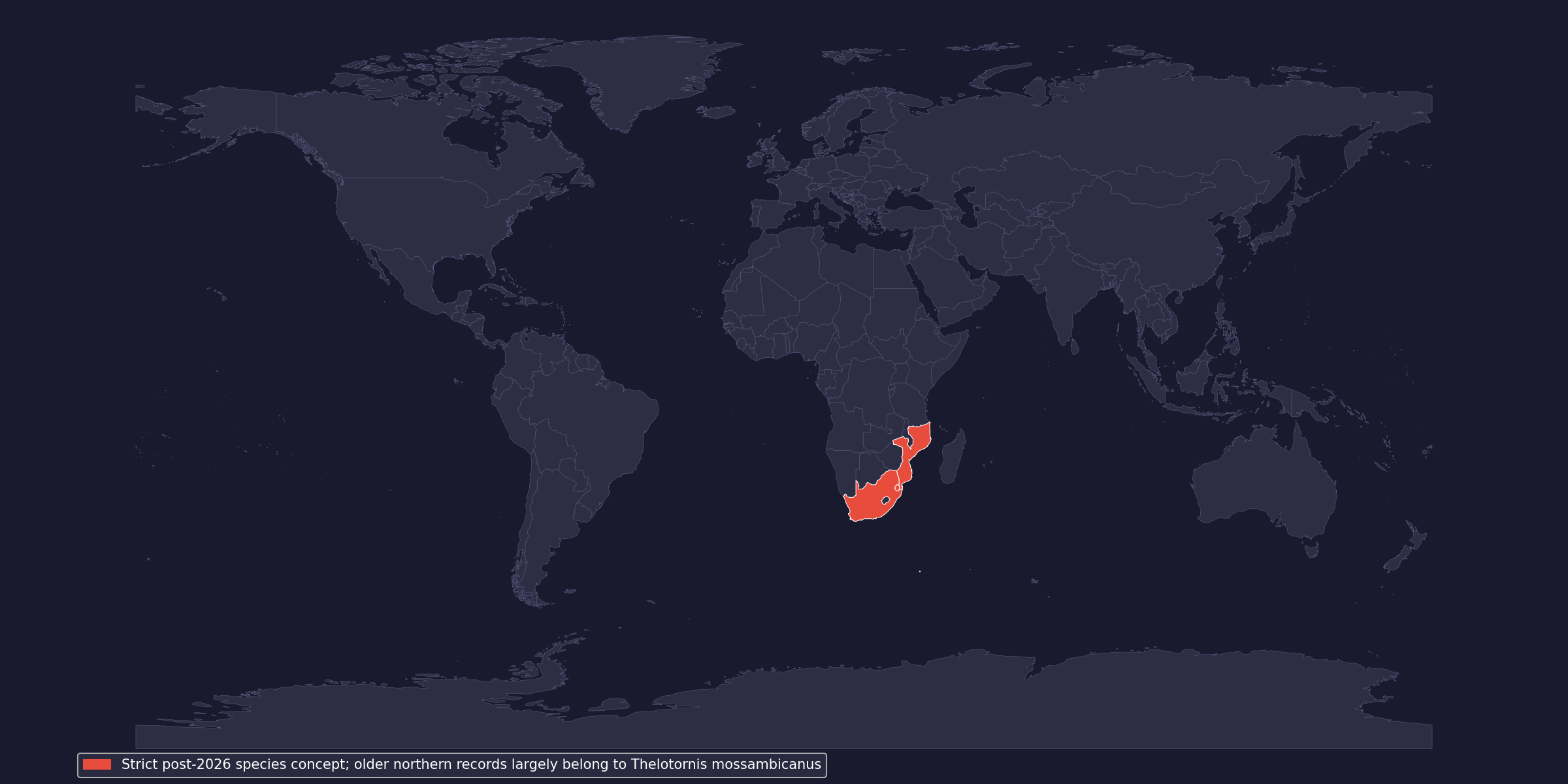
Following the 2026 revision, T. capensis in the strict sense is centred in eastern and southern South Africa and Eswatini, reaching southern Mozambique where boundaries and historical intergradation require further study. Malawi and more northerly records largely belong to T. mossambicanus; broad older maps should not be copied uncritically.
The species uses woodland margins, savanna, and especially southern coastal thicket. It often hunts from low branches despite its fully arboreal build. A captive canopy therefore needs horizontal and diagonal routes from near the floor to the upper basking zone.
⚖️ Legal status
The official CITES Appendices and EU wildlife-trade annexes checked on 29 August 2026 do not specifically list Thelotornis capensis. The Bern Convention is not relevant to this non-European species. National wildlife-export rules and dangerous-animal laws still apply.
Obtain written confirmation for possession, transport, import, and breeding before acquisition. Keep the invoice, breeder and parentage records, export/import papers, photographs, exact locality, the scientific name used on each document, and this check date. The recent split makes locality-free paperwork a serious identity and legality problem.
🤌 Husbandry
House singly in a restricted room with secondary containment. Use two full-height or branch-linked shift compartments that close externally. Staff must locate the entire camouflaged snake and lock it away before opening a service panel; an enclosure so dense that this is impossible is unsafe.
Quarantine for at least 90 days in a simpler climbing setup, preferably separate airspace. Use dedicated tools and record weight, meals, sheds, faeces, breathing, and rostral condition. Imports require veterinary examination and evidence-led parasite management.
Avoid unnecessary disturbance. The animal should be able to travel between cover, water, basking, and shifts without crossing an exposed empty box, but the planting must retain clear sight lines.
💡 Lighting
Provide bright broad-spectrum visible light for 11-13 hours, with full darkness at night and shaded foliage. Put every lamp outside primary containment or behind a secure guard.
UVB is not proven essential for a whole-prey snake, but measured Ferguson Zone 1 exposure over part of the upper canopy may support natural basking. The snake must be able to remain completely shaded at every temperature.
🌡 Heating and temperature
Maintain air at 23-27°C, an upper basking branch at 29-31°C, a cool route at 21-23°C, and nights around 19-23°C. Create a small radiant zone rather than heating the whole canopy. Thermostat all heaters and measure branch surfaces as well as air.
Persistent descent, frantic movement, gaping, or pressing against vents can indicate overheating. Seasonal night variation may follow a documented locality, but do not impose severe cooling on new, thin, sick, or poorly identified animals.
💧 Humidity and water
Aim for 50-70% humidity with ventilation and a mist-dry cycle. During shedding, offer a densely covered refuge around 70-80% rather than saturating the whole enclosure. Wet branches and stagnant air promote skin and respiratory problems.
Provide a stable elevated or easily accessed water bowl that can be changed through protected access. Light morning spray on foliage may encourage drinking, but surfaces should dry during the day.
🌿 Enclosure and decoration
Use at least 150 x 75 x 180 cm for an adult. Install rigid branches from roughly the snake’s body diameter up to several centimetres wide, including long horizontal perches, diagonals, and screened resting points. Anchor every branch so it cannot rotate or block a shift door.
Use 6-10 cm of drainage-aware soil and leaf litter, or paper during quarantine. Avoid adhesive foliage, exposed glass corridors, unstable branches, and plants that conceal the animal from all viewing angles. Doors, vents, and cable ports require independent mechanical locks.
🐁 Feeding
Published southern-African data found mainly lizards, then frogs and other snakes; birds were uncommon. Offer varied, appropriately sized frozen-thawed whole prey, prioritising captive-produced lizards and frogs where lawful and occasionally small rodents or chicks if the individual accepts them. Do not rely on muscle meat or wild-caught prey.
Juveniles generally need a small meal every 7 days; adults usually every 10-14 days. Feed from a protected position and shift before retrieving refusals. Balanced whole vertebrate prey needs no routine supplementation.
🛡 Operational safety and emergencies
Never free-handle, tail, pin, neck, or manually restrain a twig snake. Use lockable shifts, rigid transparent barriers, appropriate hooks, and two trained adults for work involving an open primary barrier. Veterinary procedures require a pre-arranged restraint and anaesthesia plan.
Coordinate a written bite plan with a poison centre or toxicologist and receiving hospital before acquisition. The plan must highlight potentially delayed coagulopathy and the absence of a dedicated antivenom; apparent early wellbeing is not reassurance.
After any bite, call emergency services, keep the patient still, immobilize the limb, remove constricting items, and follow poison-centre instructions. Do not cut, suck, ice, shock, tightly tourniquet, or wait for bleeding.
🥚 Breeding notes
The species is oviparous. Published southern data report seasonal maturity near 60 cm snout-vent length and clutches commonly of 4-7 eggs, while broader historical accounts report up to 18. Incubation is reported at roughly 60-90 days; use 26-28°C only as a conservative starting range tied to verified locality.
Breeding requires separate locked adult and neonatal housing, documented identity, and lawful placements before pairing. Egg removal must occur only after adults are secured in shifts.
🩺 Common problems
- Rostral and spinal trauma: exposed glass, poor cover, rotating branches, or panic during servicing can injure this slender snake.
- Respiratory disease: bubbles, wheeze, gaping, or abnormal head elevation require urgent reptile-veterinary care.
- Dysecdysis and dehydration: review drinking access, humid cover, and ventilation; never peel retained skin by hand.
- Parasites and stomatitis: imports may show mites, weight loss, abnormal faeces, oral swelling, or discharge.
- Refusal and regurgitation: wrong prey, oversized meals, low heat, and disturbance are common correctable causes.
- Unsafe invisibility: inability to locate the whole snake before access is an enclosure-design failure.
📌 Conclusion
Thelotornis capensis requires a large but fully inspectable canopy, specialist whole prey, exact locality records, and institutional protected contact. A facility without a plan for delayed coagulopathy or one relying on an old broad “vine snake” label should not acquire it.
📚 Sources and further reading
- ReptiFiles — checked first on 29 August 2026; no species-specific care guide was found.
- The Reptile Database: Thelotornis capensis
- GBIF species record
- Engelbrecht et al. 2026 — revision of Thelotornis
- Shine et al. — diet and reproductive biology
- SANBI Atlas account
- WHO Africa snakebite guidelines
- CITES Appendices
- EU wildlife-trade annexes, Commission Regulation (EU) 2026/1383
- Bern Convention appendices