Share

Madagascar Tree Boa
🔤 Taxonomy
Sanzinia madagascariensis is the accepted eastern and northern Madagascar species. The western “mandarin” form formerly called S. m. volontany is now generally treated as the separate species Sanzinia volontany. Older sources may also use Boa manditra or Corallus madagascariensis.
This guide does not merge the two modern species. Ask for the parents’ identity and origin because old “green phase” and “mandarin phase” labels can conceal the taxonomic split. The German name is Madagaskar-Hundskopfboa.
📌 Description
The Madagascar tree boa is a robust, heat-sensing boa with strong climbing ability. S. madagascariensis usually reaches 140-200 cm; adults may live 20-25 years. Juveniles are brown-red and become greener as they mature.
Despite the name, adults use the ground as well as branches. They require a large three-dimensional enclosure, moderate rather than extreme heat, moving humid air and impeccable legal documentation. This combination makes the species advanced.
🌍 Distribution
S. madagascariensis is endemic to eastern and northern Madagascar, including Nosy Be, where it occupies humid forest and wooded mosaics. The drier western and southern populations traditionally included under the name belong largely to S. volontany under the current split.
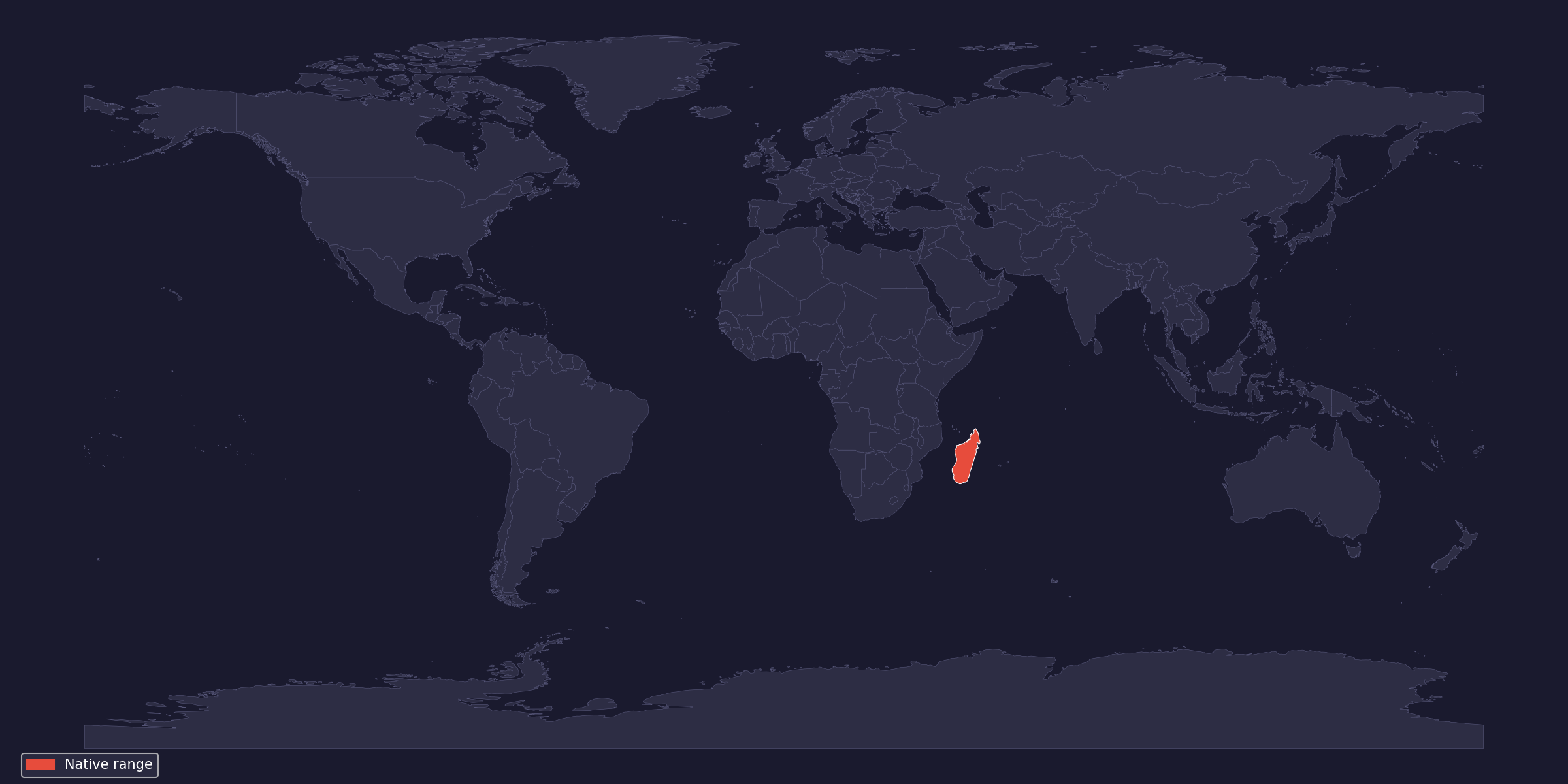
🌡 Climate across the native range
Monthly climate normals from reviewed GBIF occurrence locations:
Toamasina — Madagascar
| Month | Min °C | Mean °C | Max °C | RH % |
|---|---|---|---|---|
| January | 17.2 | 22 | 26.9 | 88 |
| February | 17.2 | 22.2 | 27.2 | 87 |
| March | 16.6 | 21.7 | 26.7 | 88 |
| April | 15.3 | 20.5 | 25.8 | 87 |
| May | 12.6 | 18.4 | 24.3 | 89 |
| June | 10.8 | 16.5 | 22.3 | 89 |
| July | 10.6 | 15.1 | 19.7 | 92 |
| August | 10.6 | 15.5 | 20.4 | 88 |
| September | 11.2 | 16.6 | 22 | 84 |
| October | 12.7 | 18.7 | 24.8 | 81 |
| November | 14.8 | 20.7 | 26.7 | 79 |
| December | 16.2 | 21.6 | 27.1 | 85 |
Fianarantsoa — Madagascar
| Month | Min °C | Mean °C | Max °C | RH % |
|---|---|---|---|---|
| January | 16.9 | 21.2 | 25.4 | 85 |
| February | 16.7 | 21 | 25.3 | 86 |
| March | 16.2 | 20.5 | 24.9 | 85 |
| April | 14.6 | 19.3 | 23.9 | 83 |
| May | 12.2 | 17.2 | 22.2 | 84 |
| June | 10.2 | 15.1 | 20.1 | 84 |
| July | 9.5 | 14.3 | 19 | 85 |
| August | 9.8 | 14.7 | 19.6 | 82 |
| September | 11 | 16.2 | 21.5 | 78 |
| October | 13.2 | 18.5 | 23.7 | 77 |
| November | 14.9 | 20 | 25.1 | 79 |
| December | 16.2 | 20.8 | 25.5 | 83 |
Antsiranana — northern Madagascar
| Month | Min °C | Mean °C | Max °C | RH % |
|---|---|---|---|---|
| January | 22.9 | 26.6 | 30.4 | 82 |
| February | 23 | 26.7 | 30.5 | 83 |
| March | 23.5 | 27.5 | 31.4 | 79 |
| April | 22.7 | 27 | 31.3 | 77 |
| May | 21.2 | 25.9 | 30.6 | 75 |
| June | 19.1 | 24.2 | 29.2 | 71 |
| July | 18.3 | 23.5 | 28.6 | 73 |
| August | 18.9 | 24 | 29.1 | 67 |
| September | 19.7 | 24.9 | 30 | 67 |
| October | 21.2 | 26.1 | 30.9 | 68 |
| November | 22.3 | 26.8 | 31.3 | 71 |
| December | 22.7 | 26.9 | 31.1 | 77 |
Weather data by WorldClim v2.1 · Monthly normals queried by Herpeton Academy from raster values; relative humidity is derived from vapor pressure and mean temperature.
Location references use GBIF.org occurrence data where available; original occurrence records retain their source dataset licenses.
⚖️ Legal status
Sanzinia madagascariensis is listed in CITES Appendix I and EU Annex A. International commercial trade in wild specimens is prohibited except under exceptional CITES provisions. In the EU, Annex A commercial activities are generally prohibited unless a competent authority issues the appropriate exemption certificate; import, export, sale, transfer and public display can require permits, certificates and individual identification.
Buy only a legally captive-bred animal whose identity matches its original documents and permanent mark where required. Before paying, have the national CITES management authority confirm that document numbers, parentage/origin codes and any Article 10 certificate cover the exact animal and intended transaction. Retain originals and transfer records for the animal’s lifetime. Bern is not relevant, but stricter national keeping and dangerous-animal rules may apply.
🤌 Husbandry
Provide a single adult at least 150 × 75 × 120 cm, with more room for a large female. The enclosure needs locked doors, sealed cable routes and supports anchored for a powerful boa. House separately except for planned, supervised breeding.
Limit handling and support the whole body. Use a removable perch for transfers. Quarantine for at least 90 days with separate tools, weight, feeding and faecal records; arrange an exotics-veterinary assessment for any animal with incomplete history.
💡 Lighting
Use an 11-13 hour photoperiod with bright visible light and deep shade. Low-level UVB is recommended in a Ferguson Zone 1-style gradient, not across the whole enclosure. Guard every internal lamp and leave several routes away from light and heat.
🌡 Heating and temperature
Provide 24-28 °C daytime ambient temperatures, a broad 29-31 °C warm perch, a 22-25 °C cool area and 20-24 °C nights. This species does not need green-tree-python-style constant high heat. Overheating and the inability to cool are serious risks.
Thermostat heaters and measure at ground and perch height. Seasonal cooling used for breeding is not ordinary husbandry and should not be copied from one breeding report without veterinary and species-experienced planning.
💧 Humidity and water
Maintain roughly 60-80% humidity with a daily rise after evening misting, strong cross-ventilation and partial drying by day. Increase local humidity to 75-85% during shedding without saturating the floor. Offer clean water in a stable bowl and change it whenever contaminated.
Persistently wet, stale housing promotes respiratory and skin disease; very dry air causes poor sheds. Use substrate and humid hides as buffers rather than chasing constant condensation.
🌿 Enclosure and decoration
Install thick horizontal and diagonal branches, elevated shelves, cork tubes and covered ground retreats. Give adults enough floor space to rest without climbing. Test every branch and plant anchor under more than the snake’s weight.
Use 8-12 cm of soil/coir and orchid or cypress bark with leaf litter, moist below but not waterlogged. Keep paper during quarantine. Avoid cedar, aromatic wood, sharp bark and any loose decoration that can collapse during nocturnal movement.
🐁 Feeding
Offer frozen-thawed mice or rats of approximately the snake’s widest body section. Juveniles usually eat every 7-10 days; adults every 14-21 days, with breeding females managed by body condition rather than a fixed surplus. Occasional captive-bred chicks can add variety.
Do not use live rodents or routinely dust whole prey. Obesity is easy to miss in a heavy-bodied boa and increases reproductive and organ risk. Record weight monthly and adjust the interval before increasing prey size.
🩺 Common problems
- wheezing, mucus or open-mouth breathing: respiratory infection, often involving poor airflow or temperature
- patchy shed or retained spectacles: dehydration or inadequate local humidity
- blisters and ventral discolouration: saturated dirty substrate
- burns: accessible heat source or failed thermostat
- obesity: oversized or overly frequent prey
- prolonged fasting with weight loss: stress, reproductive state or disease
- dystocia, stillbirths or retained material: reproductive emergency requiring an experienced veterinarian
- document mismatch: legal risk; stop the transaction and contact the management authority
📌 Conclusion
The Madagascar tree boa belongs with a keeper who can meet three requirements at once: verified Appendix I/Annex A paperwork, a large secure semi-arboreal enclosure and stable moderate tropical conditions. An undocumented “mandarin” or “green phase” animal should never be purchased on trust.
📚 Sources and further reading
- ReptiFiles was checked; no species-specific Sanzinia care guide was available on 30 August 2026.
- The Reptile Database: Sanzinia madagascariensis
- GBIF species record
- British Herpetological Society: captive husbandry and reproduction
- Muséum national d’Histoire naturelle: Madagascar tree boa
- Baines et al. 2016: UV lighting for reptiles
- CITES Checklist, CITES Appendices, EU wildlife-trade guidance, and current EU annex regulation