Share

Tiger Keelback
🔤 Taxonomy
Rhabdophis tigrinus is the accepted name for the tiger keelback. Older literature often uses Natrix tigrina or the gender-mismatched combination Rhabdophis tigrina. Mainland, Japanese, and Taiwanese populations may appear as R. t. lateralis, R. t. tigrinus, and R. t. formosanus.
The species must not be confused with R. subminiatus. Both possess medically important rear-fang venom and nuchal defensive glands, but their ranges, climate, and identification differ.
📌 Description
Adults commonly measure 60-100 cm; large females can exceed 1 m and approach 120 cm. The olive, green, or brown body bears dark bars and warm red-orange neck markings that vary by locality and age. A 10-15 year lifespan is a reasonable planning range where long-term records are incomplete.
There are two distinct exposure hazards. Duvernoy’s glands deliver venom through enlarged rear teeth during a sustained bite, while paired nuchal glands can contain cardiotonic bufadienolides sequestered mainly from toads. Nuchal fluid can contact eyes, mouth, or broken skin, and toxin-rich mothers can provision eggs. A mouse- or frog-fed captive must never be assumed chemically harmless.
📋 Quick reference
| Care point | Practical target |
|---|---|
| Adult enclosure | At least 150 x 75 x 75 cm; large clean water basin and two lockable shifts |
| Temperature | Air 21-26°C; basking 28-30°C; cool refuge 19-22°C |
| Humidity | 60-80%; well ventilated, with a wetter shedding refuge |
| Feeding | Captive-produced frogs and fish-based whole prey; adults every 7-10 days |
| Safety | Venom plus nuchal bufadienolides; eye/skin protection and protected contact |
| Quarantine | At least 90 days, separate tools, parasite and diet review |
☠️ Venom
This species is venomous. Venom exposure can cause pain, swelling or other systemic effects, and severity varies with species, locality, bite site and the amount delivered. A small wound or apparently dry bite is not proof of safety; every bite or sting requires urgent medical assessment.
If an incident occurs, move away, call emergency services or a poison centre, keep the patient still, remove rings and other constricting items, and follow dispatcher instructions. Do not use a tourniquet, cut or suck the wound, apply ice or electricity, give alcohol or medicines as a home treatment, or attempt to catch the animal. Antivenom choice and dosing are hospital decisions; verify the relevant product and local availability in advance. Sources: WHO snakebite guidance and appropriate species-specific toxinology or medical references listed below.
🌍 Distribution
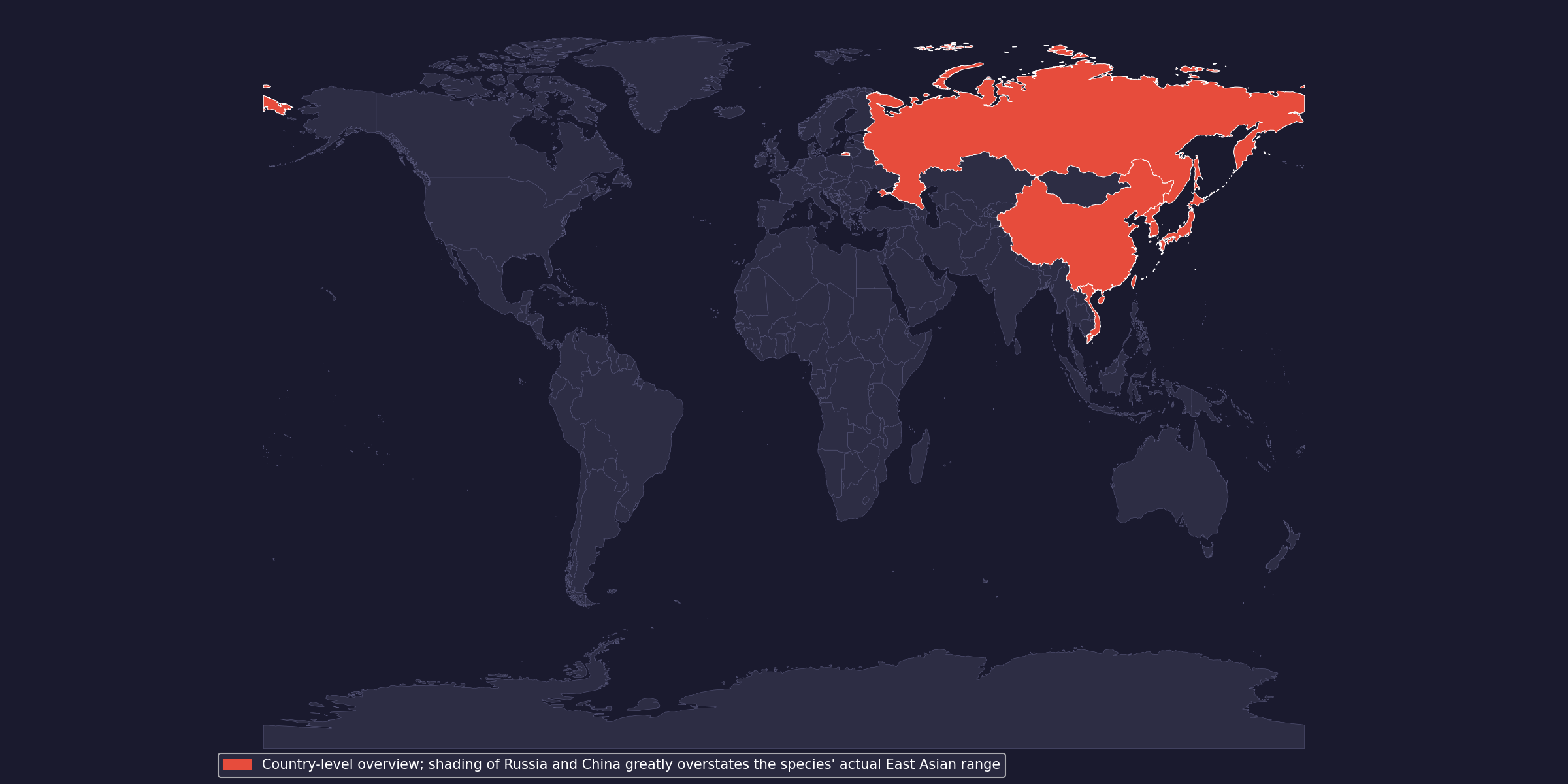
The species ranges across eastern Russia, China, North Korea, South Korea, Taiwan, northern Vietnam, and Japan. Its enormous climatic span includes paddy fields, wet meadows, river edges, forest clearings, and cool mountain valleys. Locality is essential when planning winter temperature and seasonal light.
The vivarium should provide clean water, damp cover, and open basking rather than constant saturation. Mainland and northern animals cannot safely be managed as tropical R. subminiatus.
⚖️ Legal status
The official CITES Appendices and EU wildlife-trade annexes checked on 29 August 2026 do not specifically list Rhabdophis tigrinus. The Bern Convention is not relevant to this East Asian species. National wildlife-export, quarantine, and dangerous-animal rules may still control every stage of trade and possession.
Obtain written guidance before acquisition and keep the invoice, breeder identity, captive-breeding and locality records, export/import and veterinary papers, photographs, and legal-check date. Absence from CITES is not evidence that a wild-caught animal was lawfully exported.
🤌 Husbandry
House singly in a restricted room with secondary containment and two externally lockable shift hides. Design water changes so the snake is physically separated before the basin or drain is touched. Wear eye protection and disposable gloves for contaminated water, shed, substrate, and décor because nuchal secretion is a contact hazard.
Quarantine for at least 90 days in simple housing with separate tools and preferably separate airspace. Record weight, meals, sheds, faeces, respiration, oral condition, and water use. Imported amphibian-eating snakes often arrive dehydrated or parasitized and require reptile-veterinary examination and faecal testing.
Cohabitation complicates feeding, toxin-source history, and protected servicing. Seasonal cooling should follow documented provenance and clinical condition, never the common name alone.
💡 Lighting
Provide a locality-appropriate 10-14-hour seasonal photoperiod with bright visible light and full darkness at night. Dense plants and hides should offer shade at every temperature. Fixtures must be outside primary containment or securely guarded.
Low-level UVB is not proven essential for a whole-prey diet but may be offered in Ferguson Zone 1 above part of the basking area. Measure exposure and retain complete shade.
🌡 Heating and temperature
During the active season, keep most air at 21-26°C, a basking surface at 28-30°C, a cool refuge at 19-22°C, and nights at 17-21°C. Thermostat heaters and monitor both air and wet surfaces. Permanently warm tropical conditions can suppress normal seasonality and increase bacterial growth.
Brumation at roughly 8-12°C is an advanced breeding procedure for suitable northern or temperate localities. Use gradual transitions only with established, well-hydrated, clinically healthy adults whose gut is empty. Do not cool juveniles, thin, sick, recently imported, or gravid animals without a documented plan.
💧 Humidity and water
Maintain 60-80% humidity with strong ventilation and a mist-dry cycle; a 75-90% sheltered zone supports shedding. Keep some ground damp and some surfaces dry. Permanently sodden substrate causes dermatitis and contaminates prey and water.
Provide a basin large enough for soaking but shallow and easy to exchange through protected access. High water quality matters because the species drinks, soaks, defecates, and may pursue aquatic prey in it. Remove waste promptly and disinfect without leaving residues.
🌿 Enclosure and decoration
Use at least 150 x 75 x 75 cm for an adult. Provide two shift-capable hides, 8-12 cm of moisture-buffering soil and leaf litter, cork cover, sturdy low branches, dense plants, and an open basking patch. Paper and a removable basin are safer during quarantine.
Avoid sharp rock, unstable water features, aromatic wood, adhesive décor, and clutter that prevents visual confirmation. Lock every door, vent, drain, and cable port. Keep nuchal-gland contamination in mind when selecting porous materials.
🐟 Feeding
Wild diets are dominated by frogs and can include toads and fish. Use lawful captive-produced non-bufonid frogs or nutritionally complete whole fish and amphibian prey from disease-controlled sources. Avoid wild prey, feeder goldfish, thiaminase-heavy single-species fish diets, and pieces of fillet. Some animals accept scented frozen-thawed rodents, but do not assume rodents alone meet a specialist’s needs.
Offer juveniles a small meal every 5-7 days and adults every 7-10 days, adjusting to condition and season. Use long tongs behind a barrier and shift before removing refusals. Deliberately feeding toxic toads to “restore” nuchal toxins has no husbandry benefit and adds welfare and occupational risk.
🛡 Operational safety and emergencies
Never free-handle, pin, neck, or manually restrain this snake. Use externally closing shifts, transparent barriers, appropriate hooks, and two trained adults for open-primary-barrier work. Wear eye protection and cover broken skin when handling any enclosure material.
Prepare a written bite and contamination plan with a poison centre or toxicologist and receiving hospital. A bite can cause coagulopathy and other systemic effects; nuchal secretion in an eye or wound also needs urgent professional advice. Do not assume toxin status from captive diet.
After a bite, call emergency services, keep still, immobilize the limb, remove constricting items, and follow poison-centre guidance. Flush exposed eyes immediately with abundant clean water while arranging medical assessment. Do not cut, suck, ice, shock, tightly tourniquet, or delay.
🥚 Breeding notes
Females lay approximately 5-32 eggs, often in moist communal sites. Published captive work reports successful incubation at 26-29°C for about 32-45 days; constant 30°C can shorten development and is not automatically preferable. Maternal bufadienolides can enter eggs, so treat eggs, fluids, and hatchlings as potentially chemically defended.
Pairing, egg removal, and neonates multiply exposure risk. Verify locality, prepare individual locked housing, and secure lawful placements before breeding.
🩺 Common problems
- Dehydration and dysecdysis: review water quality, humid cover, and temperature; do not restrain the snake for home removal.
- Dermatitis and respiratory disease: stagnant wet conditions are a common cause; bubbles, wheeze, or gaping need urgent veterinary care.
- Parasites: weight loss, abnormal faeces, and poor feeding are common concerns in imports.
- Nutritional imbalance: a monotonous fish diet or unsuitable substitutions can cause deficiencies; review whole-prey variety with an experienced veterinarian.
- Obesity and regurgitation: excessive feeding, oversized prey, wrong heat, and post-meal disturbance are preventable.
- Occupational contamination: nuchal secretion on tools, water, or décor requires a written cleaning and exposure procedure.
📌 Conclusion
Rhabdophis tigrinus belongs only in an authorised expert facility able to supply appropriate amphibian-rich whole prey, provide cool seasonal wetland conditions, and manage both envenomation and contact with sequestered nuchal toxins. Its colourful neck and rear fangs must never lead to casual handling.
📚 Sources and further reading
- ReptiFiles — checked first on 29 August 2026; no species-specific care guide was found.
- The Reptile Database: Rhabdophis tigrinus
- GBIF species record
- Dietary sequestration of bufadienolides
- Maternal foraging and provisioning of chemical defence
- Captive breeding records from the Russian Far East
- Baines et al. — UV lighting guidance
- WHO: snakebite first aid and treatment
- CITES Appendices
- EU wildlife-trade annexes, Commission Regulation (EU) 2026/1383
- Bern Convention appendices