Share

Red-necked Keelback
🔤 Taxonomy
This guide uses Rhabdophis subminiatus in the strict post-2021 sense: an Indonesian species centred on Java and Sumatra. The older broad concept, R. subminiatus sensu lato, included mainland snakes now recognized as R. siamensis and R. helleri, plus the Hainan endemic R. confusus. Many older field guides, pet records, bite reports, and photographs therefore carry a name that no longer identifies the same population.
The taxonomy matters operationally. Ask for country, island, parental lineage, photographs, and current identification rather than accepting “red-necked keelback” alone. GBIF currently places the species in Colubridae, while specialist literature commonly uses Natricidae; this guide preserves the GBIF classification required by the site widget.
📌 Description
The red-necked keelback is a slender, day-active, water-associated snake with keeled scales and a conspicuous red neck. It presents two separate toxic hazards. Enlarged rear maxillary teeth deliver procoagulant oral venom, and paired nuchal glands beneath the neck skin can store defensive bufadienolides sequestered from toxic prey such as toads. Severe bites have produced delayed coagulopathy and haemorrhage; pressure on the neck can also expose eyes or mucosa to gland contents.
Strict-sense adults are generally around 60-100 cm. Published longevity and husbandry data separated from the former species complex are sparse, so 8-12 years is a cautious planning range rather than a verified maximum. This is an expert-only display species despite its modest size and historically misleading “harmless colubrid” label.
📋 Quick reference
| Care point | Practical target |
|---|---|
| Adult enclosure | At least 120 x 60 x 75 cm, locked, with external-closing shift box |
| Day temperatures | 24-28°C ambient; 29-31°C limited basking patch; 22-24°C cool retreat |
| Night temperatures | 21-24°C |
| Humidity | 70-85%, moist retreat and clean water without stagnant saturation |
| Lighting | 11-13 hours; optional low-level UVB with shade |
| Feeding | Varied legally sourced whole amphibian/fish prey; small meals usually every 5-10 days |
| Social housing | Solitary |
| Safety | Medically significant rear-fanged venom plus nuchal-gland toxins; no manual contact |
☠️ Venom
This species is venomous. Venom exposure can cause pain, swelling or other systemic effects, and severity varies with species, locality, bite site and the amount delivered. A small wound or apparently dry bite is not proof of safety; every bite or sting requires urgent medical assessment.
If an incident occurs, move away, call emergency services or a poison centre, keep the patient still, remove rings and other constricting items, and follow dispatcher instructions. Do not use a tourniquet, cut or suck the wound, apply ice or electricity, give alcohol or medicines as a home treatment, or attempt to catch the animal. Antivenom choice and dosing are hospital decisions; verify the relevant product and local availability in advance. Sources: WHO snakebite guidance and appropriate species-specific toxinology or medical references listed below.
🌍 Distribution
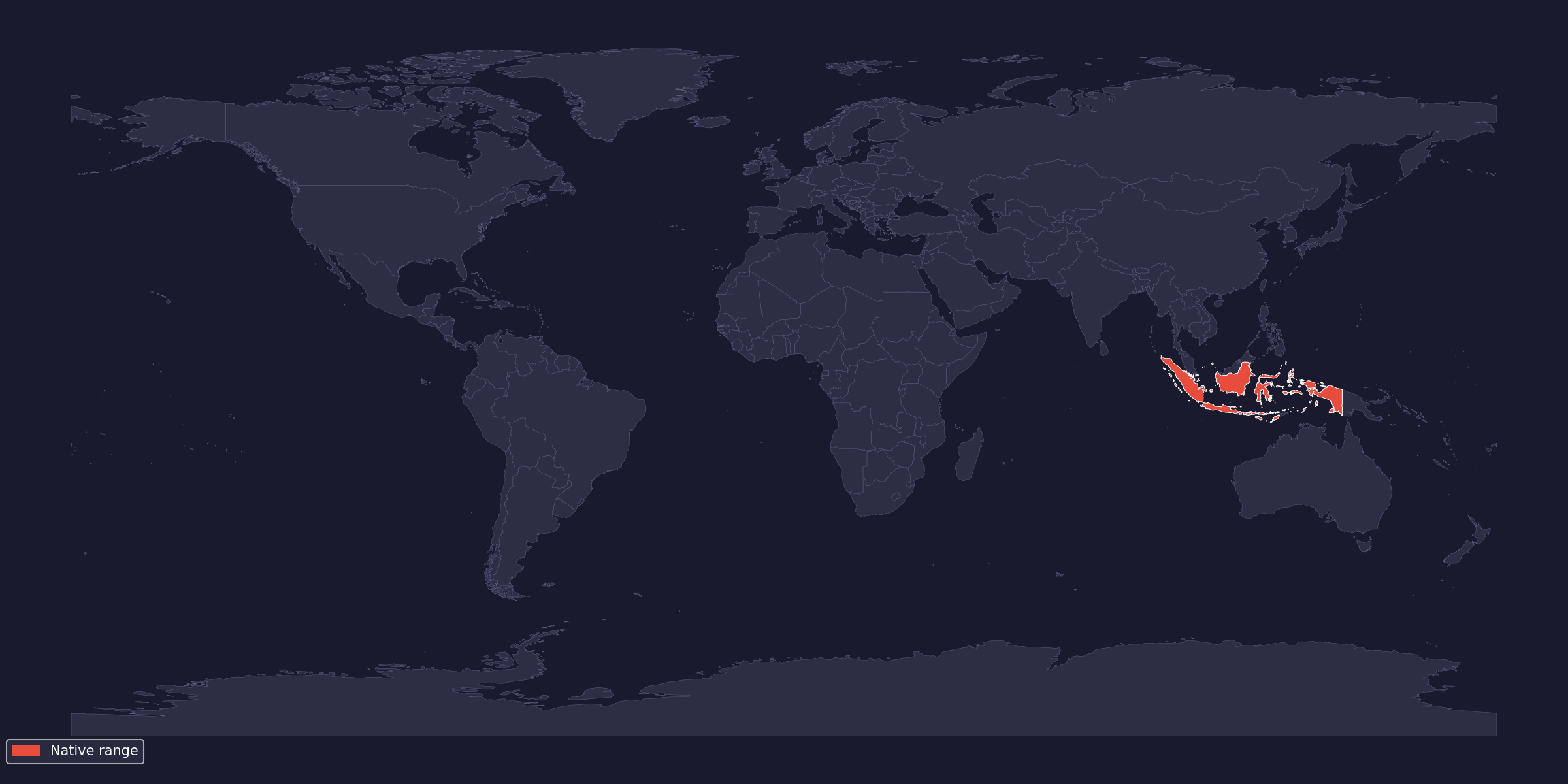
Following the 2021 revision, R. subminiatus sensu stricto is endemic to Indonesia and confirmed from Java, Sumatra, and Nias; a Sulawesi record remains uncertain. Reports from mainland Southeast Asia, southern China, Taiwan, Hainan, Nepal, Bhutan, India, and northern West Malaysia must be reassessed under R. siamensis, R. helleri, or R. confusus.
It occupies wet lowland and hill habitats near ponds, streams, rice fields, marshes, gardens, and forest edges where amphibian prey is available. It can climb and swim, but a captive animal needs usable land cover, a sanitary water option, and low branches rather than a mostly aquatic tank. The country-level map highlights all of Indonesia and is therefore broader than the documented island range described above.
🌡 Climate across the native range
Monthly climate normals from a verified occurrence of the strict-sense species in western Java:
Banten, Java — Indonesia (verified occurrence)
| Month | Min °C | Mean °C | Max °C | RH % |
|---|---|---|---|---|
| January | 25.1 | 26.3 | 27.5 | 85 |
| February | 25.1 | 26.4 | 27.7 | 85 |
| March | 25.4 | 26.7 | 28.1 | 84 |
| April | 25.6 | 27 | 28.4 | 84 |
| May | 26 | 27.2 | 28.6 | 83 |
| June | 25.7 | 26.9 | 28.2 | 82 |
| July | 25.1 | 26.2 | 27.5 | 81 |
| August | 24.9 | 26 | 27.3 | 80 |
| September | 24.9 | 26 | 27.4 | 81 |
| October | 25.2 | 26.4 | 27.9 | 82 |
| November | 25.4 | 26.5 | 27.9 | 83 |
| December | 25.1 | 26.3 | 27.5 | 85 |
Weather data by Open-Meteo.com · CC BY 4.0 · Monthly normals calculated by Herpeton Academy from daily archive values.
Location references use GBIF.org occurrence data where available; original occurrence records retain their source dataset licenses.
⚖️ Legal status
As checked on 16 August 2026, Rhabdophis subminiatus is not listed in CITES Appendices I-III and no species-specific entry was found in EU wildlife-trade Annexes A-D. The Bern Convention is not relevant because the species is not native to Europe.
That does not make ownership unrestricted. Dangerous-animal law may classify a medically significant rear-fanged snake differently between jurisdictions, and rules may control venomous possession, live amphibian prey, import, transport, breeding, or sale. Check every current complex name with the authority. Keep the invoice, export/import and transfer records, parental locality, photographs, feeding-origin records, and legal-check date.
🤌 Husbandry
Install the protected-contact system before acquisition: locked enclosure, secure room, hazard label, dedicated tools, and an opaque shift box closed from outside. Never rely on the small head or rear fang position. House singly and perform routine work only after positive visual location and secure shifting.
Quarantine for at least 90 days in separate airspace where possible. Use paper, simple hides, removable branches, and a water container that can be serviced without reaching past the snake. Record weight, meals, sheds, faeces, and hydration. Wild-caught imports need veterinary examination and faecal testing; amphibian prey can introduce additional parasites if sourcing is poor.
Do not compress, grip, or massage the neck. Nuchal-gland contents are a defensive poison, not the same secretion as the oral venom, and toxin load varies with diet. A captive history without toads must never be treated as proof that manual contact is safe.
💡 Lighting
Provide an 11-13 hour light period with bright visible light, shaded cover, and dark nights. Low-output UVB may be offered over part of the land zone within Ferguson Zone 1, but strong exposure and an open display are inappropriate for a cover-using snake.
Guard every lamp and secure every cable and probe. A lightless thermostatic heater is preferable if night heat is required. Seasonal photoperiod changes should be mild unless locality and breeding history justify something more specific.
🌡 Heating and temperature
Use 24-28°C ambient air, a restricted 29-31°C basking surface, a 22-24°C cool retreat, and 21-24°C at night. Provide measured choices on land and do not heat the whole water vessel. Persistent high temperature combined with saturated air accelerates dehydration, fouling, and respiratory risk.
Measure surface, hide, water, and air temperatures independently. Thermostat every heat source and place probes beyond the snake’s ability to shift them. Sudden deep seasonal cooling is not routine care and should not be attempted with juveniles, thin animals, new arrivals, or animals with unresolved disease.
💧 Humidity and water
Maintain 70-85% relative humidity through a moisture-retaining lower substrate, a humid retreat, plants or cover, and strong cross-ventilation. Brief rises to 80-90% can support shedding, but leaves and the upper surface should dry between misting cycles.
Provide a clean vessel large enough for voluntary soaking and easy exit. Replace water promptly after contamination and disinfect the vessel safely. A paludarium is not required; a complex permanent pool creates water-quality and servicing hazards. Never collect wild amphibians or water with unknown pesticides, parasites, or pathogens.
🌿 Enclosure and decoration
One adult needs at least 120 x 60 x 75 cm, with more room useful for active individuals. Provide 8-10 cm of drainage-aware soil/coco/leaf-litter substrate, dry and moist hides, dense visual cover, stable low branches, a basking edge, and a removable water vessel. Paper remains better during quarantine.
The enclosure needs keyed or tool-operated locks, secured vents, blocked gaps, guarded equipment, and a shift entrance that cannot be obstructed by substrate. Choose removable furnishings that allow a full visual check. Avoid sharp stone, aromatic wood, unstable piles, and deep flooded substrate. Inspect doors, tracks, drains, and locks regularly.
🐟 Feeding
This is an amphibian-oriented predator, not a routine rodent snake. Build a sustainable, legal supply of captive-produced whole frogs or other appropriate amphibian prey before acquisition; selected whole fish may add variety. Avoid wild-caught toads, frogs, and fish because of toxins, pesticides, parasites, and conservation law. Do not base the diet on thiaminase-rich fish, fillets, or muscle meat.
Offer small prey about every 5-7 days to juveniles and 7-10 days to adults, adjusting to weight and condition. Some animals may accept rodents, but a rodent-only menu is not automatically equivalent to the natural diet. Whole prey usually needs no powder supplementation. Live prey may be biologically necessary for an individual that will not transition, which raises welfare, quarantine, and servicing demands.
🥚 Breeding
The species is oviparous. Older complex-wide reports describe clutches of 5-27 eggs and incubation around 50-70 days near 26-28°C; strict-sense, locality-documented breeding data remain limited, so these are conservative planning values rather than a precision recipe.
Breeding is institutional-level work because access to a nest and multiple medically significant hatchlings sharply increase exposure. Confirm identity and locality, separate adults, prepare individual locked juvenile containers, and arrange lawful recipients before pairing. Do not manipulate eggs by hand while an adult is unshifted.
🛡️ Handling and emergency planning
Treat the snake as display-only. Do not free-handle, grip behind the head, pin, or manually restrain it. Use a shift box, hooks, tubes or barriers only within an established institutional protocol, and a second trained adult for higher-risk work. This guide deliberately provides no free-hand capture or restraint technique.
Before acquisition, coordinate a written plan with emergency services, a poison centre or medical toxicologist, and a receiving hospital. List the exact taxon, all former complex names, known diet history, expected delayed coagulopathy, address, contacts, and route. Antivenom and blood-product decisions belong to clinicians; availability and cross-use vary by country and taxon.
After any bite, call emergency services immediately even if the punctures and early symptoms appear minor. Keep the patient still, immobilize the limb, remove rings and tight objects, and report the possibility of delayed bleeding. Do not cut, suck, ice, apply chemicals or an arterial tourniquet, or wait at home. If nuchal secretion enters an eye, irrigate immediately with abundant clean water or saline and seek urgent medical and toxicology advice; do not rub.
🩺 Common problems
- Diet failure and weight loss: an unreliable amphibian supply is a predictable husbandry failure, not a reason for repeated force-feeding.
- Parasites: wild-caught snakes and prey can carry substantial parasite loads; quarantine, faecal testing, and lawful captive prey are central prevention.
- Respiratory disease: wheeze, bubbles, gaping, or head elevation needs prompt veterinary assessment; cold saturated air is a common contributor.
- Dermatitis and dysecdysis: correct dirty water, wet substrate, low ventilation, hydration, and temperatures before considering physical intervention.
- Regurgitation: oversized prey, excessive heat, stress, disease, or handling after feeding require review.
- Escape attempts and rostral abrasion: increase cover, correct temperature, and redesign exposed doors or inaccessible corners.
- Toxic exposure: any bite or nuchal-gland contact is a medical incident; delayed coagulopathy means apparent early wellbeing is not reassuring.
📌 Conclusion
The strict-sense red-necked keelback is for an expert facility able to solve three problems before acquisition: secure protected-contact care, a sustainable lawful amphibian-based diet, and hospital-level planning for delayed coagulopathy and nuchal-gland exposure. Its small size, rear fangs, or captive diet never justify casual handling.
📚 Sources and further reading
- ReptiFiles was searched before drafting; no species-specific care guide was located: https://reptifiles.com/
- David & Vogel (2021), revision of the R. subminiatus complex: https://doi.org/10.47605/tapro.v10i2.257
- Liu et al. (2021), genetic divergence and elevation of R. helleri: https://doi.org/10.1111/jzs.12484
- GBIF Backbone Taxonomy, Rhabdophis subminiatus: https://www.gbif.org/species/8904282
- Mori et al. (2024), prey discrimination and nuchal-gland toxins: https://doi.org/10.5358/hsj.43.22
- Seow et al., morbidity after a pet-snake bite: https://www.sma.org.sg/smj/4101/articles/4101cr2.htm
- Hemostatic effects of oral-gland extract: https://doi.org/10.1016/0041-0101(91)90006-D
- Lu et al. (2026), severe envenomation review: https://pubmed.ncbi.nlm.nih.gov/41662757/
- Baines et al., UV-Tool: https://doi.org/10.19227/jzar.v4i1.150
- WHO snakebite guidance: https://www.who.int/southeastasia/publications/i/item/9789290225300
- CITES Appendices and checklist: https://cites.org/eng/app/appendices.php and https://checklist.cites.org/
- Commission Regulation (EU) 2026/1383: https://eur-lex.europa.eu/eli/reg/2026/1383/oj/eng
- Council of Europe, Bern Convention appendices: https://www.coe.int/en/web/bern-convention/appendices