Share

Eastern Brown Snake
🔤 Taxonomy
Pseudonaja textilis is the accepted name for the eastern or common brown snake. The former subspecies P. t. inframacula is now treated as the separate peninsula brown snake, P. inframacula. Other similar brown snakes, including P. mengdeni, P. nuchalis and P. aspidorhyncha, overlap parts of the range. Colour is extremely variable and is not adequate identification.
New Guinean populations are often written Pseudonaja cf. textilis because their history and boundaries require further work. A captive animal labelled only “eastern brown” needs country, locality and lineage documentation.
📌 Description
This is a slender, alert, fast terrestrial elapid, usually 120-180 cm. It is mainly diurnal but may shift toward evening in very hot weather. Adults likely live at least 10-15 years in good managed care.
Envenomation can cause venom-induced consumption coagulopathy, collapse, bleeding, kidney injury and sometimes neurotoxicity. The small fang marks and modest local reaction can be deceptive. Do not use “world’s second-most venomous” claims as husbandry guidance; protected-contact design and emergency capacity are the relevant facts.
📋 Quick reference
| Care point | Practical target |
|---|---|
| Adult enclosure | At least 180 x 90 x 90 cm with two lockable shift hides |
| Temperature | Ambient 24-28°C; basking 31-33°C; cool retreat 21-24°C |
| Night | 18-22°C |
| Humidity | 35-55%; local 60-75% shed support |
| Feeding | Moderate frozen-thawed rodents every 10-21 days |
| Safety | Protected contact, two-person rule, coagulopathy-aware hospital plan |
| Quarantine | At least 90 days with separate equipment and veterinary screening |
☠️ Venom
This species is venomous. Venom exposure can cause pain, swelling or other systemic effects, and severity varies with species, locality, bite site and the amount delivered. A small wound or apparently dry bite is not proof of safety; every bite or sting requires urgent medical assessment.
If an incident occurs, move away, call emergency services or a poison centre, keep the patient still, remove rings and other constricting items, and follow dispatcher instructions. Do not use a tourniquet, cut or suck the wound, apply ice or electricity, give alcohol or medicines as a home treatment, or attempt to catch the animal. Antivenom choice and dosing are hospital decisions; verify the relevant product and local availability in advance. Sources: WHO snakebite guidance and appropriate species-specific toxinology or medical references listed below.
🌍 Distribution
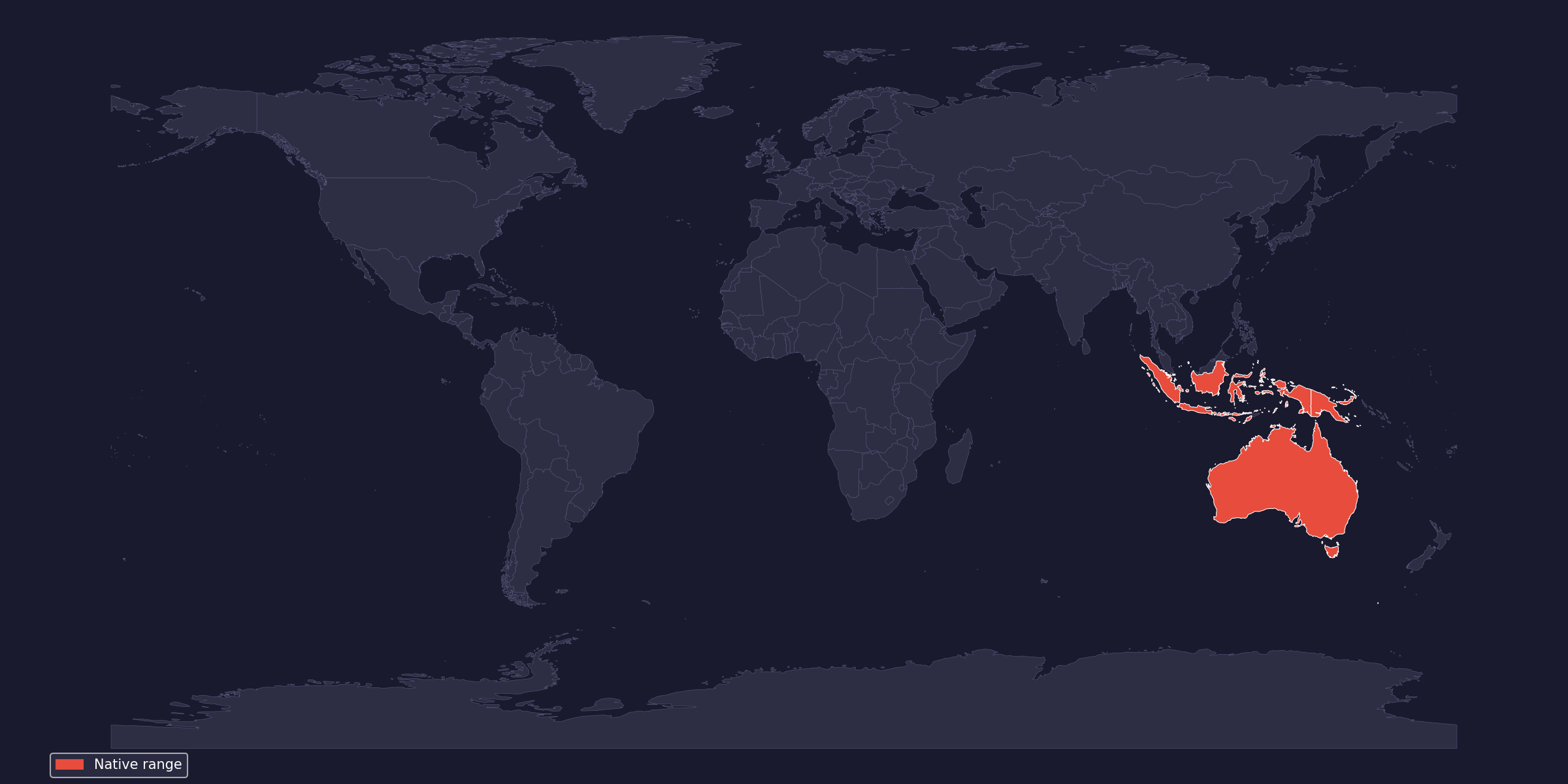
In Australia, P. textilis is widespread through eastern and central regions, with more isolated populations in parts of the Northern Territory and elsewhere; it is absent from Tasmania. Populations also occur in southern and eastern New Guinea, including localized records from Merauke in Indonesian Papua, but identification and lineage deserve the cautious cf. textilis notation where not resolved. The country map highlights all Australia, Papua New Guinea and Indonesia and therefore overstates occupied area in every country—especially Indonesia, where it cannot show that the record is confined to New Guinea rather than the archipelago.
Open woodland, scrub, grassland, agricultural landscapes, floodplains and suburban edges are typical; rainforest and alpine habitat are generally avoided. The climate station represents the temperate southern Australian range and is not a proxy for tropical New Guinea or northern Australian stock.
🌡 Climate across the native range
Monthly normals from a reviewed occurrence in the temperate southern Australian range:
South Australia — Australia (reviewed eastern brown snake occurrence)
| Month | Min °C | Mean °C | Max °C | RH % |
|---|---|---|---|---|
| January | 17.4 | 21.9 | 26.9 | 56 |
| February | 17.6 | 21.9 | 26.7 | 57 |
| March | 16 | 19.8 | 24.3 | 60 |
| April | 13.9 | 17.2 | 21 | 64 |
| May | 11.6 | 14.2 | 17.4 | 72 |
| June | 9.6 | 11.9 | 14.6 | 77 |
| July | 8.8 | 11.1 | 13.8 | 77 |
| August | 9.1 | 11.7 | 14.6 | 74 |
| September | 10.5 | 13.5 | 16.9 | 70 |
| October | 12.2 | 15.7 | 19.7 | 63 |
| November | 14.2 | 18.2 | 22.6 | 59 |
| December | 15.9 | 20.1 | 24.7 | 57 |
Weather data by Open-Meteo.com · CC BY 4.0 · Monthly normals calculated by Herpeton Academy from daily archive values.
Location references use GBIF.org occurrence data where available; original occurrence records retain their source dataset licenses.
⚖️ Legal status
No species-specific listing was found in CITES, the EU wildlife-trade annexes or the Bern Convention appendices when checked on 17 August 2026. Australian native wildlife law remains decisive: commercial export of live native reptiles is prohibited, other international movement is permit-controlled, and state or territory law regulates capture, possession and venomous-snake licensing.
Outside Australia, require a traceable captive institutional lineage and verify New Guinean source rules where applicable. Keep permits, invoices, breeder and institutional transfers, country/locality evidence, photographs and legal-check dates. “Not CITES-listed” is not evidence of legal ownership.
🤌 Husbandry
House singly. Cannibalism is documented, and cohabitation adds predation and unsafe separation work. Use a locked venomous room, secondary containment and two full shift hides with closable doors. All routine service happens after positive visual confirmation that the animal is secured.
Quarantine for at least 90 days with separate tools and preferably separate air. Track weight, meals, sheds, faeces, mouth and respiration, and test uncertain-origin stock for parasites. Confirm species, country and locality before climate cycling or breeding.
💡 Lighting
Provide 10-12 hours of bright visible light and complete night darkness, with broad shaded retreats. Guard every lamp. Low-level UVB over part of the warm zone may offer a Ferguson Zone 2 opportunity; shade must remain accessible.
🌡 Heating and temperature
Maintain 24-28°C ambient air, a local 31-33°C basking surface, a 21-24°C cool hide and nights around 18-22°C. Thermostat every source and measure air and surfaces at snake level.
Southern stock experiences cool winters, but seasonal cooling is not an automatic care step. It belongs only to locality-informed programmes with healthy established animals. New Guinean and northern stock should not receive a southern Australian winter schedule.
💧 Humidity and water
Use 35-55% relative humidity as a ventilated baseline for much Australian stock, with a local 60-75% humid hide during shedding. Tropical or floodplain provenance may require a different local moisture pattern, but no locality benefits from a permanently wet floor.
Provide a heavy clean water bowl through protected access. Let the surface dry and monitor drinking, urates and shed quality.
🌿 Enclosure and decoration
An adult needs at least 180 x 90 x 90 cm. Provide two snug shift hides, low fixed cover, secure branches, visual barriers and open floor for active searching. Avoid blind pockets and inaccessible décor.
Use 8-12 cm of compactable soil, washed sand and leaf litter, or paper in quarantine. Avoid aromatic wood, sharp chips, unstable rocks, adhesive tape and deep clutter. A slender juvenile can exploit very small gaps; use two independent locks and an airlock or equivalent room barrier.
🐁 Feeding
Wild eastern browns take mammals, lizards, frogs, birds and reptile eggs; larger individuals rely increasingly on warm-blooded prey. Feed suitable frozen-thawed rodents, with moderate adult meals every 10-21 days and smaller juvenile meals more frequently.
Use long tongs through a protected port and shift the snake before retrieving food. Live rodents create injury and recovery hazards. Routine supplements are unnecessary with balanced whole prey.
🛡 Operational safety and emergencies
Never free-handle, pin, neck or manually restrain. Use protected contact, shift boxes, transparent shields and suitable tools. Two trained adults attend every opening of primary containment.
Agree a hospital or poison-centre plan before acquisition. Include country/locality, photographs, transport and access to Australian or New Guinean antivenom expertise. The plan must anticipate coagulopathy and collapse even when the bite site looks minor.
Every bite is an immediate emergency. Withdraw, call emergency services, remove tight objects and keep the patient still. Where current Australian protocol applies, trained responders use pressure immobilisation with a firm bandage and splint; elsewhere, including New Guinea, follow the regional poison-centre and facility plan. Article text does not replace practical training. Do not cut, suck, ice, shock, apply a tight tourniquet or wait for symptoms.
🥚 Breeding notes
The species is oviparous and may lay roughly 10-35 eggs. Incubation is highly temperature-dependent; a controlled institutional range of 27-29°C commonly gives about 50-75 days, while cooler conditions can extend development substantially.
Breeding creates many small fast venomous juveniles. Verify species boundaries, lineage, permission and placements before pairing. Prepare individual locked rearing units and full origin documentation before hatching.
🩺 Common problems
- Obesity: prevent with moderate rodents, long intervals and routine weighing.
- Rostral trauma: repeated pushing indicates poor cover, sightlines or barrier design.
- Burns and overheating: guard and thermostat heat and preserve a cool hide.
- Respiratory disease: bubbles, open-mouth breathing or sounds need urgent veterinary care.
- Dysecdysis and dehydration: review water, humid hide and systemic health; no manual restraint.
- Parasites and stomatitis: strict quarantine and veterinary diagnostics for uncertain-origin animals.
📌 Conclusion
The eastern brown snake requires protected-contact housing, precise taxonomic and geographic records, and a medical plan built around rapid systemic coagulopathy rather than dramatic local injury. Australian, New Guinean and former inframacula labels cannot be treated as interchangeable.
📚 Sources and further reading
- ReptiFiles — checked first on 17 August 2026; no species-specific care guide was found.
- The Reptile Database: Pseudonaja textilis
- GBIF species record: Pseudonaja textilis
- Australian Museum: Eastern Brown Snake
- WHO South-East Asia snakebite guidelines
- Baines et al. — UV lighting guidance
- Australian Government: exporting native plants and animals
- CITES Appendices
- EU wildlife-trade annexes, Commission Regulation (EU) 2026/1383
- Bern Convention appendices