Share

Western Brown Snake
🔤 Taxonomy
Pseudonaja mengdeni is the accepted name for the western brown snake or gwardar. Older books and collection records often placed it inside a broadly defined P. nuchalis. Modern work separates P. mengdeni, the northern brown P. nuchalis and the strap-snouted brown P. aspidorhyncha. The name Pseudonaja kellyi is a synonym of P. mengdeni.
Colour is exceptionally variable and is not a safe identification method. Obtain locality, parentage and diagnostic records for every institutional animal; a label that says only “western brown” may refer to more than one species from the former complex.
📌 Description
This is a slender, fast Australian elapid, usually 100-150 cm long. It is primarily diurnal, but arid-zone animals may move in the evening or at night during extreme heat. Managed longevity is commonly at least 10-15 years.
Envenomation can produce venom-induced consumption coagulopathy, collapse, bleeding, kidney injury and neurotoxic effects. Small fang marks or limited local pain do not indicate a minor exposure. Venom-ranking slogans are irrelevant to care: the decisive controls are protected contact, reliable locks, trained staff and immediate medical access.
📋 Quick reference
| Care point | Practical target |
|---|---|
| Adult enclosure | At least 180 x 90 x 90 cm with two lockable shift hides |
| Temperature | Ambient 24-28°C; basking 31-34°C; cool retreat 20-24°C |
| Night | 17-22°C, adjusted to documented locality |
| Humidity | 30-50%; local 60-75% shed support |
| Feeding | Moderate frozen-thawed rodents every 10-21 days |
| Safety | Protected contact, two-person rule, Australian snakebite plan |
| Quarantine | At least 90 days with separate tools and veterinary screening |
☠️ Venom
This species is venomous. Venom exposure can cause pain, swelling or other systemic effects, and severity varies with species, locality, bite site and the amount delivered. A small wound or apparently dry bite is not proof of safety; every bite or sting requires urgent medical assessment.
If an incident occurs, move away, call emergency services or a poison centre, keep the patient still, remove rings and other constricting items, and follow dispatcher instructions. Do not use a tourniquet, cut or suck the wound, apply ice or electricity, give alcohol or medicines as a home treatment, or attempt to catch the animal. Antivenom choice and dosing are hospital decisions; verify the relevant product and local availability in advance. Sources: WHO snakebite guidance and appropriate species-specific toxinology or medical references listed below.
🌍 Distribution
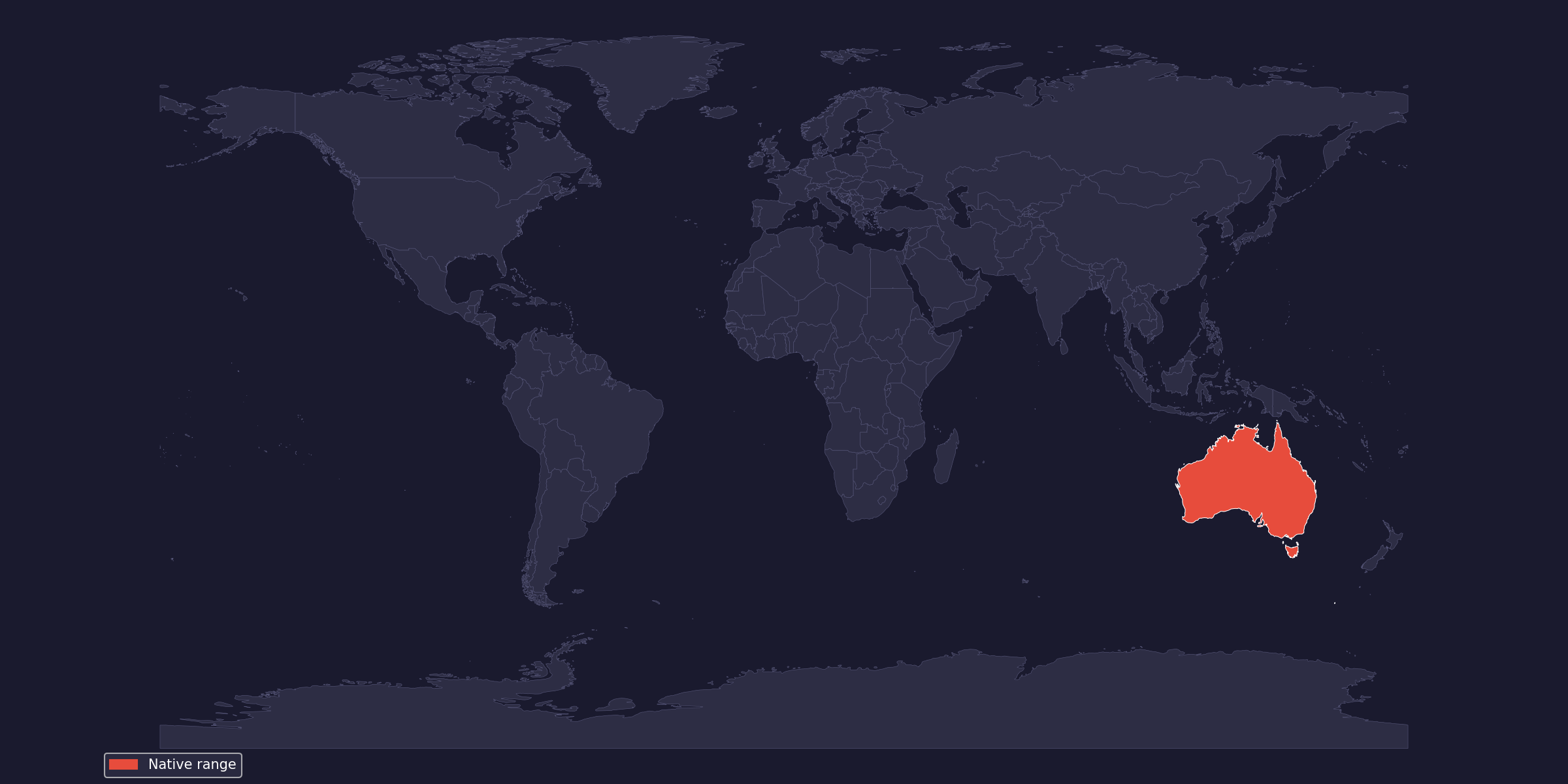
The species occupies western and central Australia, broadly from the Carnarvon region of Western Australia east through the arid interior to western New South Wales. Records span parts of Western Australia, South Australia, the Northern Territory, western Queensland and western New South Wales, but boundaries within the former P. nuchalis complex remain less precise than a simple country outline suggests.
Arid and semi-arid grassland, shrubland, savanna woodland, dry forest, pastoral land, rock cover, soil cracks and unused burrows are typical. The map necessarily colours all Australia and therefore greatly overstates occupied area. The reviewed South Australian climate point illustrates one temperate southern locality; it is not a full-range average and must not determine care for tropical or desert provenance without locality evidence.
🌡 Climate across the native range
Monthly normals from a reviewed occurrence in the temperate southern part of the Australian range:
South Australia — Australia (reviewed western brown snake occurrence)
| Month | Min °C | Mean °C | Max °C | RH % |
|---|---|---|---|---|
| January | 17.4 | 22 | 27.5 | 58 |
| February | 17.5 | 21.9 | 27.4 | 59 |
| March | 15.8 | 20 | 25.2 | 62 |
| April | 13.6 | 17.7 | 22.7 | 64 |
| May | 11.5 | 15 | 19.3 | 68 |
| June | 9.6 | 12.7 | 16.4 | 72 |
| July | 9 | 12.1 | 15.8 | 72 |
| August | 9.4 | 12.7 | 16.7 | 68 |
| September | 10.9 | 14.8 | 19.4 | 64 |
| October | 12.7 | 17 | 22.2 | 58 |
| November | 14.5 | 19 | 24.3 | 57 |
| December | 16 | 20.6 | 25.9 | 57 |
Weather data by Open-Meteo.com · CC BY 4.0 · Monthly normals calculated by Herpeton Academy from daily archive values.
Location references use GBIF.org occurrence data where available; original occurrence records retain their source dataset licenses.
⚖️ Legal status
No species-specific listing was found in CITES, the EU wildlife-trade annexes or the Bern Convention appendices when checked on 17 August 2026. Australian native-wildlife law is nevertheless strict: live native reptile export is generally prohibited, international movement is permit-controlled, and state or territory authorities control possession, transport and keeping classes. For example, Western Australia requires fauna licensing and applies higher controls to dangerous reptiles.
Use only traceable lawful institutional stock. Retain permits, invoices, breeder and transfer records, photographs, microchip or other identity records where required, and exact locality evidence. Local and national rules governing possession, transport, breeding, sale and import may apply even where no treaty listing exists.
🤌 Husbandry
House one snake per enclosure. Brown snakes may take other reptiles, and cohabitation creates predation, competition and an unsafe separation problem. Use a locked venomous-animal room, secondary room containment and a primary enclosure with two independently secured shift hides. Routine cleaning, water changes and inspections occur only after positive visual confirmation that the animal is secured behind a closed barrier.
Quarantine new arrivals for at least 90 days in simple housing with separate tools and, where practical, separate air. Record weight, meals, sheds, faeces, mouth and breathing. Arrange reptile-veterinary examination and parasite testing for any animal of uncertain origin. Confirm the species and locality before applying seasonal cycles or planning breeding.
💡 Lighting
Provide 10-12 hours of bright visible light with complete darkness at night and abundant shaded retreats. Every fitting must be outside reach or mechanically guarded.
Low-level UVB over part of the warm zone can provide a Ferguson Zone 2 opportunity, but it is not a substitute for whole prey or a gradient. Measure at snake level and leave a fully shaded route between both shift hides.
🌡 Heating and temperature
Maintain ambient air at 24-28°C, a local basking surface at 31-34°C and a cool retreat at 20-24°C. Night temperatures around 17-22°C suit many temperate and arid provenances. Thermostat every heater independently and verify air, surface and hide temperatures with fixed probes plus an infrared check.
The broad range includes large seasonal differences. Winter reduction belongs only in a locality-backed programme for healthy, established adults and is not automatic for juveniles, thin animals, new arrivals or animals under treatment. Always retain a safe thermal refuge; never reproduce outdoor extremes inside a sealed box.
💧 Humidity and water
For much of the arid range, maintain 30-50% relative humidity with strong ventilation. Offer a small humid retreat around 60-75% during shedding rather than wetting the whole enclosure. Persistent dampness and cold substrate increase respiratory and skin risk, while very dry heated air can cause dehydration and retained shed.
Provide a stable clean water bowl through a protected service port. Replace fouled water without entering the occupied compartment. Monitor drinking, urates, body mass and shed quality instead of using one hygrometer reading as the sole hydration measure.
🌿 Enclosure and decoration
An adult should have at least 180 x 90 x 90 cm, and an unusually large or active animal benefits from more floor length. Install two snug shift boxes with external doors, low anchored cover, visual barriers, fixed branches and an open route that lets staff see the animal before operating any port. Avoid inaccessible cavities.
Use 8-12 cm of compactable soil and washed sand with dry leaf litter, or paper during quarantine. Keep food off loose substrate. Avoid aromatic wood, sharp chips, unstable stone, adhesive tape and décor that blocks a shift door. A slender juvenile can use tiny gaps; construction requires two independent locks, guarded ventilation and a documented escape-response plan.
🐁 Feeding
Wild western browns take lizards, other snakes, small mammals and birds; juveniles may show a strong reptile preference. Established adults usually accept appropriate frozen-thawed rodents. Offer modest meals every 10-21 days according to age and body condition, with smaller, more frequent prey for growing juveniles.
Feed through a protected port with long tongs and shift the animal before recovering refused prey. Never reach past an unsecured snake. Live rodents risk injury and complicate removal. Whole vertebrate prey requires no routine calcium or vitamin dusting. A juvenile that refuses rodents needs a veterinary and provenance-aware feeding plan, not uncontrolled live-prey experimentation.
🛡 Operational safety and emergencies
Do not free-handle, pin, neck or manually restrain this species. Protected contact, lockable shift boxes, transparent barriers and purpose-selected tools are mandatory. Two trained adults attend every opening of primary containment, and one remains outside the immediate task with communications and the bite plan.
Before acquisition, agree a receiving hospital and poison-centre pathway, route, transport responsibility and access to appropriate Australian brown-snake antivenom expertise. Keep current species and locality records beside the emergency pack. Rehearse escape and bite drills without a live animal.
Every suspected bite is an immediate emergency. Withdraw safely, call emergency services, keep the patient still and remove tight items. In Australia, trained responders follow current pressure-immobilisation guidance with a firm bandage and splint; practical training is essential, and this text is not a substitute. Elsewhere, follow the regional poison-centre and facility protocol. Do not wash an Australian bite site, cut, suck, ice, shock, use a tight arterial tourniquet or wait for symptoms.
🥚 Breeding notes
Pseudonaja mengdeni is oviparous and large females may produce roughly 10-30 eggs, but published species-specific institutional incubation data are limited. A conservative monitored range of 27-29°C may produce hatching in approximately 50-75 days; treat those values as a managed starting range, not a universal guarantee. Record egg mass, substrate water potential, temperature and development rather than adjusting by calendar alone.
Breeding produces numerous small, fast venomous snakes. Establish lineage, permits, individual locked rearing enclosures, trained staffing and lawful placements before pairing. Do not breed animals carrying only an obsolete P. nuchalis label until identity and origin have been resolved.
🩺 Common problems
- Obesity: prevent with small whole-prey meals, long adult intervals and serial weights.
- Rostral trauma: repeated pushing usually signals poor cover, reflections, sightlines or an unsuitable barrier routine.
- Burns and heat stress: guard and thermostat all heat while preserving a measured cool hide.
- Respiratory disease: wheeze, bubbles, open-mouth breathing or abnormal posture requires urgent veterinary assessment.
- Dysecdysis and dehydration: review water access, the humid retreat, heat and systemic health; do not restrain manually to remove shed.
- Parasites and stomatitis: uncertain-origin stock requires strict quarantine, diagnostics and treatment directed by a reptile veterinarian.
📌 Conclusion
The western brown snake belongs only in licensed programmes that can prove locality, work entirely through barriers and activate a rehearsed Australian-snakebite response without delay. Treating the old broad P. nuchalis label as adequate identification is the husbandry error most likely to distort both seasonal care and breeding records.
📚 Sources and further reading
- ReptiFiles — checked first on 17 August 2026; no species-specific care guide was found.
- The Reptile Database: Pseudonaja mengdeni
- GBIF species record: Pseudonaja mengdeni
- Australian Museum: Western Brown Snakes
- Healthdirect Australia: snake-bite first aid
- Baines et al. — UV lighting guidance
- Australian Government: exporting native plants and animals
- Western Australia DBCA: fauna licences
- CITES Appendices
- EU wildlife-trade annexes, Commission Regulation (EU) 2026/1383
- Bern Convention appendices