Share

Persian Horned Viper
🔤 Taxonomy
Pseudocerastes persicus is the accepted name for the Persian or false horned viper. Older sources use Cerastes persicus, Vipera persica, Daboia persica, or include Field’s horned viper as P. persicus fieldi. Current references recognise P. fieldi and the spider-tailed P. urarachnoides as separate species.
Exact locality is essential. Records from Israel, Sinai, Jordan, and much of Syria or western Iraq in older material often refer to P. fieldi, not P. persicus in the strict sense.
📌 Description
Adults are usually 50-70 cm and can approach 90 cm. The body is stout, the head broad, and each “horn” is made of several small scales rather than one elongated scale. Colour and pattern blend with gravel, rock, and compact desert soil.
This medically significant viper is often still by day and active after dark. A placid posture is not safe access. It belongs only in an authorised facility using protected contact, locked shifts, and a hospital-coordinated bite plan.
📋 Quick reference
| Care point | Practical target |
|---|---|
| Adult enclosure | At least 120 x 60 x 60 cm; two lockable shifts and stable rocky cover |
| Temperature | Air 23-28°C; basking 31-34°C; cool retreat 20-23°C |
| Night | 17-22°C; document locality before seasonal cooling |
| Humidity | 35-55%; localized humid hide at 60-70% during shedding |
| Feeding | Modest frozen-thawed rodents, with occasional appropriate whole-prey variety |
| Safety | Display-only; protected contact, bite and escape plans |
| Quarantine | At least 90 days with separate tools and parasite screening |
☠️ Venom
This species is venomous. Venom exposure can cause pain, swelling or other systemic effects, and severity varies with species, locality, bite site and the amount delivered. A small wound or apparently dry bite is not proof of safety; every bite or sting requires urgent medical assessment.
If an incident occurs, move away, call emergency services or a poison centre, keep the patient still, remove rings and other constricting items, and follow dispatcher instructions. Do not use a tourniquet, cut or suck the wound, apply ice or electricity, give alcohol or medicines as a home treatment, or attempt to catch the animal. Antivenom choice and dosing are hospital decisions; verify the relevant product and local availability in advance. Sources: WHO snakebite guidance and appropriate species-specific toxinology or medical references listed below.
🌍 Distribution
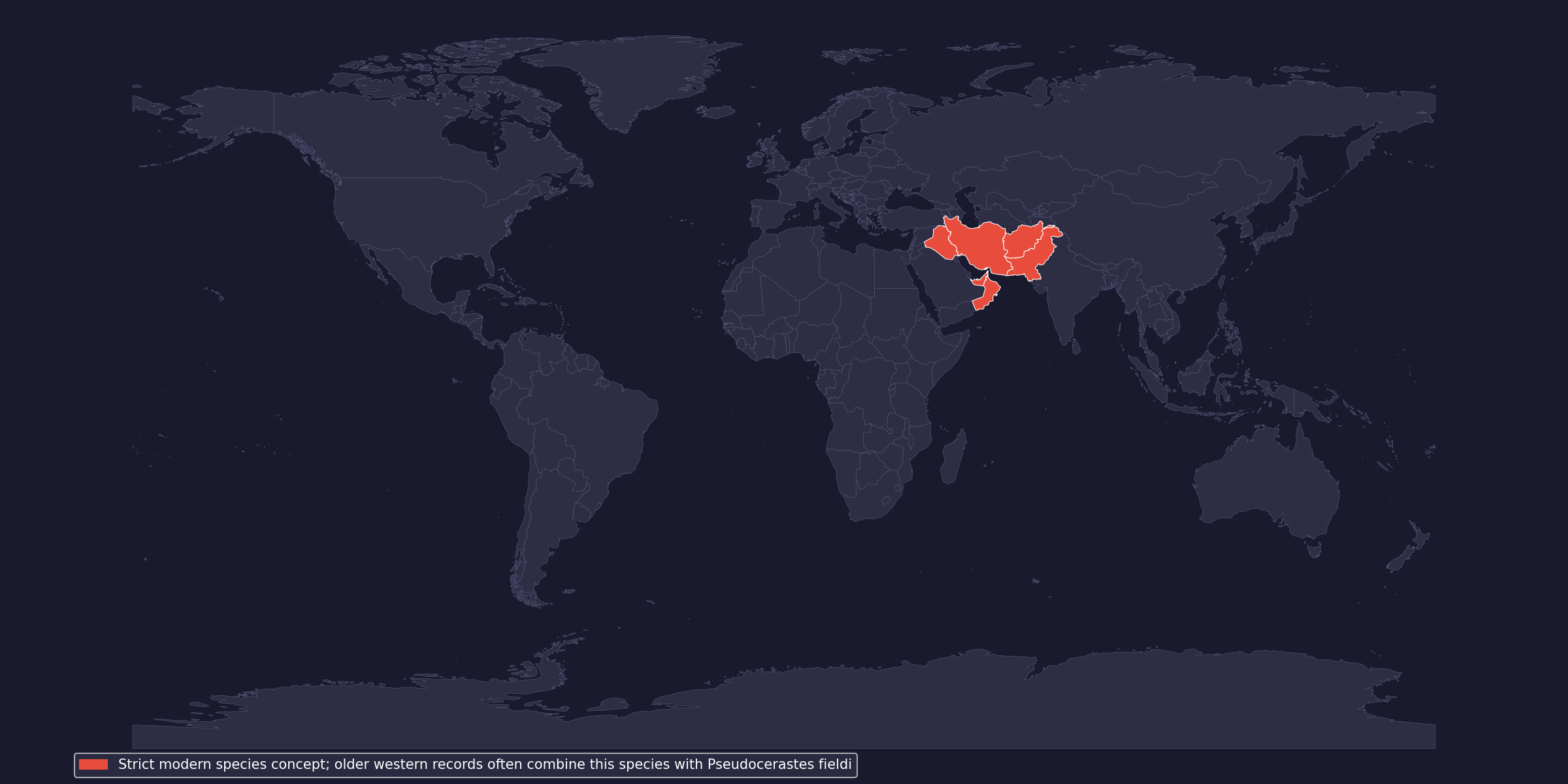
In the strict modern sense the species ranges from northeastern Iraq through Iran and southern Afghanistan to western Pakistan, with isolated populations in the Hajar Mountains of northern Oman and the United Arab Emirates. Broader old lists that include Jordan, Syria, Israel, or Sinai often combine it with P. fieldi.
Habitats include semi-desert plains, rocky slopes, wadis, gravel, compact sandy soil, and mountain terrain from low elevations to roughly 2,500 m. The enclosure should combine dry open ground, secure crevices, local radiant heat, and a genuinely cool retreat rather than a uniformly hot sand box.
⚖️ Legal status
The official CITES Appendices and EU wildlife-trade annexes checked on 29 August 2026 do not specifically list Pseudocerastes persicus. The Bern Convention is not relevant to this non-European species. Export, import, veterinary, and dangerous-animal law may nevertheless be restrictive.
Obtain written guidance from the competent authorities before acquisition. Retain invoices, breeder and parentage data, export/import and transfer documents, photographs, exact locality, and this legal-check date. Check papers for the former P. persicus fieldi combination so that another species is not traded under obsolete paperwork.
🤌 Husbandry
House singly in a restricted venomous room with secondary containment and two close-fitting shift hides across the thermal gradient. Water and waste must be reachable only when the snake is locked behind a physical barrier.
Quarantine every arrival for at least 90 days in simple housing, preferably in separate airspace. Use dedicated tools and record weight, meals, sheds, faeces, respiration, and skin. Animals of uncertain origin require reptile-veterinary examination and parasite testing.
Use locality and measured behaviour to shape seasonal care. The cold, relatively humid Hajar Mountains and the Iranian Plateau do not justify identical routines, and permanent high heat is inappropriate for both.
💡 Lighting
Provide 12-14 hours of visible light in summer, grading toward 10 hours in the cool season, with complete darkness at night. Offer shaded hides and keep lamps outside primary containment or behind secure guards.
UVB is not established as essential for a whole-prey viper, but low-level Ferguson Zone 1 exposure may be offered over part of the basking area. Shade and a cool hide remain mandatory.
🌡 Heating and temperature
During the active season keep air at 23-28°C, a basking surface at 31-34°C, a cool retreat at 20-23°C, and nights around 17-22°C. Thermostat every heater and measure rock-like surfaces independently. Avoid hot rocks and bottom heating beneath thick insulating substrate.
Cool-season cycling at approximately 10-14°C is an expert breeding procedure for established adults of suitable provenance. Use gradual transitions, confirm an empty gut, preserve hydration and ventilation, and monitor condition. Do not cool juveniles, thin, sick, newly imported, or gravid animals.
💧 Humidity and water
Maintain roughly 35-55% humidity with strong ventilation and a dry surface. Provide a localized 60-70% humid hide for shedding, especially for mountain-locality animals. Constant spraying and damp sand cause dermatitis and respiratory disease.
Supply a heavy bowl of clean water that can be exchanged through protected access. Check hydration and urates during warm weather and seasonal transitions.
🌿 Enclosure and decoration
Use at least 120 x 60 x 60 cm. Install two shift hides, firmly fixed slabs or artificial crevices, low cork, sparse visual cover, and clear service lanes. No structure may collapse or prevent staff from confirming the snake’s position.
Provide 8-12 cm of compactable mineral substrate: topsoil with washed sand, fine clay, and gravel, not pure loose sand. Use paper in quarantine. Avoid sharp stone, unstable stacks, aromatic wood, and adhesive décor. Every opening needs an independent mechanical lock.
🐁 Feeding
The species takes rodents, lizards, birds, and occasional arthropods in nature. Most established adults can receive appropriately sized frozen-thawed mice or rats every 10-21 days, with lawful whole-prey variety where needed. Track body condition because sedentary vipers become obese easily.
Offer prey with long tongs from a protected position and shift before removing a refusal. Live rodents create avoidable injury and access risk. Balanced whole prey requires no routine supplements.
🛡 Operational safety and emergencies
Never free-handle, pin, neck, or manually restrain this species for routine work. Use lockable shifts, rigid barriers, appropriate hooks, and two trained adults whenever primary containment is open. Veterinary procedures need a pre-arranged professional restraint and anaesthesia plan.
Prepare written bite and escape plans with a poison centre or toxicologist and the receiving hospital. Supply current and older scientific names and photographs. Do not assume that a suitable antivenom is stocked and never administer it privately.
After a bite, move away, call emergency services, remove constricting items, keep still, immobilize the limb, and follow poison-centre advice. Do not cut, suck, ice, shock, tightly tourniquet, or delay transport.
🥚 Breeding notes
The species is oviparous; published summaries report roughly 11-21 eggs. Captive data are stronger for animals formerly called P. persicus fieldi than for strict P. persicus, so the planning range of 27-29°C for 45-60 days must be refined from verified stock and experienced institutional records.
Breeding multiplies pairing, egg-access, and neonatal hazards. Verify species and locality, prepare individual locked hatchling containers, and secure lawful placements before introductions.
🩺 Common problems
- Overheating and dehydration: persistent exposure, soaking, wrinkled skin, or abnormal urates require immediate review.
- Respiratory disease: bubbles, gaping, repeated head elevation, or wheeze require urgent veterinary care.
- Dermatitis and dysecdysis: commonly follow damp substrate, poor ventilation, or lack of a local humid hide.
- Parasites and stomatitis: imports may show mites, abnormal faeces, weight loss, oral swelling, or discharge.
- Obesity and regurgitation: prevent with modest prey, long intervals, a correct gradient, and little disturbance after meals.
- Identity drift: undocumented animals may be P. fieldi or hybrids; appearance alone does not repair missing locality records.
📌 Conclusion
Pseudocerastes persicus is an expert display viper for a facility that can verify strict identity, provide dry but seasonally cool rocky conditions, and complete all servicing behind a locked barrier. Locality-free animals and generic desert-snake care are unacceptable foundations.
📚 Sources and further reading
- ReptiFiles — checked first on 29 August 2026; no species-specific care guide was found.
- The Reptile Database: Pseudocerastes persicus
- GBIF species record
- Phylogeny and biogeography of Arabian populations
- Venom variation, ecology, and diet in Pseudocerastes
- WHO: snakebite first aid and treatment
- CITES Appendices
- EU wildlife-trade annexes, Commission Regulation (EU) 2026/1383
- Bern Convention appendices