Share

Brown-spotted Pit Viper
🔤 Taxonomy
Protobothrops mucrosquamatus is the accepted name for the brown-spotted pit viper. Older medical, zoo and hobby material commonly uses Trimeresurus mucrosquamatus; still older combinations include Lachesis mucrosquamatus and Trigonocephalus mucrosquamatus. Search both the current and older names when checking records.
📌 Description
This is a muscular, long-tailed Asian pit viper, usually 80-110 cm and capable of exceeding 120 cm. It is mainly nocturnal, climbs readily and may move persistently after disturbance. Its speed and reach make a low, front-opening terrestrial box unsafe even when the animal spends time on the floor.
Envenomation can cause severe local injury, bleeding and systemic coagulation disorders. The species is display-only and expert-only, requiring legal authorization, protected-contact training, a locked venomous room and a hospital-coordinated bite plan. A planning lifespan of 15-20 years is prudent.
| Quick reference | Practical target |
|---|---|
| Adult size | Usually 80-110 cm; allow for 120 cm or more |
| Adult enclosure | At least 120 x 60 x 90 cm with a lockable shift box |
| Temperature | Air 23-27°C; warm perch 28-30°C; cool retreat 20-23°C |
| Night | 18-22°C; winter cooling only for known, healthy breeding stock |
| Humidity | 65-80%, with surfaces drying between misting cycles |
| Feeding | Varied whole prey when young; adults generally every 14-21 days |
| Safety | Double containment, protected transfer and written emergency plans |
☠️ Venom
This species is venomous. Venom exposure can cause pain, swelling or other systemic effects, and severity varies with species, locality, bite site and the amount delivered. A small wound or apparently dry bite is not proof of safety; every bite or sting requires urgent medical assessment.
If an incident occurs, move away, call emergency services or a poison centre, keep the patient still, remove rings and other constricting items, and follow dispatcher instructions. Do not use a tourniquet, cut or suck the wound, apply ice or electricity, give alcohol or medicines as a home treatment, or attempt to catch the animal. Antivenom choice and dosing are hospital decisions; verify the relevant product and local availability in advance. Sources: WHO snakebite guidance and appropriate species-specific toxinology or medical references listed below.
🌍 Distribution
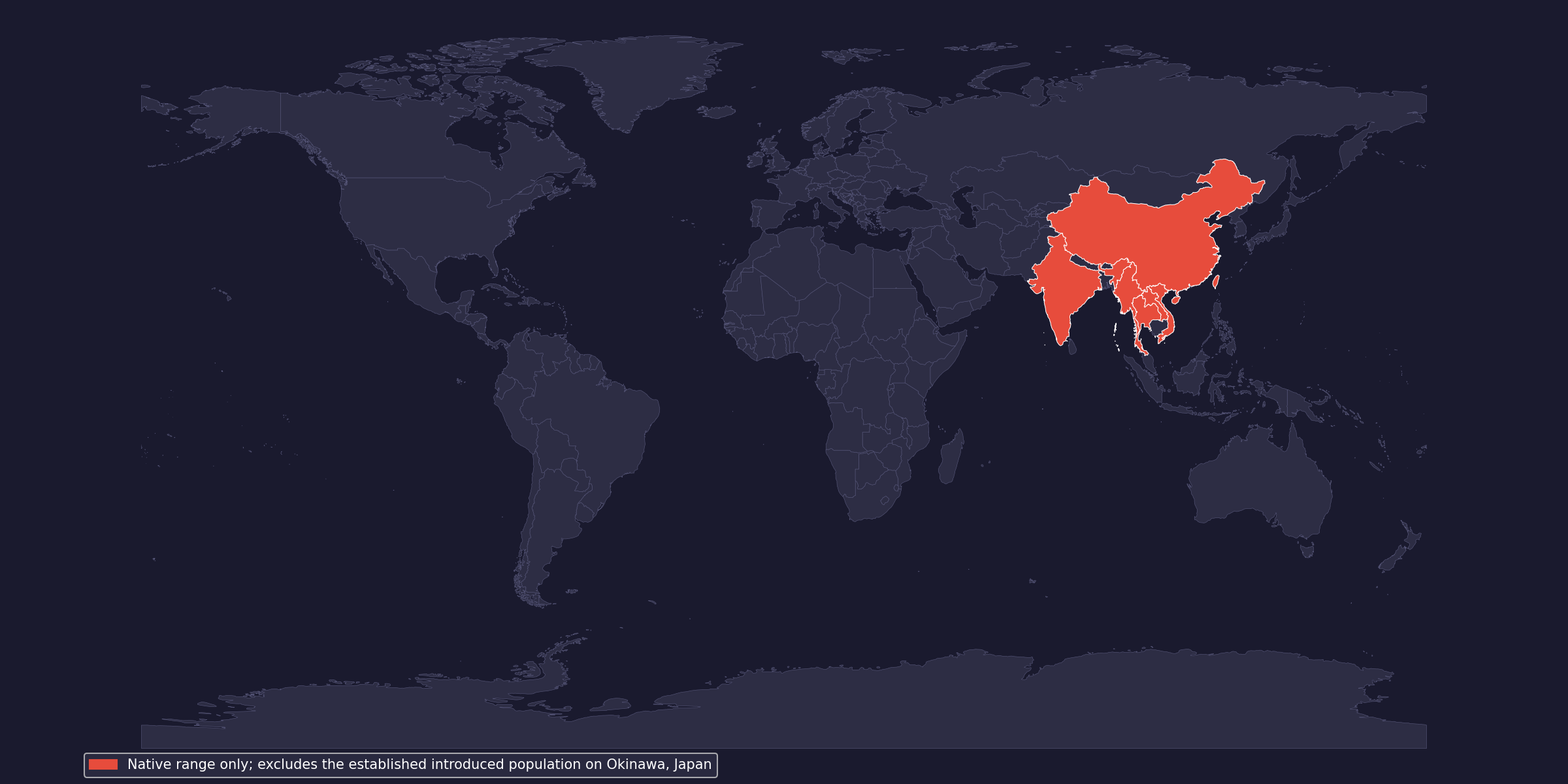
Native populations occur in north-eastern India, Myanmar, Laos, northern Thailand, northern and central Vietnam, southern and central China and Taiwan. Stable introduced populations occur on Okinawa, Japan, but Japan is not part of the native range map. Recent checklists question older Bangladesh records and treat Bhutan as possible rather than confirmed.
The species occupies forest edge, wooded hills, rocky streamsides, farms, gardens and other humid structured habitats, sometimes close to buildings. Its broad latitudinal and elevational range makes provenance critical: a Taiwan lowland animal and a northern mainland line should not receive an identical annual cycle by assumption.
⚖️ Legal status
Checked on 29 August 2026: Protobothrops mucrosquamatus is not listed in the current CITES Appendices or Annexes A-D of Commission Regulation (EU) 2026/1383. Do not confuse it with P. mangshanensis, which is listed. The Bern Convention is not relevant to the native Asian range.
Absence from trade annexes does not make possession unrestricted. Dangerous-animal, invasive-species, native-wildlife, import and transport laws may apply independently. Confirm permissions in writing before purchase, breeding or movement and retain invoices, breeder/importer identity, legal-origin and import papers, exact locality, parentage, photographs and transfers.
🤌 Husbandry
House singly in a locked enclosure inside a restricted, locked and escape-resistant room. Use independent mechanical locks, neonate-proof vents and cable passages, and a lockable elevated shift box connected through a tool-operated door. Routine water and waste servicing must not require hands in the occupied compartment.
Quarantine for at least 90 days with separate equipment, simple furnishings and paper substrate. Track weight, meals, sheds, faeces and breathing. Field and urban-conflict studies report varied parasites and prey, so wild-caught or imported snakes require veterinary examination and suitable faecal testing.
💡 Lighting
Provide 10-13 hours of broad visible daylight and full darkness at night, adjusted gradually for documented origin. Low-level Ferguson Zone 1 UVB can be offered over part of the upper structure, with equally useful shaded perches. It is optional, not a substitute for whole prey.
Mount lamps outside or behind a rigid guard. Plants and cork should create shade without making the snake impossible to count before a service door is opened.
🌡 Heating and temperature
Maintain 23-27°C air, a localized warm perch of 28-30°C and a shaded retreat at 20-23°C. Allow nights around 18-22°C. Because the snake uses several heights, measure temperatures at upper perches and at floor hides; heating the entire cage roof can trap it in excessive warmth.
Some mainland populations experience cool winters. A controlled reduction to approximately 14-18°C belongs only in a deliberate breeding programme for established adults of known provenance. Never cool a juvenile, thin, sick, gravid or newly imported snake. Every heater needs a thermostat and a robust guard.
💧 Humidity and water
Target 65-80% RH with cross-ventilation, short misting cycles and drying of leaves and perches between them. Raise a sheltered microclimate to 75-90% around shedding rather than keeping the whole enclosure wet. Condensation, sour substrate and mould indicate inadequate drying or ventilation.
Provide a stable clean water bowl and change it only through the shift procedure. Drinking from droplets can occur, but spraying never replaces fresh bowl water.
🌿 Enclosure and decoration
An adult enclosure should be at least 120 x 60 x 90 cm. Provide thick horizontal and diagonal branches, a warm and a cooler elevated resting site, a secure ground hide, an elevated shift hide and dense but serviceable cover. All branches and plant pots must remain stable under a moving adult.
Use 6-10 cm of soil-based, fine-bark and leaf-litter substrate that holds some moisture below while drying at the surface. Add drainage to planted systems. Avoid loose sphagnum over the whole floor, adhesive décor, sharp wire, unstable branches and any layout that prevents a complete visual count.
🐁 Feeding
Natural prey includes frogs, lizards, snakes, birds and mammals; younger snakes often take ectothermic prey before rodents. Established adults can usually be maintained on appropriately sized frozen-thawed rodents every 14-21 days. Juvenile feeding difficulties should be anticipated before breeding and managed by an experienced programme, not by leaving dangerous live prey unattended.
Offer food with long tongs only after the snake is positioned safely. Whole vertebrate prey needs no routine supplementation. Use weight trends and muscle tone rather than strike intensity to set meal size and interval.
🛡 Operational safety and emergencies
All routine care must use protected contact and positive shifting. Any unavoidable opening of primary containment needs two trained operators, barriers, a written door sequence and an agreed stop point. Veterinary restraint is a planned professional procedure; never improvise pinning or free handling.
Before acquisition, coordinate a species-specific bite plan with a poison centre or receiving hospital, including transport, emergency contacts and a current venom information sheet. Antivenom availability and cross-neutralization vary; only clinicians should select and administer it.
After a bite, call emergency services immediately, keep the patient still, remove constricting items, immobilize the limb and follow poison-centre advice. Do not cut, suck, ice, shock or tightly tourniquet the wound, and do not waste time catching the snake.
🥚 Breeding notes
This species lays eggs and females have been observed coiled around clutches. A 2025 Taiwan study recorded 3-21 eggs and an average hatching time of 38.3 ± 7.1 days under unmanipulated conditions. The structured range of 28-30°C for 31-50 days is conservative; maternal attendance in nature is not permission to leave eggs with a captive venomous female without a facility-specific risk assessment.
🩺 Common problems
Persistent damp causes scale disease and respiratory infection; overly dry, exposed housing promotes dehydration and dysecdysis. Regurgitation can follow oversized prey, disturbance or inadequate digestive heat. Imported animals may carry internal or external parasites even while feeding. Rostral abrasions suggest insecure cover or repeated escape attempts.
Secure the animal before troubleshooting. Record temperatures at every height, humidity cycle, weight and recent meals, then arrange a protected examination with an experienced reptile veterinarian.
📌 Conclusion
The brown-spotted pit viper requires a tall, serviceable enclosure, genuine night and seasonal relief, and contact-free shifting. Its adaptable ecology does not make it forgiving of procedural errors.
📚 Sources and further reading
- The Reptile Database — Protobothrops mucrosquamatus
- Liu et al. (2025), urban conflict and natural history in Taiwan
- Orlov et al. (2001), biology of Protobothrops
- GBIF species record
- WHO snakebite-envenoming resources
- CITES Appendices
- Commission Regulation (EU) 2026/1383