Share

Habu
🔤 Taxonomy
Protobothrops flavoviridis is the accepted name for the habu. Older books commonly use Trimeresurus flavoviridis; still older combinations include Bothrops flavoviridis and Lachesis flavoviridis. The proposed subspecies P. f. tinkhami remains disputed and is not recognized by all modern treatments. Preserve island locality rather than treating a subspecies label as settled fact.
Do not confuse this species with the Tokara habu P. tokarensis, Sakishima habu P. elegans or introduced Taiwan habu P. mucrosquamatus. “Habu” alone is an ambiguous trade or exhibit label.
📌 Description
The habu is a long, powerful pit viper, often 120-180 cm and capable of exceeding 200 cm. It is primarily nocturnal, climbs well and uses ground, rock walls, branches and human-modified edges. Managed lifespan may reach 15-25 years.
Envenomation can produce severe pain, rapidly progressive swelling, tissue injury, bleeding, coagulopathy, hypotension and systemic complications. Its size, reach and climbing ability make enclosure geometry as important as venom precautions.
📋 Quick reference
| Care point | Practical target |
|---|---|
| Adult enclosure | At least 180 x 90 x 120 cm with two lockable shift hides |
| Temperature | Ambient 23-27°C; basking 29-31°C; cool retreat 20-23°C |
| Night | 18-22°C, with locality-informed cool season |
| Humidity | 65-80% with airflow; local 80-90% shed support |
| Feeding | Moderate frozen-thawed rodents every 14-28 days |
| Safety | Protected contact, two-person rule, habu-capable hospital plan |
| Quarantine | At least 90 days with separate tools and parasite screening |
☠️ Venom
This species is venomous. Venom exposure can cause pain, swelling or other systemic effects, and severity varies with species, locality, bite site and the amount delivered. A small wound or apparently dry bite is not proof of safety; every bite or sting requires urgent medical assessment.
If an incident occurs, move away, call emergency services or a poison centre, keep the patient still, remove rings and other constricting items, and follow dispatcher instructions. Do not use a tourniquet, cut or suck the wound, apply ice or electricity, give alcohol or medicines as a home treatment, or attempt to catch the animal. Antivenom choice and dosing are hospital decisions; verify the relevant product and local availability in advance. Sources: WHO snakebite guidance and appropriate species-specific toxinology or medical references listed below.
🌍 Distribution
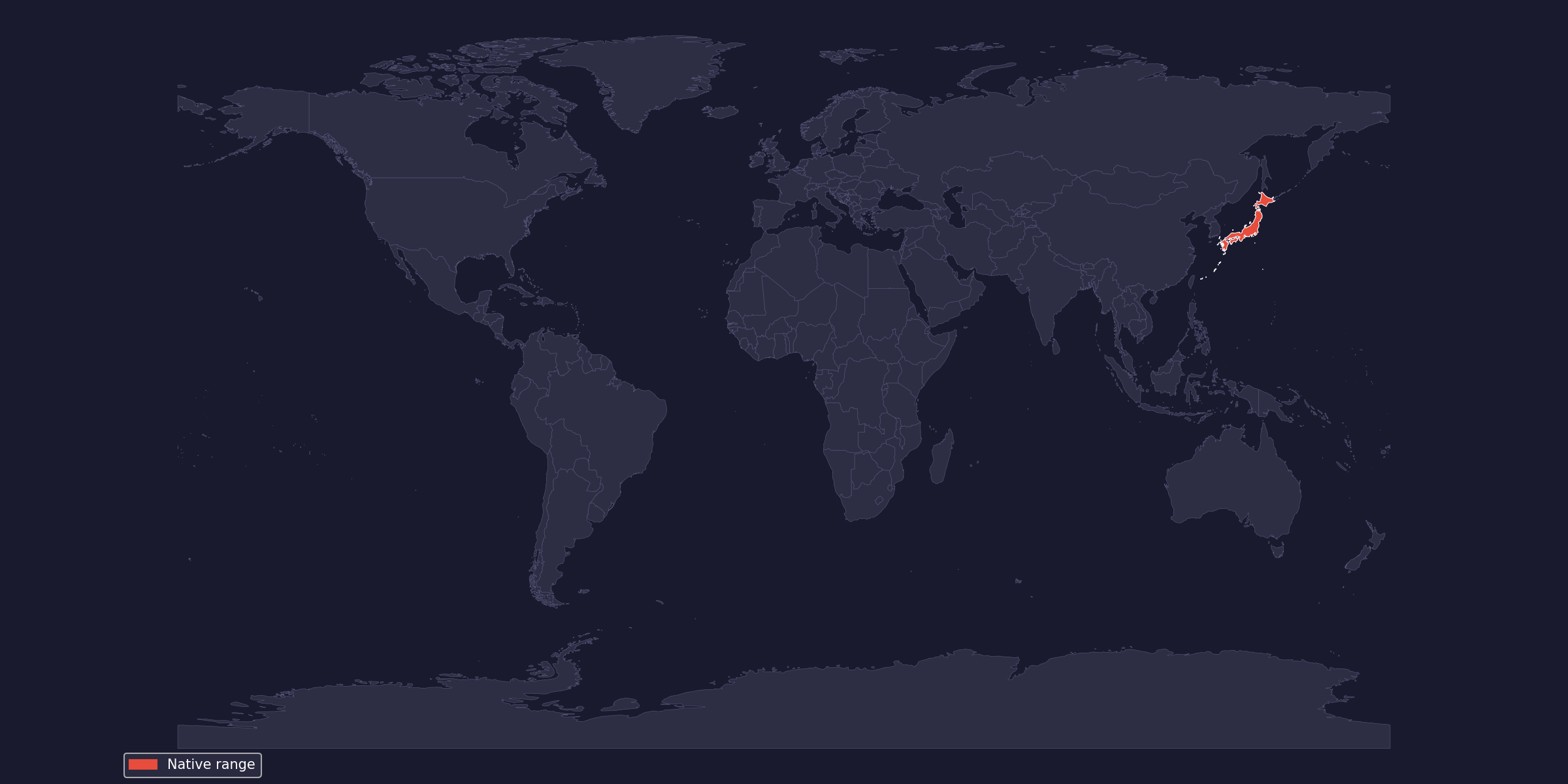
The species is endemic to Japan’s central Ryukyu chain, on selected islands of the Amami and Okinawa groups. Important populations occur on Amami Ōshima, Tokunoshima and Okinawa-jima, with presence on several associated islands; it is not naturally distributed across the Japanese main islands or every Ryukyu island. Island boundaries and the status of labels such as tinkhami require careful source documentation.
Habitats include subtropical evergreen forest, forest edge, limestone and rock walls, stream valleys, fields and settlements. The map colours all Japan and therefore drastically overstates the occupied island area. The reviewed Amami Ōshima climate point represents one subtropical island and is not a full-range average for Okinawa and every smaller island.
🌡 Climate across the native range
Monthly normals from a reviewed occurrence in the subtropical Amami island group; this point is not an average for every occupied Ryukyu island:
Amami Ōshima, Kagoshima — Japan (reviewed habu occurrence)
| Month | Min °C | Mean °C | Max °C | RH % |
|---|---|---|---|---|
| January | 13.3 | 14.6 | 16 | 70 |
| February | 13.4 | 14.9 | 16.5 | 72 |
| March | 15.1 | 16.7 | 18.5 | 74 |
| April | 17.8 | 19.4 | 21.3 | 77 |
| May | 20.9 | 22.4 | 24.3 | 82 |
| June | 24 | 25.4 | 27.1 | 88 |
| July | 26.5 | 27.8 | 29.6 | 85 |
| August | 26.5 | 27.9 | 29.6 | 84 |
| September | 25.3 | 26.6 | 28.2 | 82 |
| October | 22.5 | 23.7 | 25.2 | 76 |
| November | 19.1 | 20.3 | 21.7 | 73 |
| December | 15.2 | 16.5 | 17.9 | 70 |
Weather data by Open-Meteo.com · CC BY 4.0 · Monthly normals calculated by Herpeton Academy from daily archive values.
Location references use GBIF.org occurrence data where available; original occurrence records retain their source dataset licenses.
⚖️ Legal status
No species-specific listing was found in CITES, the EU wildlife-trade annexes or the Bern Convention appendices on 17 August 2026. In Japan, venomous snakes fall within the regulated “Specified Animals” framework. Since 1 June 2020, keeping Specified Animals for pet purposes has been prohibited; zoos, research facilities and other qualifying purposes require permission from the relevant prefectural governor or designated-city authority, compliant containment, escape prevention, signage and individual identification where required.
Island wildlife collection, transfer and transport can carry additional national, prefectural or municipal restrictions. Keep permits, facility approvals, origin and island-locality records, transfer papers, photographs and legal-check dates. Local and national rules governing possession, transport, breeding, sale and import may apply even without CITES listing.
🤌 Husbandry
House singly in a locked venomous room with secondary containment. The adult enclosure needs two externally operated shift hides positioned so that a climbing snake can be positively located and secured before any port opens. Routine work is protected contact only and always follows visual confirmation behind a closed barrier.
Quarantine for at least 90 days on paper with separate tools and preferably separate air. Track weight, feeding, sheds, faeces, mouth and respiration. Imported or uncertain-origin stock warrants veterinary examination, repeated faecal testing and ectoparasite control before naturalistic substrate.
💡 Lighting
Use a seasonal 10-13-hour photoperiod with complete darkness at night and broad shaded cover. Guard every fitting. Low-level UVB over part of the warm zone may provide Ferguson Zone 1 exposure; the snake must be able to avoid it on the ground and in the branches.
🌡 Heating and temperature
Maintain 23-27°C ambient air, a local 29-31°C basking surface, a 20-23°C cool refuge and nights around 18-22°C. Avoid persistent tropical heat without a cool retreat. Thermostat every source and measure at ground hides and elevated resting sites.
The islands have a genuine cool season, but this is not deep continental brumation. Healthy, locality-documented adults may receive a gradual winter reduction in room temperature and photoperiod; keep a safe gradient and do not cool juveniles, thin animals, new arrivals or animals with respiratory signs.
💧 Humidity and water
Maintain 65-80% relative humidity with cross-ventilation and partial drying between misting events. Offer an 80-90% humid retreat for shedding. Subtropical humidity must not become stagnant wet substrate; scale disease and respiratory problems follow poor drainage.
Provide a heavy clean water bowl through protected access. Mist foliage and part of the substrate, then allow airflow to clear surface water. Monitor drinking, urates, body mass and sheds.
🌿 Enclosure and decoration
An adult needs at least 180 x 90 x 120 cm; exceptionally large animals benefit from 240 cm length. Include two lockable shift hides, anchored ground cover, broad sturdy climbing branches, shelves and foliage. Avoid routes that place a perched snake above an open service door.
Use 10-15 cm of well-drained forest soil, fine bark and leaf litter over drainage, or paper during quarantine. Eliminate inaccessible hollows, unstable rock, aromatic wood, sharp mesh and adhesive tape. Use two independent locks, guarded ventilation, room-level containment and a rehearsed escape plan.
🐁 Feeding
Wild habu take rodents, birds, amphibians, reptiles and other small vertebrates. Established adults generally accept appropriate frozen-thawed mice and rats. Feed juveniles about every 10-14 days and adults a moderate meal every 14-28 days according to body condition and season.
Use long tongs through a protected port. Shift before retrieving refused prey. Live rodents can injure the snake and create recovery hazards. Whole prey needs no routine supplementation.
🛡 Operational safety and emergencies
Never free-handle, pin, neck or manually restrain. Use protected contact, lockable shifts, shields and purpose-selected tools within a written two-person procedure. The second trained adult remains outside the immediate operation with communications and the emergency plan.
Before acquisition, confirm a Japanese or regional poison-centre pathway, receiving hospital, transport, specialist consultation and access to appropriate habu antivenom. Keep island provenance and photographs with the plan. Rehearse escape and bite scenarios without a live animal.
Every bite is an immediate emergency. Withdraw, call emergency services, keep the patient still and remove tight items. Because habu venom can cause severe local tissue injury, do not apply pressure immobilisation, constricting wraps or a tourniquet unless the responsible regional medical authority explicitly directs it. Do not cut, suck, ice, shock, apply chemicals or delay for symptoms.
🥚 Breeding notes
The habu is oviparous and may produce approximately 4-18 eggs. Published captive observations support warm controlled incubation around 27-29°C with hatching often around 45-60 days, but maternal retention and incubation conditions can change the interval. Record egg mass, substrate moisture, temperature and development.
Breeding requires verified island lineage, permits, remotely closable pairing compartments and individual locked neonatal units. Prepare staffing and lawful placements before pairing. Do not assign disputed tinkhami status without diagnostic and locality support.
🩺 Common problems
- Obesity: large ambush predators need conservative prey and regular weights.
- Rostral trauma: review cover, reflections, climbing routes and shift design.
- Burns or overheating: guard and thermostat heat; preserve a measured cool refuge.
- Respiratory disease and scale damage: correct saturated stagnant conditions and seek veterinary diagnosis.
- Dysecdysis or dehydration: adjust localized humidity and water rather than flooding the enclosure.
- Parasites and stomatitis: strict quarantine and veterinary testing are essential for uncertain-origin animals.
📌 Conclusion
The habu requires a tall, secure, humid-but-ventilated protected-contact system and a medical plan linked to appropriate Japanese antivenom expertise. Island provenance matters more than a disputed subspecies label, and a whole-Japan map cannot guide seasonal care.
📚 Sources and further reading
- ReptiFiles — checked first on 17 August 2026; no species-specific care guide was found.
- The Reptile Database: Protobothrops flavoviridis
- GBIF species record: Protobothrops flavoviridis
- Japan Ministry of the Environment: permission for Specified Animals
- WHO South-East Asia snakebite guidelines
- Baines et al. — UV lighting guidance
- CITES Appendices
- EU wildlife-trade annexes, Commission Regulation (EU) 2026/1383
- Bern Convention appendices