Share

Inland Taipan
🔤 Taxonomy
Oxyuranus microlepidotus is the accepted name for the inland taipan. Older literature may list Diemenia microlepidota, Pseudechis microlepidotus, Parademansia microlepidota or Oxyuranus scutellatus microlepidotus. It is a full species, distinct from the coastal taipan O. scutellatus and the central ranges taipan O. temporalis; locality and photographs must accompany every institutional record.
📌 Description
The inland taipan is a substantial, fast Australian elapid, generally 150-220 cm. Its colour changes seasonally from lighter warm-season tones to a darker cool-season head and body. It is often secretive in cracking clay and rodent burrows, but restraint or blocked retreat can produce rapid defensive movement.
Venom rankings based on mouse tests are not useful husbandry information. A human bite is a life-threatening emergency requiring immediate Australian first aid and definitive hospital care. This species belongs only in licensed institutions with protected-contact systems.
📋 Quick reference
| Care point | Practical target |
|---|---|
| Adult enclosure | At least 240 x 120 x 120 cm with two lockable shift hides |
| Temperature | Ambient 24-29°C; basking 32-34°C; cool retreat 20-24°C |
| Night | 16-22°C, seasonally adjusted |
| Humidity | 35-55%; local 55-70% shed support |
| Feeding | Moderate frozen-thawed rodents every 10-21 days |
| Safety | Protected contact, two trained staff, bite and escape plans |
| First aid | Australian pressure-immobilisation and splinting by practically trained responders |
☠️ Venom
This species is venomous. Venom exposure can cause pain, swelling or other systemic effects, and severity varies with species, locality, bite site and the amount delivered. A small wound or apparently dry bite is not proof of safety; every bite or sting requires urgent medical assessment.
If an incident occurs, move away, call emergency services or a poison centre, keep the patient still, remove rings and other constricting items, and follow dispatcher instructions. Do not use a tourniquet, cut or suck the wound, apply ice or electricity, give alcohol or medicines as a home treatment, or attempt to catch the animal. Antivenom choice and dosing are hospital decisions; verify the relevant product and local availability in advance. Sources: WHO snakebite guidance and appropriate species-specific toxinology or medical references listed below.
🌍 Distribution
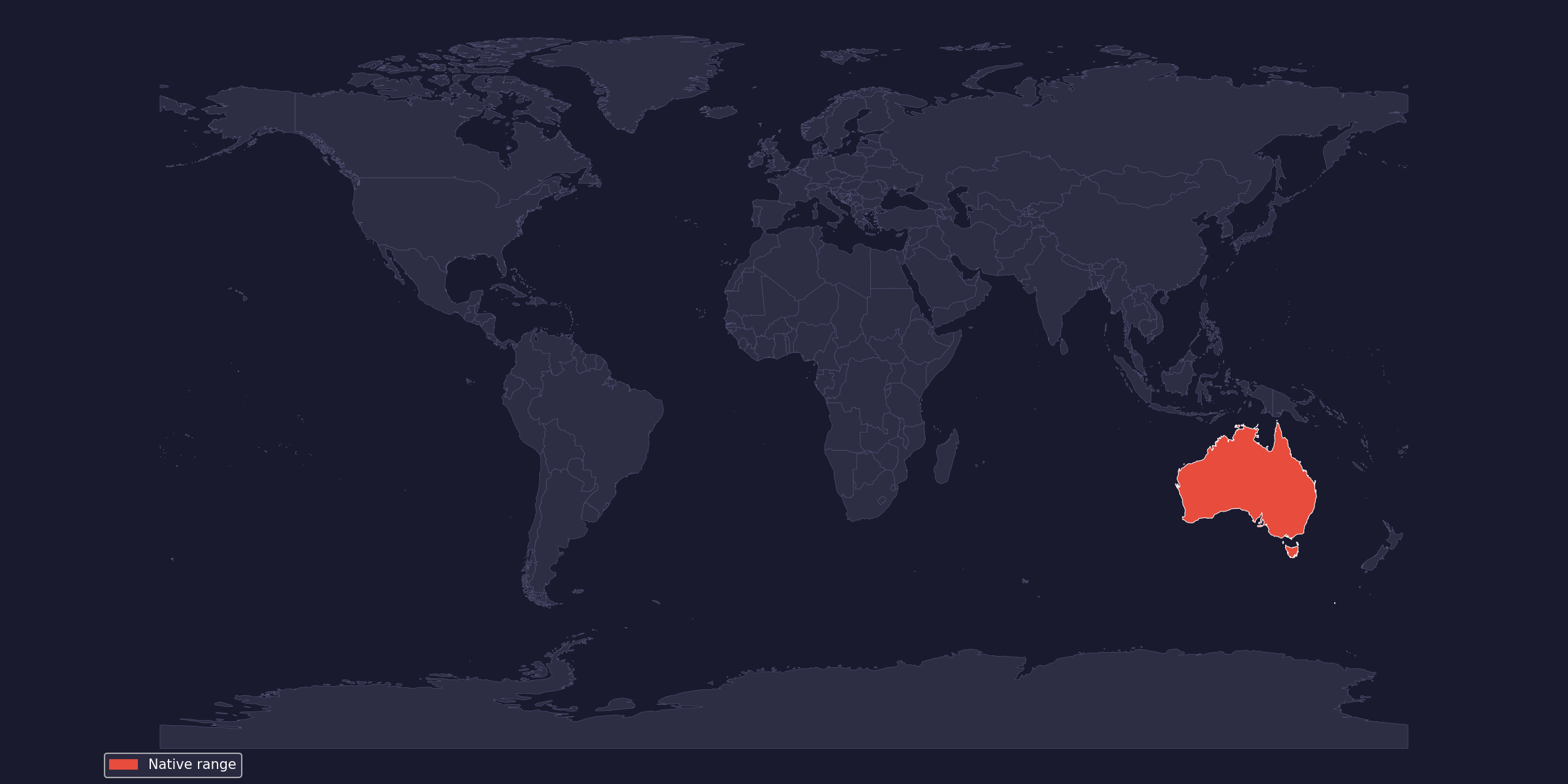
The core range is narrow and discontinuous within the arid Channel Country of southwestern Queensland and northeastern South Australia, with records around the Diamantina, Georgina and Cooper drainage systems and adjacent cracking-clay country. Peripheral records require careful verification against O. temporalis and other large brown elapids.
An Australia-wide country map greatly overstates the occupied area and cannot represent state boundaries or the sparse floodplain and gibber habitats. The Astrebla Downs climate point is one reviewed core-range occurrence, not an average for Australia or even every Channel Country season.
🌡 Climate across the native range
Monthly normals from one reviewed Channel Country occurrence; this point is representative context, not an average for the full range:
Astrebla Downs National Park — Queensland, Australia (reviewed inland taipan occurrence)
| Month | Min °C | Mean °C | Max °C | RH % |
|---|---|---|---|---|
| January | 26.6 | 32.2 | 37.7 | 37 |
| February | 25.7 | 31.1 | 36.6 | 39 |
| March | 23 | 28.7 | 34.3 | 38 |
| April | 19 | 24.7 | 30.6 | 37 |
| May | 14.2 | 19.5 | 25.3 | 44 |
| June | 10.7 | 15.8 | 21.6 | 51 |
| July | 9.6 | 15.2 | 21.6 | 46 |
| August | 11.3 | 17.5 | 24.3 | 37 |
| September | 15.7 | 22.3 | 29.1 | 31 |
| October | 19.6 | 26.2 | 32.8 | 28 |
| November | 22.8 | 29.2 | 35.4 | 31 |
| December | 25.2 | 31.3 | 37.1 | 32 |
Weather data by Open-Meteo.com · CC BY 4.0 · Monthly normals calculated by Herpeton Academy from daily archive values.
Location references use GBIF.org occurrence data where available; original occurrence records retain their source dataset licenses.
⚖️ Legal status
No species-specific entry for O. microlepidotus was found in the CITES Appendices, EU wildlife-trade annexes or Bern Convention appendices when checked on 17 August 2026. Australian native-reptile export is controlled federally, while possession, movement, display and breeding are licensed by states and territories; ordinary private export is not implied by absence from CITES.
Local and national rules for possession, transport, breeding, sale and import may require dangerous-snake authority, inspected premises, documented competency, animal records and emergency planning. Keep acquisition, breeder, locality, state permit, export/import and transfer records. Obtain written approval from every authority before moving an animal across a jurisdiction.
🤌 Husbandry
House one animal alone in a locked venomous room with secondary containment. Use two complete shift compartments with remotely closable doors, transparent confirmation panels and service points outside the strike path. The system must accommodate rapid movement without relying on hooks to hold the snake in an open enclosure.
Quarantine for at least 90 days with separate tools, simple flooring and preferably separate air. Record weight, meals, sheds, faeces and respiration. Confirm identity and locality through reliable records because broad trade labels and colour alone are inadequate.
💡 Lighting
Provide 10-13 hours of bright visible light according to season, with full darkness overnight. Deep hides must remain dark throughout the day. All lamps sit outside primary containment or behind rigid guards.
Low UVB may be offered across part of the basking zone as a Ferguson Zone 2 opportunity with adjacent shade. Measure output at snake height and do not sacrifice secure hide cover to create exposure.
🌡 Heating and temperature
Maintain active-season ambient air at 24-29°C, a local basking surface at 32-34°C, a cool hide at 20-24°C and nights around 16-22°C. Large daily and seasonal outdoor swings are not instructions to expose a captive snake to extremes. Thermostat every source and use independent alarms.
Only healthy, locality-documented breeding adults may be gradually cooled toward roughly 12-16°C under an institutional plan. Juveniles, thin, ill, gravid or newly acquired snakes must not be cooled. Preserve hydration, daily inspection and a safe reversible gradient.
💧 Humidity and water
Keep a well-ventilated 35-55% baseline with dry upper surfaces. A localized humid hide at 55-70% assists shedding. Channel Country floods do not justify continuously damp housing; wild animals choose dry burrows and retreat depth even after rainfall.
Provide a heavy clean water bowl via protected service. Record drinking and urates, especially during seasonal transitions. Dehydration, excessive heat and dusty substrate can contribute to poor sheds and respiratory irritation.
🌿 Enclosure and decoration
An adult needs at least 240 x 120 x 120 cm. Include two tight shift hides, low shelves, sturdy cover and open routes. A hide with a narrow, controlled entrance resembles a soil crack while still allowing safe visual confirmation.
Use 10-15 cm of compactable clay-rich soil and washed sand, with paper for quarantine. It should hold shallow contours without collapsing into inaccessible tunnels. Avoid deep uncontrolled burrows, unstable rock, aromatic wood and adhesive décor. Doors require two independent locks and the room an airlock or equivalent barrier.
🐁 Feeding
Offer appropriately sized frozen-thawed rodents. The species specializes strongly on mammals in nature, but a captive feeding response is not evidence of underfeeding. Adults usually remain lean on moderate meals every 10-21 days, adjusted for season and condition.
Feed through a protected port with long tongs, and shift before retrieving leftovers. Live rodents can injure the snake and create an unsafe recovery task. Complete whole prey needs no routine supplements.
🛡 Operational safety and emergencies
Routine free handling, pinning and manual restraint are unacceptable. Use protected contact, shift boxes, transparent shields and equipment suitable for a fast elapid. Two trained staff attend any opening of primary containment and rehearse escape, bite, communications and ambulance access.
For a suspected bite in Australia, call emergency services immediately. A practically trained responder should apply the current Australian pressure-immobilisation method: a firm broad bandage over the bite and entire limb, followed by splinting and complete stillness, while monitoring breathing. Do not remove the bandage before medical direction. This text cannot replace hands-on training; facilities outside Australia must follow their regional poison-centre plan.
Do not wash the bite site, cut, suck, ice, use an arterial tourniquet, allow walking or delay transport to capture the snake. The hospital plan must include exact identification, transport time, airway support and access to appropriate taipan antivenom expertise.
🥚 Breeding notes
Inland taipans are oviparous. Reported clutches commonly contain about 11-20 eggs. Institutional incubation near 27-29°C often lasts around 60-70 days, but egg mass, substrate water potential and development must be monitored.
Breeding creates fast, medically significant neonates. Confirm lawful authority and placement before pairing. Prepare individually lockable rearing units, records and appropriately sized shift containers before the eggs hatch.
🩺 Common problems
- Obesity: avoid large frequent meals; weigh and maintain locomotor space.
- Overheating and burns: guard and thermostat every source and preserve a verified cool hide.
- Dehydration and dysecdysis: review water, humid retreat and temperature rather than wetting the whole enclosure.
- Respiratory disease: abnormal sounds, bubbles or open-mouth breathing require urgent veterinary care.
- Rostral injury: persistent rubbing suggests poor hide design, exposure or unsuitable barriers.
- Parasites and stomatitis: uncertain-origin animals require strict quarantine and diagnostics.
📌 Conclusion
The inland taipan is an arid floodplain specialist, not a generic hot-desert snake and not a vehicle for venom superlatives. Suitable care requires verified Channel Country provenance, safe seasonal choices, fully protected servicing and a team practically trained in Australian pressure-immobilisation response.
📚 Sources and further reading
- ReptiFiles — checked first on 17 August 2026; no species-specific care guide was found.
- The Reptile Database: Oxyuranus microlepidotus
- GBIF species record: Oxyuranus microlepidotus
- Queensland Museum: inland taipan
- Australian Resuscitation Council Guideline 9.4.8 — envenomation pressure immobilisation
- Australian Government — commercial export of native specimens
- Baines et al. — UV lighting guidance for captive reptiles
- CITES Appendices
- EU wildlife-trade annexes, Commission Regulation (EU) 2026/1383
- Bern Convention appendices