Share

King Cobra
🔤 Taxonomy
Ophiophagus hannah is now the northern king cobra in the strict taxonomic sense. A 2024 revision divided the former wide-ranging concept into four species: O. hannah north and east of the Western Ghats and through Indo-Burma and Indochina; O. kaalinga in India’s Western Ghats; O. bungarus on the Sunda Shelf and parts of the southern Philippines; and O. salvatana on Luzon. Old labels that say only “king cobra” or O. hannah may therefore conceal a different species or a mixed lineage.
Older combinations include Hamadryas hannah and Naja hannah. Scientific name, precise origin, banding photographs and transfer history must travel with every animal. This guide must not be applied automatically to Malaysian, Indonesian, Western Ghats or Philippine stock.
📌 Description
The strict-sense king cobra is an exceptionally long, active elapid. Adults commonly exceed 3 m, large animals reach 4-5 m, and planning must allow a 20-30-year lifespan. It travels, climbs, investigates elevated cover and can raise a substantial length of the forebody; a conventional display vivarium is inadequate.
Venom can cause rapidly progressive neuroparalysis, respiratory failure, cardiovascular collapse and local tissue injury. The combination of reach, speed, body mass and venom yield leaves no safe margin for routine free handling. Only a licensed institution with purpose-built rooms, trained teams and a pre-agreed hospital pathway should acquire one.
📋 Quick reference
| Care point | Practical target |
|---|---|
| Adult suite | At least 600 x 300 x 300 cm plus two full-length lockable shift compartments |
| Temperature | Ambient 24-28°C; basking 30-32°C; cool retreat 22-24°C |
| Night | 21-24°C, adjusted to documented locality and season |
| Humidity | 60-80% with strong airflow; local 80-90% shed support |
| Feeding | Disease-screened, safely killed or frozen-thawed snake prey every 10-21 days |
| Safety | Protected contact, two trained staff, written escape/bite plan and receiving hospital |
| Quarantine | At least 90 days in a separate secure suite with parasite screening |
☠️ Venom
This species is venomous. Venom exposure can cause pain, swelling or other systemic effects, and severity varies with species, locality, bite site and the amount delivered. A small wound or apparently dry bite is not proof of safety; every bite or sting requires urgent medical assessment.
If an incident occurs, move away, call emergency services or a poison centre, keep the patient still, remove rings and other constricting items, and follow dispatcher instructions. Do not use a tourniquet, cut or suck the wound, apply ice or electricity, give alcohol or medicines as a home treatment, or attempt to catch the animal. Antivenom choice and dosing are hospital decisions; verify the relevant product and local availability in advance. Sources: WHO snakebite guidance and appropriate species-specific toxinology or medical references listed below.
🌍 Distribution
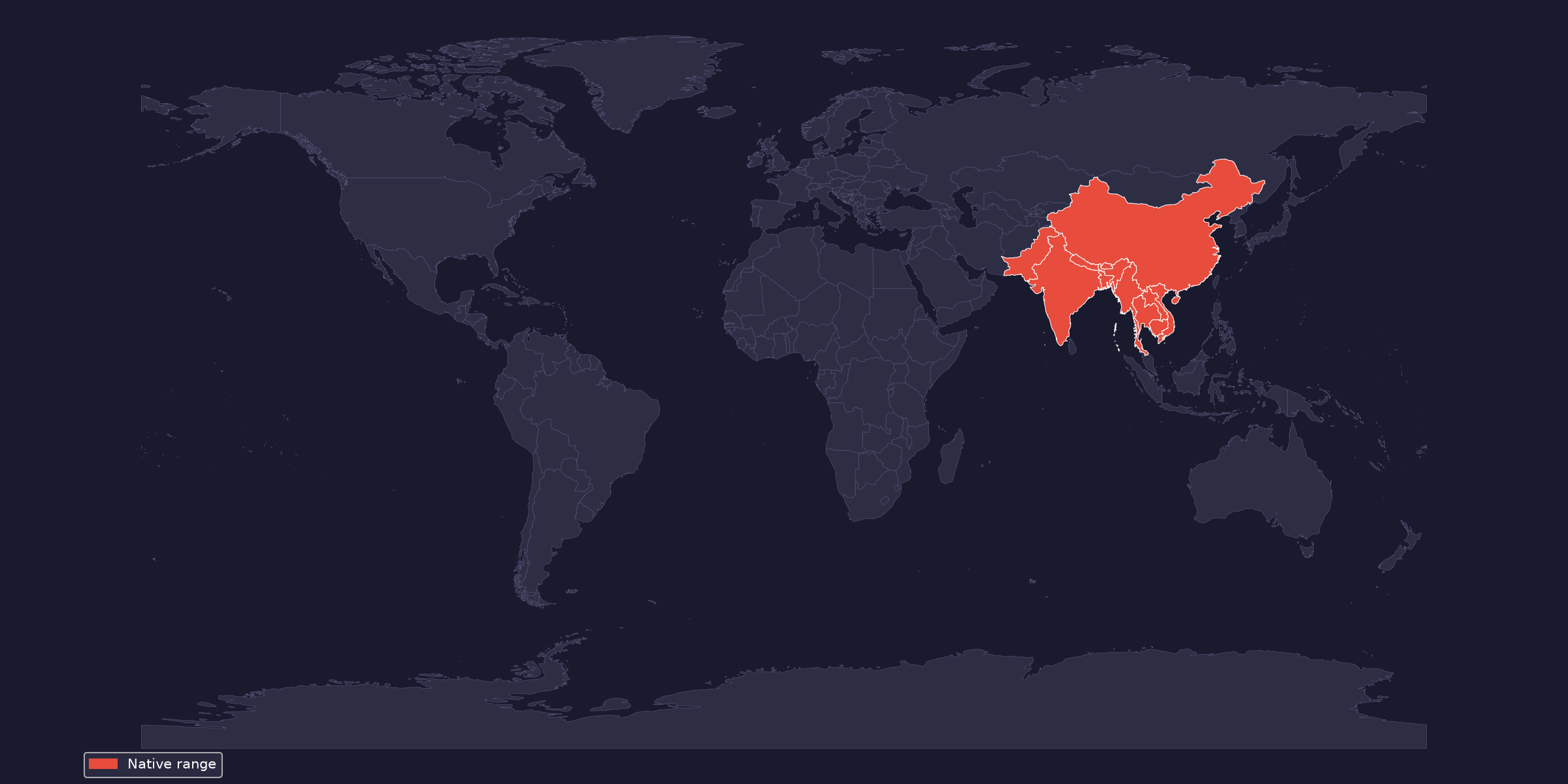
Following the 2024 revision, O. hannah sensu stricto occurs from eastern Pakistan through northern and eastern India, Nepal, Bhutan and Bangladesh to Myanmar, southern China and Indochina, extending south to central Thailand; the Andaman Islands also belong to this concept. Western Ghats populations are O. kaalinga, populations on the Malay Peninsula south of the central Thai boundary and the Greater Sunda region are O. bungarus, and Luzon animals are O. salvatana.
It uses evergreen and seasonal forest, bamboo, wetlands, mangrove margins, agricultural mosaics and wooded foothills, often near water. The range image colours entire countries and cannot show the central-Thai lineage boundary, fragmented forest, unsuitable highlands and dry interiors, or which Indian regions belong to O. kaalinga. It is a coarse geographic warning, not an identification tool. The reviewed Mizoram point represents one humid north-eastern Indian locality within the strict-sense range, not China, the Himalaya, the Andamans or Indochina.
🌡 Climate across the native range
Monthly normals from one reviewed occurrence in the north-eastern Indian part of the strict-sense range; this point is not an average for the species’ broad climatic envelope:
Mizoram — India (reviewed strict-sense king cobra occurrence)
| Month | Min °C | Mean °C | Max °C | RH % |
|---|---|---|---|---|
| January | 10 | 16.3 | 22.5 | 69 |
| February | 11.4 | 18 | 24.7 | 65 |
| March | 15.3 | 21.9 | 28.5 | 61 |
| April | 18.3 | 24 | 29.6 | 68 |
| May | 19.8 | 24.3 | 28.9 | 79 |
| June | 21.1 | 24.5 | 27.8 | 87 |
| July | 21.4 | 24.6 | 27.7 | 92 |
| August | 21.2 | 24.5 | 27.8 | 90 |
| September | 20.8 | 24.3 | 27.9 | 89 |
| October | 19.3 | 23.3 | 27.4 | 84 |
| November | 15.5 | 20.2 | 25 | 78 |
| December | 11.5 | 17.1 | 22.7 | 73 |
Weather data by WorldClim v2.1 · Monthly normals queried by Herpeton Academy from raster values; relative humidity is derived from vapor pressure and mean temperature.
Location references use GBIF.org occurrence data where available; original occurrence records retain their source dataset licenses.
⚖️ Legal status
Ophiophagus hannah is listed in CITES Appendix II and EU Annex B as checked on 17 August 2026; the Bern Convention does not provide a species-specific listing. International and EU transactions therefore require the applicable permits, lawful-origin evidence and commercial-use documentation. Because the 2024 split post-dates many permits and collections, authorities may also require evidence that an animal is actually O. hannah rather than another Ophiophagus species.
Range states apply separate wildlife, export and facility rules, and many jurisdictions classify every king cobra as a dangerous animal. Local and national requirements for possession, registration, transport, breeding, sale and import may demand licensing, inspected containment, insurance and an emergency plan. Retain permits, invoices, breeder and parent records, locality evidence, photographs, identifiers and dated legal advice.
🤌 Husbandry
House one animal in a locked, access-controlled venomous suite with room-level secondary containment. The primary enclosure must connect to two full-length, externally operated shift compartments so that the entire snake can be visually located, moved and positively isolated before any service hatch opens. Routine work is protected contact under a written two-person procedure; free handling, pinning and manual restraint are not husbandry techniques.
Quarantine for at least 90 days in a separate secure room or air space, using simple cleanable surfaces and dedicated tools. Record weight, body condition, prey, faeces, sheds, mouth and respiration. Test for internal and external parasites and investigate regurgitation before naturalistic furnishing. Treat old “O. hannah” paperwork as incomplete until lineage and origin are reviewed.
💡 Lighting
Provide bright, broad-spectrum daylight for 10-13 hours according to locality and season, complete darkness at night and extensive shaded cover. Guard every lamp and cable. Low-output UVB over part of the warm zone can provide Ferguson Zone 2 exposure, but measured gradients and retreats must allow complete avoidance.
🌡 Heating and temperature
Maintain most air at 24-28°C, a local basking surface at 30-32°C, a 22-24°C cool retreat and nights near 21-24°C. A huge enclosure needs multiple calibrated sensors; measure occupied shelves, floor hides and both shift boxes, not only the room. Every heater must be thermostatically controlled and physically guarded.
Do not hold the whole suite at the basking temperature. Strict-sense populations span monsoonal lowlands and seasonal foothills, so seasonal adjustments must follow documented origin. Cooling is only for stable, healthy adults in a managed breeding programme, never for a new arrival, juvenile, thin animal or snake with respiratory signs.
💧 Humidity and water
Use 60-80% as a practical ventilated range with local 80-90% humidity during shedding. Large planted or soil-based rooms need drainage, cross-ventilation and surfaces that partially dry; continuous condensation and warm stagnant air promote dermatitis and respiratory disease.
Provide a large, stable water vessel that can be drained, filled and removed from protected access. Monitor drinking, urates, weight and sheds. Moist retreats and deep leaf cover create safer local humidity than indiscriminate spraying that brings the animal toward a service point.
🌿 Enclosure and decoration
An adult suite should be no smaller than about 600 x 300 x 300 cm, with more length for an animal approaching 5 m. Add two externally lockable full-body shifts, broad anchored shelves and trunks, visual barriers, ground hides, an open travel route and a protected staff corridor. No elevated route may terminate above a door, and no hollow may be impossible to inspect.
Use 15-20 cm of well-drained forest soil, fine bark and leaf litter over drainage, or sealed paper-lined flooring during quarantine. Anchor everything against a powerful snake. For a female, provide a remote-lockable nesting compartment deep enough for a substantial mound of clean leaf and bamboo material. Use double mechanical locks, guarded vents, camera coverage and an independently secured room boundary.
🐍 Feeding
King cobras are specialised snake predators. Build a legal, biosecure supply of correctly identified, disease-screened, safely killed or frozen-thawed snakes before acquisition; some individuals also take monitor lizards or other ectothermic prey. Do not rely on live feeding or assume a permanent rodent diet is nutritionally or behaviourally equivalent.
Offer juveniles smaller meals around every 7-14 days and established adults a moderate meal every 10-21 days, adjusted to body condition, temperature and reproductive state. Use a protected feeding hatch and long tools, and isolate the animal before removing refuse. Quarantine feeder reptiles separately, reject wild-caught prey and keep source records. Whole vertebrate prey needs no routine supplements.
🛡 Operational safety and emergencies
Never free-handle, neck, pin or manually carry this species. Use lockable shifts, rigid shields and task-specific tools under a two-person rule. The second trained person remains outside the immediate work zone with keys, communication and authority to activate the plan. Rehearse escapes and bites without a live snake, including closure of the room-level barrier.
Before acquisition, obtain written confirmation from the regional poison centre and receiving hospital covering transport, airway and ventilation capability, critical care, specialist consultation and an appropriate antivenom strategy for the documented lineage. Products used for Thai, Indian, Chinese or other king-cobra populations are not automatically interchangeable. Keep current photographs, scientific name, the 2024 lineage determination and origin with the medical file.
Every bite is an immediate emergency. Withdraw and secure the room, call emergency services, keep the patient still and remove rings, watches and tight clothing. Follow the regional poison-centre protocol; do not improvise a constricting wrap or tourniquet. Never cut, suck, ice, shock, apply chemicals or delay transport to catch the snake. Respiratory weakness can progress quickly, so observation at home is unacceptable.
🥚 Breeding notes
King cobras are unusual among snakes because females gather plant material into a nest and guard it. Reported clutches are commonly around 20-40 eggs. Institutional reports describe incubation around 26-28°C with hatching roughly 70-90 days after laying, but maternal retention, lineage, nest conditions and true egg temperature produce substantial variation.
Breeding requires a shiftable nesting module, remote observation, separate male and female compartments and a written plan for defensive nesting behaviour. Never remove eggs by confronting or manually restraining a guarding female. Pair only documented same-species lineages, monitor male conflict risk and prepare individual locked neonatal units, permits and qualified placements before introduction.
🩺 Common problems
- Obesity or nutritional imbalance: record weights and prey taxa; an indiscriminate rodent programme is not a substitute for a reviewed ophiophagous diet.
- Regurgitation and parasites: feeder reptiles and uncertain-origin animals require strict separation and veterinary investigation.
- Rostral trauma: repeated pushing indicates reflections, inadequate travel space, blocked routes or poorly designed shifts.
- Burns and overheating: guard and thermostat every source while preserving a measured cool retreat.
- Respiratory disease and dermatitis: correct wet stagnant conditions and seek reptile-veterinary diagnosis.
- Dysecdysis or dehydration: improve localized humidity and safe water access rather than saturating the suite.
- Reproductive obstruction: restlessness, prolonged straining or failure to settle in a female requires remote veterinary planning, not manual examination.
📌 Conclusion
The strict-sense northern king cobra belongs only in a facility built around its exceptional length, activity, specialised diet and medical consequence. The non-negotiable starting points are lineage-proof records, a room-sized two-compartment protected-contact system, a lawful snake-prey supply and a hospital plan that exists before the animal arrives.
📚 Sources and further reading
- ReptiFiles — checked first on 17 August 2026; no species-specific king cobra care guide was found.
- The Reptile Database: Ophiophagus hannah
- Das et al. (2024): taxonomic revision of the king cobra complex
- GBIF species record: Ophiophagus hannah
- Pfaff: Taxon Management Account for the King Cobra
- Lobo & Sreepada: institutional captive breeding and nesting
- WHO: Guidelines for the management of snakebites
- Baines et al. — UV lighting guidance
- CITES Appendices
- EU wildlife-trade annexes, Commission Regulation (EU) 2026/1383
- Bern Convention appendices