Share

Tiger Snake
🔤 Taxonomy
Notechis scutatus is the accepted species name for tiger snakes. The historically separate N. ater was synonymized with it, although references and permits still use combinations such as N. s. ater, occidentalis, humphreysi and niger. Some authorities retain subspecies while genetic work has treated the variation as a single species without formal subspecies. For care, never replace exact mainland, Tasmanian, Bass Strait, Kangaroo Island or Western Australian provenance with a colour-based label.
📌 Description
Tiger snakes are robust Australian elapids, usually 90-180 cm, with exceptional variation in size, colour, banding, head proportions and diet. Mainland wetland animals and large offshore-island populations can differ markedly because local prey and climate shape development.
A bite may produce neurotoxicity, coagulopathy and muscle injury and is immediately life-threatening. The species is not a handling animal. It requires a licensed institutional programme with protected contact and responders practically trained in Australian snakebite first aid.
📋 Quick reference
| Care point | Practical target |
|---|---|
| Adult enclosure | At least 200 x 100 x 100 cm with two lockable shift hides |
| Temperature | Ambient 20-26°C; basking 28-31°C; cool retreat 16-21°C |
| Night | 14-20°C according to provenance and season |
| Humidity | 50-70%; local 70-85% shed support |
| Feeding | Provenance-aware varied whole prey every 10-21 days |
| Safety | Protected contact, two trained staff, bite and escape plans |
| Winter cycle | Only measured cycling for healthy, locality-documented adults |
☠️ Venom
This species is venomous. Venom exposure can cause pain, swelling or other systemic effects, and severity varies with species, locality, bite site and the amount delivered. A small wound or apparently dry bite is not proof of safety; every bite or sting requires urgent medical assessment.
If an incident occurs, move away, call emergency services or a poison centre, keep the patient still, remove rings and other constricting items, and follow dispatcher instructions. Do not use a tourniquet, cut or suck the wound, apply ice or electricity, give alcohol or medicines as a home treatment, or attempt to catch the animal. Antivenom choice and dosing are hospital decisions; verify the relevant product and local availability in advance. Sources: WHO snakebite guidance and appropriate species-specific toxinology or medical references listed below.
🌍 Distribution
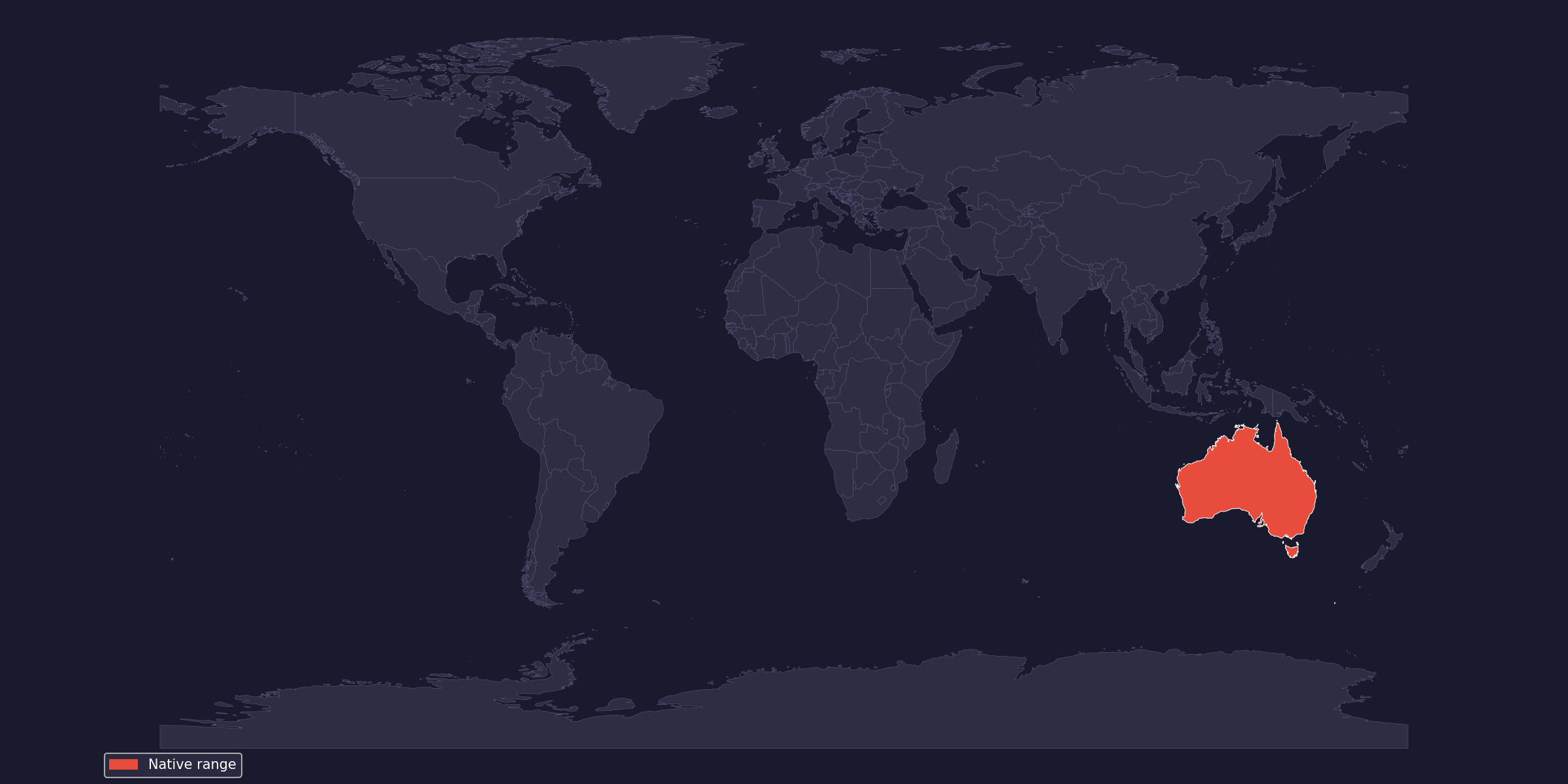
The species occurs discontinuously in southern and eastern Australia: Tasmania and Bass Strait islands, much of Victoria, southeastern South Australia, coastal and tableland New South Wales, small parts of southeastern Queensland, southwestern Western Australia and several offshore islands. Populations often centre on wetlands, creek lines, damp grassland, coastal heath and prey-rich island habitats.
An Australia-only country map cannot show this strongly regional distribution and therefore overstates the range. It also cannot distinguish mainland and island lineages. The southeastern Tasmanian station below is one reviewed cool-climate occurrence, not an Australian or species-wide average.
🌡 Climate across the native range
Monthly normals from one reviewed cool-climate island occurrence; this point is representative context, not an average for the species’ climatically diverse range:
Southeastern Tasmania — Australia (reviewed tiger snake occurrence)
| Month | Min °C | Mean °C | Max °C | RH % |
|---|---|---|---|---|
| January | 10.4 | 14.3 | 19.3 | 66 |
| February | 10.3 | 14.1 | 18.8 | 68 |
| March | 9.2 | 12.7 | 17.1 | 70 |
| April | 6.9 | 10.1 | 14.1 | 74 |
| May | 5.1 | 8 | 11.6 | 78 |
| June | 3.4 | 6.1 | 9.5 | 81 |
| July | 2.7 | 5.5 | 9.1 | 80 |
| August | 3 | 6.1 | 9.9 | 76 |
| September | 4.1 | 7.5 | 11.6 | 73 |
| October | 5.6 | 9.2 | 13.6 | 70 |
| November | 7.3 | 11 | 15.5 | 69 |
| December | 8.9 | 12.7 | 17.3 | 67 |
Weather data by Open-Meteo.com · CC BY 4.0 · Monthly normals calculated by Herpeton Academy from daily archive values.
Location references use GBIF.org occurrence data where available; original occurrence records retain their source dataset licenses.
⚖️ Legal status
No species-specific entry for N. scutatus was found in the CITES Appendices, EU wildlife-trade annexes or Bern Convention appendices when checked on 17 August 2026. Australian native-reptile export is federally controlled, and state or territory wildlife law regulates possession, movement, breeding and display. Local island populations may carry additional collection protection.
Local and national rules for possession, transport, breeding, sale and import may require a venomous-snake licence, inspected premises, competency records and emergency planning. Keep exact locality, breeder, acquisition, state permit, transfer and export/import documents. Confirm the accepted name on each permit before movement.
🤌 Husbandry
Keep one tiger snake alone in a locked venomous room with secondary containment. Two full-size shift hides connected by remotely closable doors are essential. Water changes, feeding and cleaning occur only after the animal has been visually confirmed and locked in the other compartment.
Quarantine for at least 90 days with separate tools and preferably separate air. Record weight, food, sheds, faeces, respiration and skin. Imported or uncertain-origin animals require parasite screening, and locality claims should be supported by records rather than appearance.
💡 Lighting
Provide 9-13 hours of bright visible light according to the season and provenance, with darkness at night. Give opaque hides and shaded cover. All fittings must remain outside reach or behind rigid guards.
Low-level UVB can provide a Ferguson Zone 2 opportunity over part of the basking zone, with adjacent deep shade. Measure the output; island melanism or basking behaviour does not justify intense exposure.
🌡 Heating and temperature
For many temperate populations, active-season targets are 20-26°C ambient air, a local 28-31°C basking surface, a 16-21°C cool hide and nights around 14-20°C. Warmer mainland stock and cool Tasmanian or Bass Strait stock should not be managed identically. Thermostat each source and measure surfaces and air.
Only healthy, locality-documented breeding adults may be gradually cooled to roughly 8-14°C under veterinary and institutional oversight. Do not cool juveniles, thin, sick, gravid or newly acquired animals. Water, observation and a reversible gradient remain available.
💧 Humidity and water
Maintain 50-70% relative humidity with good ventilation and a local 70-85% humid hide during shedding. Wetland association does not mean permanently saturated substrate. Allow exposed surfaces to dry to prevent dermatitis and respiratory disease.
Provide a large stable water bowl, serviced through protected access. Some individuals soak or swim readily, but a permanent pool is unnecessary unless the enclosure can support safe filtration and dry land. Record increased drinking, especially around shedding and reproduction.
🌿 Enclosure and decoration
An adult requires at least 200 x 100 x 100 cm; very large island animals benefit from more. Add two tight shift hides, low shelves, robust cover, cork and open basking ground. Furniture must permit visual accounting without reaching into hidden pockets.
Use 8-12 cm of compactable soil, washed sand and leaf/grass litter, or paper in quarantine. Provide a dry base and a localized damp zone. Avoid sharp mesh, unstable rocks, aromatic wood and inaccessible tunnels. Doors need two independent mechanical locks and the room an airlock or equivalent barrier.
🐁 Feeding
Diet must respect provenance. Mainland animals commonly take frogs, small mammals, birds and reptiles, while some island populations are adapted to seasonally abundant seabird chicks and may develop very large heads and bodies. In captivity use safe, legally sourced frozen-thawed whole prey selected through a veterinary nutrition plan; do not force every lineage onto oversized rodents.
Adults often feed every 10-21 days, adjusted for body condition and season. Feed through a protected port and shift before recovering leftovers. Live prey creates injuries and unsafe service work. Balanced whole prey requires no routine supplements.
🛡 Operational safety and emergencies
Routine free handling, necking and manual restraint are unacceptable. Use protected contact, shift boxes, transparent shields and tools rated for a powerful elapid. Two trained staff attend any primary opening and rehearse escape, bite, communication and ambulance access.
For suspected Australian snakebite, call emergency services immediately. A practically trained responder applies the current pressure-immobilisation method: a firm broad bandage over the bite and entire limb, followed by splinting and complete stillness, while breathing is monitored. Do not remove it before medical direction. Written instructions do not replace hands-on training; facilities outside Australia follow their regional poison-centre plan.
Do not wash the site, cut, suck, ice, use an arterial tourniquet, allow walking or delay transport to catch the snake. The hospital plan must carry exact taxon/locality, transport time, airway capability and access to appropriate antivenom expertise.
🐣 Breeding notes
Tiger snakes are viviparous. Litters often contain roughly 20-30 live young, but population and maternal size produce broad variation. There is no egg-incubation stage. Seasonal cycling, maternal basking access and body condition must be managed without overheating gravid females.
Every neonate is medically significant. Confirm legal breeding and placement before pairing and prepare individually lockable rearing units, records and small shift containers before birth.
🩺 Common problems
- Obesity: common where island diet adaptations are translated into frequent captive meals; use regular weights and condition scoring.
- Overheating: cool-climate animals need a real cool retreat and seasonal nights.
- Dermatitis and respiratory disease: permanently wet, cold, stale housing is dangerous despite wetland ecology.
- Dysecdysis: adjust local moisture and hydration rather than soaking the whole enclosure.
- Rostral injury: repeated rubbing indicates poor cover or unsuitable barriers.
- Parasites and stomatitis: uncertain-origin animals need strict quarantine and diagnostics.
📌 Conclusion
The tiger snake is a locality-dependent species complex in practical husbandry even where treated as one taxon. Responsible institutions preserve provenance, match seasonal heat and diet to that population, use protected contact for every task and maintain a team trained in Australian pressure-immobilisation first aid.
📚 Sources and further reading
- ReptiFiles — checked first on 17 August 2026; no species-specific care guide was found.
- The Reptile Database: Notechis scutatus
- GBIF species record: Notechis scutatus
- Keogh et al. — molecular phylogeny and tiger-snake taxonomy
- Rawlinson — taxonomy and distribution of Australian tiger snakes
- Australian Resuscitation Council Guideline 9.4.8 — envenomation pressure immobilisation
- Australian Government — commercial export of native specimens
- Baines et al. — UV lighting guidance for captive reptiles
- CITES Appendices
- EU wildlife-trade annexes, Commission Regulation (EU) 2026/1383
- Bern Convention appendices