Share

Philippine Cobra
🔤 Taxonomy
Naja philippinensis is the accepted northern Philippine cobra. Older works may use Naja naja philippinensis or combine records under broadly defined Asiatic cobras. Those names do not make animals from different Philippine islands interchangeable.
The species occurs on Luzon, Mindoro, Masbate, Marinduque, Catanduanes and Lubang. The southern Philippine cobra N. samarensis occupies Mindanao and several central and southern islands, while N. sumatrana occurs in Palawan. Keep island locality, photographs and parentage with every institutional record.
📌 Description
This is a robust brown cobra, commonly around 100-140 cm and exceptionally near 160 cm. It can raise and spread the anterior body and direct venom toward the eyes. A closed hood or apparently calm posture does not establish a safe working distance.
Bites can produce rapid descending neurotoxicity with little early swelling. In a clinical series, respiratory paralysis sometimes developed within 30 minutes. Venom in an eye can cause intense pain and corneal injury. This species is suitable only for licensed teams that can maintain protected contact and immediate airway support.
📋 Quick reference
| Care point | Practical target |
|---|---|
| Adult size and lifespan | Usually 100-140 cm, up to about 160 cm; approximately 15-20 years |
| Adult enclosure | At least 180 x 90 x 90 cm with two lockable shift compartments |
| Temperature | Ambient 25-29°C; basking 31-33°C; cool hide 23-25°C |
| Night | 22-25°C |
| Humidity | 60-80%; local 70-85% shedding retreat |
| Feeding | Appropriately sized frozen-thawed rodents every 7-14 days |
| Safety | Hard barriers before PPE, splash goggles plus face shield, two-person rule |
| Quarantine | At least 90 days with separate airspace and dedicated tools |
☠️ Venom
This species is venomous. Venom exposure can cause pain, swelling or other systemic effects, and severity varies with species, locality, bite site and the amount delivered. A small wound or apparently dry bite is not proof of safety; every bite or sting requires urgent medical assessment.
If an incident occurs, move away, call emergency services or a poison centre, keep the patient still, remove rings and other constricting items, and follow dispatcher instructions. Do not use a tourniquet, cut or suck the wound, apply ice or electricity, give alcohol or medicines as a home treatment, or attempt to catch the animal. Antivenom choice and dosing are hospital decisions; verify the relevant product and local availability in advance. Sources: WHO snakebite guidance and appropriate species-specific toxinology or medical references listed below.
🌍 Distribution
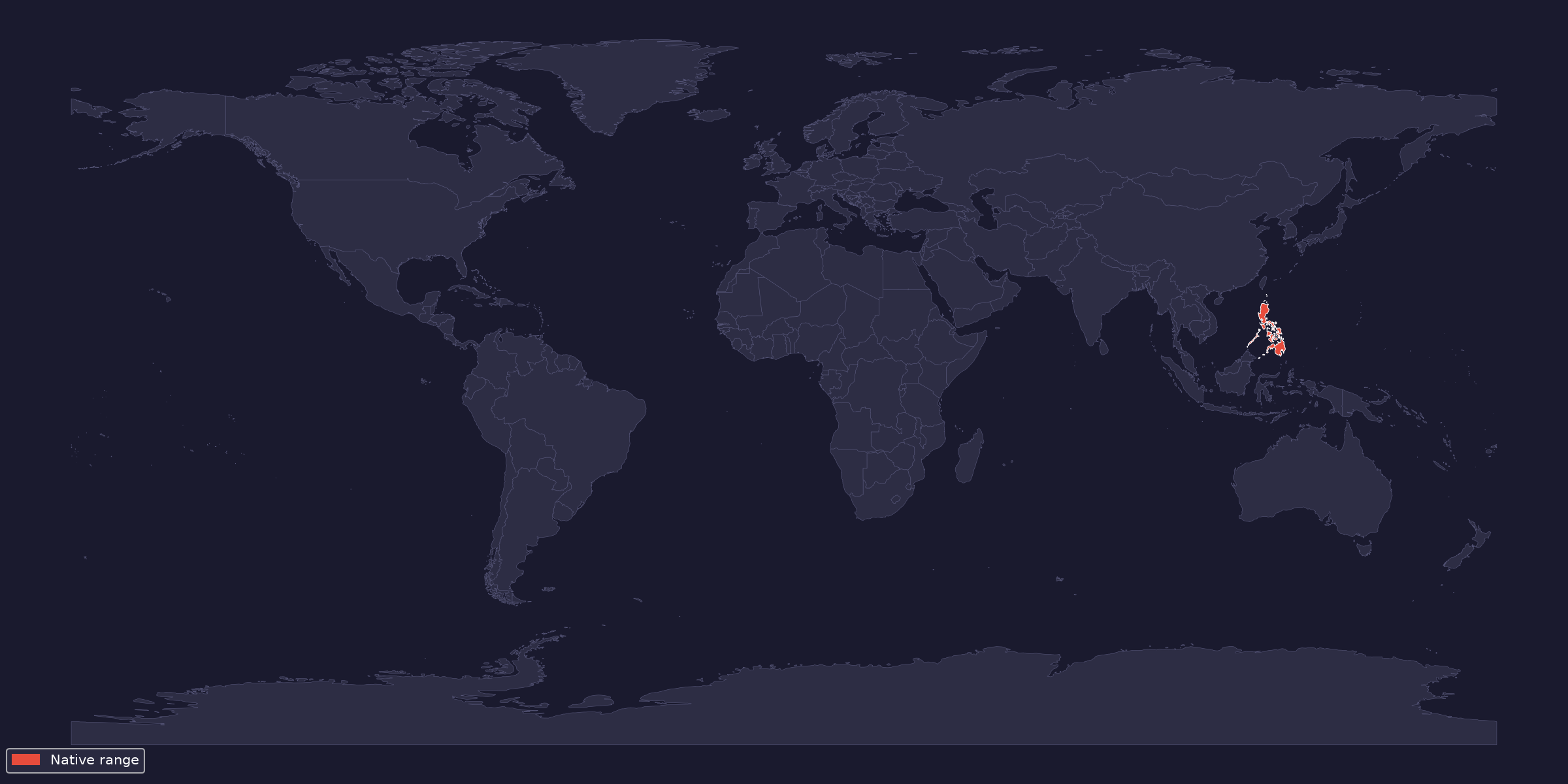
The verified range is restricted to northern and central Philippine islands: Luzon, Mindoro, Masbate, Marinduque, Catanduanes and Lubang. It occupies lowland forest edges, grassland, agricultural mosaics and rodent-rich disturbed habitat. Records from Mindanao or most of the Visayas should be checked against N. samarensis; Palawan records concern N. sumatrana.
A country-level map necessarily colours the whole Philippines and therefore greatly overstates the range. It cannot show the sea barriers, the absence from many islands or the contact-free separation among Philippine cobra species. The reviewed Laguna GBIF point is an approximate, coordinate-obscured observation on Luzon and is used only for regional climate context.
🌡 Climate across the native range
Monthly normals from a reviewed, coordinate-obscured occurrence in the Laguna lowlands of Luzon:
Laguna, Luzon — Philippines (reviewed approximate occurrence)
| Month | Min °C | Mean °C | Max °C | RH % |
|---|---|---|---|---|
| January | 21.1 | 24.9 | 28.6 | 79 |
| February | 21.2 | 25.3 | 29.4 | 76 |
| March | 21.9 | 26.4 | 30.9 | 74 |
| April | 23 | 27.6 | 32.3 | 73 |
| May | 23.6 | 27.9 | 32.2 | 77 |
| June | 23.5 | 27.3 | 31.1 | 82 |
| July | 23.2 | 26.6 | 30 | 86 |
| August | 23.4 | 26.6 | 29.8 | 86 |
| September | 23.1 | 26.4 | 29.8 | 86 |
| October | 22.9 | 26.3 | 29.6 | 85 |
| November | 22.5 | 25.9 | 29.2 | 83 |
| December | 21.8 | 25.2 | 28.5 | 81 |
Weather data by WorldClim v2.1, 1970–2000 · Monthly normals queried by Herpeton Academy from raster values; relative humidity is derived from vapor pressure and mean temperature.
Location references use GBIF.org occurrence data where available; original occurrence records retain their source dataset licenses.
⚖️ Legal status
As checked on 17 August 2026, Naja philippinensis is listed in CITES Appendix II and EU Annex B. International movement and EU commercial use therefore require the applicable permits, notifications and proof of lawful acquisition. The Bern Convention does not cover this Philippine endemic.
Philippine wildlife law, export controls and destination dangerous-animal rules may separately prohibit or license collection, possession, registration, transport, breeding, sale and import. Obtain written decisions from origin, transit and destination authorities. Retain CITES documents, permits, invoice, breeder and parentage data, island locality, photographs and the check date; a generic “Philippine cobra” invoice is inadequate.
🤌 Husbandry
House one snake in a controlled-access venomous room with secondary containment, sealed penetrations and a documented door protocol. The primary enclosure must contain two positively lockable shift compartments. The snake is moved and visually confirmed behind a locked barrier before a main door is opened.
Quarantine for at least 90 days in simple housing with dedicated tools and preferably separate airspace. Record weight, meals, sheds, faeces, mouth, skin and respiration; screen imports for dehydration, mites, internal parasites, stomatitis and respiratory disease.
Never free-handle or cohabit for display. Hooks, tubes and transparent shields support trained procedures but do not replace shifting. Design every normal task—water, waste, feeding and inspection—to occur without sharing open space with the cobra.
💡 Lighting
Provide 11-13 hours of bright visible light, followed by complete darkness. Use a modest seasonal change rather than abrupt cycling. Lamps belong outside primary containment or behind locked guards, and both shift retreats must stay shaded.
Low-output UVB can be offered as a Ferguson Zone 1 opportunity. Measure it at snake level and preserve a completely shaded route. UVB is optional support, not a reason to expose staff or remove cover.
🌡 Heating and temperature
Maintain ambient air at 25-29°C, a basking surface at 31-33°C, a cool hide at 23-25°C and nights at 22-25°C. Thermostat and guard every heat source; measure both surface and air temperatures and alarm high values.
Tropical weather does not justify a uniformly hot enclosure. A genuine cool retreat is essential. Adjust small seasonal changes to documented island provenance and body condition; do not brumate this species.
💧 Humidity and water
Keep ambient humidity around 60-80% with strong cross-ventilation and a dryable surface. One shift retreat may reach 70-85% around shedding. Avoid permanent saturation, which conceals waste and promotes dermatitis and respiratory disease.
Provide a heavy clean water bowl that can be removed through a protected port. A drainage layer or replaceable tray helps during humid weather. Use measured humidity, shed quality and hydration records rather than routine spraying of the animal.
🌿 Enclosure and decoration
An adult requires at least 180 x 90 x 90 cm, with more floor area preferred. Install two lockable shift boxes, anchored low cover, visual barriers and an inspection lane. Doors need independent two-step locks; vents, tracks and tool ports must exclude juveniles.
Use 8-10 cm of compactable soil and leaf litter that buffers moisture without remaining waterlogged. Paper is safer in quarantine. Avoid unstable branches, sharp mesh, aromatic wood and heavy décor that must be lifted during servicing.
🐁 Feeding
Wild prey is dominated by small vertebrates, especially rodents, frogs and other reptiles. Established adults generally accept appropriately sized frozen-thawed rodents every 7-14 days. Adjust interval and prey mass to measured condition; fast growth and obesity increase long-term risk.
Feed through a protected port with long tongs and shift before retrieving refused prey. Do not release live rodents. Whole vertebrate prey needs no routine calcium or vitamin dusting.
🛡 Operational safety and emergencies
Hard barriers come before personal protective equipment. Staff use splash goggles plus a full face shield whenever a spit could reach them, but the enclosure and shift system must prevent a direct line to the face. Two trained adults attend every primary opening. Never free-handle, pin, neck or manually restrain the cobra in routine work.
Before acquisition, agree a written plan with the receiving hospital or poison centre using the exact species and Philippine origin. The plan must cover immediate intubation and ventilation because paralysis may precede obvious local injury, and it must identify an appropriate, in-date antivenom through authorised clinical channels.
After a bite, move away, call emergency services, remove rings, keep the patient still and the limb neutral and supported, and follow poison-centre instructions. Do not cut, suck, ice, shock, massage or use a tourniquet. Do not delay transport to catch the snake.
For ocular exposure, immediately irrigate with abundant clean water or saline for at least 15-20 minutes, remove contact lenses if easy, and obtain urgent ophthalmic assessment. Do not put antivenom, chemicals or unprescribed drops in the eye, and do not rub it. Maintain a written escape plan and stop work whenever the animal cannot be positively located.
🥚 Breeding notes
The species is oviparous. Reports for Philippine cobras support clutches roughly in the low tens; 10-20 eggs is a cautious institutional planning range. Published species-specific incubation evidence is limited, so 28-30°C and about 55-70 days should be treated as conservative starting values, not a universal recipe.
Breed only within a lawful, genetically managed programme. Confirm island provenance and sex, use barrier-separated introductions, and prepare individually lockable neonate enclosures before pairing. Record parentage and every transfer; hatchlings can spit and envenomate from emergence.
🩺 Common problems
- Obesity: weigh and condition-score; reduce prey mass or frequency rather than adding handling.
- Dehydration or dysecdysis: review clean water, the humid shift retreat, airflow and temperature.
- Respiratory disease: bubbles, wheeze, open-mouth breathing or prolonged head elevation need urgent veterinary care.
- Dermatitis: investigate wet dirty substrate, mites, poor ventilation and abrasions.
- Stomatitis and parasites: oral swelling, abnormal faeces or weight loss are especially important in imports.
- Burns and overheating: prevent with guarded thermostatic heat, alarms and a verified cool hide.
- Regurgitation: review prey size, temperature, disturbance and infection with a reptile veterinarian.
Do not attempt hands-on home treatment. Secure the snake in a shift compartment and arrange a trained veterinary containment and anaesthesia team.
📌 Conclusion
Naja philippinensis belongs only in a licensed facility that can document its island origin, keep it separate from N. samarensis and N. sumatrana, service it behind locked barriers and deliver immediate eye irrigation and respiratory support. A calm animal or a bite without swelling never reduces that threshold.
📚 Sources and further reading
- ReptiFiles — checked first on 17 August 2026; no species-specific care guide was found.
- The Reptile Database: Naja philippinensis
- GBIF species record: Naja philippinensis
- Leviton et al. — synopsis of Philippine snakes
- Watt et al. — Philippine cobra bites and rapid neurotoxicity
- Kazandjian et al. — defensive venom evolution in spitting cobras
- WHO South-East Asia snakebite management guidelines
- Baines et al. — UV lighting guidance
- Northern Ireland government venomous-reptile guidance
- CITES Appendices
- EU wildlife-trade annexes, Commission Regulation (EU) 2026/1383
- Bern Convention appendices