Share

Central Asian Cobra
🔤 Taxonomy
Naja oxiana is the accepted name for the Central Asian cobra, also called the Caspian or Oxus cobra. Older literature often treats it as Naja naja oxiana; the name Tomyris oxiana is an older combination. It differs from the Indian cobra N. naja, which overlaps locally in the eastern part of the range.
Plain colour is not sufficient identification. Keep locality, scale photographs, parent records and all CITES documents with the animal.
📌 Description
This is a robust terrestrial cobra, usually 100-160 cm and occasionally approaching 180 cm. It uses rocky foothills, dry scrub, irrigated valleys, field margins and rodent burrows across a strongly continental climate. Institutional longevity may reach 20-30 years.
Envenomation can cause severe neuroparalysis and respiratory failure, with local pain and tissue effects also possible. The species is neither a routine display snake nor a private handling animal. It requires licensed protected-contact management and a hospital able to provide rapid airway support.
📋 Quick reference
| Care point | Practical target |
|---|---|
| Adult enclosure | At least 210 x 105 x 105 cm with two lockable shift hides |
| Temperature | Ambient 24-29°C; basking 31-34°C; cool retreat 20-24°C |
| Night | 16-21°C in the active season |
| Humidity | 35-55%; local 60-75% shed support |
| Feeding | Moderate frozen-thawed rodents every 10-21 days |
| Safety | Protected contact, two trained staff, bite and escape plans |
| Winter cycle | Only for healthy adults of known origin under a documented programme |
☠️ Venom
This species is venomous. Venom exposure can cause pain, swelling or other systemic effects, and severity varies with species, locality, bite site and the amount delivered. A small wound or apparently dry bite is not proof of safety; every bite or sting requires urgent medical assessment.
If an incident occurs, move away, call emergency services or a poison centre, keep the patient still, remove rings and other constricting items, and follow dispatcher instructions. Do not use a tourniquet, cut or suck the wound, apply ice or electricity, give alcohol or medicines as a home treatment, or attempt to catch the animal. Antivenom choice and dosing are hospital decisions; verify the relevant product and local availability in advance. Sources: WHO snakebite guidance and appropriate species-specific toxinology or medical references listed below.
🌍 Distribution
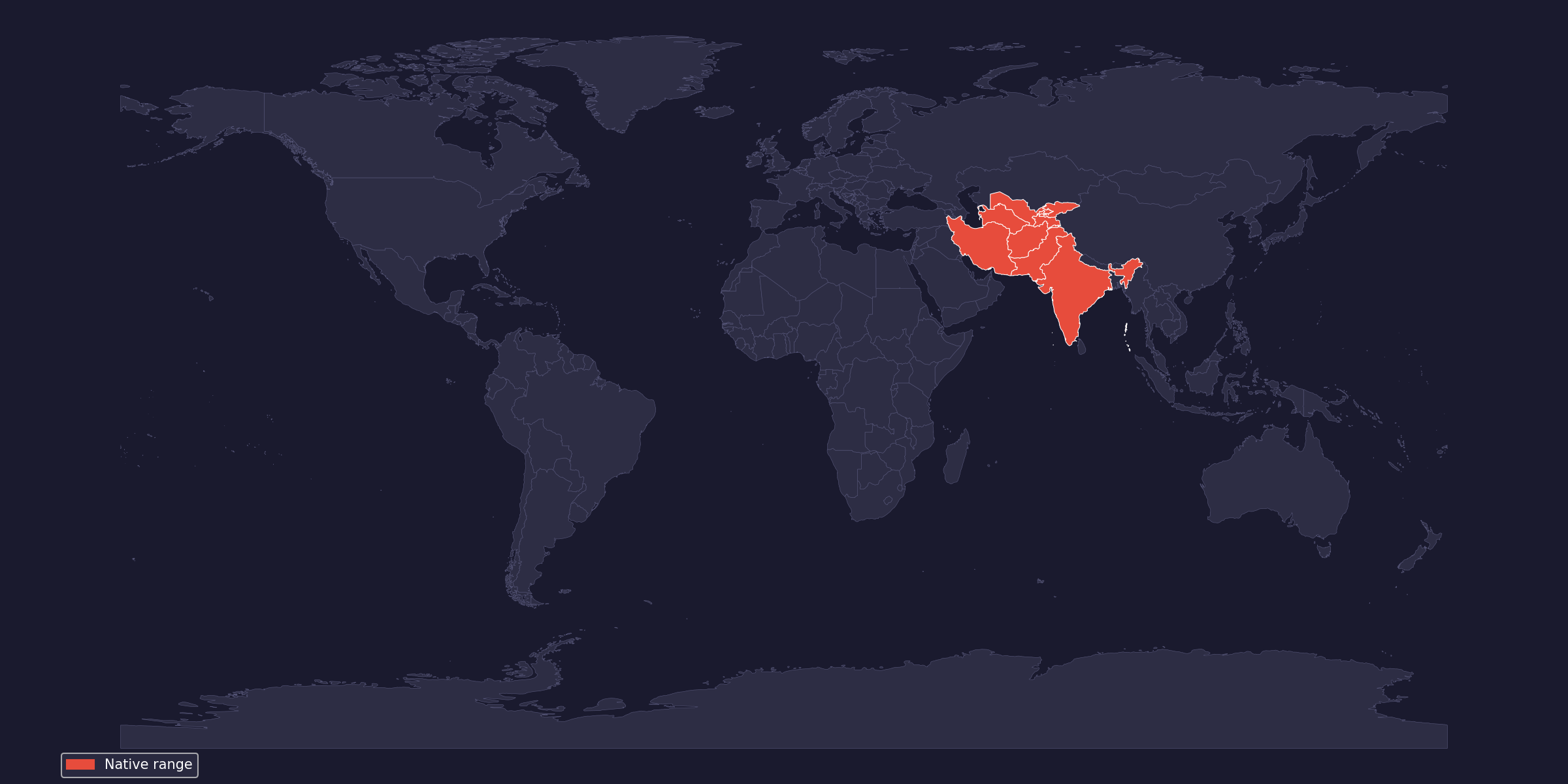
The accepted range covers Afghanistan, northeastern Iran, northwestern India, Pakistan, Kyrgyzstan, Turkmenistan, southwestern Tajikistan and Uzbekistan. Reports from Kazakhstan require caution and are not included in the map. Within these countries the cobra is patchy, following warm foothills, river valleys, rocky slopes, scrub and agricultural edges rather than open high mountains or broad deserts.
The range spans major seasonal gradients. Provenance therefore matters: a lowland Turkmen animal and a mountain-valley animal from Pakistan should not receive an identical annual cycle without evidence.
⚖️ Legal status
Naja oxiana is listed in CITES Appendix II and in Annex B of the EU wildlife-trade regulations; the 2026 EU annex update retains it there. It was not found in the Bern Convention appendices when checked on 29 August 2026. International commercial movement requires the applicable CITES export and import procedures, and EU sale or transfer must be supported by lawful-origin documentation.
Dangerous-animal and native-wildlife rules can add permits, inspected containment, registration, insurance or competence requirements. Keep original CITES papers, import records, invoices, breeder and parent details, photographs and transfer history. Confirm every movement with the relevant authorities before it occurs.
🤌 Husbandry
House one cobra alone in a locked venomous room behind secondary containment. Provide two complete shift hides linked by remotely operated doors so cleaning, feeding and veterinary preparation occur after positive isolation. Seal cable holes, vents and door tracks and log every lock operation.
Quarantine for at least 90 days with separate tools, simple substrate and preferably separate air. Record weight, appetite, faeces, sheds and breathing. Imported or uncertain-origin animals need reptile-veterinary parasite assessment and close examination of provenance and CITES documents.
💡 Lighting
Use a seasonal photoperiod of about 9-14 hours, changed gradually, with bright visible light in the active season and full darkness at night. Opaque hides must remain available in both warm and cool zones. Guard all lamps and place them outside primary containment where possible.
Measured low-level UVB over part of the warm area may provide a Ferguson Zone 2 opportunity. It is optional; shade and whole-prey nutrition remain essential.
🌡 Heating and temperature
During active months maintain ambient air at 24-29°C, a 31-34°C basking surface, a 20-24°C cool hide and nights around 16-21°C. Thermostat every heat source and measure surfaces inside both shift compartments. A hot dry enclosure with no cool burrow rapidly causes dehydration and thermal stress.
Healthy, established adults of known origin may receive gradual winter cycling around 8-14°C within a formal breeding programme. This is not automatic brumation advice. Juveniles, thin, sick, gravid or newly acquired animals must not be cooled, and hydration, mass and remote observation continue throughout.
💧 Humidity and water
Maintain general humidity around 35-55% with good air exchange. Offer a tight local humid retreat at 60-75% during shedding, while leaving most substrate dry. Damp cold bedding and sealed, stale air are inappropriate even during winter cycling.
Provide a heavy clean water bowl through protected service. Replace spills promptly and monitor changes in drinking, especially after warming from seasonal rest.
🌿 Enclosure and decoration
An adult needs at least 210 x 105 x 105 cm. Include two tight shift hides, anchored rock-like shelves, cork, visual barriers and an open basking patch. Furniture must allow the whole snake to be located without staff entering or dismantling the enclosure.
Use 8-12 cm of compactable soil and washed sand with some clay and leaf litter, or paper in quarantine. Avoid dusty pure sand, unstable stone and hidden voids. Doors need two independent mechanical locks, and the room needs an airlock or equivalent barrier.
🐁 Feeding
Offer appropriately sized frozen-thawed rodents. Adults usually maintain condition on a moderate meal every 10-21 days, with intake reduced during planned cool periods. Weigh prey and follow body condition rather than offering food whenever the cobra displays.
Feed through a protected port and shift before retrieving leftovers. Never offer live rodents. Balanced whole prey requires no routine supplements.
🛡 Operational safety and emergencies
No routine free handling, necking or manual restraint is acceptable. Use protected contact, shift boxes, transparent shields and long tools, with two trained staff present for every opening. The team must rehearse both escape and bite plans, including winter or night access.
Before acquisition, the receiving hospital and poison service must review transport time, species identification and the current locally appropriate antivenom pathway. The plan must include 24-hour intubation, mechanical ventilation and intensive-care capacity. Keeper-held antivenom alone is not a medical system.
After any bite, withdraw and secure the room, call emergency services, keep the patient still and follow the regional poison centre’s immobilisation advice. Do not wait for ptosis or weakness; do not cut, suck, ice, shock, tourniquet or attempt to catch the snake.
🥚 Breeding notes
The species is oviparous, with reported clutches broadly around 6-19 eggs. A conservative institutional incubation window is 27-29°C for roughly 60-70 days, with calibrated egg-level monitoring and records for the specific lineage.
Pairing must use remote introduction and separation. Confirm sex, locality, CITES legality and qualified placements first, then prepare an accessible laying box and individual locked neonate units before introductions begin.
🩺 Common problems
- Chronic overheating and dehydration: preserve a measured cool hide and seasonal night drop.
- Respiratory disease: cold damp substrate, abrupt cycling and stale air require correction and veterinary review.
- Rostral injury: repeated pushing indicates inadequate cover, poor barriers or an unusable shift.
- Dysecdysis: use a local humid retreat rather than raising whole-enclosure humidity.
- Obesity: measure prey and reduce intake before or during seasonal inactivity.
- Parasites and stomatitis: imported animals need strict quarantine and diagnostics.
📌 Conclusion
The Central Asian cobra needs a dry, strongly graded enclosure and an annual cycle based on documented origin, not a generic tropical-cobra setup. CITES traceability, protected contact and immediate ventilation-ready medical care must be established before acquisition.
📚 Sources and further reading
- ReptiFiles — checked first on 29 August 2026; no species-specific care guide was found.
- The Reptile Database: Naja oxiana
- GBIF species record: Naja oxiana
- WHO: Guidelines for the management of snakebites
- Baines et al. — UV lighting guidance for captive reptiles
- CITES Appendices
- EU wildlife-trade annexes, Commission Regulation (EU) 2026/1383
- Bern Convention appendices