Share

Black-necked Spitting Cobra
🔤 Taxonomy
Naja nigricollis is the accepted name for the black-necked spitting cobra. The southern barred forms formerly called N. n. nigricincta are now Naja nigricincta and must not be included under this guide. The name crawshayi has moved between the synonymy of N. nigricollis and treatment as Naja crawshayi; current reference commentary is not fully settled, so animals carrying that label require documented central-southern African locality and specialist identification rather than an assumed assignment.
📌 Description
This is a robust African spitting cobra, usually 120-220 cm, active by day or night depending on heat and disturbance. It can direct venom toward the eyes from beyond ordinary servicing distance. A bite may cause serious local tissue injury and systemic effects; ocular exposure can damage the corneal surface.
The species is an expert institutional display animal. Face protection is only one layer: safe care depends on shift compartments, solid barriers, trained two-person teams and procedures that keep a raised cobra out of a worker’s line of sight.
📋 Quick reference
| Care point | Practical target |
|---|---|
| Adult enclosure | At least 200 x 100 x 120 cm with two lockable shift hides |
| Temperature | Ambient 25-29°C; basking 31-33°C; cool retreat 23-25°C |
| Night | 21-24°C |
| Humidity | 50-70%; local 70-85% shed support |
| Feeding | Moderate frozen-thawed rodents every 10-21 days |
| Safety | Protected contact, face and eye protection, two trained staff, written response plans |
| Quarantine | At least 90 days with separate tools and veterinary screening |
☠️ Venom
This species is venomous. Venom exposure can cause pain, swelling or other systemic effects, and severity varies with species, locality, bite site and the amount delivered. A small wound or apparently dry bite is not proof of safety; every bite or sting requires urgent medical assessment.
If an incident occurs, move away, call emergency services or a poison centre, keep the patient still, remove rings and other constricting items, and follow dispatcher instructions. Do not use a tourniquet, cut or suck the wound, apply ice or electricity, give alcohol or medicines as a home treatment, or attempt to catch the animal. Antivenom choice and dosing are hospital decisions; verify the relevant product and local availability in advance. Sources: WHO snakebite guidance and appropriate species-specific toxinology or medical references listed below.
🌍 Distribution
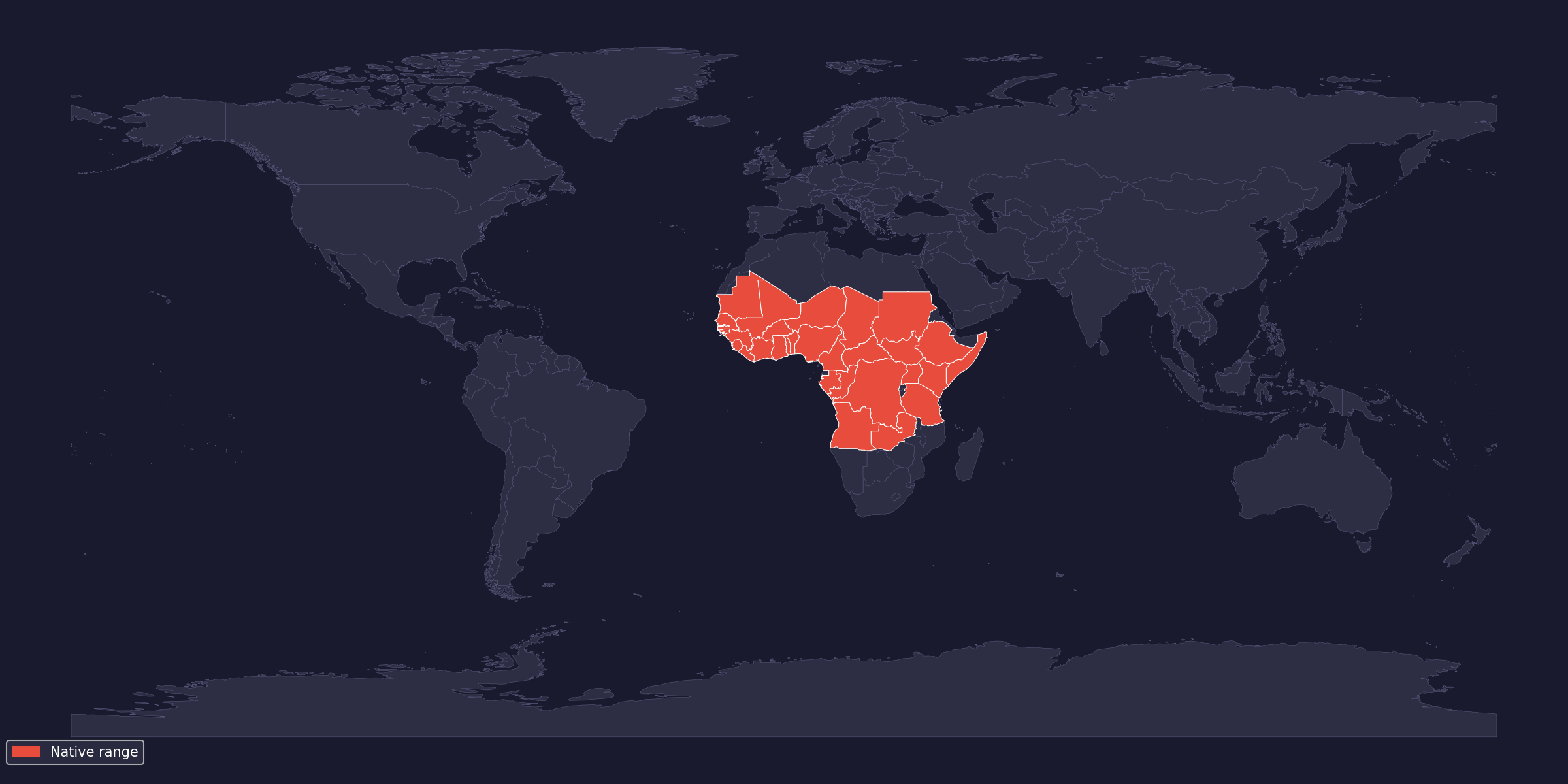
The strict current concept spans much of sub-Saharan savanna Africa: from Senegal, Gambia, Guinea and neighbouring West Africa east through the Sahel and central African countries to Ethiopia, Somalia, Kenya and Tanzania, and south through Angola, Zambia and parts of the Democratic Republic of the Congo. It occupies savanna, open woodland, riparian vegetation, farmland and settlement edges.
The country map is a broad envelope. It cannot show unsuitable rainforest interiors, deserts, highlands or contact zones, and it excludes N. nigricincta in southwestern Africa, N. mossambica farther southeast and other spitting-cobra species. The Pwani station is one reviewed East African occurrence, not an average for this enormous range.
🌡 Climate across the native range
Monthly normals from one reviewed East African occurrence; this point is representative context, not an average for the species’ broad range:
Pwani — Tanzania (reviewed black-necked spitting cobra occurrence)
| Month | Min °C | Mean °C | Max °C | RH % |
|---|---|---|---|---|
| January | 24.2 | 27 | 31 | 78 |
| February | 24.2 | 27.3 | 31.7 | 77 |
| March | 23.7 | 26.5 | 30.6 | 83 |
| April | 23 | 25.3 | 28.8 | 86 |
| May | 22.2 | 24.6 | 27.9 | 84 |
| June | 21 | 23.9 | 27.7 | 79 |
| July | 20.5 | 23.6 | 27.8 | 76 |
| August | 20.3 | 23.8 | 28.3 | 76 |
| September | 20.8 | 24.6 | 29.6 | 74 |
| October | 21.9 | 25.6 | 30.5 | 75 |
| November | 22.9 | 26.1 | 30.3 | 79 |
| December | 23.6 | 26.5 | 30.5 | 81 |
Weather data by Open-Meteo.com · CC BY 4.0 · Monthly normals calculated by Herpeton Academy from daily archive values.
Location references use GBIF.org occurrence data where available; original occurrence records retain their source dataset licenses.
⚖️ Legal status
No species-specific entry for N. nigricollis was found in the CITES Appendices, EU wildlife-trade annexes or Bern Convention appendices when checked on 17 August 2026. This is separate from national wildlife protection, range-state export control and dangerous-animal licensing.
Local and national rules for possession, transport, breeding, sale and import may still demand licences, inspected containment, insurance and emergency arrangements. Preserve invoices, breeder/importer details, the claimed locality, photographs, permits and transport papers. Confirm both the accepted taxon and legal route in writing before any transaction.
🤌 Husbandry
House one cobra alone in a locked venomous-animal room with an airlock or equivalent second barrier. Two full-size shift compartments should close remotely and allow the animal to be visually confirmed before any service door opens. Water and waste routes must be accessible without placing a face or hand in the strike-and-spit zone.
Quarantine for at least 90 days in simple, observable housing, using dedicated tools and preferably separate air. Record weight, meals, sheds, faeces, skin and mouth condition. Wild-caught and poorly documented animals carry substantial parasite, dehydration and misidentification risk.
💡 Lighting
Provide 10-12 hours of broad visible light and complete darkness overnight. Use opaque hides and visual barriers, especially around the viewing front, so the cobra can withdraw rather than repeatedly hood or spit. Guard all lamps outside its reach.
Low-level UVB may be offered over part of the warm zone as a Ferguson Zone 2 opportunity with adjacent deep shade. Eye-safe positioning, measured output and secure lamp servicing are essential.
🌡 Heating and temperature
Maintain 25-29°C ambient air, a 31-33°C basking surface, a 23-25°C cool hide and nights around 21-24°C. Measure surface and air temperatures at the animal’s level. Thermostat all heat sources and use independent alarms.
The broad range includes dry and humid seasonal climates, so locality should shape modest cycling. Never turn the entire enclosure hot or wet, and never cool thin, sick, juvenile or newly imported animals for breeding.
💧 Humidity and water
A ventilated 50-70% baseline suits many localities; provide a local humid retreat at 70-85% during shedding. Animals from drier savanna must have dry surfaces, while more humid origins may need more frequent local watering. Persistent wet substrate promotes dermatitis.
Provide clean water in a heavy vessel serviced through a protected port. Inspect from outside before removal because a cobra may shelter behind it. Do not use spraying that predictably provokes hooding or directs the head toward staff.
🌿 Enclosure and decoration
An adult requires at least 200 x 100 x 120 cm. Include two tight shift hides, fixed low shelves and branches, dense visual cover and clear routes for observation. The front must permit a hood to open without repeated contact with glass.
Use 8-12 cm of compactable soil, washed sand and leaf litter, or paper in quarantine. Avoid aromatic wood, unstable rock, adhesive décor and blind service pockets. Each access door needs two independent locks, and the enclosure needs a conspicuous venom and eye-exposure warning.
🐁 Feeding
Offer appropriately sized frozen-thawed rodents. Adults commonly maintain lean condition on a moderate meal every 10-21 days; juveniles receive smaller meals more often. Natural prey is diverse, but captive novelty must not increase pathogen or handling risk.
Feed through a protected port with long tongs and shift the animal before retrieving refused prey. Live rodents may injure the cobra. Complete whole prey requires no routine supplementation.
🛡 Operational safety and emergencies
Never free-handle, pin, neck or manually restrain this cobra during routine work. Use protected contact, shift boxes and transparent shields. Full face and splash-rated eye protection is mandatory whenever primary containment opens, but it does not replace distance and a closed barrier. Two trained staff must attend and rehearse both escape and exposure responses.
For venom in the eye, immediately move out of range and irrigate the open eye continuously with copious clean water or saline for at least 15 minutes. Remove contact lenses if easily possible, do not rub or try to neutralize the venom, and obtain urgent medical/ophthalmic assessment. Irrigation equipment must be beside the work area, not behind a locked door inside it.
A bite is a separate immediate emergency. Call emergency services, keep the patient and limb still, remove tight objects and follow the regional poison centre’s directions. Because this venom can cause important local injury, do not improvise pressure bandaging. Do not cut, suck, ice, shock, apply a tourniquet or delay transport. The hospital plan must include exact taxon/locality, expert antivenom advice and airway support capability.
🥚 Breeding notes
The species is oviparous, with clutches often around 10-24 eggs. Institutional incubation commonly uses 27-29°C for approximately 55-70 days, while documenting substrate water potential, egg mass and development rather than relying only on a calendar.
Breeding produces numerous spitting neonates. Confirm identification and locality, legal authority and placements before pairing. Prepare individual locked rearing units, eye-irrigation access, labels and origin records before hatching.
🩺 Common problems
- Rostral injury and chronic defensive display: improve visual cover, retreat access and service procedure.
- Ocular exposure: immediate irrigation and professional examination are required; prevention depends on barriers and face protection.
- Burns and overheating: guard and thermostat every source and preserve a measured cool retreat.
- Respiratory disease: open-mouth breathing, bubbles or abnormal sounds need urgent veterinary care.
- Dysecdysis: correct hydration and the humid retreat; do not restrain manually.
- Mites, parasites and stomatitis: especially important in imports and animals of uncertain identity.
📌 Conclusion
The black-necked spitting cobra requires a facility designed for both bites and projected venom. Responsible care means accurate taxon and locality records, service entirely behind barriers, immediate eye irrigation, and a rehearsed hospital response—not confidence in personal reflexes.
📚 Sources and further reading
- ReptiFiles — checked first on 17 August 2026; no species-specific care guide was found.
- The Reptile Database: Naja nigricollis
- GBIF species record: Naja nigricollis
- Wüster et al. — phylogeny and biogeography of the Naja nigricollis complex
- WHO: Guidelines for the prevention and clinical management of snakebite in Africa
- South African National Department of Health — pre-hospital snakebite guidance
- Baines et al. — UV lighting guidance for captive reptiles
- CITES Appendices
- EU wildlife-trade annexes, Commission Regulation (EU) 2026/1383
- Bern Convention appendices