Share

Indian Cobra
🔤 Taxonomy
Naja naja is the accepted name for the Indian or spectacled cobra. Older material may use subspecies names such as N. n. ceylonicus, karachiensis or polyocellata, but these labels should not replace documented locality. The species is distinct from N. kaouthia in northeastern South Asia and N. oxiana farther northwest; hood pattern alone is not a reliable identification.
📌 Description
The Indian cobra is a robust terrestrial elapid, usually 120-180 cm, with strong vision, exploratory behaviour and the characteristic defensive hood. Adults may live 15-20 years. Venom can cause progressive paralysis and respiratory failure, with local tissue damage also possible.
This is an expert-only institutional display animal. A hooding cobra is communicating distance, not offering a handling opportunity. The facility must use protected contact, redundant locks, trained teams and a hospital-coordinated response.
📋 Quick reference
| Care point | Practical target |
|---|---|
| Adult enclosure | At least 180 x 90 x 100 cm with two lockable shift hides |
| Temperature | Ambient 25-29°C; basking 31-33°C; cool retreat 23-25°C |
| Night | 22-25°C |
| Humidity | 45-65%; local 65-80% shed support |
| Feeding | Moderate frozen-thawed rodents every 10-21 days |
| Safety | Protected contact, two-person rule, written bite and escape plans |
| Quarantine | At least 90 days with separate equipment and veterinary screening |
☠️ Venom
This species is venomous. Venom exposure can cause pain, swelling or other systemic effects, and severity varies with species, locality, bite site and the amount delivered. A small wound or apparently dry bite is not proof of safety; every bite or sting requires urgent medical assessment.
If an incident occurs, move away, call emergency services or a poison centre, keep the patient still, remove rings and other constricting items, and follow dispatcher instructions. Do not use a tourniquet, cut or suck the wound, apply ice or electricity, give alcohol or medicines as a home treatment, or attempt to catch the animal. Antivenom choice and dosing are hospital decisions; verify the relevant product and local availability in advance. Sources: WHO snakebite guidance and appropriate species-specific toxinology or medical references listed below.
🌍 Distribution
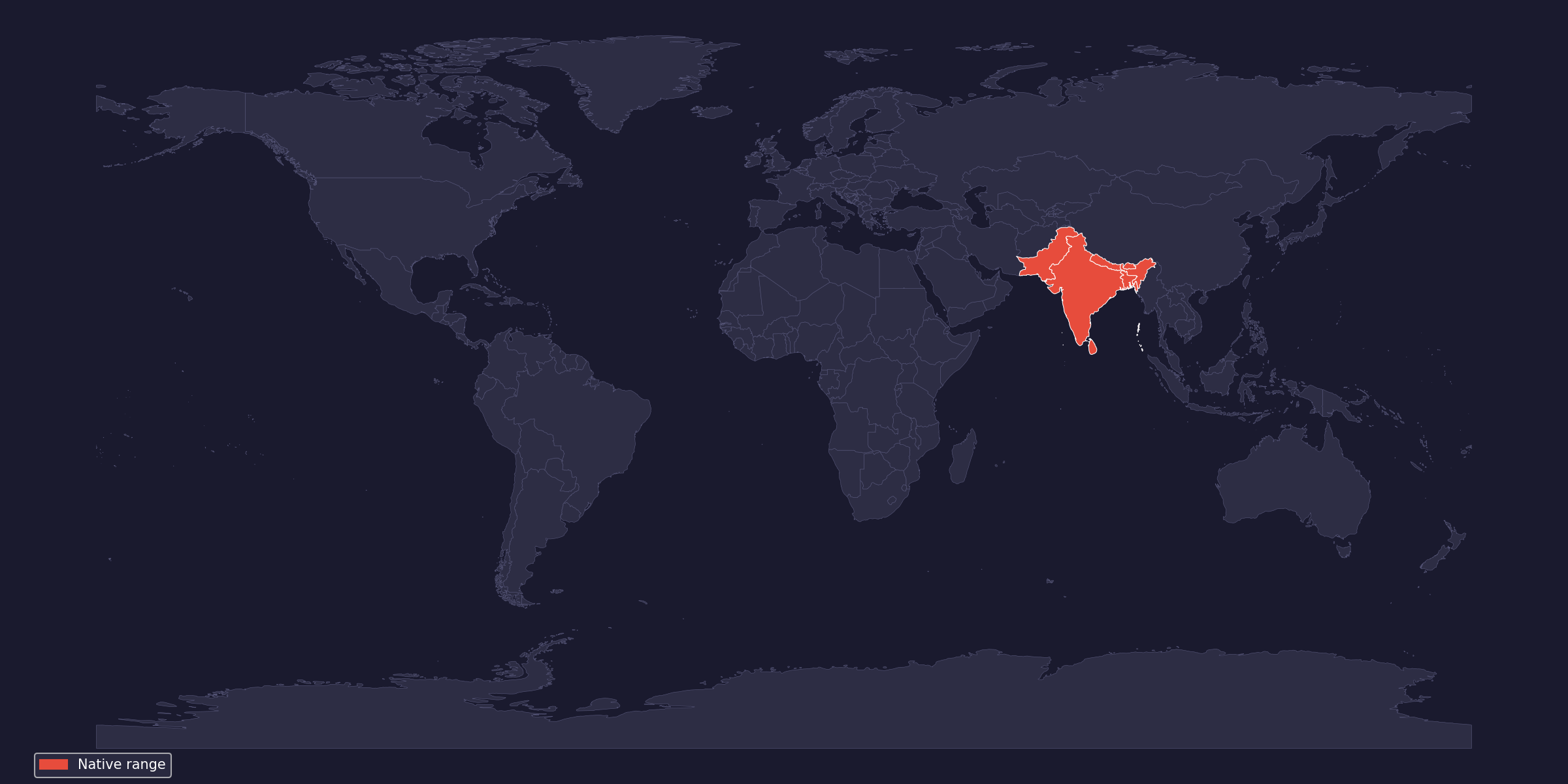
The current broad range includes Pakistan, India, Sri Lanka, Bangladesh, Nepal and Bhutan. An eastern Afghan presence is reported with uncertainty and is omitted from the country map. Northeastern records require care because N. kaouthia overlaps the old broad cobra concept, while Sri Lankan and Pakistani populations carry names and variation that make exact provenance useful.
Indian cobras occupy plains and lower hills, open woodland, scrub, agricultural ground, wetlands and settlement edges where rodents and frogs are abundant. The map cannot show absences within whole countries, nor the complex contact zones with related cobras. The climate station represents southern peninsular India, not every locality.
🌡 Climate across the native range
Monthly normals from a reviewed occurrence in southern peninsular India:
Karnataka — India (reviewed Indian cobra occurrence)
| Month | Min °C | Mean °C | Max °C | RH % |
|---|---|---|---|---|
| January | 14.4 | 20.3 | 26.8 | 62 |
| February | 15.8 | 22.4 | 29.2 | 53 |
| March | 18.1 | 25 | 31.8 | 47 |
| April | 20.3 | 26 | 32.2 | 56 |
| May | 20.6 | 25.2 | 31 | 68 |
| June | 19.7 | 22.9 | 27.3 | 77 |
| July | 19.2 | 22 | 26 | 79 |
| August | 18.9 | 21.7 | 25.8 | 80 |
| September | 18.5 | 22 | 26.4 | 79 |
| October | 18 | 21.6 | 26 | 80 |
| November | 16.5 | 20.6 | 25.3 | 76 |
| December | 14.7 | 19.6 | 25.1 | 71 |
Weather data by Open-Meteo.com · CC BY 4.0 · Monthly normals calculated by Herpeton Academy from daily archive values.
Location references use GBIF.org occurrence data where available; original occurrence records retain their source dataset licenses.
⚖️ Legal status
Naja naja is listed in CITES Appendix II and EU Annex B. International movement therefore requires the applicable CITES export or re-export documents, and EU import or commercial-use rules may add permits and proof requirements. The Bern Convention is not relevant to its Asian range.
Range-state wildlife law can prohibit capture and tightly restrict possession or trade; dangerous-animal law elsewhere is independent of CITES. Retain permits, source and breeder records, invoices, photographs and identifiers. Confirm the accepted taxon and current rules with both wildlife-trade and dangerous-animal authorities before any transfer.
🤌 Husbandry
Keep one animal per enclosure. Provide a locked venomous room, secondary containment and two full shift hides connected by closable doors. Water, waste, heating controls and removable furniture must be serviced only after the cobra is visibly secured.
Quarantine new arrivals for at least 90 days with separate tools, simple substrate and preferably separate air. Record weight, meals, sheds, faeces, mouth and respiration. Wild-caught or poorly documented cobras have substantial parasite, dehydration and misidentification risk.
💡 Lighting
Use 10-12 hours of broad visible light, full night darkness and shaded cover. Guard all fittings. Low UVB over part of the warm zone may provide a Ferguson Zone 2 opportunity, but the animal must always be able to retreat from it.
🌡 Heating and temperature
Maintain ambient air at 25-29°C, a local basking surface at 31-33°C, a cool hide at 23-25°C and nights around 22-25°C. Thermostat every heater and verify surface and air values at snake height.
Do not turn a monsoon-climate animal’s entire enclosure hot and wet. Give choices. Seasonal rain and temperature changes belong only in a locality-informed breeding programme and never substitute for a stable daily gradient.
💧 Humidity and water
Use 45-65% relative humidity as a ventilated baseline, with a local humid hide at 65-80% during shedding. Coastal and monsoonal animals may need more frequent local moisture, while northwestern stock may need drier surfaces. Provenance should guide adjustment.
Provide clean water in a heavy bowl that can be serviced through protected access. Keep the main floor dry between localized watering; continuously wet substrate encourages dermatitis.
🌿 Enclosure and decoration
An adult needs at least 180 x 90 x 100 cm. Include two tight shift hides, low fixed shelves, sturdy branches, deep visual cover and open floor for locomotion and inspection. The front must allow the hood to expand without the animal striking glass repeatedly.
Use 8-12 cm of compactable soil, washed sand and leaf material, or paper for quarantine. Avoid aromatic wood, sharp chips, unstable stones, adhesive décor and service dead ends. Every door needs two independent mechanical locks; clearly label the room and enclosure.
🐁 Feeding
Feed appropriately sized frozen-thawed rodents. Adults commonly maintain lean condition on a moderate meal every 10-21 days; juveniles need smaller, more frequent meals. Some individuals accept frogs or other prey in nature, but captive diet experiments should not create pathogen or handling risk.
Use long tongs from a protected port. Secure the cobra before retrieving refused food. Live rodents can injure the snake and complicate safe removal. Whole prey requires no routine supplementation.
🛡 Operational safety and emergencies
Never free-handle, pin, neck or manually restrain an Indian cobra in routine care. Use shift boxes, transparent barriers and tools suitable for an alert elapid. Two trained adults must attend every opening of primary containment.
Agree a bite plan with the receiving hospital or poison centre before acquisition. Give them exact origin, current and older names, photographs, transport arrangements and access to expert antivenom advice. Indian polyvalent antivenom is not a universal cobra product; product and geographic effectiveness are clinical questions.
A bite is an immediate emergency. Withdraw, call emergency services, remove tight objects, keep the patient still, immobilize the limb and follow poison-centre advice. Do not cut, suck, ice, shock, apply a tight tourniquet or delay transport to catch the snake.
🥚 Breeding notes
The species is oviparous, commonly laying about 10-30 eggs. In controlled programmes, viable eggs are usually incubated near 27-29°C for roughly 55-70 days. Exact development varies, so incubation must be continuously monitored rather than managed by calendar alone.
Breeding creates many dangerous neonates and increases open-containment work. Verify the adults’ locality, legal breeding authority and placement of offspring before pairing. Prepare individual locked rearing units and CITES or origin documentation before hatching.
🩺 Common problems
- Obesity: use measured prey, long adult feeding intervals and routine weighing.
- Rostral damage: repeated glass pushing or striking signals stress, poor cover or unsuitable viewing barriers.
- Burns and overheating: guard and thermostat heat sources and preserve a cool hide.
- Respiratory disease: open-mouth breathing, bubbles or abnormal sounds require urgent veterinary care.
- Dysecdysis: review hydration and the humid hide; never restrain the cobra to pull shed.
- Parasites, mites and stomatitis: especially important in imports and animals without reliable history.
📌 Conclusion
The Indian cobra can be maintained responsibly only by a licensed facility that can prove lawful CITES origin, identify the correct cobra and locality, service it behind barriers, and deliver a rehearsed medical response. Hooding behaviour is a warning that the safety system should prevent staff from ever needing to test.
📚 Sources and further reading
- ReptiFiles — checked first on 17 August 2026; no species-specific care guide was found.
- The Reptile Database: Naja naja
- GBIF species record: Naja naja
- WHO South-East Asia: Guidelines for the management of snakebites
- Baines et al. — UV lighting guidance for captive reptiles
- Northern Ireland government guidance on keeping venomous snakes and lizards
- CITES Appendices
- EU wildlife-trade annexes, Commission Regulation (EU) 2026/1383
- Bern Convention appendices