Share

Mozambique Spitting Cobra
🔤 Taxonomy
Naja mossambica is a distinct African spitting cobra whose older names include placement as a form or subspecies of N. nigricollis. Those historical labels should not be carried into breeding or legal records without review. Preserve locality, parentage, scale and hood photographs and the identifier’s name.
Do not identify it by colour alone. Southern African spitting cobras include other species, and locality can be as important as pattern. This guide applies only to verified N. mossambica.
📌 Description
This robust, mainly terrestrial cobra is usually about 90-160 cm. It shelters in burrows, termite mounds, rock cracks, hollow logs and buildings and may be active from dusk through night or by day when conditions favour it. A managed lifespan of 15-20 years is a realistic commitment.
It can direct venom toward the eyes from defensive posture. Ocular exposure can cause severe pain, corneal injury and loss of vision without prompt irrigation and examination. A bite can produce painful progressive swelling, blistering and necrosis, sometimes with systemic effects. Goggles and a face shield are supplementary layers, never permission to work with an open occupied enclosure.
📋 Quick reference
| Care point | Practical target |
|---|---|
| Adult enclosure | At least 200 x 100 x 100 cm with two externally lockable shift hides |
| Temperature | Ambient 25-29°C; basking 31-33°C; cool refuge 23-25°C |
| Night | 21-24°C according to documented origin and season |
| Humidity | 45-65% with local 70-85% shed support |
| Feeding | Appropriately sized frozen-thawed rodents every 7-14 days |
| Eye safety | Hard barrier first; eyewash immediately accessible outside the room |
| Quarantine | At least 90 days with separate tools and parasite screening |
☠️ Venom
This species is venomous. Venom exposure can cause pain, swelling or other systemic effects, and severity varies with species, locality, bite site and the amount delivered. A small wound or apparently dry bite is not proof of safety; every bite or sting requires urgent medical assessment.
If an incident occurs, move away, call emergency services or a poison centre, keep the patient still, remove rings and other constricting items, and follow dispatcher instructions. Do not use a tourniquet, cut or suck the wound, apply ice or electricity, give alcohol or medicines as a home treatment, or attempt to catch the animal. Antivenom choice and dosing are hospital decisions; verify the relevant product and local availability in advance. Sources: WHO snakebite guidance and appropriate species-specific toxinology or medical references listed below.
🌍 Distribution
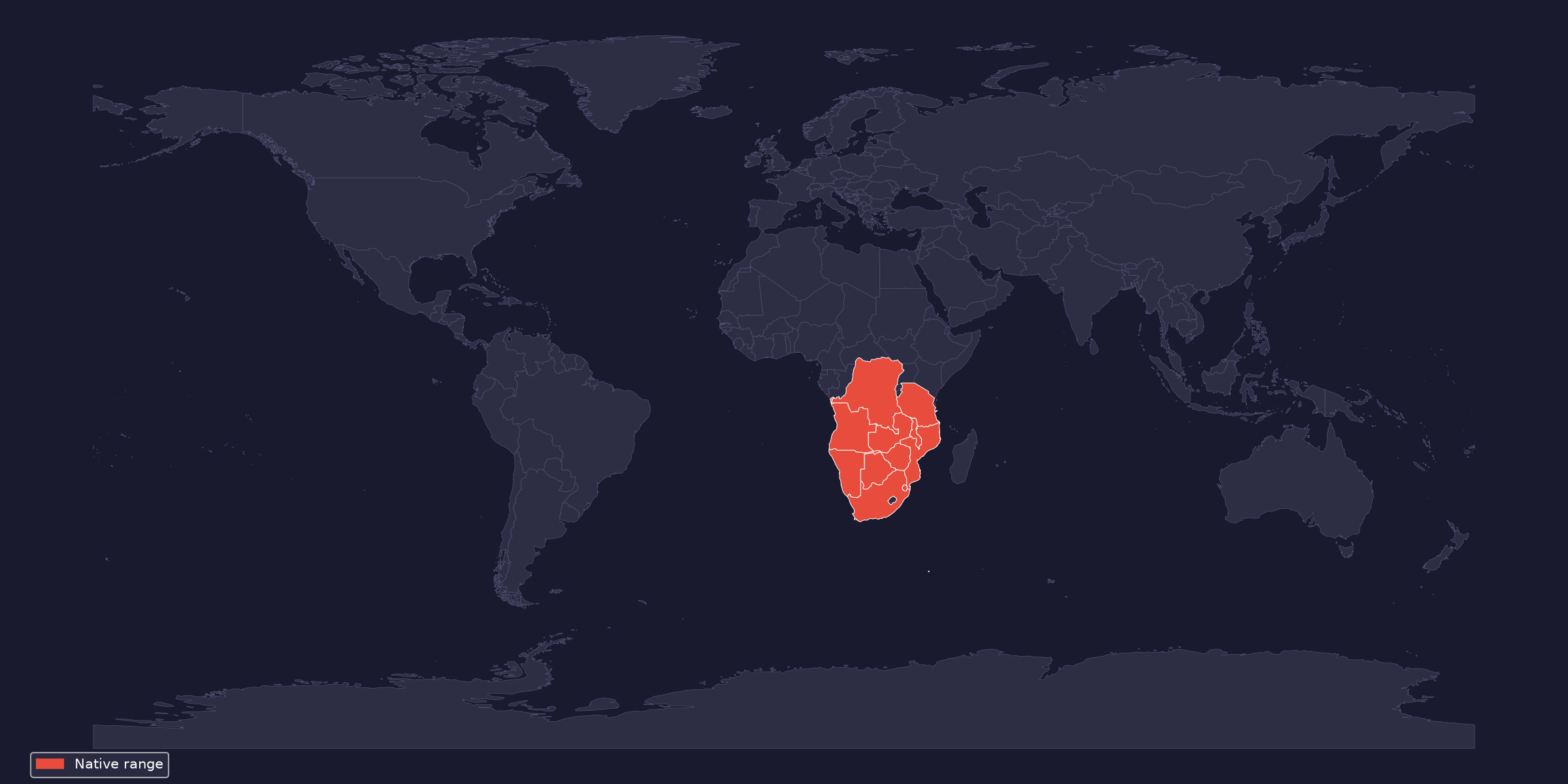
Verified records extend through much of Mozambique, Malawi, Zambia, Zimbabwe, Botswana, Eswatini and northeastern South Africa, with records from Tanzania including Pemba, southeastern Democratic Republic of the Congo, extreme southeastern Angola and northeastern Namibia. The isolated Somalia listing deserves locality-level confirmation.
The species occupies savanna, open woodland, floodplains, coastal thicket and human-modified sites across strong rainfall gradients. The map colours whole countries, so it greatly overstates tiny peripheral ranges in Angola, Namibia and DR Congo and hides internal gaps; the questionable isolated Somalia record is deliberately not shaded. The reviewed Sofala point represents one central coastal context, not every inland, southern or upland population.
🌡 Climate across the native range
Monthly normals from one reviewed occurrence near the central Mozambican coast; this point does not represent every inland, southern or highland locality:
Sofala — Mozambique (reviewed Mozambique spitting cobra occurrence)
| Month | Min °C | Mean °C | Max °C | RH % |
|---|---|---|---|---|
| January | 22 | 27 | 31.9 | 74 |
| February | 21.7 | 26.5 | 31.2 | 77 |
| March | 20.9 | 26 | 31.1 | 75 |
| April | 18.9 | 24.6 | 30.3 | 73 |
| May | 15.3 | 22 | 28.7 | 72 |
| June | 13.1 | 19.8 | 26.5 | 74 |
| July | 12.5 | 19.5 | 26.4 | 74 |
| August | 14 | 21 | 27.9 | 72 |
| September | 16.3 | 23 | 29.7 | 68 |
| October | 19 | 25 | 31.1 | 66 |
| November | 21 | 26.3 | 31.7 | 67 |
| December | 21.5 | 26.5 | 31.6 | 71 |
Weather data by WorldClim v2.1 · Monthly normals queried by Herpeton Academy from raster values; relative humidity is derived from vapor pressure and mean temperature.
Location references use GBIF.org occurrence data where available; original occurrence records retain their source dataset licenses.
⚖️ Legal status
No species-specific entry for N. mossambica was found in the CITES Appendices, EU wildlife-trade annexes or Bern Convention appendices on 17 August 2026. Range-state wildlife and export controls and domestic dangerous-animal laws can still be decisive.
Local and national rules for possession, registration, transport, breeding, sale and import may require permits, inspected containment, insurance or an approved emergency plan. Verify them in writing before acquisition or transfer, and retain invoices, lawful-origin documents, taxonomic identification and dated authority advice.
🤌 Husbandry
House singly in a locked venomous room with room-level secondary containment. Use a sealed enclosure connected to two full-body shift hides that close and lock from outside. Water, waste, heat and furniture are serviced only after the cobra is visually confirmed and positively secured in the other compartment. Protected contact is mandatory; free handling is not routine care.
Quarantine for at least 90 days on paper with separate tools and preferably separate air. Record weight, meals, faeces, sheds, mouth, skin and respiration. Wild-origin or poorly documented animals need repeated parasite testing and identity review.
💡 Lighting
Provide broad visible light for 10-13 hours according to locality and season, complete darkness at night and opaque retreats. Guard every lamp. Low-output UVB over part of the warm zone can provide Ferguson Zone 2 exposure, while shade must allow complete avoidance.
🌡 Heating and temperature
Maintain 25-29°C ambient air, a local 31-33°C warm surface, a measured 23-25°C cool refuge and nights around 21-24°C. Thermostat each source and log air and surface temperatures at snake height.
Do not impose one winter programme across the range. A healthy adult of known temperate southern origin may receive a small, gradual seasonal reduction; tropical coastal stock may not. Never cool a juvenile, thin animal, new arrival or snake with respiratory signs.
💧 Humidity and water
Use a ventilated 45-65% baseline and a local humid hide around 70-85% during shedding. Coastal Mozambique, dry inland savanna and seasonal floodplain animals should not be kept identically. Let most substrate dry between localized wetting.
Provide a heavy bowl that can be exchanged through protected access. Persistent saturation and warm stagnant air promote dermatitis and respiratory disease. Monitor drinking, urates, body mass and sheds rather than chasing one room-humidity number.
🌿 Enclosure and decoration
An adult baseline of 200 x 100 x 100 cm is a minimum operational footprint, not a target maximum. Provide deep packed soil-sand substrate, several opaque floor hides, cork or rock-like cover anchored against collapse and an unobstructed route to both shifts. A raised shelf adds usable choice without sacrificing floor area.
Seal cable penetrations, shield vents and use tamper-resistant locks. Inspect seals and shift doors before every opening. Avoid reflective glass, narrow dead ends and loose heavy furnishings. Design drainage, bowls and substrate trays for replacement from the safe side.
🐁 Feeding
Offer appropriately sized frozen-thawed rodents with remote tongs, generally every 7-10 days for growing animals and 10-14 days for adults, adjusted to body condition. Some wild individuals also take frogs, reptiles and other vertebrates; do not use wild-caught prey or live prey as enrichment.
Feed only after the animal is isolated behind a barrier. Remove remains without entering an occupied section. Record refusal, regurgitation and weight; repeated failure needs review of temperature, security, parasites and disease rather than repeated disturbance.
🛡 Operational safety and emergencies
The facility needs trained named staff, access control, a two-person rule, inventory and lock logs, species cards, escape tools and rehearsed bite and escape plans. Before acquisition, the receiving hospital and poison service must confirm the current locally appropriate antivenom pathway, transport time and capacity to manage airway, pain, swelling, necrosis and complications. Antivenom availability and coverage change; a vial stored by a keeper is not a medical plan.
Wear sealed splash goggles plus a face shield for any justified close protected-contact task, but keep a hard transparent barrier between face and snake. Eyewash capable of continuous flow must be immediately accessible outside the secured room. After venom reaches an eye, start copious irrigation at once with clean water or saline for at least 15-20 minutes, remove contact lenses if this does not delay rinsing, do not rub or apply chemicals, drops or antivenom, and obtain urgent medical and ophthalmic assessment. Continue evacuation while irrigation is arranged; do not re-enter to pursue the snake.
After a suspected bite, leave and secure the room, call emergency services, keep the patient still, remove constricting jewellery and transport urgently with the species card. Because this bite can be tissue-destructive, do not improvise a tourniquet, tight pressure wrap, cutting, suction, ice or electric treatment. Staff follow the pre-agreed clinician-led protocol, not internet instructions, and never try to capture the snake.
🥚 Breeding notes
Reported clutches are commonly about 10-22 eggs; 27-29°C and roughly 55-70 days are defensible planning ranges, not guaranteed outcomes. Record calibrated temperature at egg level, mass change and hatch timing because nest moisture, setup and lineage alter development.
Breeding requires documented compatible identities, remote introduction and separation, a secure laying chamber and individual lockable neonate boxes. Verify permits and qualified placements before pairing. Never manually restrain a gravid female or improvise treatment of suspected egg retention.
🩺 Common problems
- Rostral trauma: correct reflections, exposed routes, insufficient cover or poor shift geometry.
- Obesity: weigh prey, lengthen adult intervals and trend body mass.
- Burns or overheating: guard and thermostat heat while preserving a measured cool refuge.
- Dermatitis and respiratory disease: correct saturated substrate or stale warm air and seek reptile-veterinary diagnosis.
- Retained shed or dehydration: improve the local humid refuge and water access without soaking the floor.
- Parasites and stomatitis: especially important in wild-origin or uncertain-history animals.
- Egg retention: prolonged straining or inability to settle requires a remote veterinary plan, not manual examination.
📌 Conclusion
The Mozambique spitting cobra belongs only in a protected-contact institution whose enclosure makes routine work possible behind locks. Hard barriers, immediate high-volume eyewash and a preconsulted hospital pathway for both ocular injury and tissue-destructive bites are core husbandry equipment.
📚 Sources and further reading
- ReptiFiles — checked first on 17 August 2026; no species-specific care guide was found.
- The Reptile Database: Naja mossambica
- GBIF: Naja mossambica
- WHO: Guidelines for prevention and clinical management of snakebite in Africa
- South African national paediatric guidance: snake venom in the eye
- Hardcastle et al.: South African snakebite guidance for special groups and surgery
- Baines et al. — UV lighting guidance
- CITES Appendices
- EU annexes, Regulation (EU) 2026/1383
- Bern Convention appendices